Which version of events would you find more frightening? you're sleeping in bed when you jolt awake. you're unsure if you felt someone pull you or if you just dreamt that.
scanning your dark room you don't see anyone, but something doesn't quite feel right. you get up, deciding to look for your parents. luckily you don't have to go far to find the light switch.
peering into their room you notice they aren't there, which leaves only one option. . .
you have to go downstairs into the dark hallway below, past the door. as you reach the bottom lightning flashes and you notice it's open. the door that your parents always keep locked.
too scared now, you decide to go back upstairs into the light only to find it click off by itself. then you hear a rumbling, as if the darkness were growling at you. staring at it seems to be growing, coming towards you.
so you run down a hallway into the one room with a light still on and slam the door but here pounding on the other side. it gets louder and louder, and it seems like the door might break down any second now. then it stops.
the light fades from beside you and you can faintly hear something. . .
your rocking chair creaking back and forth. slowly, you turn around and see a woman. a woman you've never met before, on your rocking chair in the corner.
now let's try that again but remove the suspense building! you're sleeping in bed when you jolt awake, you must have dreamt you were falling or something. getting up you decide to look for your parents downstairs.
suddenly lightning flashes scaring you. so you run into the next room you can see and close the door. but then, you hear a weird sound.
turning around, you see an old lady rocking on your rocking chair in the corner. i'm willing to bet for most of us, just randomly seeing an old lady in our house would be pretty scary. but in that first scenario, because of all that tension and fear we're subjected to from the start, we'd be terrified by the time we saw her.
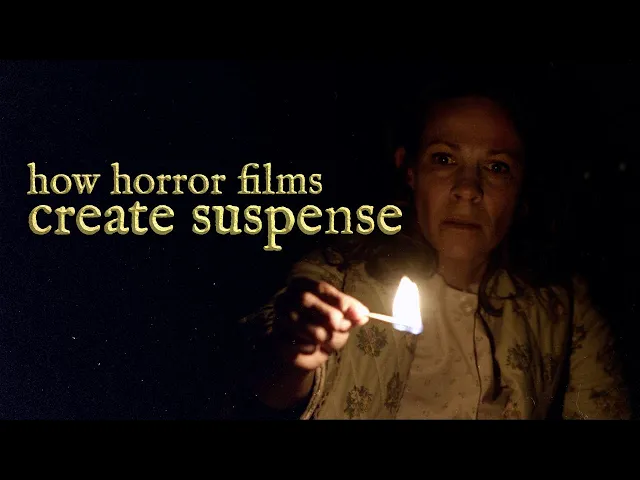
and this is just an example of a well-known principle in cinema. one of the most repeated quotes of Alfred Hitchcock (known as the master of suspense) is "there is no terror in the bang only in the anticipation of it" and that's true, because in horror films suspense is often the promise of something awful to come, and we, the audience, are forced to watch as any second that promise might be fulfilled. the ability to not only create suspense, but to drag it out and keep raising the tension ultimately makes the scares, and the movie as a whole, more terrifying.
writing, casting, acting, directing. . .
there are hundreds of factors that go into the final product to make a really good horror film, but because of the nature of this channel i thought we'd push past those and focus on how cinematography, editing, and sound come together to create and elevate suspense in horror films. cinematography is how we communicate the story to the viewer with the camera. every scene can be shot a thousand different ways, and each of those convey different meaning.
looking up at a character can make them feel more dominant, meanwhile looking down at the other can make them feel weaker. framing characters who are in a conversation. .
. alone. .
. can make them feel more isolated, and slowly pushing in with a camera can align us more with how a character is feeling. the thing is we need to know WHAT we're trying to communicate before we communicate it.
what do we need to convey with the camera to create anxiety, suspense, or fear? HP Lovecraft is commonly held as one of the most influential horror fiction writers . .
. despite a lot of his work being . .
. problematic. but in an essay titled "Supernatural Horror in Literature" he perfectly summarizes his thoughts on fear in the very first sentence.
"the oldest and strongest emotion of mankind is fear, and the oldest and strongest kind of fear is fear of the unknown" at some point we were all afraid of the dark, the monster under our bed, or the ghost in our attic. so if you want to evoke suspense, play with the audience as fear of the unknown. there's a ton of ways we can do this, one of the most popular being to exploit our fear of the dark.
when we can't see what's down that hallway, or behind that door, or anything behind the character at all. we instantly start to feel a sense of tension, because we know ANYTHING could be hiding there. but here's a more uncommon one, instead of hiding parts of our scene using darkness, what if we hide parts of our scene by just.
. . holding tighter shots on our characters?
now instead of the monster potentially being in that dark corner, it could be right beside our character, just out of frame. one scene that does this brilliantly is the car scene from The Babadook. we never actually see it in the scene, but the framing is absolutely intentional in exploiting our fear of the unknown.
["why can't you just be normal? ! "] [screams] ["there is no babadook!
"] ["get out! "] Samuel reacting to something right beside him that we couldn't see was just TERRIFYING to me the first time i saw it. in that scene we also quickly jumped into a POV shot so let's touch on those too.
the main purpose a point of view shot serves in a horror film is to put us in the shoes of the character emotionally. we ARE the character for a moment, so we can more easily empathize with them. and that's actually pretty important because in order to build suspense, we have to like or empathize with the character in some way.
if we didn't, we'd probably just be cheering on their death instead of feeling anxious for them. POV shots fall into the category of what James Cameron calls the "subjective camera" where we're either explicitly viewing through a character's eyes, or viewing through the eyes of something watching our characters. and knowing we're viewing a subjective camera is not always as obvious as a shaky-cam half hiding behind something.
sometimes a moving camera suddenly stopping, or even just a slow zoom is enough to convey that feeling of being watched which is so effective in building suspense because it implies the characters being watched are in danger in some way that they themselves probably don't realize. the last thing i want to touch on for cinematography is how the use of empty space can really make an audience uncomfortable. .
. like something's missing. sometimes it feels like an obvious threat to the audience saying "hey, something extra might be here when we cut back" and sometimes when more subtle it just instills a sense of unease because as viewers of film we all have an understanding of this unspoken film language.
whether we consciously know it or not. when something feels off, we can tell, and it makes us nervous. another example of exploiting unspoken film language lies in the editing.
a really effective technique to make an audience uneasy is to simply hold a shot longer than you normally would. everyone, including non-editors, have an intuition when a shot's lingered for too long. we can feel it before we can even put it into words.
this unspoken film language has taught us that what we're seeing on screen is there because there was a choice to put it there. so it MUST be relevant or important to the story. so when an otherwise uninteresting shot seems to linger, there's a subconscious flag raising that this must be in some way important.
and since we're watching horror, that feelings seamlessly translates into unease at what's going to happen as soon as this long shot is over. now on the other side of Lovecraft's quote about fear of the unknown, another very viable way to raise tension is to explicitly show the audience the danger, but keep the protagonist unaware by crosscutting. (meaning cutting between our character and the danger) this is done amazingly in the movie Hush a home invasion film about a serial killer and his next victim a deaf woman.
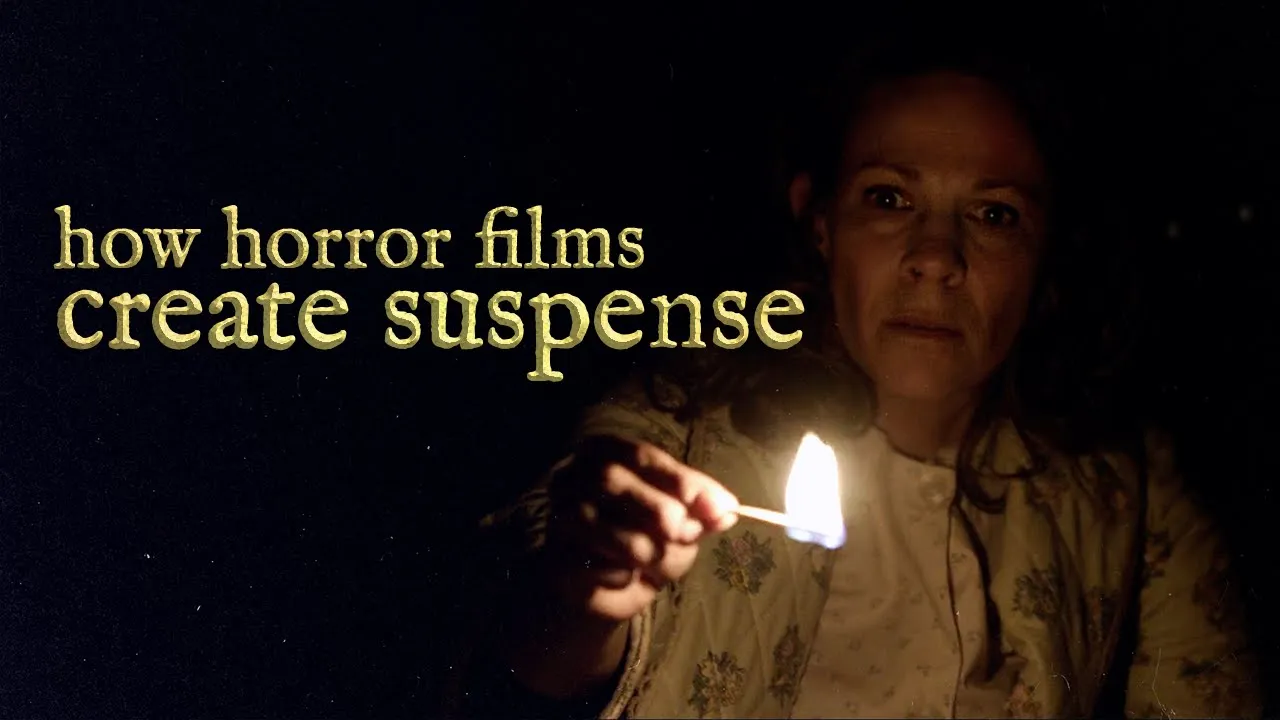
at the beginning of the film, we cut between these two often showing the audience that the danger is getting closer and closer to her, which increases our anxiety for her safety. another example of cross-cutting is used in the conjuring. this time, we aren't cutting from a dangerous being to an unaware protagonist, in fact, April being aware of the danger approaching her is what makes it all the more horrifying.
in either example we have something dangerous getting closer to a vulnerable character that we empathize with. and crosscutting between the two elevates the tension more than either one of their perspectives alone would. now while the focus of the video is on BUILDING suspense, it's equally important to also "reset" the audience with periods of no tension.
if suspense drags on for too long at the same level without raising the stakes, the audience will eventually get used to it and the tension will decline. and that's why by building suspense, releasing the tension with a scare, and then cutting to a scene or two that doesn't have anything particularly suspenseful, you reset the audience's tolerance for the suspense and can then build it back up again. i've actually rewatched a couple horror films to show you what i mean.
i brought them into Premiere and created 6 video tracks. that way i could cut and stack moments on the timeline depending on how much suspense or fear i felt. clips on the very first video track had no suspense at all like a family having breakfast together, then as things get progressively more scary or suspenseful, i raised them up all the way to video track 6 which is reserved for the moments where it's hard for me NOT to look away from the screen.
Although this is obviously a subjective scale, you can clearly see the rhythm of tension and release that all of these films share. typically there's a scare or suspenseful moment near the start to set the tone of the film, followed by a period of low or no suspense to deliver story, then as we get into the film more, it's more or less sections of rising suspense that peaks where the scare is, after which is followed by scenes of no suspense in order to reset the audience's baseline. and at the climax what they all have in common is very minimal time spent on scenes with low or no suspense (as you can see by video track 1 being very bare) instead of the tension rising to a peak and then returning to the usual baseline, generally they re-establish a NEW baseline higher up on the suspense scale.
and this is pretty true for most horror films. so it's a good idea to keep in mind the rhythm of tension and release if you're editing something for horror. there's a lot to discuss when it comes to sound design in horror films so to keep it simple i'm going to focus on 3 categories: suspense building sounds - like droning tones that build over time, or violins playing an eerie score.
foley sounds - like floorboards creaking, or scraping against a door. and finally, stings - which are the loud noises that usually accompany a jump scare. Sounds that fall under that first suspense building category are usually non-diegetic sounds, meaning sounds that the characters in the film can't hear.
and so they're specifically there to create anxiety in the AUDIENCE using techniques like sustained high notes, uncomfortable strings, and deep droning. aside from these sounds just being generally anxiety inducing, they also usually act as a warning to the viewer that something bad is about to happen. in most cases these sort of sounds are risers, which are sounds that start quiet and get louder as they go.
usually either ending in a sting. . .
or silence . . .
inevitably followed by a sting (which we'll get to in a sec) the second category was foley sounds more specifically i'm talking about diegetic sounds (meaning the characters can hear them) that are used to place the audience in the scene with the characters. this is usually accompanied by very minimal sound design, so no music, no droning, or violins. just the sound of the room and the sound of threatening footsteps.
. . or breathing.
by limiting the sounds to diegetic sounds, we're more likely to be pulled into the environment more likely to empathize with the characters, and in turn more likely to be scared for them or feel anxiety and suspense on their behalf. finally let's talk about stings. these are pretty self-explanatory, we've all heard them.
it's the sudden and aggressive blast of noise accompanying a jump scare. these are really effective in getting the result that they want because humans actually react to sound faster than visuals. so by the time we even process what jump scare we're looking at, we're already in a startled state making it all the more scary.
to make the punch of the sting even greater, it's typically used after all sound is cut from the edit so that the sting is even louder in comparison. and because that technique is pretty well known to anyone who watches horror, silence is often used as a threat to the audience that any second your ears are about to be assaulted with a sting. .
. . and whether that sting actually comes or not, the audience is already more tense.
which is why silence is the secret fourth category of sound design in horror films so now that you know all these tricks about building suspense using cinematography, editing, and sound you might think horror films are gonna have to try harder to scare you now. but don't worry, after researching and learning all this for the video i still had to watch a ton of horror films to get these clips, and i was just as terrified the whole time. knowing these techniques won't make you invulnerable to them but hopefully it'll help you replicate them and make some awesome horror shorts or films in the future.
hey everyone, thank you so much for watching. this video is brought to you by skillshare. if you didn't know skillshare is an online learning community with thousands of classes for creators.
they've got a ton of topics you can explore, but the ones that i was personally drawn to were film and video (of course), productivity, and creative writing. these types of deep-dive videos are by far the minority on my channel which is why watching Roxanne Gay's class called Creative Writing: Crafting Personal Essays with Impact helped me get this thing written. there are a lot of good tips in there that i used while writing the script for this video and i'm sure i'll get to use more while writing future scripts as well.
skillshare is curated specifically for learning, so you don't have to worry about ads and they're constantly launching new premium classes for members so you can stay focused and follow where your creativity takes you. if you're interested in joining, the first thousand of my subscribers to click the link in the description will get a one month free trial of skillshare so you can start exploring your creativity today.