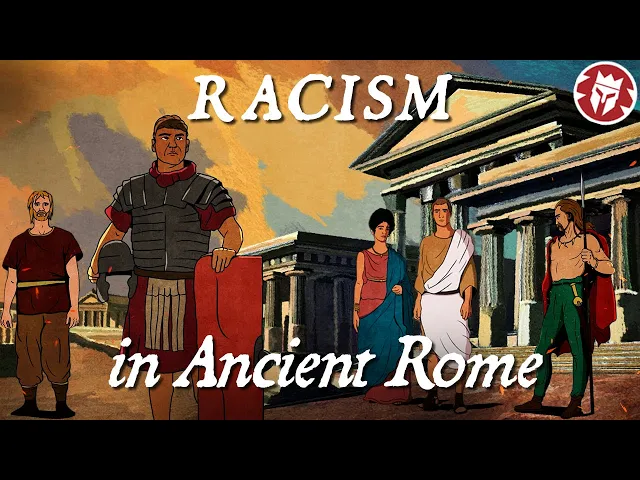
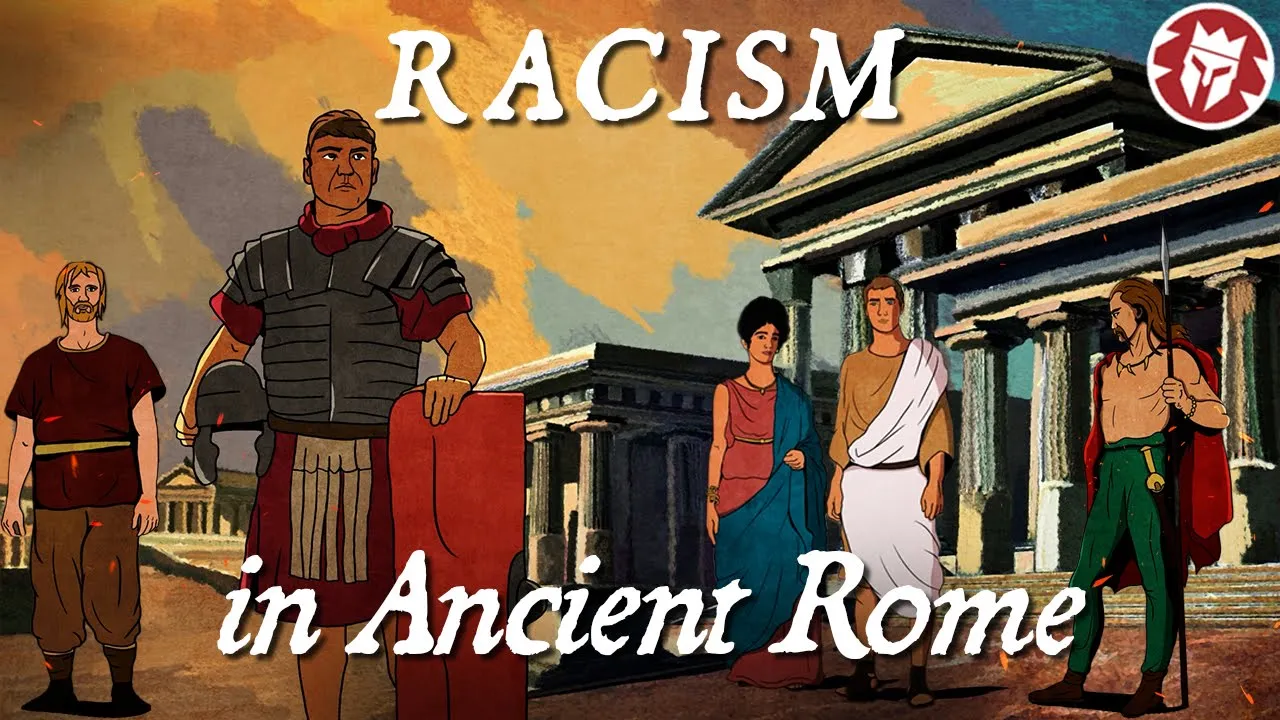
The concept of racial identity as we know it today did not exist in the ancient world. However, the peoples of antiquity still had ways of labelling, defining and stereotyping those they saw as foreign or different from them. This was especially true in the Roman Empire, an originally Italic nation which, throughout its long history, interacted with myriad different cultures in both war and trade, integrated them into its imperial project, and incorporated their religions and customs into the fabric of their society.
Roman attitudes towards race and identity were inspired by the Greeks in many ways but also rejected Greece’s legacy in many others. Moreover, Roman experiences in the Near East, North Africa, Germania and Gaul all helped to shape the Empire’s perception of outsiders, be they barbaric or civilized, servile or warlike. Welcome to our second episode on racism in antiquity, covering the Roman Empire and its massive ethnic and cultural diversity.
Some Definitions: Much like our first episode on Greece, we will need to begin with some clarifications on notions of race in ancient Rome. Firstly, Rome’s history is massive in scope and length, so it is impossible to cover all of the changes in attitudes towards other peoples that occurred within the Empire across its many centuries of history. Thus, we will focus on the most well-known periods of Roman history, Republican and Imperial Rome, with a specific focus on the thinkers of this time and the laws that existed during this age to see what both can tell us about how the Roman people viewed other cultures.
As with Greece, these attitudes can be seen as ethnic prejudice and were not necessarily hierarchical like modern racism, but scholars debate as to whether they constitute this or racism in the modern sense. There is also difficulty in knowing to what extent commoners shared the prejudices shown in Roman writings, which almost exclusively depict the perspective of Rome’s elites. Overall, Roman commoners had more interactions with other peoples than patricians did.
Thus, they had more exposure to how other people lived. We will also discuss a little bit about whether and how the advent of Christianity or the shift towards Byzantium changed these attitudes in any way. With these disclaimers in mind, we will now move on to the rest of the video.
Roman Authors on Race and Ethnicity: Let us start our exploration of Roman race relations by leafing through the writings of some seminal Roman authors and examining what they had to say about foreign peoples. Coming from the aspirational equestrian class and with allegiances to the aristocratic Optimates faction, the Roman Senator Cicero is an interesting case study. In seeking to justify Roman imperialism in the Near East, he seems to ascribe a spiritual servitude to Jews and Syrians, for he calls them ‘Servituti Nati’ or, in modern English, ‘natural-born slaves .
’ This is not a natural condition, which was the type of racism that European colonizers held against Africans, Americans, and Asians, but it does show a Roman attitude that once someone is enslaved, they lose a part of their humanity. Moreover, Cicero’s writings perpetuate a Roman belief that some peoples, in this case the peoples of the Levant, have inherently servile cultures. In Cicero’s eyes, what makes a culture servile is not the skin colour or appearance of its people but the climate in which it exists, for he considers not natural blood to be the cause of their supposed defects but the environment they come from.
According to Benjamin Isaac, author of ‘The Invention of Racism in Classical Antiquity,’ Cicero’s approach is focused on climate and environment as the primary factor over any other natural influences like blood lineage as the primary driver of ethnic difference between peoples. Such views were driven by Roman imperial attitudes to justify conquest abroad. Cicero’s views of other nations that either opposed or were subjugated by Rome are equally meant to differentiate from the Romans and their own martial, elite culture.
Gauls faced particularly acidic commentary, portrayed by Cicero as a violent people prone to destroying sacred religious shrines. Cicero saves similar vitriol for the Sardinians, who he considered to be particularly barbaric to the point that even the Phoenicians, who the Romans also despised, found the Sardinians unbearable when colonizing their island. Similar sentiments were shared of the people from the Maghrib in North Africa.
Cicero’s xenophobic attitudes stem from his imperialist mindset and Roman exceptionalism: the idea that Rome, a veritable shining city on a hill, was surrounded by barbarians and that it was Rome’s sacred duty to go forth on a civilizing mission across the world. As we see in Cicero’s writing, Roman stereotypes of foreign ethnic groups were often utilized politically to promote or justify Rome’s expansionist policies. Nowhere is this more evident than in the writings of Julius Caesar in his commentary on the Gauls.
During his conquests of Gaul, Caesar was keen to portray the Gallic tribes as lazy, violent, and politically unstable. Caesar also asserts that Gauls who lived near Rome were more decadent than ones who lived near Germans, with the latter being more martial and violent. This was likely because he considered people who lived further north, and therefore further away from civilization, to be both more marital and less prone to Roman perceptions of moral degeneracy like the wearing of trousers or of women fighting in battles.
However, there is also an intriguing contradiction, one stemming from Caesar’s own ambition and self-aggrandizement. According to Caesar, the Gauls' warlike nature, while proof of their barbarity, is also a trait to be admired. Through their rugged, brutal lifestyles, Caesar claimed that the Gauls embodied virtue.
This probably stemmed from Caesar’s need to show off his own achievements by fighting against a ‘noble’ enemy. Caesar’s behaviour in Gaul also shows Roman imperialism’s disregard for the lives of their enemies. Many of Caesar’s descriptions of his army’s atrocities in Gaul have been compared by some scholars to ethnic cleansing or even genocide, as various massacres took place and even criminal neglect, like the case of Alesia.
During the siege of Alesia, Vercingetorix let out the women and children of the besieged city of Alessia to come out and hopefully be left through the Roman walls. Caesar was intransigent and left them trapped between the Roman and Gallic walls. The grass was as green as it always was on those sinister days as the Gaul civilians slowly died of starvation.
These behaviours were typical of Roman imperialism. Even the Romans themselves were aware of how ruthless and destructive their armies could be, as a few decades later, the Roman historian Tacitus would exclaim: “Neither East nor West can sate their appetite. They are the only people on earth to covet wealth and poverty with equal craving.
They plunder, they butcher, they ravish, and call it by the lying name of 'empire. ' They make a desert and call it 'peace. '” Ethnicity and Citizenship: We will now move on to examining the laws of the Roman Empire and what they can tell us about how the Romans saw other ethnic and ‘racial’ groups.
An interesting example lies in the post-Social War landscape when Rome began a mass enfranchisement campaign of the various Italian tribes. The Social War lasted from 91 - 87 BCE. It occurred because Rome’s neighbouring tribes in the Italian peninsula, such as the Samnites and Marsi, wished to gain citizenship and thus the privileges of Roman citizens.
Initially, Rome was very strict on who could gain citizenship, but the Social War changed this landscape, as the Romans only won by passing legislation giving citizenship to cities that made peace or stayed loyal to Rome. Thus, they ensured that various surrounding groups were also entitled to citizenship. We can thus see that the notions of who was considered Roman was a fluid category that changed over time.
This was not the last time that Rome would extend citizenship to former enemies and conquered peoples. For instance, the Gallic nobles in what is today’s northern Italy were afforded the same privilege. These were usually pragmatic moves, as acquiring citizenship through military service was a means of perpetuating and encouraging Roman imperialism via giving privileges to the soldiers and thus providing Rome with personnel for wars.
However, the Romans’ willingness to extend citizenship to subjects of various backgrounds did not mean that they did not have laws that discriminatorily targeted specific groups of people. For instance, Jews had to pay a special tax to avoid sacrificing to the Emperors, the so-called Fiscus Judaicus. Initially, all citizens were meant to worship the Emperor via these sacrifices, but Jews felt this betrayed their monotheistic beliefs.
In Later Rome, various laws were targeted against Germanic groups that had settled inside Roman territories by restricting the use of trousers as opposed to togas and even long hair. These discriminatory laws were driven by the attitudes of Roman high officials on how to define Romanness and manage the Empire’s population. Intriguingly, some of the provinces of Rome show us how ethnic and racial attitudes against locals actually changed local governance.
Throughout Roman rule, the laws that regulated who was a citizen and who was not were ever-changing. In the province of Roman Egypt, local laws stipulated that if a Roman citizen was to marry a Greek or Egyptian, their child was to receive a lower citizenship status. These were not necessarily laws based on preserving some sort of Roman purity per se.
This was mainly to avoid having too many people exempt from paying Roman poll taxes. How did this affect Roman ethnic diversity? On the one hand, Rome could be harsh on rebellious ethnic groups, such as the ethnic cleansing of many Jews from the Near East during the various Jewish rebellions.
This also manifested itself in the Alexandria riots in Roman Egypt in 70 C. E. , in which Greek and Roman mobs attacked Jewish houses, a fact discussed by Philo of Alexandria.
On the other hand, there were many regions throughout the Roman Empire where people lived in ethnically diverse societies for centuries with little conflict. For instance, in York, archaeological excavation has revealed the so-called ‘Lady of York,’ a Christian woman who was buried in the region during the 4th Century CE. Strontium isotope analysis showed that she likely ate a Mediterranean diet for part of her life and was thus from somewhere in the Mediterranean .
Her various bracelets show her to have been connected to broader trade in the region. Thus, we can assume that migration exposed the average Roman subject to various kinds of people from all over the imperial realm. Stereotypes of Ethnic Groups: Now that we have discussed the legal aspects of Roman racism, we will move on and discuss some stereotypes of ethnic groups.
The Romans perceived Phoenicians and Syrians to be excellent merchants and artisans but deceitful in nature. For some Roman authors like Florus, the Roman conquest of Syria resulted in the corruption of the Roman's traditionally masculine, militaristic culture as more and more Roman citizens embraced the luxurious delights of the East. For Juvenal, the influx of Syrian migrants into Rome was a tragedy, for it brought the aforementioned cultural corruption to the Tiber river itself.
Another culture the Romans had a complex relationship with was Egypt. The Romans respected Egypt for its ancient pedigree, yet also often denigrated it for the same reasons as Syria, for being soft and hedonistic. We have already discussed briefly how Gauls and Germans were perceived as lazy and violent, attitudes which were extended to many other cultures from Northern Europe.
When it came to what was arguably Rome’s fiercest enemy in Parthia, Roman stereotypes were contradictory. The Parthians, being nomadic, were considered by the Romans to be little more than underdeveloped barbarians. However, the Parthian military and its prowess in defeating the legions of Rome was respected and well-regarded by Romans, a people who valued military might and strength.
This martial nature was a double-edged sword because it made the Parthians seem particularly violent in the eyes of many Romans. The same dichotomy followed Greece. While some ancient Greek cultural traits were valourized, the Greeks of the Roman era were seen as corrupted and debaucherous and thus unworthy of respect.
This varied from author to author, with some Roman writers expressing significant admiration of Hellenic culture and others detesting the influence that the Greek customs and religion had on Rome. Some interesting shifts occurred in late antiquity after the Western half of the Empire collapsed and its eastern half lived on as the Byzantine Empire, adopting Christianity as its predominant religion along the way. One shift that occurred during this period was the nature of Roman anti-Semitism.
During the Late Antique Period, emperors like Theodosius, Justinian I, or Herakleios often used Christianity to attack Jews as scapegoats for various political or legal reasons, using theological excuses for these political actions. Roman-ness also, at times, was opposed to non-Orthodox Christian groups, impacting the social mobility of non-Chalcedinian Christian ethnicities, such as the Armenians. There was a linguistic bias to this as well, as Orthodox Christians who did not speak Greek, like Serbs, Bulgarians, and the Rus, were not considered Roman.
These examples show that the Roman Empire’s transition to Christianity throughout late antiquity and into the Middle Ages erased some boundaries, raised others, or reconfigured some prejudices to fit new political agendas. Conclusion: As we have seen, Ancient Rome had a variety of complex, peculiar, and multilayered attitudes towards non-Roman populations, which were brought upon by interaction with other cultures as well as through imperialist expansion. The conquests of Rome brought mass slavery and wars upon the world but also brought many non-Romans into the population centres of ancient Rome.
From Caesar’s imperialist ambitions against the Gauls to the politicized hatred against all things Oriental during the with Parthia, Rome developed many prejudices as well as rejections of said prejudices. Rome could be a very exclusionary but also a very inclusionary place, a contradiction many modern societies have come to understand. This is perhaps the greatest lesson for us today: how these attitudes unfold and how to undo them so humans can co-exist in cosmopolitan societies.
With this in mind, Rome becomes both an example to avoid, but also to follow. More videos on culture and society in the ancient world are on the way. To make sure that you don’t miss it, please consider liking, commenting, and sharing – it helps immensely.
Our videos would not be possible without our kind patrons and youtube channel members, whose ranks you can join via the links in the description to know our schedule, get early access to our videos, access our private discord, and much more. This is the Kings and Generals channel, and we will catch you on the next one.