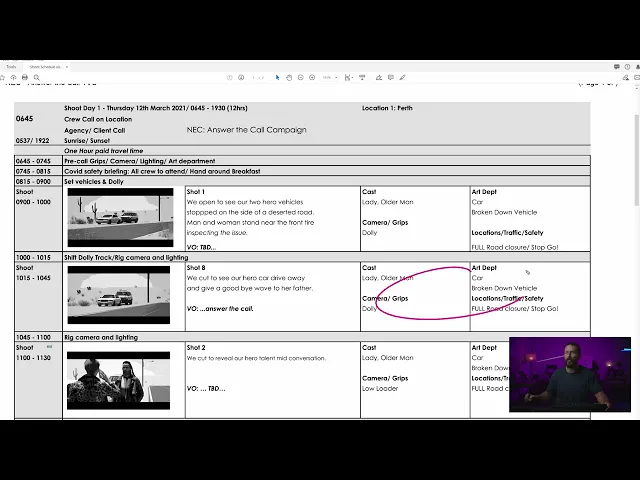
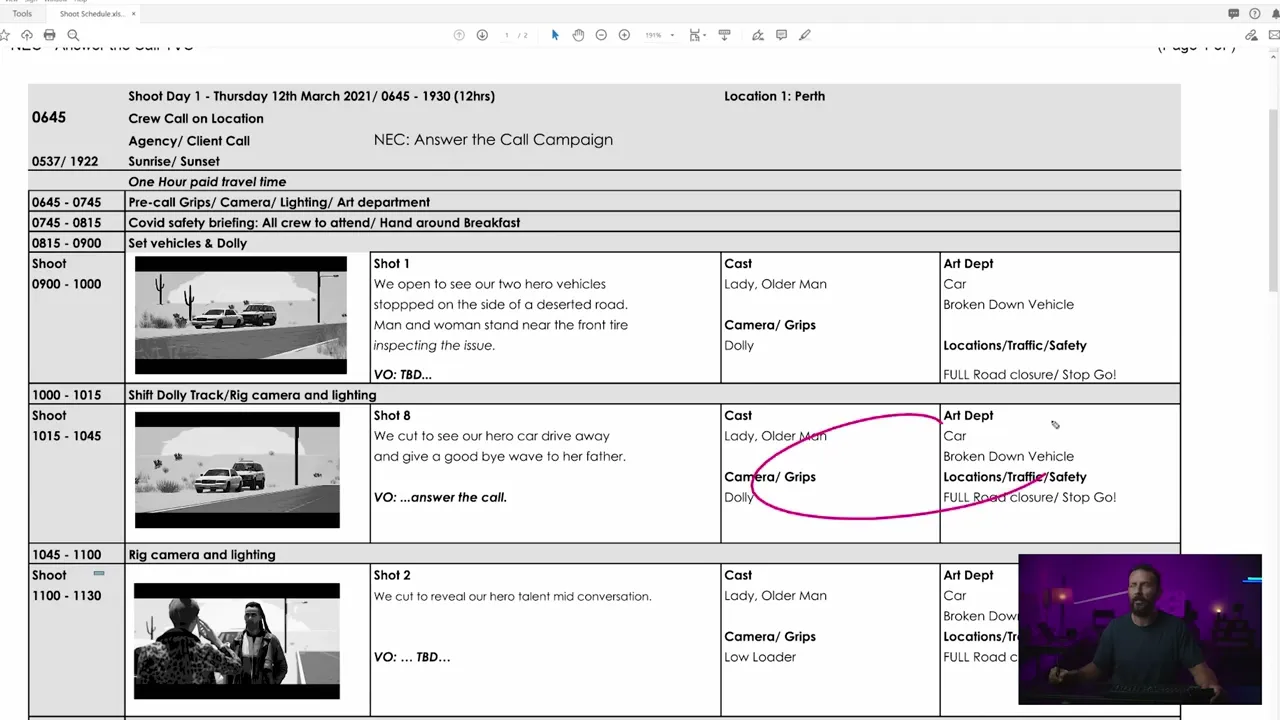
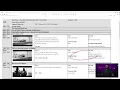
foreign [Music] let's jump into the schedule right we just got the email from the first ad after all of our conversations and here it is we're going to take a first look at what it is now as I mentioned before in the previous one uh all of this stuff right you'll be able to download this just click the link uh in the description here you'll be able to download this material so you can see it for yourself but really the only things like I said that we're looking for here initially is was the schedule as
we spoke about on the tech Scout right so we've got our big wide the opening shot of the commercial we want to do this first even though this is probably the bigger shot right this 10 15 to 10 45 shot here which ends up being shot number eight even though that's the bigger shot for the ad the more important shot really here we're opening up the look and this is happening slightly later so I'm going to take a higher Sun for this shot also if you don't if you don't work on the hardest shot at
the beginning sometimes it just gives you a little Runway into the day right you just get one in the can everybody's happy you can then move on and it feels like a momentum is picking up so we're going to start with shot number one this is as we discussed and shoot time is going to be nine o'clock now you remember back to the tech Scout why is it nine o'clock why aren't we shooting this at a very nice time of the day well it's because all of these shots all how many is it now eight
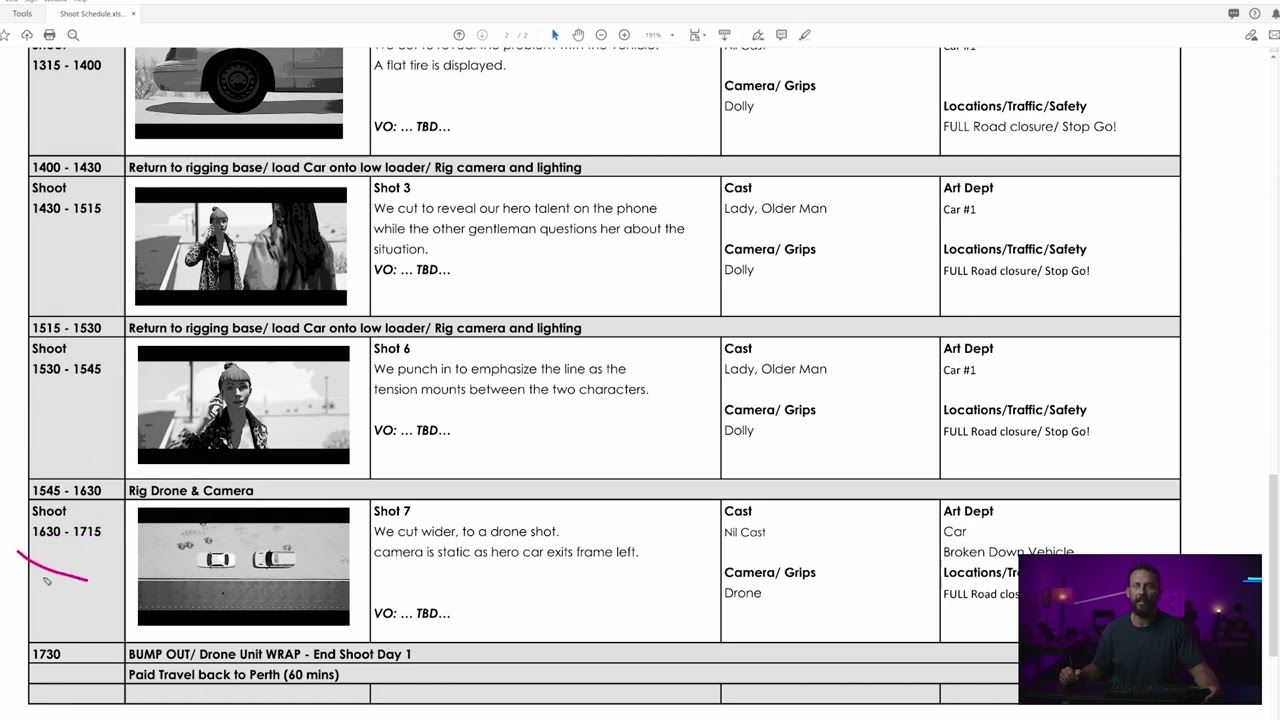
shots I think we ended up having um eight shots all together this is all supposed to take place in a period of 30 seconds right but we have to the entire day to shoot this so if we look at our last shot what we're bumping out of there shot's supposed to be finished at 5 15. so now we know the entire day but we have to make that look like 30 seconds so we can't go with the sun too low in the sky right if we start with the sun way down here we're gonna get
these huge Long Shadows coming out this way and by the time we get to you know the 11 o'clock shot the light is going to be so completely different that it's not going to look the same so we're going for matching so even though yes it would probably be a nicer Standalone shot if we started at Blue hour right just as the sun is just you know about to Crest over here and you got a nice soft Sky it would have quite a unique look but we're not going to be able to maintain that the
rest of the day so we can't really lead with that so just looking at start times and crew call times none of this really makes a difference it really comes down to this and then working backwards from here okay if I'm got to start at nine o'clock which makes sense because with our sun Seeker app we realize that at about 8 30 it starts to clear the frame that we want to use so best to be setting everything and be ready for nine o'clock because that's when we're going to be super safe we can always
be rolling into nine o'clock so just starting to get whether there's action going on or anything like that if the Sun is in the frame we know it's going to clear by nine o'clock and that's what the schedule says we're just giving ourselves a little bit of padding right at 8 30 we should be turning over ready to roll because there's not a lot of equipment to put up it's not like we're putting up bounces and neg or anything like that the shot is wide enough to where it's going to be a fairly quick setup
also looking at pre-calls if there is anything major I like to show up whenever there's anybody from my Department's on set because I want to make sure whatever they're doing is right you're going to get questions constantly and if they work you know if your call is at 7 45 and the pre is at 6 45 they could be working on an hour of pre but not doing it correctly or doing something that they could probably spend their time more efficiently doing something else so I like to be there early on pre-call days no matter
what time you actually get called and this comes back to are you actually being paid for that time no but you're being paid for how well the job comes out so it's in your best interest to get there and organize and be across everything especially if you're working with newer crew as you get more experience with the crew and they know what you like and they know how you work you can be a little bit more forgiving but with new Crews I like to be there for the pre-calls just to make sure everything is going
as planned uh sunrise sunset all of those things don't really make a difference for the schedule this is basically how it's laid out you'll have time you'll have the storyboard the shot description cast camera grip Dolly I mean I don't really look at this stuff either uh maybe if you see something like a techno Crane or something and you haven't actually ordered it you might want to look into that but really this is just art Department stuff locationy stuff if you've got Department specific things it's going to be over here really for our purposes we're
looking at time and the shot itself so we've got pre-call at 6 45 then crew call at 7 45 with a safety briefing then we're setting between 8 15 and 9 and this is a long setup for a really easy shot right this is not this is probably overkill for pre-calls for any of these people but I always fight for the prequels because again it gets you moving early on if the department asks for a pre-call I'm always going to go to production and say hey this is probably a good idea because we're going to
get ahead doing this this and this whatever thing things they're looking to rig if they're looking to pre-rig the overheads that we're going to use for shot number two or whatever it is here we're starting fairly easy so we don't have to go into too much pre but I wouldn't fight it and generally Productions are much happier to start with a pre-call rather than go overtime so it's just shifting a mindset and trying to figure out what is going to be acceptable and what is not okay so this nine o'clock very important that you start
the day off you get some strong runs on the board and this shot is easy we know we're not really going to set anything up for this shot so that's in a good spot then we've got 15 minutes to then shift Dolly track rig camera and do any lighting over here and really in this we're talking about doing you know a little tiny push in just to keep that slow anticipation up like a David Fincher style of just a slow creep a push straight in so we'll probably be on the dolly and then we'll do
the same thing over here and I've talked about ordering gear in this course already about the idea that even though it's going to be steady and static and there's not going to be a whole lot of movement I want the thing on a dolly because I want to be able to move those two inches left and right very quickly I want to be up and down I don't want to have to you know call for the grips to then change the stick height and do all sorts of stuff just to change a few different things
so it's going to be Dolly everywhere so when we say Dolly track even though we're not moving we sort of hate to shift the dolly around so it takes a little bit of time so it's just that little 15 minute padding window then then if we've got an hour for this that always makes sense when you again when you're leading into the day you're going to want a little bit more time then we come down here and now we're at 30 minutes of shooting even though this has an action of the car pulling out which
usually makes for longer resets maybe the director on the day maybe Andre won't play it that way maybe he'll just have the person get into the car or something like that but 30 minutes again seems feasible like I said first draft of this stuff or first pass you're just looking for red flags another 15 minutes to light and rig this shot now this is probably where I would say 15 minutes is pushing it because this is going to be our first build of the lighting kit right this is shot number two here we know that
our lighting kit is going to consist of we're going to have an overhead to take the bite out of the Sun right more maybe not an overhead maybe we just have a frame to the left hand side depending on how high the sun is in the sky at this time that we get here then we're going to wrap around the sun with a little bit of a bounce we're going to create some contrast with some neg on this side and then finally we're going to add a little tiny Edge down here right that's what I
would typically do in these situations take the bite out wrap the sun around depending on how harsh we had seen that the references were or how harsh the director wanted to go with the light this would be my general plan of attack now I know that that's our first big setup so if I see at 10 o'clock when we're starting to make the move to this shot I look over at the lighting team or the grip team depending on where you're working and who's looking after the diffusion and the bounce and all these materials if
I look over there and they're not doing anything or they haven't got this stuff already ready that's when I would go over and say hey what's going on like let's think about getting this stuff ready because we only have 15 minutes to rig this thing and I know it takes a lot more than 15 minutes to build this stuff right but with their pre-call with the tech Scout with the conversations that you've had with those departments they should already be across this so on the day it would just be about making sure that they were
actually doing their job just by looking over having a quick glance and mentioning hey we're about to go to this shot let's be ready so a 15-minute move ambitious but if we're all ready to go might be the case also because we are setting the look in this Min shot for levels in the background levels the foreground 15 minutes is going to be tight 30 minutes to shoot nice and easy right there's there is a few lines back and forth also something to be looking out for like here we have a voiceover that is they're
still writing the voiceover for the ad so oftentimes you'll get this but we know there's going to be dialogue back and forth and dialogue will oftentimes add lots to depending on the director that you're working with add a lot of time to this 30 minutes because I don't know if they're going to try variations or if it's going to be 55 takes some directors are much more efficient than others or or like to shoot a lot less so but in the order of things that's not bad right that's the the way that I would have
it we go to the mid shot then we're going to go to the close-up and this change should be 15 minutes right because we're not really changing much we're only bringing in the material closer that we already had up so I would say this is a good time which puts us shooting between 11 45 and 12 15. the worst time of the day we want to be doing our close-ups because then we can get in the material as close as humanly possible to affect the background to keep the shadows in basically the same place as
we had in these nine o'clock and ten o'clock shots okay those are going to be significantly nicer