in today's fast-paced business World understanding competition is crucial for Success however the concept of competition is often shrouded in complexity and misconceptions this book aims to simplify the approach to business strategy and provide a fresh perspective on understanding competitive advantages in this podcast we'll dive deep into the key insights and ideas presented in the book we'll explore how Greenwall challenges the conventional wisdom of Porter's five forces model and presents a streamlined approach to assessing competitive Landscapes by focusing on the essence of competitive Advantage barriers to entry Greenwald offers a clear and practical framework for businesses
to develop and maintain their Edge in the market throughout this series we'll break down the book into four main chapters unveiling competition strategies the three pillars of competitive Advantage mastering competitive strategy games the essence of business competition in each chapter we'll delve into the Core Concepts supported by real world examples and case studies our goal is to make these ideas accessible and applicable to businesses of all sizes and industries in this chapter we'll start by examining the limitations of port five forces Model A widely used framework for analyzing competitive Landscapes while the model provides a
comprehensive view of the factors influencing competition it can be overwhelming and challenging to apply in practice Greenwald argues that the true essence of competitive Advantage lies in the barriers to entry by focusing on this critical aspect businesses can simplify their strategic thinking and decision-making process we'll explore how barriers to entry shape the competitive dynamics of an industry and determine the sustainability of a company's market position to assess the height of barriers to entry Greenwall provides three key indicators presence of dominant long-standing Market leaders if an industry has companies that have maintained a stable market share
over an extended period it suggests that incumbents have established strong competitive advantages making it difficult for new entrance to penetrate the market in frequency of entry and exit when there are few instances of companies entering or leaving an industry it implies the existence of significant barriers to entry new players find it challenging to gain a foothold while existing players are less likely to be pushed out of the market sustained High profits for for Market leaders if the dominant companies in an industry consistently generate High profits it indicates that their competitive advantages have translated into tangible
Financial benefits this further reinforces the strength of the entry barriers as new entrance struggle to replicate such profitability by examining these indicators businesses can gain a clearer understanding of the competitive intensity of an industry and the feasibility of entering or expanding within it however it's important to note that these indicators may vary depending on the specific industry for example in the tech industry where Network effects and economies of scale are prevalent Market leaders may not always exhibit high profitability due to the adoption of freeer models or aggressive reinvestment strategies therefore a nuanced analysis that considers
industry specific Dynamics is crucial Greenwald also emphasizes that in Industries with low entry barriers the primary means of competition is through Relentless operational efficiency in the absence of sustainable competitive advantages companies must constantly optimize their processes reduce costs and improve productivity to maintain their Market position having established the importance of entry barriers in shaping competitive Dynamics we now turn our attention to the three primary sources of competitive Advantage cost Advantage customer captivity and economies of scale Greenwald argues that these three factors form the foundation of sustainable competitive advantages and are critical for building and maintaining
entry barriers a cost Advantage refers to a company's ability to prod produce goods or services at a lower cost than its competitors this can be achieved through various means such as access to cheaper raw materials more efficient production processes or Superior technology by operating at a lower cost companies can either offer lower prices to gain market share or maintain higher profit margins while keeping prices competitive Greenwald emphasizes is that cost advantages are not limited to manufacturing or production costs alone they can also stem from factors such as lower distribution costs more effective marketing strategies or
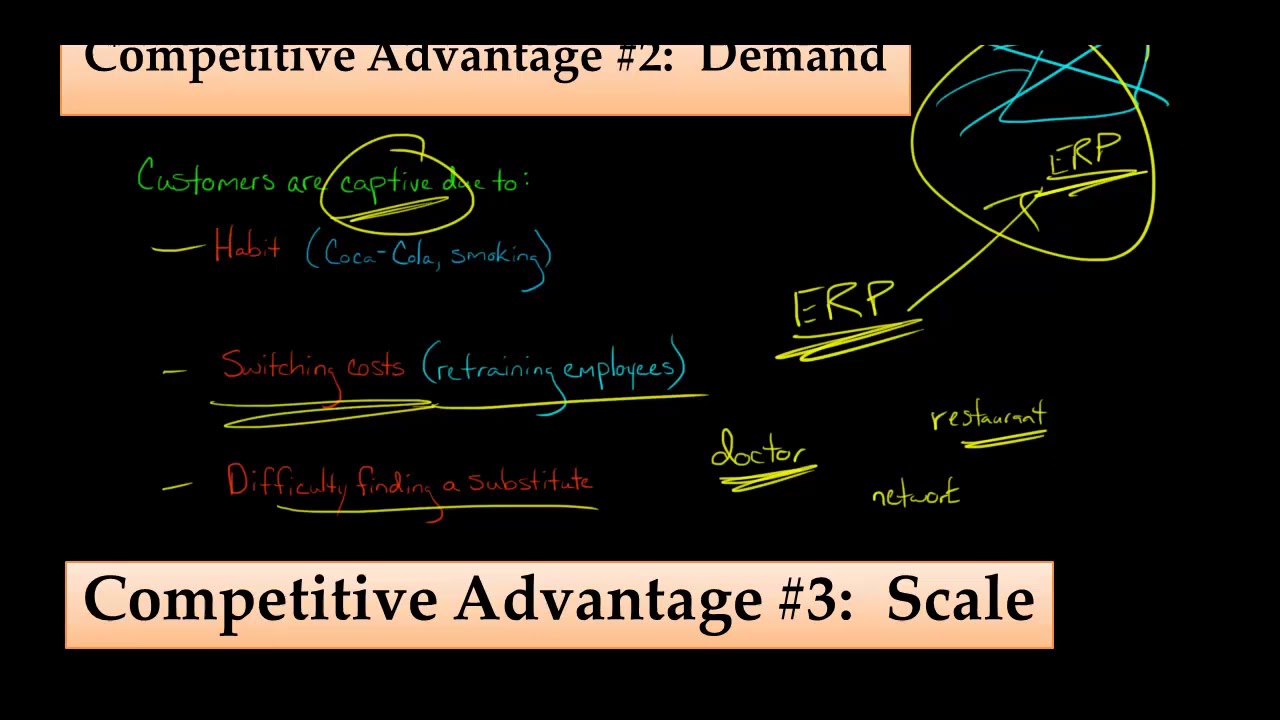
better bargaining power with suppliers the key is to identify and exploit areas where a company can create a sustainable cost advantage that is difficult for competitors to replicate we'll explore case studies of companies that have success sucessfully leveraged cost advantages to establish formidable entry barriers from Walmart's supply chain efficiency to Southwest Airlines lowcost business model we'll see how cost leadership can provide a powerful Competitive Edge customer captivity refers to a company's ability to retain customers and prevent them from switching to competitors this can be achieved through various means such as creating High switching costs offering
unique value propositions or fostering strong brand loyalty when customers are locked in to a company's products or Services it becomes difficult for new entrance to attract them away thus creating a significant barrier to entry Greenwald highlights several factors that contribute to customer captivity one is the presence of network effects where the value of a product or service increases as more people use it this is particularly evident in Industries such as social media or software where the size of the user base itself becomes a competitive Advantage another factor is the accumulation of customer data and insights
which allows companies to personalize their offerings and create a more compelling value proposition we'll dive into examples of companies that have successfully created customer captivity such as Apple's ecosystem of products and services Amazon's Prime Membership program and Netflix's personalized content recommendations by understanding the mechanisms behind customer captivity businesses can develop strategies to enhance customer loyalty and erect barriers against competitors economies of scale refer to the cost advantages that arise from increased production volume as a company grows and produces more it can spread its fixed costs over a larger number of units resulting in lower costs
per unit this concept is closely related to cost advantages but it specifically focuses on the benefits of scale Greenwald emphasizes that economies of scale are not just about overall company size but rather about scale within specific product lines or Geographic markets he introduces the concept of local scale economies which suggests that scale advantages are often concentrated in particular areas rather than being evenly distributed across a company's entire operations for example a company May achieve economies of scale in a specific product category by dominating that segment even if it has a relatively small presence in other
categories similarly a company may enjoy scale advantages in a particular geographic region even if it has limited reach in other areas we'll explore how companies can leverage economies of scale to create entry barriers such as by investing in large scale production facilities building extensive distribution networks or securing exclusive Partnerships with K suppliers Casey studies of companies like Intel which has maintained its dominant in the semiconductor industry through scy advantages will illustrate the power of this concept green wall challenges the conventional wisdom that differentiation is a distinct source of competitive Advantage he argues that differentiation alone
is not sufficient to create sustainable entry barriers as it can be easily imitated by competitors instead He suggests that differentiation must be supported by underlying cost advantages or customer captivity to be truly effective for example a company May invest heavily in research and development to create a differentiated product but if competitors can easily replicate The Innovation or offer similar features at a lower cost the differentiation Advantage will be shortlived on the other hand if the differentiation is backed by proprietary Tech Technologies economies of scale or a loyal customer base it becomes much harder for competitors
to erode the company's market position we'll look at examples of companies that have successfully combined differentiation with cost advantages or customer captivity such as Apple's premium pricing strategy supported by its efficient supply chain and loyal customer base or Starbucks unique coffee shop experience back by its scale and brand loyalty Greenwald argues that the most potent and sustainable competitive advantages arise from the combination of economies of scale and customer captivity when a company achieves significant scale in a specific Market or product category and simultaneously cultivates a loyal customer base it creates a virtuous cycle that reinforces
its dominant position as the company grows and benefits from economies of scale it can invest more in Innovation marketing and customer experience which in turn enhances customer captivity The increased Customer Loyalty further fuels growth and scale creating a self-reinforcing feedback loop we'll explore case studies of companies that have successfully leveraged this powerful combination such as Amazon's dominance in e-commerce through through its vast scale and Prime Membership program or Coca-Cola's global scale and strong brand loyalty by understanding the synergies between scale economies and customer captivity businesses can develop strategies to create and sustain unassailable competitive advantages
having laid the foundation of competitive advantages we now turn our attention to the dynamic interplay between competitors Greenwald introduces two key Frameworks for analyzing and navigating competitive interactions the entry preemption game and the prisoners dilemma the entry preemption game is a framework for analyzing the Dynamics between incumbents and new entrance in a market it helps companies understand the likely reactions of competitors and develop strategies accordingly the key Insight is that when making decisions companies must consider not only their own actions but also the potential responses of their competitors for new entrance the framework suggests considering
the incumbent possible counter moves and planning for subsequent steps for incumbents it involves assessing whether a new entrant poses a credible threat and determining whether to retaliate the game unfolds in a series of moves and counter moves with each player trying to anticipate and outmaneuver the other Greenwald introduces the concept of tree building as a tool for mapping out the entry preemption game by creating a decision tree that outlines the possible moves and outcomes companies can systematically evaluate their options and choose the most advantageous path we'll walk through a hypothetical scenario of a new entrant
challenging an incumbent market and show how to apply the tree building tool to develop a robust strategy by mastering the entry preemption game companies can make more informed decisions and improve their chances of success in competitive markets for new entrance directly challenging incumbents can be a risky proposition Greenwald suggests that a more effective approach is to enter the market stealthily avoiding direct confrontation and gradually building a presence by staying under the radar new entrance can minimize the chances of triggering a strong retaliation from incumbents several strategies can be employed to execute a stealth attack first
new entrance should avoid directly attacking incumbent core markets and instead focus on underserved or Niche segments by targeting customers that are less important to the incumbents new entrance can gain a foothold without immediately threatening the incumbent market share second new entrance should adopt a gradual and phased approach to Market entry rather than making a splashy entrance with a full-scale launch they should start small and expand incrementally this allows them to test the market refine their strategies and build a customer base before attracting the attention of incumbents third new entrance should be cautious about price pricing
and avoid triggering price Wars by setting prices that are not significantly lower than incumbents new entrance can signal that they are not trying to undercut the market and disrupt the existing equilibrium this reduces the likelihood of a strong retaliation from incumbents who may perceive the new entrant as a serious threat finally if there are multiple incumbents new entrance should diversify their attack rather than than focusing on a single competitor by spreading the impact across multiple Players new entrance can minimize the risk of provoking a concentrated response from anyone incumbent we'll explore realworld examples of successful
stealth attacks such as how Netflix initially focused on the DVD by mail Market before gradually expanding into streaming and original content production or how Dollar Shave Club targeted the underserved Market of budget conscious razor buyers before being acquired by unil lver in some cases new entrance may find themselves in a position of weakness facing established incumbents with significant Market power Greenwald offers strategies for how underdogs can break free from competitive disadvantages and turn the tables on incumbents one approach is to identify and exploit the incumbent blind spots or areas of complacency by focusing on market
segments or customer needs that are overlooked by the incumbent underdogs can carve out a niche and build a loyal customer base this requires a deep understanding of customer preferences and a willingness to innovate and adapt quickly another strategy is to leverage new technologies or business models to disrupt the incumbent traditional ways of operating by introducing innovative solutions that offer Superior value propositions or cost advantages underdogs can LeapFrog the competition and redefine the rules of the game we'll look at case studies of successful underdogs such as how Airbnb disrupted the hotel industry by leveraging the sharing
economy or how Tesla challenged the automotive industry with its focus on electric vehicles and direct to Consumer sales model the prisoners dilemma is a classic game theory concept that highlights the tension between individual and Collective interests in the context of business strategy it refers to situations where competitors engage in actions that may be individually rational but collectively detrimental the key Insight is that when companies Focus solely on their own interests they may end up in a worse position than if they had cooperated Greenwald argued that many competitive situations resemble the prisoner's dilemma where companies can
choose to either cooperate or defect common examples include price Wars advertising battles or product quality races while each company may feel compelled to engage in these actions to gain an advantage the collective result is often reduced profitability for all players to illustrate the prisoner's dilemma we'll walk through a hypothe iCal scenario of two competing firms considering whether to cut prices or maintain the current price level will show how the pursuit of individual gain can lead to suboptimal outcomes and discuss strategies for breaking out of the Dilemma by understanding the prisoners dilemma companies can recognize situations
where cooperation may be more beneficial than competition and develop strategies to promote industrywide stability and profit profitability for incumbent firms facing competitive threats Greenwald offers several defensive strategies to avoid the destructive outcomes of the prisoner's dilemma the goal is to prevent the escalation of competitive actions that can erode profitability for all players one strategy is to Signal a commitment to cooperation and stability by communicating a willingness to maintain prices or limit advertising spending incumbents can encourage competitors to follow suit this requires a delicate balance of firmness and flexibility as being too rigid May invite challenges
while being too accommodating may be seen as weakness another approach is to create structural barriers that limit the scope of competitive actions for example companies can Lobby for industry regulations that restrict price discounting or establish Cooperative agreements ments with suppliers or Distributors to prevent competitors from gaining an advant incumbents can also imploy price matching strategies where they commit to matching any price cuts by competitors this removes the incentive for competitors to engage in price discounting as they know that any temporary Advantage will be quickly eroded by establishing a credible threat of retaliation incumbents candet aggressive
competi ative actions finally incumbents can focus on building strong customer loyalty and switching costs by creating a loyal customer base that is resistant to competitors offerings incumbents can reduce the effectiveness of competitive actions this can be achieved through loyalty programs personalized services or proprietary technologies that make it difficult for customers to switch to Alternatives we'll explore real world examples of defensive strategies such as how Coca-Cola and Pepsi have maintained relatively stable market shares and pricing despite intense competition or how Airlines have used frequent flyer programs and Alliance Partnerships to create switching costs and deter new
entrance in the Final Chapter Greenwall challenges the conventional view of competition as a zero sum game and argues for a more nuanced understanding of the nature of business competition He suggests that the ultimate goal of competition should not be to destroy Rivals but to create value and Achieve sustainable growth Greenwald argues that the traditional view of competition as a battle for market share is misguided in many cases the size of the market is not fixed and companies can grow by expanding the overall p rather than fighting over a limited slice by focusing solely on beating
competitors companies may miss opportunities to create value and satisfy unmet customer needs we'll look at examples of Industries where competition has actually grown the overall Market such as how the rise of smartphones expanded the market for mobile devices and apps or how the competition between streaming services has increased the overall demand for video content by recognizing that competition is not always a zero sum game companies can shift their focus from market share to Value creation Greenwald suggests that companies should look for opportunities to create value through cooperation and collaboration even with competitors by working together
to solve common challenges or expand the market companies can achieve better outcomes than by focusing solely on rivalry one way to create value through cooperation is to develop industry standards and platforms that benefit all players by agreeing on common technical standards or interoperability protocols companies can reduce duplication of efforts and create a larger ecosystem that attracts more customers and developers this is particularly relevant in Industries with network effects where the value of the platform in increases with the number of participants another approach is to engage in co-option where companies simultaneously compete and cooperate in different
areas for example two companies May compete fiercely in one product category while collaborating on research and development in another area by selectively cooperating where interests align companies can share costs reduce risks and accelerate Innovation we'll explore real world examples of value creation through cooperation such as how the development of the USB standard benefited the entire computer industry or how the alliance between Toyota and BMW to develop fuel cell technology helped accelerate the adoption of clean energy Vehicles Greenwald argues that companies need to shift their mindset from one of pure competition to one of coexistence in
many Industries the success of one company does not necessarily come at the expense of others instead companies can Thrive by finding ways to differentiate themselves and serve different segments of the market this requires a shift from a zero sum mentality to a positive sum mentality where the goal is to create value for all stakeholders including customers employees suppliers and and even competitors by recognizing the interdependence of players in an industry ecosystem companies can identify opportunities for Mutual benefit and long-term sustainability we'll look at examples of companies that have successfully shifted their mindset and found ways
to coexist with competitors such as how Netflix and Amazon have both thrived in the streaming video Market by focusing on different content strategies and Target audiences or how the craft beer industry has grown by emphasizing differentiation and collaboration rather than Cutthroat competition Greenwald concludes by emphasizing that the path to enduring success lies not in destroying competitors but in creating unique value and building sustainable competitive advantages he argues that companies should focus on their core strengths continuously innovate to meet evolving customer needs and cultivate a culture of adaptability and resilience by understanding the true nature of
competition and the sources of competitive Advantage companies can develop strategies that enable them to thrive in the long run this requires a balanced approach that combines a focus on cost efficiency customer loyalty and scale economies while also being open to cooperation and value creation opportunities ultimately the goal is not to win the game of competition but to create a better game all together one that benefits all players and contributes to the overall well-being of society by embracing this mindset and applying the insights from competition demystified companies can navigate the complexities of business strategy and Achieve
enduring success in this indepth exploration of competition demystified we've seen how Bruce Greenwald challenges conventional wisdom and offers a radically simplified approach to understanding and navigating business competition by focusing on the essence of competitive Advantage barriers to entry and the three key sources of Advantage cost customer captivity and economies of scale green wall provides a powerful framework for developing effective business strategies we've also delved into the Dynamics of competitive interactions exploring Concepts such as the entry preemption game and the prisoners dilemma and discussing strategies for both attackers and Defenders finally we've seen how Greenwald reframes
the nature of competition itself emphasizing the importance of value creation cooperation and [Music] coexistence