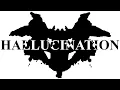
this is the shower curtain in the upstairs bathroom at my parents house they've had it for at least as long as i can remember probably longer when i was a kid it was the shower curtain in this bathroom and 20 years later it's still here i always liked it when i was very young i used to stare into this pattern of jagged squiggly lines strewn across it and out of these patterns forms would spontaneously emerge this is the one that always stuck out to me the most he's a cartoon clown with a giant nose if
i outline it like this you can plainly see the eyes the right ear his grin and this little tuft of hair something about him always made me a little uneasy this one was the first one i found the frog monster you can see his tail his hunched back his eye and his puffed up frog throat right beside him is this monster who i decided was his friend above both of them is this character who seems to be hanging from something and it looked like he had the head of an anteater i always had the sense
that he was writing something even though it didn't exactly look like it coming out of the clown's nose is this snot monster coming out of his nose is another snot monster and coming out of him is a third snot monster if you looked at this curtain i'd imagine you'd see other shapes and other characters you'd probably see at least a few things that i don't and perhaps you have some difficulty seeing the things that i see but when i look i'm unable to see anything other than this this effect is called peridolia and it's what
causes people to see faces where there are none pareidolia is technically a kind of hallucination it is to see something which is not physically there and it happens more often than you think this is not a man's face it's a piece of stone this is not the moon it's a picture in my room this is not a city it's a bunch of pixels on your screen it's very difficult to define the difference between peridolic hallucination and art you might say that art has to be artificial it has to be made by a human but that's
not what i mean what i mean is is there a difference between this phenomenon and this one because i don't think there is this is a stone that resembles a human face and so is this this one is a sculpture and this one is not but both are examples of the same effect if you watched my video the shape of everything you may remember that when i talked about color i said that what gives red its redness is not the color itself but the memory of the color colors like it and what they've meant in
the past a red thing reminds us of other red things and that memory is what makes red feel like red to some extent those memories are inherited certain colors and red is a good example probably some things so often and so reliably that the connection between the two has left a mark on our dna but i think at the same time there is a degree to which the color makes itself known to us as individuals imagine somebody who was held in a gray prison with no windows the walls were gray all the prisoners wore gray
and all the guards wore gray except for one who wore yellow this guard in yellow wore the only color our prisoner ever saw and twice a week the garden yellow would come into his cell and beat him how do you think this would affect his perception of the color yellow if it was his favorite color going into prison it probably wasn't when he got out that alone means his perception of the color changed this is a very extreme example of what's happening all the time every time you encounter something that has a particular color the
object makes a subtle impression on your perception of that color the same is the case for shapes objects tastes smells etc there are some smells for example that take me back to childhood and sometimes i listen to certain songs to visit a memory i'm sure you know what i'm talking about sensation is memory sometimes your own memory sometimes someone else's but always memory when you look at a color you feel the memory of every previous encounter with it these compound super memories are the stuff your perceptions are made of and they are responsible for the
feelings which all perceptions evoke i call these emanations in jungian language we would say that these super memories or emanations are projected onto the objects of experience however i think to some extent this term confuses people the projector was a relatively recent innovation at the time that freud and young were writing it was something fresh in the minds of their readers to say that one was projecting one's own mind onto the world would have conjured a vivid and illuminating mental image projectors allow us to change the perception of a screen even though the screen is
not really doing anything that things are happening on the screen is an illusion conjured from a distance by the projector as a metaphor for human perception it works and it bears an interesting resemblance to plato's allegory of the cave had plato lived today he would have only needed to describe a cinema however my main gripe with the term is that projection is an active process it's not something which happens involuntarily you do not accidentally project a reel of film onto a screen furthermore a literal projector can be turned off and so many people get the
idea that you can stop projecting and observe the world as it really is these apparent implications are misleading if you did not project an emanation onto the color red you could not meaningfully perceive the color at all because the color in and of itself does not mean anything the emanation is the perceived meaning and so perception without projection would be meaningless the material world is ultimately an undivided field of chaotic activity everything affects everything else and so everything is at least to some extent connected everything is only where it is because of everything else and
everything is made of the same stuff and so everything is at least to some extent one substance but in order for human beings to interact with this field in the way that we do we have to give names to the patterns we see donald hoffman likens perception to a computer interface and this is a useful metaphor here the machine you are looking at is interpreting a vast sequence of ones and zeros but it translates that data which is meaningless to you into letters sounds colors etc the patterns which we observe in the world are really
like waves in the ocean all ocean waves are made of the same stuff the only difference is where that stuff is and what it's doing the only reason things seem so separate and distinct is because your mind is hyper attuned to the differences between them and to their practical functions it's all the rage today in occult circles to say all is one you are god and separation is an illusion but none of that is actually true it just sounds nice a hand has five fingers your thumb is not your pinky and your pinky is not
your thumb but they are both your hand your hand is not more real than your fingers and your fingers are not more real than your hand this wave is not this wave but they are both the ocean separation is an illusion but unity is also an illusion for no unity is ever absolute and no division is ever absolute [Music] but these illusions are necessary ones they are approximations of reality which are better than nothing that's what all concepts are and that's why we need our projections flawed as our ideas may be we can't see without
them the projected psyche is ultimately a sense organ which interprets and translates the information from the physical senses and relays them to consciousness the meanings which surround us are all technically speaking projected emanations peridolic hallucinations this is a candle in my room candle is not a substance a candle is a type of pattern the term candle is not describing what it is it describes what a human may use it for that is a projection it has almost nothing to do with the object and almost everything to do with us as human observers this is another
candle which i made out of an orange peel structurally and chemically these two objects are nothing alike but they're both candles and the reason they are is because they mean the same thing to a human being and that has absolutely nothing to do with their composition so that candleness is a projection it's in the observer not the object the only thing which distinguishes it from the common idea of a hallucination is that it works but that doesn't mean the psychic mechanism is different what is occurring is the unconscious psyche observes the phenomenon remembers that similar
patterns of information were called candles and so it names this new pattern of information a candle as well it then transmits this interpretation to consciousness the alchemists assigned this function of connecting consciousness and the body to mercury the metal named after the roman messenger god to the alchemists mercury was the feminine spirit the counterpart to the sulphuric masculine soul yellow flammable sulfur was likened to the sun and silver watery mercury to the moon the last third of the alchemical trioprima was salt which represents crystallization physical matter and therefore the earth the mercurial spirit corresponded to
what we would call the mind or the psyche and this correspondence is quite apt because the psyche is as the alchemist supposed mercurial it acts as an intermediary between the physical body and consciousness carrying messages back and forth between the two mercury was the god of communication the patron of the eloquent deceivers and truth-tellers alike he was a trickster just so our hallucinations can help us perceive the world in a useful way or they can fool us however they are always nonetheless hallucinatory it is as though surrounding consciousness is a shell or cloud of projections
there is a backdrop of feelings what we might call qualia and in front of that a layer of ideas behind these two veils the real world as it is lies hidden in the east these veils are called maya or illusion and interestingly the mother of mercury was also named maya now the word maya has the same root as the word magic and in his human incarnation mercury was the legendary magician hermes trismagistus a master of alchemy astrology and theory all of this essentially points to the same idea there is at bottom no difference between hallucination
and true perception there are the fabled occult magicians who command spirits and bend the world to their will with secret knowledge and there are the modern stage magicians who make you think you saw something you didn't the metal mercury unlike other metals is a fluid at room temperature and because mercury is a liquid it forms smooth even surfaces which are reflective and that is my preferred metaphor for perception technically speaking there is no difference between a projection and a reflection a projector screen is a reflector but as a metaphor reflection has a distinct advantage you
do not make a mirror reflect your image it simply happens and there is nothing you can do to prevent it let's return to our candle from before imagine for a moment that the flame of this candle is your consciousness light shines out from the flame and is reflected by the objects that surround it what shines back from those objects is nothing other than the same light which came from the candle as a matter of fact what shines back is literally the candle's own reflection which just so happens to be rather bright but because the surfaces
are not ideal reflectors you can't tell but if i hold the candle up to something smooth its reflection is obvious there is nothing special about glass other than its smoothness reflection is reflection even if it doesn't look like it if that were not so projectors would not work in the first place when the white candle light shines on a red object the object absorbs all the light except the red light which it reflects when it shines on a blue object the blue light is reflected i think the candle simplifies the idea i'm trying to explain
so when i looked at the shower curtain as a child what i saw were projected emanations i saw the kinds of things which are likely to attract and hold a young boy's attention frogs monsters cartoon characters and snot the same process which causes me to identify this color as red causes me to identify this meaningless shape as a cartoon clown and it is the same process which caused ancient humanity to see gods and monsters in the stars it is a mistake i think to regard these as utter illusions it isn't technically wrong to call them
hallucinations nor is it technically wrong to say that calling this a book is a hallucination in the first place it's just a photograph however if all you perceived in this rectangle were the pixels and that would not be misperception that would mean that there is a real channel of information in this array of data which you would not have access to if you only perceived what was objectively here that is a matrix of dots far from seeing accurately you're actually missing things this is why the word information means in formation the problem it seems is
that we only call this process hallucination when it malfunctions this muddies the water considerably furthermore a book is not a thing not according to anything other than a human being to the rest of the universe this is a bunch of wood pulp but you're not the rest of the universe are you and that means that as far as you should be concerned the book is more real than the paper the real problem which all of this illuminated for me was this how can we tell when we can trust these phantasms and when we can't i
think the answer lies in an entirely different perspective it is to be found through the recognition of one's own reflection in the world in the understanding that the world which each of us inhabits is an image of the condition of our own souls this is a stone but it is also a face because that is what you and i see and you and i are not illusions consider this a primer on this subject there is much more i'd like to say in time but for now i think this will suffice all subjective realities exist but
some are better at it than others until next time thank you for watching and be well [Music] [Music] you