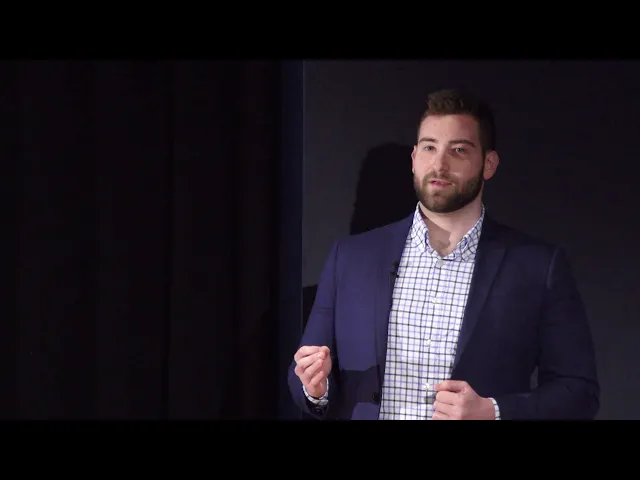
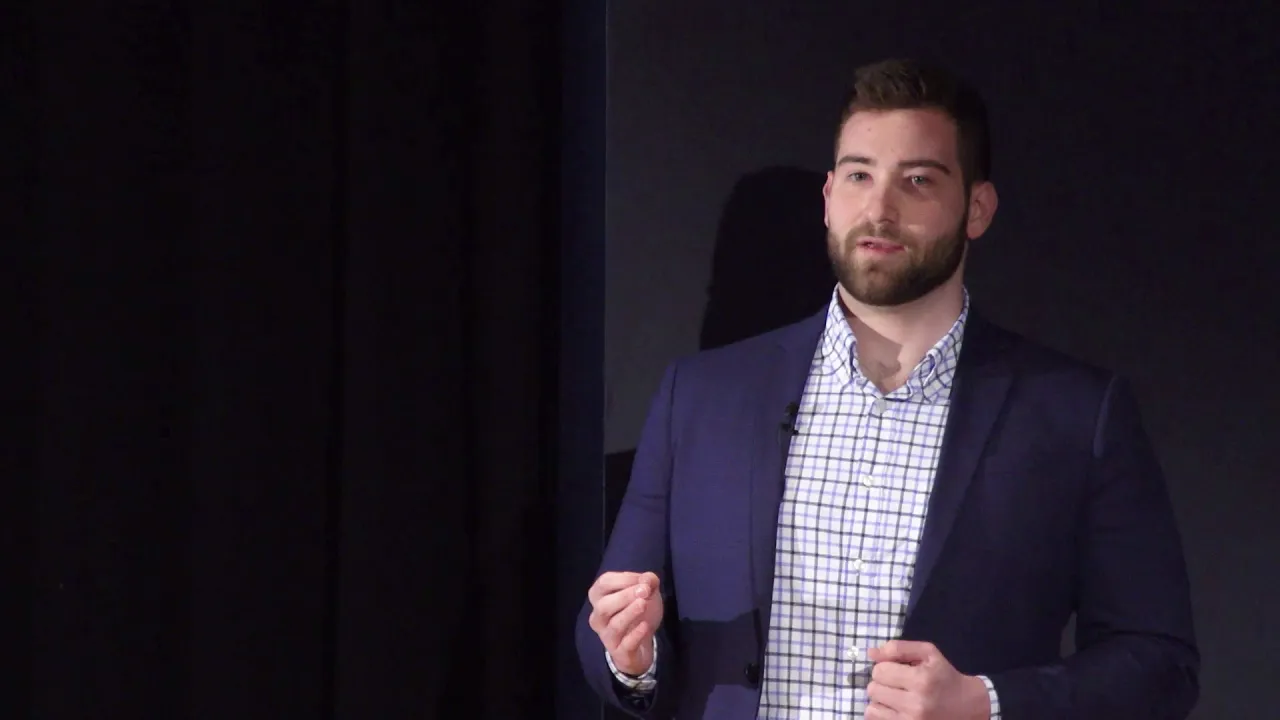
The next presenter is Ben Rein, who's a PhD student in the Department of Physiology and Biophysics in the Jacobs School of Medicine and Biomedical Sciences. The title of his 3MT presentation is "Putting the Brakes on Autism: A New Molecular Strategy". Ben is clearly a person with wide ranging interests.
Not only did he enter his PhD program when he was 20 years old, but he also served as the chief editor for a nonfiction novel that was published last year, and four years ago, he produced and released a complete hip hop album. So, ready, set, pitch. - You may not find it surprising that one in every 59 children is diagnosed with autism, a disorder that affects the way the brain develops in ways that make socializing very challenging.
But with so many children affected, you may be surprised to learn that there are no drug treatments which can improve the social symptoms of autism. We know that about 60% of all autism cases are caused by gene mutation. But it's still very unclear exactly why or how these mutations lead to autism.
The goal of my research is to identify how these gene mutations change the brain. If we can answer this question, we can grow much closer to identifying treatment strategies, which may be able to improve the social symptoms of autism. So, let's talk about the brain.
The brain is made of billions of cells called neurons, which believe it or not, actually have conversations with each other. They do this by communicating at little junctions called synapses. An example of a synapse is shown on the left side of the screen.
Now, this is all very complicated, so let's break it down. Think about the brain like a roadmap of a big city, and each of these synapses, like an intersection with a traffic light. Just as traffic light signals stop or go to control the flow of traffic, these synapses can send either positive or negative signals to control the flow of information across brain cells.
Of course, red lights are very important for preventing car accidents and traffic buildup. Similarly, we have red lights in the brain called Gaba synapses. And these are equally important for preventing brain activity from getting out of control.
People who don't have autism have a healthy balance between red lights and green lights in the brain. But we often see that this balance is lost in patients with autism. And I wanted to get to the bottom of what was causing that.
So, I looked into the brains of mice carrying one of the most common gene mutations in autism, and I found that in a brain area which controls social interaction, they actually had less of these red lights. And as a result, these mice showed reduced social interactions. Just imagine if the part of your brain controlling your social interactions was like a city with no red lights.
After investigating, I also found that a molecule called Npas4 was also reduced. And this is important because in the brain, Npas4 is responsible for building these red lights. By performing a surgical procedure, I was able to restore the level of Npas4, and I found that this, not only caused more red lights to be built, but more importantly, it made these mice significantly more social to the point where they were indistinguishable from normal mice.
This research indicates that by targeting Npas4 and building more red lights in the brain, we may have identified a new molecular strategy to put the brakes on autism. I'm very excited about this research and I can't wait to take it to the next level. In fact, I'm now testing drugs in the lab, which may be able to target Npas4, and therefore serve as novel therapeutics for autism.
I can't wait to complete this research here at UB. Thank you.