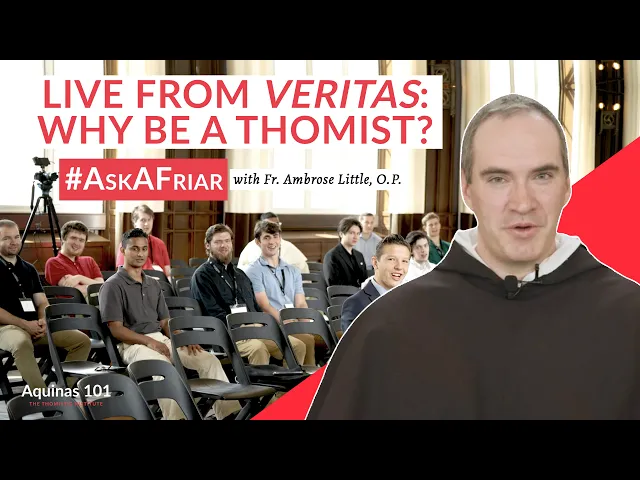
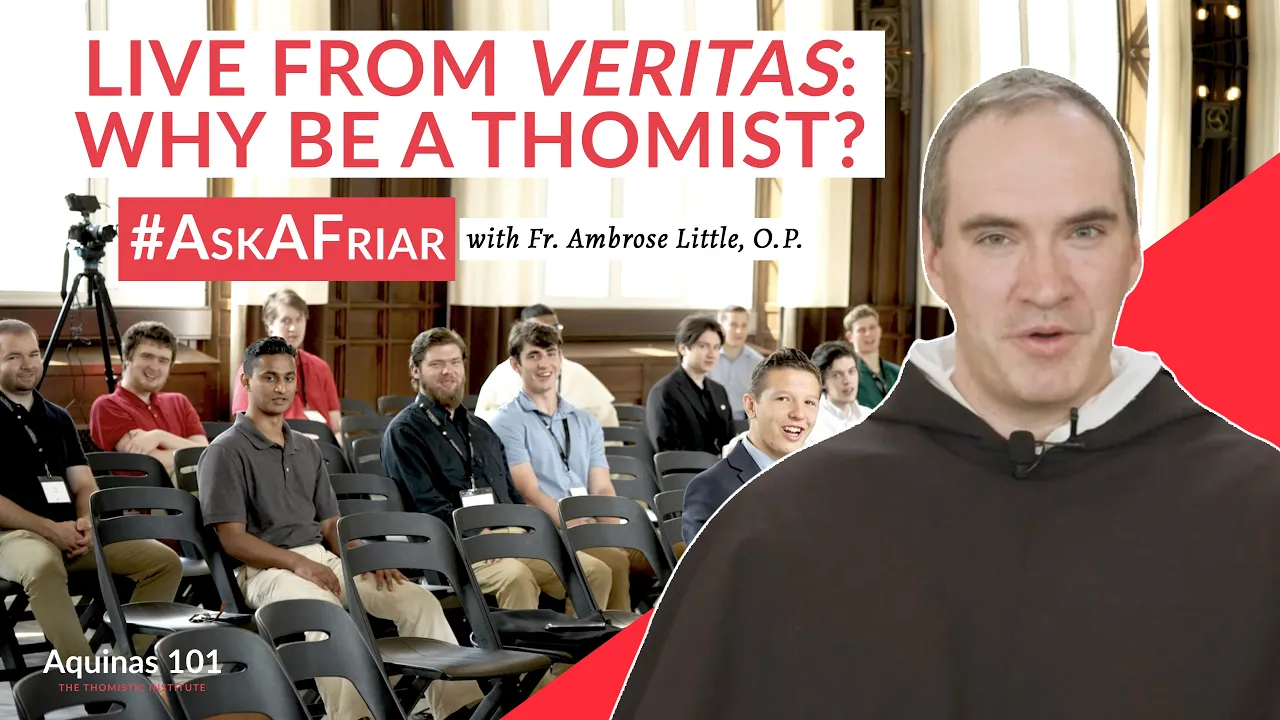
[Music] hello my name is Father Ambrose little and I teach philosophy at the Dominican House Of Studies welcome to this special live episode of big questions little answers the series where I do my best to answer your big questions about philosophy theology ology and more you may be wondering wait live does that mean with an audience what's going on well I broadcasting to you from theistic Institute Summer Conference called Veritas where we have gathered together students from our various campus chapters alumni and other friends of the ti Community for an opportunity to hear great lectures
and meet great people today's format will be a little different than usual before they arrived we solicited questions from participants and I will Begin by addressing some of those questions the theme of our conference is why be a toist so the questions I will begin with are all questions about tomis once I have addressed those questions I will abandon the safety of the teleprompter and take questions from our live audience be warned it might not go well having issued that caveat let's turn to our first question does tomis evolve across time or is it a
fixed system of thought this is a complicated question the big question here is what exactly is tomis and what does it mean for someone to be atomist if we can figure that out it will be easier to see whether tomis evolves over time or not to begin I want to note that tomis is a school of thought as a result it is helpful to begin by thinking about what a school of thought actually is why because this question is not a special problem for tomis because every school of thought does try to delineate what can
change and what has to stay the same in order for the school to continue existing over time one way this question is approached is by deciding on criteria for including a particular thinker within a school of thought so to give an example when talking about platonism the scholar Lloyd Gerson says that we can talk about big tent platonism and little tent platonism Gerson thinks that Aristotle can be called a platonist in his version of big tent platonism but not in his version of little tent platonism what is interesting about this remark is that the people
who count as members of a school partially depends upon the CR criteria one uses for inclusion in that school and most schools have big tent and little tent versions of their criteria regardless the first point I'm making is that this is not a special problem for tomis because it's hard for any school of thought to come up with unchanging criteria in general I think that if you want to conceive of a particular school as a fixed system of thought the easiest way to do that is to establish big tent criteria but if you do that
then there are a number of non-essential beliefs held by members of of the school that may vary widely what is more while there is a wider variety allowed for when we use big tank criteria there is also a good amount of variety even if you use little tent criteria for even there one can find variation among the non-essential beliefs either way a fixed system of thought can have evolving non-essential parts and so every school can be both a fixed system of thought in its criteria and still evolve with respect to its non-essential points therefore the
answer to this question for all schools of thought seems to presuppose that any given school could be both fixed in some respects and evolving in other respects so now let's go back to the question does Tom ISM evolve over time or is it a fixed system as you might suspect from what I just said I think that tomis is both a fixed system and an evolving one it is a fixed system in so far as a toist must be a student of St Thomas which means that there will be some common belief beliefs among all
Tomas that will not change but tomis also evolves since new questions arise that St Thomas never could have answered it is the job of St Thomas's students to answer those questions and in so far as that adds to inm morphism then it does evolve but it cannot evolve in such a way that a toist of today would deny a central principle of St Thomas like the real distinction between act and potency so that is the answer to my first question let's now move on to our next question which which is how should a budding toist
navigate the different readings of St Thomas my first response to this question is as follows theistic Institute but more seriously this is a difficult question because there are many schools of tomis I think a helpful approach is always to ground your judgments about the faithfulness of a particularistic scholar or totic school is a deep knowledge of the text of St Thomas therefore if you want to be a toist read St Thomas and read him often and deeply on all the issues that you can if you do that then you will be in a position to
discern which thinkers in schools of thought are more or less faithful to him in addition to reading St Thomas pay attention to the priorities of various schools of tomis you know we give these schools names and sometimes those names can be helpful in understanding the approach and priorities of the thinkers who work within those schools of interpretation how so well consider this a roommate of mine from college once described the difference between us in the following way he said that I was Irish Catholic whereas he was Catholic Irish what's the difference the difference is between
the subject and the adjective the idea being that an Irish Catholic is a person who is Catholic first but who practices Catholicism in a way typical of the Irish people the Catholic Irish individual is principally an Irishman who happens to be Catholic when investigating different schools of Tomas you will come across labels like Arista tilian tomis or platonizing tomis or analytic tomis or existentialist tomis and other such names the question you should ask yourself is is the person principally a toist who happens to practice tomis under the influence of a particular methodology or a person
who is principally a member of a different school of thought who is heavily influenced by St Thomas so the question is is this person a tomisic plate or platonizing toist is this scholar an analytic toist or a totic analytic philosopher I would say that we should privilege those individuals who see themselves primarily as Toms so to sum up the best way to navigate the schools of tomis is to be familiar with what St Thomas actually says and determine which thinkers tend to prioritize his thought and methodology a third question I received about tomis is the
following after Aristotle who are the next most important non-Christian think in the Thomas tradition the answer to this question depends on how you qualify important I think a good case can be made either for abisa or aoiz as the most important non-Christian influences on aquinus after Aristotle in large part because their interpretations of Aristotle made very important contributions to aquinus understanding of logic metaphysics and natural philosophy I'm not an expert on this subject so I'm unwilling to weigh in on which thinker had a greater influence on aquinus but I think I think it is quite
clear that both had a strong influence on St Thomas's thought that being said I think contemporary Scholars often Overlook the importance of the helenistic Roman philosophers on the thought of St Thomas so Saka and Cicero in particular are cited frequently in aquinas's treatment of ethics and morals however their influence does appear to be limited to the ethical realm which is why I think the Arab thinkers are more important as an influence on St Thomas than the Roman ones okay so those are my prepared remarks now I'm going to open the floor to some big questions
from our studio audience uh good morning Father um here's my big question is do men and women have different Souls so the question I was just asked is do men and women have different Souls now there are different ways we can approach this question do we think about different souls in terms of different individual Souls absolutely but it's not just men and women that have different individual Souls every individual has a different soul from every other individual but then the question is does do you mean by this does do men and women have different souls
in the in terms of their forms that's a little bit more complicated in so far as every human being primarily has a human soul then no men and women all have the same kind of Soul now each individual is qualified by different properties in different ways and so um as a result right you know these the expression of our Humanity can change from one individual to another and that we can group individuals based upon the different common qualities that we have as best as I can tell uh maleness and femaleness uh tend to be Properties
or qualities of an individual qualities that are permanent and unchanging but nevertheless qualities so they follow from the human form and our human form must necessarily be qualified in one way or the other but that doesn't mean that our human form or our human souls are different in kind from one another so recently I've been praying about the relationship between the Eucharist and the process of I'm not sure from is right divinization um and how so the Eucharist is the body blood soul and Divinity of Jesus and how the Holy Spirit uses that as like
the raw material to conform our own hearts into Christ's heart and how like our nature is conformed into his but also like how we operate isn't like conformed to him and how uh by changing our hearts and our desires through the Eucharist it like that's like the new law within our hearts they just wanted to get like the metaphysics of that like how does the Eucharist transform us into uh Jesus I guess so the basic question there is how does the Eucharist transform us into into our Lord Jesus Christ so that's a complicated question and
I should remind the audience that I'm a philosopher and not a theologian so what you what you are hearing from me yeah you should double check with Father Gregory and father Dominic at a later point but in general we have to recogn recognize that the sacraments are Avenues of Grace and through Grace we are transformed our our human nature is transformed and elevated to come into communion with god um how the metaphysics of that works out exactly I'm unsure of and I'm not willing to comment on but I will say that there is a way
in which through the sacraments right are we are elevated now in the Eucharist in particular there is a union with God through charity St Thomas calls it the sacrament of charity itself and so in the Eucharist we become what we eat as Pope Leo the great said that we become members of the body of Christ because we are filled with his grace and filled with the life of the Holy Spirit and brought into an intimate Union with him in such a way that even the angels can't experience that that's about as much as I'm going
to say on that because I don't know if I can say anything else more clearly without going through particular text but it is mysterious and there are certain features in the metaphysics of it that we simply can't know at least certainly not while we're here on Earth in Via but there might even be aspects of it we might not know because of God's Transcendent Grace and Transcendent like awesomeness so yeah that's about all I'm going to give you for that uh father my question is uh is it possible to lie an animal whether through word
or action is it possible to lie to an animal and by that I believe you mean brute animal animals non-rational animals I would imagine so in so far as lying is trying to communicate something that is not true or to mislead or to say something that is not true now there are some different there are some complications here because animals are not the sorts of beings that can receive truth but they can receive commands um and so you can't lie to them in so far as they are not able to receive truth in the way
that human beings are able to receive truth but you are able to miss lead them through commands and there's probably something wrong with that so you can I think you can uh lie to animals in so far as you can actively mislead them and even mistreat them through misleading them but there you can't lie to them in the most proper sense because they are not by Nature receptive of Truth in its intellective form hi um thank you for taking these questions um I was wondering if you could comment on how ainus would um approach the
trolley problem and um maybe just in a broader sense um moral dilemmas in general and how acquain us would approach them the question is how would St Thomas approach the trolley problem now the trolley problem comes to us in a variety of ways right there are many modifications many Spurs that can be added to it and there's even the introduction of a fat man being pushed off of a bridge um I would say that the the trolley problem is a very complicated process and so in so far as as the trolley problem actually includes a
variety of problems there's not going to be one particular answer to it we also have to recognize that it's given to us the trolley problem is given to us in the context of a world where that approaches ethical questions differently um and so all of that makes it difficult to give a straightforward answer to how St Thomas would answer the trolley problem but in general the way that St Thomas approaches ethical issues is an examination of three things the end the object and the circumstances of an action so the question we have to ask in
each case is what is the end or the purpose of my actions why am I doing it right um and so like am I doing it to save lives am I doing it to murder somebody am I doing it for self-promotion right or what are the what is the end of the action that I'm going about it's sometimes associated with intention but it's actually a little bit more more than just intention because when we are pursuing the end we are pursuing our good as well as the goods of others and that includes both common goods
and individual goods and so any good that we are pursuing is going to be something that's going to complete us and going to bring us to rest or at least bring us along the path towards that now um in dilemas there's also the question of the object right so that is what is it that you're doing so in some ways the trolley problem is presented to us the object of the action could be simply pulling a lever right so um but the but we might ask what are you doing when you pull the lever well
when you pull the lever you are changing tracks that the train will go upon and so that then brings in some complications we'd have to we'd have to examine individually what is it that you are doing what is the object of your act to then determine whether or not that act is permissible or or impermissible and then quite often in in dilemmas you have to bring into account the um the principle of double effect which can be and often is misused in in questions of this sort that requires a much longer discussion to figure out
how to properly use the principle of double effect in consideration of the object of Your Action but I will say that it's a uh it's probably it's never the case that you should put the push the fat man off the bridge because that is always a bad action all right then you have the question of circumstances right and this is where the circumstances can can um take a good action and make them bad a good object and make them bad um and so it's particularly with the circumstances that the question of the principle of double
effect comes into play now with circumstances right they can never make an action right they can only make an action wrong and so once we've examined the end and the the object of the action then we have to consider do the circumstances make what would normally be a a good action or a permissible action into an evil action and then for that we'd have to look at the particularities of the of the individual situation I'm not quite sure if by adding a number of Spurs you change the circumstances all that much but people do worry
about that um my question is knowing that Earth isn't our ultimate home why do we take so many Extraordinary Measures to like prevent death for as long as possible so that's a good question why so knowing that Earth and this life is not our ultimate home why do we take so many extraordinary efforts to preserve life so with that there there are actually a different number of ways in which we can cash out this question um the first is that we we if we want to cash it out in a positive way like as if
it is good to try to preserve life as long as possible what we are doing when we do that is we recognize that life is good and it's valuable and that death is evil and that the reason why our Lord Jesus Christ to save came to save us he came to save us from death and from sin and so in so far as life is the ultimate goal of the Salvation of our Lord Jesus Christ then we should always we should we should aim to preserve it but of course right Life as we know it
here is only a shadow of what life will be there and so we should make sure that nothing that we do here will prevent us from attaining to True Life in in eternity now there are ways in which we try to preserve life here on Earth that can be problematic trying to use extraordinary means to extend life uh Beyond its natural capacity in those cases what we are doing is putting an emphasis on Life as We Know It And so in so far as our actions show a lack of Hope in eternal life then the
the attempt to increase life using extraordinary means beyond our natural capacity can be wrong that doesn't mean that we are never permitted to use extraordinary means to extend our life right we see St Paul worried about this in his letters where he says I long to die and to go to Christ but if I remain I may do good for you right and likewise we can recognize that if we are intentional about extending our lives here we can still do good and so if we want to uh work to extend our lives here we should
always make sure that we do so in light of eternal glory in Hope of the resurrection and for the benefit of our brothers and sisters but if God comes to take our lives at the moment we may freely surrender ourselves to him but we may never do anything to intentionally hasten the end of our lives or to take it because life is a gift from God and ought to be preserved as long as God as long as God dains to give it to us and then when we give up our life we are not giving
it up unto death but we are giving it up unto Resurrection trusting that the Lord Jesus Christ who paved way through death to life will draw us upon that path and bring us to eternal life that's all I have for you today thanks for joining me for this special episode of big questions little answers I look forward to seeing you next time until then may God bless you and keep you in his grace I hope that answers all your questions but if not please let us know by submitting your questions using # ask Ayer in
the YouTube comments and on social media and don't forget to subscribe like and share with your friends [Music]