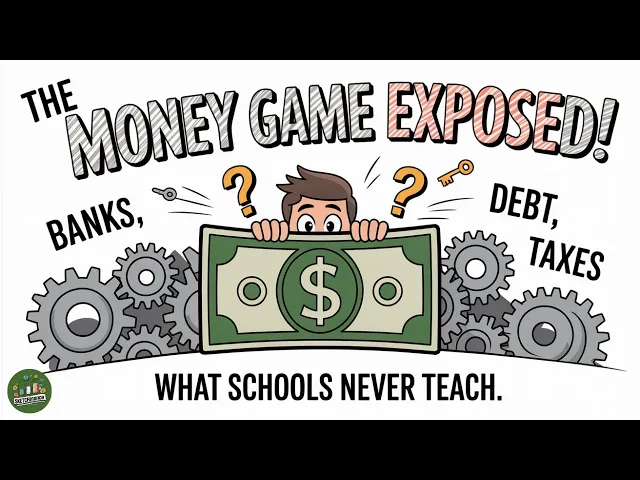
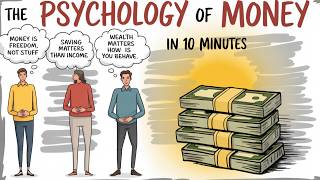
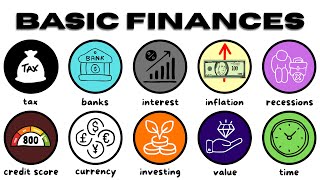
You know what's wild? Most people spend their entire lives working with money, but they've never actually understood how it works. Not the textbook definition.
I'm talking about the real system, the invisible architecture that decides whether you'll struggle or sleep peacefully at night. Here's the thing. Nobody explains it because the people who benefit most from you not knowing, they're the ones writing the rules.
And in the next few minutes, I'm going to show you exactly how you've been playing a game without ever learning the actual rules. Let me ask you something. What is money?
Most people say it's a medium of exchange, a store of value. And that's technically true, but it's incomplete. Because really, money is just trust.
It's a collective agreement that this piece of paper or these numbers on a screen have value. Fiat currencies like the dollar have no intrinsic worth. Their value depends entirely on public confidence.
And that's the first illusion. When you get a paycheck, you're not getting wealth. You're getting a claim on wealth.
A promise. The moment people stop believing in that promise, it evaporates. If tomorrow everyone woke up and decided the dollar wasn't worth anything, it wouldn't be.
The government couldn't stop it. It only works because we all agree it works. Centuries ago, a small group realized that if they could control that agreement, that trust, they could control everything.
And so they did. They built banking systems and institutions to make money seem mystical, something you couldn't possibly understand. And it worked.
Most people never question what money is. They just use it. And if they don't have enough, they blame themselves.
That's not an accident. That's by design. So, let me walk you through how the actual system works.
When you deposit money in a bank, the bank doesn't just keep it, it loans it out. This system is called fractional reserve banking, where banks are only required to hold a fraction of their deposits in reserve. But here's the part that will make your grain hurt.
The bank lends out money that doesn't exist yet. They create it digitally by making loans. Every dollar in the system beyond the physical currency is a debt that someone owes to a bank.
Think about that. Your salary, the money in your account, a huge portion of it only exists because someone somewhere is paying interest on a loan. If they default, that money effectively disappears from the system.
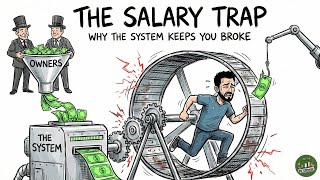
And here's where it gets darker. The system requires debt to grow. It requires perpetual growth.
Why? Because every loan has interest attached. If a bank creates $1 million in loans with 5% interest, it has created $1 million in the economy.
But it's also created a requirement for $1 million and $50,000 to exist to pay it back. Where does that extra $50,000 come from? More loans, more debt.
It's a cycle that needs constant expansion to function. It's not a bug, it's a feature. The people who created this system understood that most people would rather feel rich living in debt than feel poor being free.
They engineered a culture where debt is normal. And the statistics are insane. The average American household now carries over $154,000 in debt.
And that's just households. The US national debt surged past $37 trillion in 2025. And most people think it's their own fault.
They think they're not good with money. But they're not bad with money. They're just playing a game where the rules were written by people who win when they lose.
But the first step to changing any game is to finally learn the rules. You might be thinking, "Okay, the system is designed for debt, but I could still opt out, right? I could just not participate.
" And technically, you're right. You could. But the system has built-in layers of psychological hooks to make sure most of us never even try.
First, there's the status effect. Money isn't just for survival anymore. It's about signaling that you've made it.
And the system has made sure the way you signal that is by consuming expensive things. The house, the car, the phone that costs more than a month's rent. You weren't born wanting these things with this intensity.
You are trained to want them through ads, social media, the people around you. And the most genius part, this system lets you have them before you can afford them. That's what debt is.
It's time travel for consumption. You get to feel rich today and you pay for it for the next 30 years. But here's what's terrifying.
While you're paying, you can't afford to take risks. You can't quit the job you hate. You can't start a business.
You're trapped, not in chains, in comfort. The people at the top of the system rely on this. They know that people with debt are predictable and controllable.
So, they create financial products designed to confuse you and extract fees. Overdraft fees, annual percentage rates that are high sky, credit card minimums designed to keep you paying interest forever. It's not complicated by accident.
It's complicated on purpose. Because when you don't understand the system, you blame yourself. when you fail within it.
And when you blame yourself, you don't get angry at the system. Now, let me show you how the other half lives. The people who actually understand money.
They don't use debt the way you do. They use it as a tool. Here's the difference.
When you borrow money, you borrow to consume. You buy a car, take a vacation. Your debt goes up, but your assets stay the same.
When a wealthy person borrows money, they borrow to invest. They buy a property, start a business, purchase stocks. Their debt goes up, but their assets go up faster.
And here's the magic. The interest they pay is often taxdeductible. So, while you're paying interest with after tax dollars, they're using a tax advantage to fund their investments.
It's the same tool, but when you use it, it enslaves you. When they use it, it enriches them. This is where compound interest becomes the most powerful force in finance.
not on your debt, on their assets. If you invest $10,000 at a 10% annual return, after 40 years, you have over $450,000. But here's the catch.
You need money first to invest. And the system ensures most people are too busy servicing debt to ever get there. The wealthy often start with generational wealth.
That gives them a head start. By the time they're 30, their assets are already generating income. Meanwhile, the average person is just starting to get ahead in their 50s.
right? As they need to prepare for retirement. The math was never meant to be in your favor.
So, here's what I want you to understand. Knowing how the system works doesn't magically free you from it, but it does something far more important. It lets you stop blaming yourself for being trapped in it.
And that changes everything. Because once you understand the game, you can start to choose differently. Not perfectly, but differently.
You can decide you don't need to signal wealth you don't have. You can decide you don't need to consume what you can't afford. You can't opt out of the system entirely, but you can opt out of participating in it the way it wants you to.
You probably won't become a billionaire, but you could build a life where money serves you instead of the other way around. And that isn't nothing. That's everything.
So now you know how money really works. The question is, what are you going to do with that knowledge? That's up to you.
If you found this eye opening or want to explore more untold truths about finance, hit that subscribe button below. There are new videos every week breaking down the systems that shape your life. And the more you know, the better your chances to win at this game.
That next episode might just be the one that changes everything for you. So don't miss it. Thanks for watching.