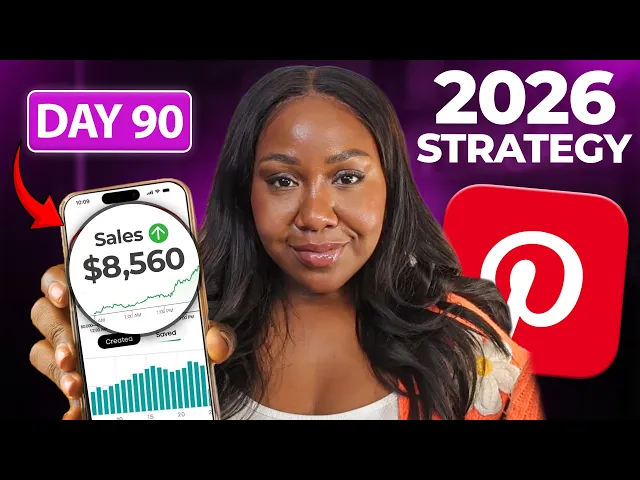
I challenge you to commit to Pinterest for the next 90 days and see how much your traffic, leads, and sales can grow. I'm Michelle and Pinterest made me over $50,000 last year through digital products and affiliate marketing. It helped me quit my 9-to-five job and build [music] a six-f figureure online business without posting on social media every day.
Most people give up way too soon and they never get to experience results like mine or of my students. And I know that if you can just stay consistent for the next 90 days, you will start seeing real momentum, real traffic, and real [music] sales. And so, in this video, I want to show you why this simple Pinterest challenge works even if you're starting from zero.
why Pinterest is worth your time in 2026 and the opportunities that most people are missing and what to focus on to get results, plus how to set yourself up for success [music] from day one. So, let's start with why choosing Pinterest over every other marketing channel like Instagram or Tik Tok is such a good idea. When I first started selling digital products on my own website, the very first platform I tried to market on was Tik Tok.
And yes, you can grow quickly on Tik Tok. You can [music] get followers, you can get a lot of views, but turning those views into actual sales, that's a completely different story. It was actually really hard for me.
And the algorithm on Tik Tok is like a hungry beast. you have to feed three to five times a day [music] and before you know it, you're so burnt out. And realistically, the only reliable way that a lot of people are making sales on TikTok [music] is by going live every day.
Now, if you're an introvert or you simply don't want to be on live video constantly, [music] I mean, I enjoy lives, but I don't want to be on live every single day. Tik Tok becomes incredibly difficult, especially for beginners. All right.
So, then we have Instagram. Now, I see a lot of people on YouTube telling you that Instagram is the best place [music] to sell your digital product, and that can be true, but I'm only seeing people successful once they've already built an audience. [music] And I've never really seen any normal person start from scratch on Instagram and recommend it as their very first and best marketing channel.
Now, posting multiple reels a day, getting no likes, getting no sales, no follower growth, it's demoralizing. It makes you feel like you're just shouting into a black hole. Okay, I don't wish that on you at all.
So, now let's talk about YouTube. I absolutely love YouTube. You probably can tell.
I think it's an amazing place to sell your digital products and coaching services, but YouTube takes time. It takes scripting, filming, [music] editing, and a whole level of commitment that not everybody has at the start of their journey. And so, this is why I'm challenging you to commit to Pinterest, [music] okay?
Because Pinterest really is the easiest platform to start with. In my opinion, it gives you long-term searchbased traffic without you needing to show up on camera every day or show up at all. You can do it faceless.
And once you understand how to use Pinterest to drive consistent traffic, [music] you can later pair it with other platforms and together, especially Pinterest and YouTube, they become a power couple for your digital products. But that's later down the line. Right now, I want you to focus on mastering one platform, and we need to get Pinterest working for you.
And this is where most people are going to start getting stuck. They don't actually know how to hack the Pinterest system. Okay.
And I'm going to teach you that today. It starts with understanding that Pinterest isn't a social media platform at all. It's actually a search engine.
And this is exactly how it works. Okay? Think of Pinterest like a giant library of solutions.
Okay? People aren't coming to Pinterest just to scroll. They're coming because they're looking for something very specific.
So, if you think about this like a library, you would walk up to the librarian, which is the Pinterest search [music] bar, and then you type in exactly what you need. It could be something like easy recipe ideas, meal planning for moms, budget tracker, how to manage my 50k salary, whatever it is. Pinterest's entire job is to go through its library and pull out the books, which is basically the pins that most closely match the words that [music] that person has just typed in.
So, it's not about looking for viral content. It's not just about looking for pretty content either. And it's certainly not about looking for trending audios.
Okay? No dancing on Pinterest [music] around here. Pinterest is about looking for solutions.
solutions that match the exact words. We call these keywords that people are typing in the Pinterest search bar. Okay?
So, for example, if someone does type in how to manage my money on a 50k salary, Pinterest will pull up pins related to the keywords related to managing salaries, [music] budgets, budgeting, monthly budget worksheet. Like, these are the things that Pinterest are going to be pulling up. And this is exactly why Pinterest converts so much better than Instagram or Tik Tok because people aren't just scrolling on Pinterest.
They're actually searching. They have intent. [music] They already want help in a specific area and they are ready to click and [music] ready to buy.
All right? And that is why Pinterest users are 70% more likely to buy than any [music] other platform. So, how do you make sure that your pins show up when people are searching?
It's actually really simple. I want you to go to the Pinterest search bar. I want you to type in a word that's related to your topic or [music] niche, okay?
And look at the keywords that is autocompleting. Pinterest is suggesting these because these are the exact phrases that people [music] are searching for. You would then use these keywords in your titles, in your description, and even your Pinterest profile.
Okay? And when you do that, you're basically telling Pinterest, hey, my pins belong in this part of the library. These are the people I want to click on it.
[music] And that's how you make sure that your pins are SEO optimized. Not just for Pinterest, [music] but this also works for Google, too, because your pins rank on both Pinterest and Google. It's a twofor one deal.
Now, it's time to talk about how you're going to actually get results. This is where the 90-day challenge [music] kicks in. This is exactly how it's going to work.
For the next 90 days, I'm going to show you the exact steps that you need to be taking to get results on Pinterest, right? We're going to make sure that your account is set up properly, that you're posting the right kind of pins, that you've actually got a funnel in place, and that you have a way to monetize your Pinterest. Whether you're doing that through digital products, affiliate products, or even physical products, this works for any business where you need customers, which [music] is pretty much every business, right?
And basically, if you need traffic, this challenge is going to help you. Now, before we get into the step by step, [music] you might be thinking, Relle, why 90 days? Why do I have to commit that long?
I thought this happened overnight. It doesn't. Okay, there's two reasons why this challenge [music] is 90 days long.
First, and this is the same with almost anything in life, it takes [music] around 3 months to really find momentum and build new routines. [music] Okay, so you doing something for a week and then stopping doesn't cut the mustard. Second, Pinterest actually needs time to index your content.
Remember said it's a search engine. [music] It needs time to understand your keywords, follow your pins properly into its library. Okay, [music] so it knows who to show them to and who not to.
This process doesn't happen overnight. And this is not for the post for a week and get rich on a platform type of effect. This is not that.
Pinterest is a compound effect over time. The more you ping consistently, the more traffic you will get [music] over time. Okay?
So people that do this and quit after 2 weeks, no, you're not going to see results. People that commit to 90 days and beyond, you're the ones that are going to build traffic machines. [music] Okay?
And you're going to see results. Now, if you're thinking, "Okay, this feels like a long time. " I want you to just compare it to your 9 to5.
How long would it take you to get a promotion and earn [music] even a little bit closer to the money that you deserve at work, right? Usually a lot longer than 3 months. [music] But if you can spend 3 months building something that has the potential to change your [music] life, be completely yours.
I mean, I literally quit my job because of this. That feels like a fair [music] trade to me. Okay.
So, if it's a fair trade to you, let's jump in. And with this in mind, [music] let's break down the step by step starting with your day one. Okay.
So, you only need to do two tasks. One, set up your free business account. Two, claim your website.
[music] Claiming your website is actually really important because this is what tells Pinterest, [music] "Yes, the site belongs to me. Yes, I am reputable. " It really helps Pinterest trust your account more and push your pins out even further.
It usually takes a couple of minutes. So, it's really worth doing at the start. And that's all you have to do for day one.
Probably take you a few minutes. Right [music] now, day two. On the second day, you are going into your new business profile and you are adding all [music] of your information.
You're adding your bio, your profile image, your profile cover. You are just making your Pinterest [music] look really well put together. And this also builds trust and signals to people when they land on your account like you're the real deal.
You've got all your ducks in a row. Okay. Now, day three, this is where the this is where the work starts kicking in.
Really, you need to go and do your keyword research. So, if you have pin perfection, which is my Pinterest marketing system, this is going to help you move so much quicker. All right?
Because you could go and put all of your keywords [music] into the keyword tracker and be really, really organized. It's a great way to level up. But even if you do or you don't, you're going to take the same approach I showed you earlier in the video.
You're going to go to the Pinterest search [music] bar and you're going to start typing in keywords relevant to your niche. And you're simply going to note down every single one that comes up. You're going to do that for all of the content [music] pillars that you have.
So everything that you make content about, make sure you get keyword groups for each. All right? Whether it's related to your products, whether it's related to your affiliate marketing, make sure your keywords are personalized to the actual pins that you're creating.
So for me, for example, I would be getting keywords related to Pinterest marketing. I talk about that. I talk about AI, I talk about email marketing, I talk [music] about digital products, I talk about entrepreneurship.
Like all of these different things, I would [music] have different keyword groups, okay? Because these are each of my content pillars. So, I do encourage you to basically write down like what are the topics that you're actually going to be talking about.
This is going to help you with content no matter what platform [music] you're using. Now, we're on to day four and this is when you're going to start creating your boards. Think of your boards like your folders.
Okay? [music] This is where you organize your pins. Okay?
You put all your related pins onto the same board. And [music] you're also going to use all of the keywords that you got the day prior to add to your board titles, add to your board descriptions. This is how [music] we SEO optimize our boards.
And it's really simple. You're literally just putting those keywords in. [music] So again, Pinterest knows where to file your content.
All right. And again, Pin Perfection, my Pinterest marketing system, I include an AI that's going to literally create all of your board names and your [music] descriptions for you and SEO optimized. But if you don't have that, it's fine.
You can just do it manually in chat GPT. [music] You can say something like, I want to create a board around these keyword phrases. [music] They won't be as good, but they will do.
As long as they align with your keywords, that is the most important thing. Okay, so we're on to day five and it's time to start pinning. You are literally going to create one of each of the four major pin types.
And I'm going to show you exactly what they are later. So, make sure you keep watching. But all you need to know now is that you're going to create one [music] of each, even more if you can.
And then you're going to schedule them through Tailwind. [music] Tailwind is a program that allows you to schedule all of your pins. and actually have a whole another video giving you complete free training on Tailwind and I'll line that up after this video.
Okay, so day five you start pinning. Now we're on to day six and we are talking about repins. [music] This is a big part of the Pinterest strategy that most people miss or they don't know about, but it literally involves you going onto Pinterest, finding other pins that [music] are similar or complimentary to yours and then repinning them onto your profile.
[music] And I like to repin pins across a couple of different boards. I will personally repin a lot of quotes that relate to my niche and I will put them all on a quote board. But you can experiment with this and really this is the only piece of engagement engagement that you need to do on Pinterest.
You know, it's not like Instagram where you have to pretend to DM someone [music] or like people's posts that you've got no interest in or that you'll never really talk to. on Pinterest, you literally just have to repin pins and it takes all of two seconds. And again, I show you how to do that in the Tailwind tutorial that's coming up after this one, okay?
But it takes no [music] time. And then on the last day, you are going to be getting familiar with analytics. You are going to go into Pinterest [music] analytics.
And right now, there won't be much data in there. You're just going to get familiar with how it works. You're going to see things [music] like where you can find your best performing pins.
You're going to also have a look at Pinterest trends. Okay, this is a great tool on [music] Pinterest. It gives you insight into what keywords are trending on Pinterest right now, which is going to help increase your views and your clicks.
So, go and get familiar with Pinterest analytics [music] cuz we're going to be using it a lot throughout the challenge. Okay, so now you've done your first seven days of the challenge and you've actually done all of the key tasks that you need for Pinterest growth. [music] The rest of the challenge is really simple because you've done everything.
This now just becomes your rhythm. Okay? So, you're going to be repeating the tasks in a certain [music] way and I'm going to break down exactly how that will look over the next 83 days left of the challenge and show you what you should be focusing on each month.
Okay? So, in month one, days 1 to 20, you're going to be focusing on your creation. [music] Now, so for the first 20 days, your whole focus is just getting comfortable creating pins, scheduling pins, spending a little time on Pinterest, and seeing what other pins [music] perform well in your niche.
Okay? So, do some research. This is really where you're building your foundation.
I want you creating pins often. I want you scheduling them, and I want you actually actively to go out and find other pins in your niche that are doing well. The whole [music] point of this part of the challenge is to really get used to how Pinterest behaves and nothing needs to be perfect here.
All you need is to be consistent. For [music] this whole month, you are just establishing your posting rhythm, which actually should [music] be really simple. You are going to schedule at least three of your own pins [music] for every single day.
And then you can actually repin at least two pins. Okay? So, three of your own, two repins.
This means you've always got a minimum of five pins going out every single day. Now, you're going to be like, Relle, you told me that I didn't need to post every day. No, you [music] don't.
The easiest way to stay consistent with this is to batch all of your creations. Okay? I recommend doing pin creation in one or two days out of the month and then you can schedule everything in Tailwind and never have to think about it again.
It's so simple. And so, that is your month one. You are settling in, you are practicing, you are learning the flow of Pinterest and getting into [music] your pinning rhythm.
Right? So month two around days 21 to 40, this is where I want you to start expanding [music] your keywords. All right?
And nothing that you were doing in month one disappears. You're simply building out bigger lists of keywords. You're also bringing in what we call more longtail keywords.
Okay? This is marketing speak for keywords that are just more than a few words. Okay?
So maybe short phrases. So for example, back to my finance niche, a longtail keyword here could be [music] finance planning checklist or finance planning Excel or personal budget management [music] for moms. Okay, these are longtail keywords.
And this is the time also when I want you to start testing [music] different variations of pins. So you might want to also add something like infographics or more videos. Okay?
And you can also add in new boards when you need them. So more pins, more boards, more variety. And Pinterest actually loves this and it loves clarity.
[music] The more you tell Pinterest, okay, this is what my content is about. The more boards you create, the more pins you create, the faster it knows who to show your content to. Right?
So month two is all about layering on that clarity on top of the consistency that you already built in month one. Now, by the time you get on to the next part, things start to get exciting because you're going to get real data coming back in your analytics. This is the month when Pinterest is probably going to start giving you feedback.
You're going to see which pins are getting impressions, which ones are getting clicks, which ones people are saving, [music] and what topics are really resonating with your audience. And it's your job right here to start repeating what works. Okay, this is month three of the challenge.
[music] And so if something is performing well, do more pins about it. Do different style of pins about [music] it. You know, repeat the pattern.
Okay? If something isn't doing well, don't throw it out necessarily, [music] but you can tweak it. Change the hook.
Change the way that you phrase it. Okay? So, in this month, it's all about refinement.
It's all about building on the things that work the most and letting data guide your next step. And we're going to add in the last layer, right? And this is more monetization.
So at this point, you've already been pinning to some of your digital products at least or been pinning to some affiliate links. Now, I want you to test new angles. Create [music] different ways to talk about your digital products.
Create different blog posts. Really lean into the topics that Pinterest is already telling you is performing well on the platform. And you can get a lot of that insight [music] through Pinterest trends.
This is the final stretch. This is where your traffic is going to grow the fastest because now it understands exactly what your account is about and everything that [music] you've been doing for the last few months just starts to compound. This is why I say it's [music] so important that you stay consistent through the full 90 days cuz you're honestly going to be shocked at how much traffic and how much leads and how many sales start to build through your content.
Now, I know this plan works because it's the exact thing [music] that I did that took my Pinterest from crickets, no clicks, no saves, to being [music] an absolute traffic machine, but to make sure that you're actually getting the sales and real results from all of this, you actually need to be creating the right type of pins. This is so important. But the good news is I have done a ton of testing and there are actually only four types of [music] pins you need to focus on to monetize on Pinterest.
Okay, now this works no matter what type of digital products you're selling, physical products or affiliate marketing. [music] Before I discovered these four types, I was literally pinning anything and everything and then wondering why nothing was happening, [music] why I wasn't getting clicks, why I wasn't getting saves, why I wasn't getting sales. Okay, but once I started to really double down on these four types, my [music] sales blew up and yours can, too.
So, these are the four types of pins you're going to be creating throughout [music] the challenge. Let's start with the first type, which are your freebie content pins. These pins [music] should talk specifically about the problems that your freebie or lead magnet helps people overcome.
[music] So, if your freebie is a 30-day healthy eating plan, you'd be creating pins that speak to things like wanting to be healthier, wanting the more simple routine, feeling like you're snacking all day and how to stop, wanting quick meal ideas. Okay, those type of pins, [music] that's the kind of messaging that makes people really click. These pins go directly to your freebie landing page, your lead [music] magnet page, okay?
Because you want them to sign up and you also let them know, hey, click this for a free guide or click this for a free thing. Let people know it's free, okay? And you can also send these pins to blog posts as [music] well.
This also helps to warm people up. If you're getting trouble with getting people's emails directly, send [music] them to a blog post. But make sure your links are really, really prominent so people can't miss it.
And if you're using pin perfection, you already know that the custom GPT is going to create pretty much all of this pin [music] content for you. And so you're never stuck staring at a blank screen. Okay, so the second type of pin go to your paid product.
Okay, this is where you really go deep into the problems that your paid product [music] solves. You can also pull in stuff like FAQs here as well. And even if you don't have customers yet, your research on other similar pins should be telling you exactly what your people are struggling with.
[music] Okay? Whether you're doing that research just on Pinterest or you also go into Facebook groups, Amazon reviews, Reddit threads, competitor comment sections, like if you commit to it, you can find this content. [music] And when you create these pins, they go directly to your sales page, especially if you have a long form sales page, not like a [music] stand store, but you can also use the same blog strategy I gave you for your freebie pin.
So, [music] you write a blog post related to that specific topic and then you naturally link people through to your paid [music] product from there. This strategy works extremely well because it's kind of already warming people up and then you can get to the sales process a lot quicker. Okay, now let's talk about the third piece of content which is your general educational content.
Yes, [music] educational content still works. And this doesn't necessarily go directly to your product. So you're speaking here about some [music] of the broader pain points but also the solutions, okay?
How people can actually get results. [music] And so, for example, if someone is typing something like low blood sugar recipes into Pinterest and your product is a general healthy eating guide, that is still relevant. [music] Okay?
So, you want to talk about healthy habits, healthy lifestyles, improvements, routines, [music] anything that your audience would naturally care about. And this type of content should always go through to your blog. Your audience is looking for information.
[music] They want to consume more information. So, give it to them. Okay?
This is how you build trust, [music] you get more clicks, and you get more saves. It also lets Pinterest understand exactly what your niche is, cuz those are the type of people clicking on your pins. [music] Now, please know that these pins usually don't lead to instant sales, but they absolutely grow your visibility, which makes everything else that you do, all of your freebie, all of your paid product pins convert better.
All right, the fourth type of content that you're going to be creating in your pins is your affiliate content. These are pins that link to products, platforms, [music] or tools that you genuinely use and recommend. Now, if you're in the business niche, it could be something [music] like some software that you rely on.
Or if you're in the lifestyle niche, it might be items around your home or things that you think your audience would love. But there's just one very important rule, okay? [music] and that is do not link directly to the affiliate program.
There is a myth on YouTube that you can just get rich [music] by pinning directly to Amazon affiliate products and honestly [music] it just doesn't work like that. Well, not anymore, right? What works now is sending people to a blog post where you can talk more about the product that you're recommending, explain why you recommend it, and then include your affiliate links on the blog page.
That is how you get conversions. Okay? And please, please, please only recommend things that you genuinely use and trust [music] because nothing destroys trust faster than someone buying something that you promoted and then [music] they hate it.
Yeah, we don't want that. Okay, so those are the four types of pins. Your freebie content, your product content, your educational content, and [music] your affiliate content.
And these are the type of pins to rotate throughout the entire 90day challenge. [music] Once you stick to these consistently, that's when you will see your traffic start to grow, your clicks increase, your sales begin [music] to build because you have the system, you have the strategy, and you know exactly what to do next. But the one thing that makes the difference between the students who get great results on Pinterest and those that maybe struggle and give up before they should.
It isn't really in the strategy or in the steps. And it's not because you're not smart enough. It's because you lack accountability.
[music] The strategy works. The steps are simple. But actually showing up for 90 days, staying consistent, pushing through the moments where you feel stuck or you feel self-doubt, you know, it's hard.
It's where most people fall off. [music] And that's exactly why I'm inviting you into my world where I can support you directly. A space where you can actually stay consistent [music] and make progress, okay?
Because you don't have to do this on your own anymore. And so I've left a link [music] for my coaching group program below. Okay, so now you have pretty much everything, but the only thing left for you to [music] learn is how to use Tailwind because this is the tool that makes everything I've just [music] taught you possible.
Okay, it makes it possible to create that content in just a few days a month because you can batch your pins, schedule them out, and have Pinterest working for you every single day, [music] even when you're not online. And so I want you to watch the video on your screen right here where I show you exactly how to use Tailwind step by step so you can smash this challenge, grow your traffic, start making sales, and make this year the one that you finally build a real income online. I'll see you there.