Beneath the surface of our oceans lies a world we were never meant to see. [music] A realm where light dies and life takes on forms that shouldn't be possible. [music] [music] As we descend deeper, crossing the sunlight zone, then the twilight zone, then the midnight zone, the creatures we encounter turn progressively [music] stranger.
We've sent rovers to Mars. We've mapped distant galaxies. But the deep sea, we've explored less than 5% of it.
We know more about the surface of the moon than we do about what's happening 6,000 ft below our own oceans. At the surface, the ocean is bright and full of life. Sunlight fuels plankton blooms, which feed fish, which feed entire food chains stretching from coral reefs to whales.
But drop below 200 m and that light [music] begins to fade. We are now entering the twilight zone, a vast belt of ocean stretching down to a kilometer [music] deep. Here, the sun's rays are too weak for photosynthesis.
The forests of plankton vanish. There are no plants, no green energy. Only the slow snowfall of particles drifting from above.
Tiny fragments of plankton waste and the remains of the dead. Scientists call it marine snow. To us, it looks insignificant.
To [music] the creatures here, it is life itself. And where there is food, there is life, but not life as we know it. The animals of the Twilight Zone have [music] evolved into some of the strangest forms on Earth.
Many are transparent, their bodies like glass. The glass squid drifts with organs barely visible, a ghost against the blue. The glass octopus is almost invisible.
Its eyes, the only solid feature. Why so many species take on transparency here is still a mystery. It may be camouflage, a way to vanish in the faintest light.
Or perhaps [music] a way to conserve energy in a world where every pigment costs more than it gives back. Others choose the opposite strategy, not invisibility, but light. In the gloom, some creatures [music] create their own glow through a chemical reaction known as bioluminescence.
To us, it's dazzling. Flashing dots, glowing patterns, entire bodies flickering like lanterns. But here, light is survival.
Some use it to lure prey, some to find a mate, and some to disappear. This trick is called counter illumination. From below, predators can spot a dark silhouette against the faint shimmer above.
To hide, animals like the firefly squid cover their bellies with light producing organs. They adjust the brightness to perfectly match the glow from the surface, erasing their outline and vanishing into the background. It is camouflage by imitation, making light to disappear into light.
Other species play stranger [music] games. The bloody belly comb jelly shines in deep red. Down here, red light never penetrates, making the jelly appear completely black.
Inside its stomach, bioluminescent prey is concealed, hidden from predators that might otherwise detect its glow. In a world defined by light, or the lack of it, every adaptation revolves around who can be seen and who cannot. But the Twilight Zone holds more than tricks of light.
It also hosts some of the ocean's greatest spectacles. Each night as darkness falls above, billions of creatures rise from the depths. Lantern fish, squid, jellies, and entire army of the deep climbing towards the surface to feed on plankton under cover of night.
At dawn, they sink back down, vanishing into the gloom. This vast daily movement is called the Dal vertical migration. It is the largest synchronized migration on Earth, greater in numbers than all herds, all flocks, all swarms combined.
And yet, despite its scale, [music] this event remained hidden until World War II. Naval sonar operators detected a mysterious false seabed, [music] a dense layer that rose every night and sank every morning. It wasn't the ocean floor at all.
It was life. An entire invisible world moving [music] as one. The Twilight Zone is where the familiar rules of life begin to bend.
Where transparency is armor. [music] Where light is used to hide. Where billions of animals rise and fall in a rhythm older than humanity itself.
This is the threshold of the deep. The first layer of a world we still cannot explain. Past 1 kilometer, all sunlight disappears.
We have reached the midnight zone, a realm stretching down to 4,000 m. Here, there is no dawn, no dusk, only endless night. Temperatures hover just above freezing.
The pressure is hundreds of times greater than at the surface. To humanize, this seems like a world where nothing could survive. And yet, it is here that evolution becomes most creative.
Take the dragon fish. Unlike most creatures, it can produce red bioluminescence. To most eyes in the deep sea, red light is invisible, which makes the dragonfish's glow a private search light.
It illuminates prey without giving itself away. Even more mysterious, its eyes are specially adapted to detect this hidden color. It's as though the [music] dragonfish has invented a secret wavelength seen only by itself.
Other predators here are masters of disappearance. Some fish are cloaked in ultra black skin, so efficient at absorbing light that it reflects less than half a% of what touches it. Even when a spotlight from a submarine beams directly on them, they almost vanish.
And then there are the angler fish. Perhaps the strangest hunters in the deep. The female dangles a luminous lure in front of her mouth, drawing in unsuspecting prey.
But her greatest mystery lies in reproduction. Males are born tiny, weak, and helpless. Their only task is to find a female, a nearly impossible feat in the vast dark ocean.
When he does, he latches onto her with special jaws, [music] fusing his body into hers. His organs wither away until he is little more than a sack of sperm, permanently attached, nourished by her blood. It is one of the most extreme forms of sexual adaptation known in the animal kingdom.
Not every animal here is a hunter. Some are opportunists, scavengers, waiting for the fall of food from above. A single whale carcass sinking to this depth becomes an oasis, feeding entire communities for decades.
And yet, even with submersibles, what we know of this zone is fragmentaryary. For every species documented, scientists believe dozens remain unknown. Each dive into the midnight zone uncovers creatures never before seen by science.
animals with glowing eyes, needle-like teeth, or bodies so fragile they disintegrate [music] when brought to the surface. This is the Midnight Zone. A world where light is weapon, where invisibility is survival, where even reproduction follows rules beyond our imagination.
4 km down, we leave the open waters and touch the bottom of the abyss. This is the abyssal plane, one of the largest habitats on Earth, covering more than half of the planet's surface. And yet, it is also one of the least understood.
Here, there are no landmarks, no coral reefs, no kelp forests, no towering mountains, only a vast desert of mud stretching for thousands of kilome in every direction. Temperatures never rise above 4° C. Food is scarce.
Survival here demands strategies unlike anywhere else on Earth. One adaptation is size. Many animals of the abyss are giants compared to their shallow water relatives.
Giant isopods the size of puppies scuttle across the sediment. Amphipods, normally tiny, [music] can grow longer than a human hand. Even the colossal squid, among the largest invertebrates alive, is thought to prow these depths.
Scientists call this phenomenon deep sea gigantism, but why it occurs remains an open mystery. Some suggest it conserves energy. Others think it provides better defense against scarce predators.
The truth is, we still don't know. Another oasis of life arrives when giants from above fall. A dead whale sinking to the abyssal plane becomes a rare jackpot.
Within hours, scavengers gather. [music] Sharks, hagfish, amphipods. Soon after, stranger creatures move in.
Bone eating worms called oidac colonize the skeleton, feeding on oils locked inside the bones. Entire ecosystems spring up on a single carcass, [music] lasting decades until all that remains dust. Other animals here survive on less dramatic meals.
The vampire squid, despite its terrifying name, is not a predator at all. It collects drifting particles of marine snow using long sticky filaments. Even in the oxygen starved depths, it thrives using a blood pigment with the highest oxygen affinity of any known sephalopod.
In this desert of silt and silence, life is slow. creatures grow slowly, reproduce rarely, and live for centuries. The Greenland shark, which can dwell at these depths, may live over 400 years, the longest lifespan of any vertebrate known.
Time itself seems to move differently here. And yet, even the abyss is not empty. Each grain [music] of sediment hides countless microbes, recycling nutrients, sustaining a hidden food web that we are only beginning to map.
The abyssal plains remind us of Earth's scale. They cover more territory than [music] all forests, grasslands, and deserts combined, yet remain largely unseen, unexplored, and unexplained. Beyond the abyssal plane lies an [music] even deeper frontier.
The trenches carved by tectonic forces. [music] These are the scars of the Earth. Places where one plate of the planet's crust slides beneath another, pulling the ocean floor down into unfathomable depths.
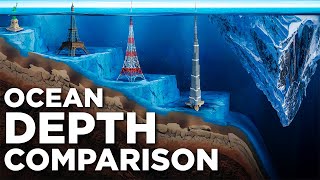
Here begins the Hadal zone, named after [music] Hades, the underworld. It stretches from 6,000 m all the way down to the deepest known point on Earth, nearly 11,000 m below the surface. To put that in perspective, [music] if Mount Everest were dropped into the Mariana Trench, its peak would still be more than a mile underwater.
Conditions here are almost beyond comprehension. Temperatures remain near freezing. [music] Pressures can exceed a thousand times what we experience at the surface.
To a human body, it would be instantly fatal. And yet, life not only survives here, it thrives. Among the most astonishing creatures are the snail fish that inhabit the very bottom of trenches.
Fragile, gelatinous, with thin, translucent skin. They look too delicate to exist in such a hostile world. Yet, they are the deepest living vertebrates ever discovered, [music] thriving where no other fish can.
Their bodies lack rigid bones and their cell structures are reinforced with unique molecules that keep proteins functioning under crushing pressure. Other inhabitants are smaller but no less extraordinary. Amphipods, shrimplike crustaceans, swarm across the trench floor in huge numbers.
Recent studies found plastic fibers inside their bodies. Proof that even these most remote habitats are touched by human waste. It is a sobering reminder that the deep is not as isolated as we once believed.
At hydrothermal vents along trench walls, life takes an even stranger turn. [snorts] Here, microbes feed not on sunlight or marine snow, but on chemicals spewing from the Earth's crust. hydrogen sulfide, methane, even metals dissolved in superheated water.
Entire communities of worms, clams, and crabs depend on these microscopic pioneers. It is a food web based on chemistry, not photosynthesis, showing us that life can exist [music] in conditions utterly alien to the surface. These discoveries fuel a larger question.
If life can adapt to such extremes here on Earth, could it not also exist on other worlds? Icy moons like Europa and Enceladus hide oceans beneath their frozen crusts, warmed not by sunlight, but by internal heat. To study the Hadel zone is to glimpse the possibilities of extraterrestrial oceans.
And yet, despite its importance, we know almost nothing about the trenches. Fewer people have visited the Mariana Trench than have stood on the surface of the moon. Each dive brings back creatures unknown to science.
From translucent sea cucumbers drifting like parachutes to gelatinous blobs with no clear anatomy to microbes whose metabolisms remain a mystery. For centuries, humans imagined the trenches as lifeless voids, silent graves beneath the sea. What we've found instead is resilience.
Life that bends, reshapes, and reinvents itself to endure the most extreme pressures imaginable. For all we have seen, the deep sea remains a world of questions. More than 80% of the ocean is still unexplored.
Each dive into the depths, each ROV expedition brings back creatures never before imagined. transparent fish, glowing worms, jellies that break every rule of biology. It is a world where discovery is not rare but constant.
Even among the animals we know, so much remains unsolved. Why do so many deep sea creatures grow to enormous sizes? The giant isopods, the colossal squid, the amphipods the length of a human hand.
Why do others turn nearly invisible or cloak themselves in ultra black skin that absorbs almost all light? The greatest mystery of all may be bioluminescence. Nearly 3/4 of deep sea life produces light.
Yet the reasons vary wildly. Hunting, hiding, mating, or simply surviving. We still cannot explain how many of these species evolved such complex chemical systems or why some can glow in colors that no other animal can see.
There are deeper puzzles still. For now, these are mysteries without explanation. Perhaps that is what makes them so powerful.
They remind us that Earth still holds secrets. Secrets [music] worth protecting. Secrets worth discovering.