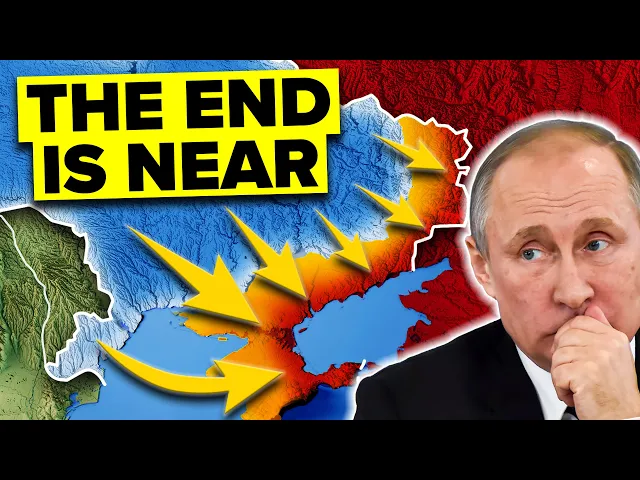
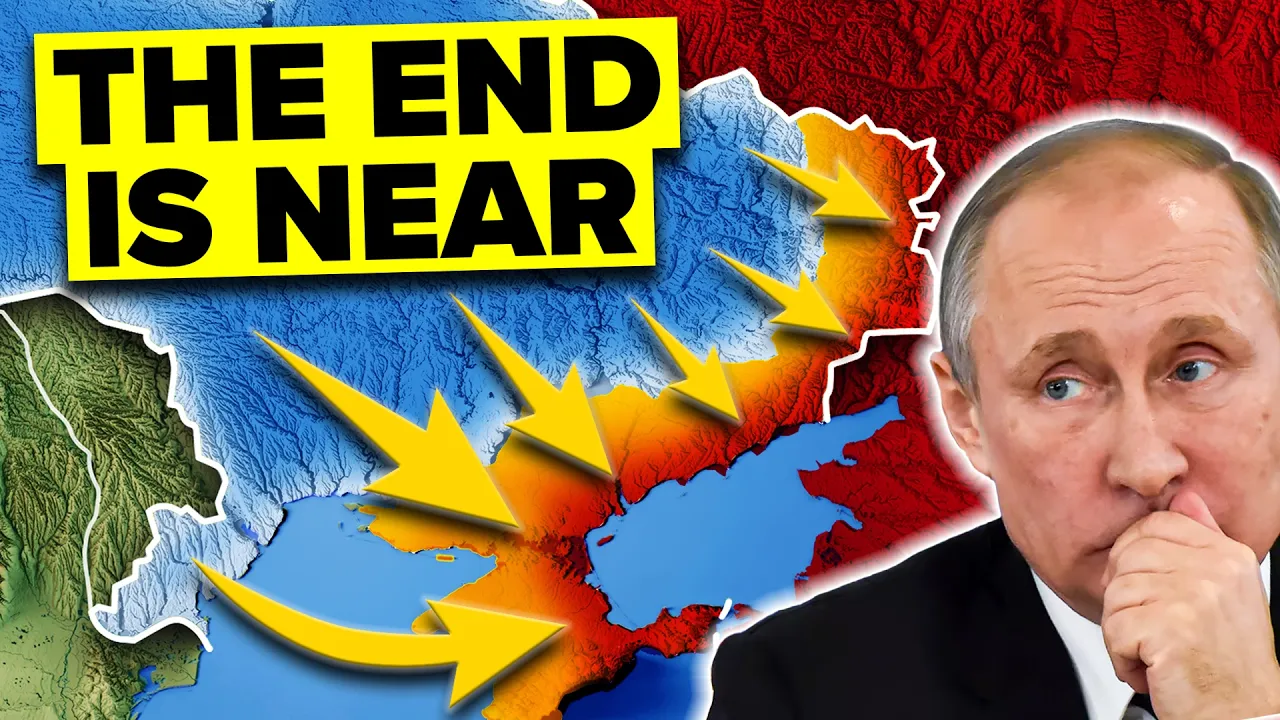
Over two and a half years of bloodshed, destruction, and defiance. Putin's "special military operation" was supposed to crush Ukraine within weeks, but Kyiv didn’t fall. Instead, Ukraine has turned the war into a relentless, high-stakes grind that neither side can afford to lose.
With Russia throwing everything it has into the meatgrinder, 18% of Ukraine's land is under occupation, but there's a twist. Victory isn’t waiting for Russia—it’s coming for Ukraine. Several military experts believe that this war is nearing its explosive conclusion—and not in Putin's favor.
The question isn’t if Ukraine will win. The real question is: When? Before we answer that, let’s take a trip to the Center for Strategic and International Studies, or CSIS.
On February 23, 2024, the CSIS held its International Security Program, during which it hosted a virtual discussion between several key military experts. These experts included Emily Harding, Michael Vickers, Dr Seth G. Jones, and the man who put a date on Ukraine’s victory, Dr Eliot A.
Cohen. The holder of the Arleigh Burke Chair at CSIS, Cohen noted during the discussion that he believes the perception many have of the Ukraine war right now is incorrect. Many see it as a World War I-style stalemate, in which each side is grinding against each other with little change to the frontlines outside of small pieces of territory being taken or reclaimed here and there.
That’s true, to an extent, and it’s a view Cohen claims Russia is keen to promote as it tries to convince the rest of the world that its victory against Ukraine is inevitable. After all, such a scenario would eventually see Russia wear Ukraine out, with its larger population and access to resources giving it greater staying power. But that’s not really how the war is playing out, at least according to Cohen.
Instead, it’s a conflict revolving around “positional warfare” in which momentum and initiative swing back and forth based on a variety of factors. “There’s a lot of initiative, there’s a lot of adaptation and innovation and change with the initiative going back and forth,” he claimed before adding that it’s difficult to judge how long this positional phase might last. Again, he speaks the truth.
Innovations during the war have included the prevalence of drone warfare, which has played a major role in Ukraine managing to destroy around a third of Russia’s much-vaunted Black Sea Fleet. Advances in satellite reconnaissance and even cellphone signal tracking have also occurred, with the side that gets to grips with these innovations first often gaining momentum. Still, Cohen says that the positional phase has to end sometime, and that will come when Ukraine faces what he calls its “year of decision.
” This year will see one—or even both—sides exhaust themselves in terms of the military equipment and manpower they have available. That exhaustion may even carry through to the aid they can attract as the rest of the world grows war-weary and starts to limit support. That “year of decision” may also be punctuated by another innovation or, perhaps more tellingly, a change in military tactics that lends one side a clear advantage over the other.
Cohen believes so intently in this that he believes Ukraine’s Defense Minister Rustem Umierov is already preparing for the war’s endgame. His policies will switch to sustaining the Ukrainian military as far as possible, which will involve finding the troops to keep up the fight even as Russia conscripts many more thousands of soldiers to its ranks. Developments since the discussion have borne this viewpoint out, as Ukraine lowered its military draft age from 27 to 25 in April 2024, giving it access to thousands more potential soldiers that may play a part in this sustainment strategy.
Combine that with designing military tactics that see Ukraine take (and hold) territory in refreshed offensives and counter-offensives, and Cohen says that Umierov is building his approach around this strategy. All it needs is a disruptor. That disruptor could come in many forms.
Innovation is one, but so is a switch from a defensive approach to an offensive one on the part of Ukraine. As Emily Harding noted during the discussion, Ukraine could succeed by figuring out “a way to pick its battles differently…ways to focus on a particular area and make gains there. ” Those words would prove prophetic given what happened in the war during the summer of 2024.
Falloffs in Russian munitions production could also dent the country’s ability to sustain the war, as could changes in Ukraine’s funding situation. Bear in mind that this conversation took place in February 2024 – two months before the U. S.
approved a new $60 billion aid bill to Ukraine. Perhaps it won’t be just one of these things that helps Ukraine win the war. All may combine, along with several other factors, to bring Ukraine to the “year of decision” that will ultimately lead to its victory.
The question now is the same one we posed at the beginning of the video: When will Ukraine win the war against Russia? According to Cohen, it’s going to arrive sooner than many think: in 2025. Yes, next year will be pivotal for the Ukraine war, Cohen says, as it will mark the confluence of a host of issues that will ultimately play out in Ukraine’s favor.
But that leads us to another, much larger question, that we need to answer: Why is 2025 ahead of any of the other possible years Cohen could have chosen? The answer to that question is multi-faceted and starts with two of the issues that Cohen highlighted during the CSIS event – military aid and a possible change in the dynamics of the war. In terms of aid, Cohen may have actually been incorrect in his assumption that aid would dry up, at least partially.
After all, it was only two months after the CSIS event that the U. S. approved the $60 billion aid package mentioned earlier.
His comments also came on the heels of the European Union, or EU, agreeing its own $54 billion package, suggesting that Cohen’s comments were somewhat mistimed. Except they may not have been. While both of these aid packages are impressive, there’s no guarantee that the U.
S. or the E. U.
will repeat this level of spending once the money runs out again. Plus, news is already emerging out of Europe that some of its countries are going to reduce the level of aid they provide. For instance, Politico reported in August 2024 that Germany’s ruling coalition government has decided that it will stop sending new military aid to Ukraine in an effort to reduce the country’s spending.
Only previously approved aid will be sent over, with any renewed aid being subject to a moratorium. That’s a major blow for Ukraine since Germany had been one of the top providers of military aid to Ukraine, but will now slash its aid to only $4. 45 billion in 2025.
It's unknown if other countries will follow suit. But if they do, Ukraine’s military funding situation may get a lot worse in 2025. Still, it’s not like Russia is doing any better on the money front.
Putin doesn’t have billions of dollars coming in from allies and he’s transformed Russia into an unsustainable wartime economy. Worse yet, Russia’s cash reserves are dwindling. The country’s National Wealth Fund – which is a fund holding accumulated energy revenues that Russia essentially sets aside for a rainy day – was down to $55 billion in February 2024 compared to $112.
7 billion before the war. That fund will dwindle even more thanks to a combination of sanctions placing Russian oil at $60 per barrel and money being drawn to cover budget deficit issues and investment projects. Tax hikes and high interest rates are also issues in Russia affecting its citizenry, with these issues all being indicative of a country that’s slowly running out of money.
Perhaps we’re entering the endgame in terms of both country’s ability to fund the war. That will be a major problem for Russia as its tactics mostly revolve around throwing superior manpower at Ukrainian positions. Still, it’s bad news for Ukraine, too – if funding dries up, its ability to defend itself slowly disappears.
Of course, this alone isn’t indicative of Ukraine being about to win the war in 2025. However, we’ll draw your attention back to Emily Harding’s comments – Ukraine has to find “a way to pick its battles differently…ways to focus on a particular area and make gains there. ” That’s precisely what it’s done with the Kursk invasion.
On August 6, 2024, Ukraine invaded Russia. A small contingent of troops—numbering somewhere between 300 and 1,000—broke through the frontlines in the north and entered the Kursk oblast. They’re still in that oblast.
And not only are they still there, but they’re gaining territory with each passing day. According to Ukraine, it has captured 463 square miles of territory in Kursk, which includes 93 separate villages and settlements, along with the Sudzha gas pumping station. That station is owned by Gazprom – Russia’s largest state-owned energy company – and serves as the point through which Russia sends natural gas to the rest of Europe.
The Kursk invasion has forced the evacuation of 200,000 people, and Ukraine isn’t stopping there. It’s also been sending troops into the Belgorod region to capture territory. Why does this matter?
The incursion in Kursk is the first time in the Ukraine war that Ukraine has gone on the offensive. Before August 6, the war followed a predictable pattern – Russia would launch assaults on Ukrainian positions, with Ukraine being forced to defend. There were occasional counterattacks, but they all happened on Ukrainian territory, meaning Putin—and the Russian people—never had to worry about the war coming to their doorsteps.
That’s all changed. With the Kursk invasion, Ukrainian President Volodymyr Zelensky took a massive gamble that looks like it’s paying off. Not only is Russia being forced to divert troops from key regions in Ukraine to fend off the invasion, but the international community hasn’t come out to decry his actions.
If anything, other countries approve of the crossing of a major “red line” in the conflict. Cohen mentioned a change in military tactics being a trigger for the end of the war. We’re seeing that with the Kursk invasion right now.
Zelensky’s gamble has completely changed the battlefield, and the very nature of the war, in several ways. It’s placed Putin on the back foot, forcing him (for the first time) to change his approach because he now has to deal with Ukrainians on Russian territory. The Kursk invasion also brought the war to the Russian people.
For the first time in around 30 months, they’re getting a small taste of what has been happening in Ukraine throughout the war. Russian people are being evacuated. Some are seeing the horrors of war first-hand for the first time.
There’s a good chance that many of these people will quickly lose their appetite for the war, and thus support will dwindle within Russia as a result. More on that point later. But perhaps the biggest payout to this gamble is that taking and holding territory in Kursk means that Ukraine finally has some leverage.
That’s according to Chatham House, which says that, though Russia has claimed it won’t discuss a ceasefire while Ukraine holds Russian territory, Ukraine’s position at the negotiating table has been strengthened regardless. The invasion also highlights Ukraine’s agency. It was carried out without any support from Ukraine’s Western partners, which is a shot at Russia’s attempts to portray the Ukraine war as a proxy war with the West.
Add to that the clear Ukrainian morale boost that comes from taking territory in Kursk and you have a clear turning point in the war. If Ukraine is able to hold onto or take even more of Russia’s territory, questions over Putin’s legitimacy will start to emerge. Russia’s army has already been exposed as being too weak to take Ukraine in the smash-and-grab raid that the war was supposed to be in its early days.
It’s now also been exposed as too weak to prevent another country from entering Russia, all of which puts dents into the image of Putin as the strongman leader. Perhaps 2025 will see Putin being forced to the negotiating table not just because Ukraine holds territory in Kursk, but because the Russian people will demand it. That could bring an end to the war.
Plus, it’s not like Russians were fully behind Putin before the Kursk invasion in the first place. In January 2024, The Atlantic Council reported on the results of several polls conducted by the Levada and Russian Field organizations. The Levada poll, which came from November 2023, showed that the number of Russians who offer unquestioned backing for the war had fallen to 36% from a peak of 53% in March 2022.
To be clear, the poll revealed the majority still supported the war said they did, even if they questioned Putin’s motives—but this decline in unquestioning support would have been worrying for Putin even before the events in Kursk. Worse yet for Putin, it seems that support for the war is declining rapidly among Russia’s youngest adults. In September 2023, Valery Fedorov, who is the leader of the Kremlin-friendly polling company WCIOM, was forced to admit in an interview that only between 10% and 15% of Russians enthusiastically supported Putin’s decision to invade Ukraine.
“The majority of Russians do not want to seize Kyiv or Odesa,” claimed Fedorov at the time. Even worse for Putin, the same pollster revealed that only 5% of Russians under the age of 25 think that the country’s state television is an objective source of information. Coming back to Levada, it found that only 30% of people aged 25 or below offer unconditional backing for Putin’s war.
The message here is that public sentiment toward the Ukraine war has been mixed for about a year. Bear in mind that the people being polled also live in an authoritarian country where rebellion against the norms instituted by the state can carry harsh penalties. The odds are high that there are many more Russians who don’t support the Ukraine war but won’t say so when polled for fear of retaliation.
These polls all came before Ukraine entered Kursk. Now, with the war finally encroaching on their territory, it’s likely that the already shaky public sentiment will turn completely against the Ukraine war. That’s another major payoff to Zelensky’s tactical gamble.
By making the war a reality for the Russian people, he’s placing pressure on Putin to enter negotiations. After all, even a strongman authoritarian leader still needs to listen to his people if those people become adamant that his policies aren’t working. Perhaps 2025 will be the year during which Ukraine makes even more gains in Russia.
After all, Russia has failed to repel its soldiers from Kursk. What’s to stop Ukraine from pouring more troops into the country, taking more territory as they go, and transforming the complexion of the war to the point where Putin has to end it for his own country’s safety? It’s certainly a possibility.
And it’s a possibility that could veer closer to becoming real if Ukraine can cross another “red line” – the use of long-range missiles in Russia. Toward the end of May 2024, the United States finally permitted Ukraine to use some of the weapons it was providing to strike Russia on Russian soil. However, that permission came with caveats, the chief one being that these missiles could only be used in the defense of the besieged Kharkiv region of Ukraine.
In other words, you can use the missiles to protect your territory, but you can’t use them to take out Russian targets further afield. As a result, Ukraine hasn’t been using long-range missiles, such as The Army Tactical Missile System, or ATACMS, in Kursk. Yet.
The use of such missiles to attack targets that don’t represent an immediate threat to Ukraine would represent another “red line” crossed in the Ukraine war. To explain, a “red line” is any action the West believes would provoke a potentially dangerous response from Putin. The Ukraine war has been punctuated at many points by dithering over whether or not to cross these lines.
Early on, providing weapons to Ukraine was seen as a “red line” that could provoke Putin. So was providing F-16s to Ukraine and allowing Ukraine to use weapons to attack Russia on its own territory. Those lines have since been crossed, with Putin failing to follow through on the threats he made prior, which has given Ukraine and the West more confidence in crossing other red lines.
Being allowed to use ATACMS outside of the defense of Kharkiv would be another “red line” crossed. And there are signs that permission may come at some point in 2024. For instance, August 15, 2024, came with news that President Biden’s administration is open to the idea of sending long-range cruise missiles that can be fired from F-16s to Ukraine.
Not only would those missiles make Ukraine’s growing fleet of F-16s more effective, but they would also open up opportunities to launch aerial attacks deeper into Russian territory. It’s telling that considerations over sending these missiles, which can carry warheads weighing up to 1,000 pounds and can travel 230 miles, started once Ukraine entered Kursk. Perhaps Washington is becoming more open to the idea of lifting its restrictions on missile usage now that Ukraine has proven it can enter Russian territory without Putin doing anything in response to the West.
Adding the option of using long-range missiles to how the Kursk invasion has changed the Ukraine war amounts to the tactical shift Cohen spoke of during the CSIS conference. By 2025, that combination may be enough to force Putin to end the war as more Russian oblasts come under attack. Speaking of the Western response to Russia’s actions, that could also prove to be an influencing factor.
It’s fair to say that the West was hesitant to truly help Ukraine during the early stages of the war. The “red lines” were worrisome and Russia was seen as having one of the world’s strongest militaries. Provoking Putin seemed problematic.
Putin hoped he could take advantage of this by using threats and intimidation tactics to show the West—but particularly Europe—that he was somebody who presented a clear threat. But we’re now 30 months into the war and Russia’s military is proving to be a paper tiger. Putin’s “special military operation” woke the rest of Europe up in terms of his willingness to act aggressively.
But his failure to get the results he wanted from that aggression has prompted many European countries to bolster their defenses to limit his ability to make further gains should he somehow manage to succeed in Ukraine. The Lowy Institute highlighted this in a July 2024 article in which it discussed four of the key factors that could influence the Ukraine war in 2025. It points out that Europe has “slowly but surely emerged from its strategic slumber,” during the war, resulting in European defense budgets starting to increase.
Data from the European Defense Agency, or EDA, highlights this. In November 2023, it released its findings on European defense spending in 2022. It found that 20 of the 27 members of the European Union, or EU, had raised their budgets in response to the “special military operation,” with many of these increases being remarkable.
Sweden committed an extra 30. 1% to its military, for instance, with Spain adding 19. 3%.
All told, 2022 saw EU members dedicate almost $65 billion to defense spending—most of it dedicated to acquiring new weapons—which showcases a shift in strategic attitudes in Europe. This shift continued into 2023 and 2024. For instance, former British Prime Minister Rishi Sunak announced in April 2024 that Britain was working on increasing defense spending to equal 2.
5% of national gross domestic product, or GDP, by 2030. Poland, which is fast emerging as a European military powerhouse, is also planning an increase, with the country set to spend 5% of GDP on defense in 2025. This expansion of European defense budgets is the exact opposite of what Putin wanted to achieve with the Ukraine war.
Russia was supposed to win quickly and then become a bigger threat to Europe. Instead, Ukraine has valiantly held its ground – with support from the West – and Putin must now face a revitalized Europe that not only sees him as a threat but also one that it could likely handle because his saber-rattling turned out to be inconsequential. Why does that matter in the context of Ukraine winning the war in 2025?
One word – pressure. Putin is dealing with a very different Europe than the one he faced in 2022. Back then, he could get away with making threats because Russia still had the intimidation factor.
But with his “special military operation” stalling in Ukraine, with Ukraine even making gains in Russian territory, Putin’s military is revealed to be a paper tiger, at least compared to what it was believed to be before the war. An increasingly strong Europe can exert more pressure on Putin to end the Ukraine war in 2025 because it’s more prepared to face and defeat Russia. What’s more, those stronger militaries can offer greater backing to Ukraine, even if funding starts to dwindle, with the message being delivered that Putin simply can’t take Ukraine without facing retaliation.
It's a complete turnaround of the messaging that Putin wants out there. And that pressure, when combined with all of the other factors discussed in this video, could be enough to bring Putin to the negotiating table in 2025. Worse yet for Putin, it’s not just external pressures that are being exerted on Russia.
Internally, the country is becoming less capable of sustaining the Ukraine war, at least in the form that it has taken over the last couple of years. Coming back to the CSIS conference, Emily Harding noted that Russia has taken a “metal and personnel” approach to the war. In other words, it relied on having more equipment and higher manpower to roll through Ukraine.
Both are running out. As The New Voice of Ukraine notes, Russia has been relying on Soviet-era stock to maintain the “metal” portion of its strategy. Those stockpiles are dwindling.
The outlet claims Russia has lost at least 3,000 ranks and around 5,000 armored vehicles during the war, though Ukraine claims the numbers to be much higher. Its Ministry of Finance, or Minfin, says Ukraine has destroyed 8,547 tanks and over 16,600 armored vehicles at the time of writing this script. Either way, the losses are massive, and Russia is struggling to replace the lost equipment.
The International Institute of Strategic Studies, or IISS, says this is as much down to poor Russian maintenance practices as it is simply using up its equipment. One IISS analyst, Michael Jerstad, points out that Russia still has about 70% of its Soviet-era tanks and armored vehicles in stock, but most “have not moved since the start of the war,” because they’re not capable. Many are in poor condition – a consequence of having been left uncovered since the 1990s.
Jerstad believes that this equipment shortage could force Russia into a more defensive position toward the end of 2024—and perhaps we’re already seeing that with Kursk—which would give Ukraine the momentum it needs to end the war the following year. Forbes military analyst David Axe backs that up, claiming that Russia had a one-year reserve of weapons back in April 2024. In short, its manufacturing capabilities, despite being ramped up since the Ukraine war began, aren’t strong enough to keep pace with its losses.
Combine that with a lack of personnel and you have a swift one-two punch that may put a stop to Putin’s ambitions. Minfin says that Russia has amassed over 607,000 casualties since the Ukraine war began and is currently losing soldiers at a rate of about 1,000 per day. The Kursk invasion has also cast a harsh spotlight on Russia’s military manpower problem.
The invading Ukrainians have captured hundreds of prisoners of war in around 20 days, with those captures being the result of Russian military policy. Typically, Putin sends contract soldiers to the frontlines in Ukraine, keeping inexperienced conscripts in border regions like Kursk. Those conscripts simply aren’t capable of mounting a defense against the more experienced Ukrainian soldiers.
And given that Russia has already lost so many hundreds of thousands of soldiers in Ukraine, Putin will increasingly find himself in a position where the manpower he’s sending to fight simply isn’t well-trained or tactically astute enough to complete his objectives. Russia doesn’t face a manpower issue in terms of sheer numbers. Global Firepower points out that it still has over 46 million people who are fit for service.
However, it faces issues when it comes to experience and capabilities that, when combined with all of the factors discussed in this video, will make its military much less effective as time goes on. It all adds up to a bad situation for Russia. Though it’s still trying to project power and isn’t yet changing its tactics when it comes to taking Ukrainian territory, the signs are all pointing to a possible Ukrainian victory in 2025.
Russia is running out of equipment and manpower, which hobbles its “metal and personnel” approach. The Kursk invasion changed the entire state of the war, representing the distinct change in military tactics Cohen talked about as a potential war-ending scenario. And then there’s the pressure Putin’s facing.
Many of his own people’s appetites for the war were waning even before Ukraine entered Kursk, and it’s likely that many more will want an end to hostilities now that the war is approaching their doorstep. Add a resurgent Europe applying military pressure to the conflict via renewed efforts to improve their own troops, combined with Ukraine’s increasing willingness to cross “red lines” to heap even more pressure on Russia, and Putin is quickly finding himself in an unwinnable position. A position that could lead to a victory for Ukraine come 2025.
But what do you think? Is Ukraine really on the verge of winning the war at some point in 2025 or does Putin have more tricks up his sleeve? Does the Kursk invasion represent the strategic change that will serve as the catalyst for the end of Russia’s “special military operation?
” Share your thoughts in the comments and thank you for watching this video. Now go check out Ukraine is Winning War AGAIN or click this other video instead!