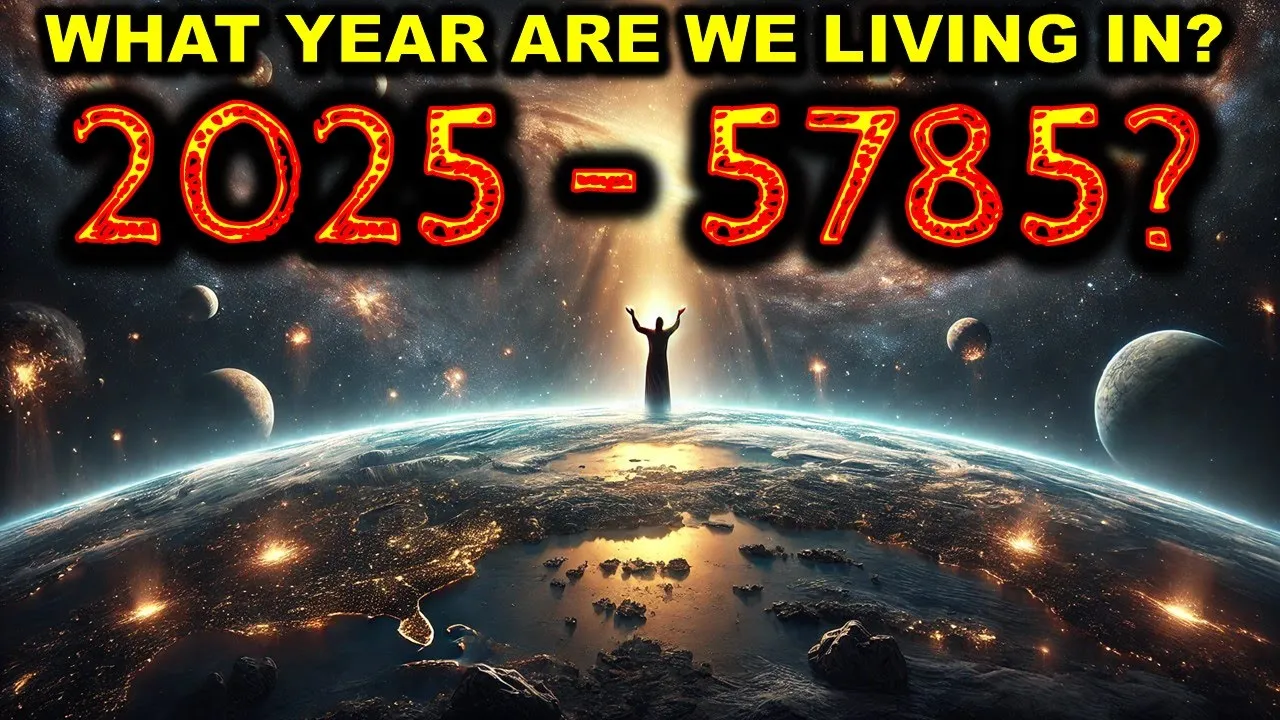
what year is it really is it simply 2025 as our modern calendars tell us or could it be [Music] 5,785 according to the Hebrew Bible what does the Bible say about time and how does it align or differ from the history we've recorded stick with me as we unravel the fascinating mystery of the world's year and uncover the Divine timeline hidden in scripture and history before we begin take a moment to like this video subscribe to our Channel and hit that notification Bell so you don't miss out on more thought-provoking biblical content share this message
with your friends and family they might just discover something life-changing and let us know in the comments what you think about the topic your insights and questions mean so much to us let's dive in and uncover the truth about the Year we're truly living in let's get started the year 2025 is what most of the world recognizes today it's based on the Gregorian calendar introduced by Pope Gregory I 13th in 1582 this calendar was a reform of the earlier Julian calendar which had been in use since it was established by Julius Caesar in 45 BC
while the Julian calendar was a significant advancement for its time it miscalculated the solar year by about 11 minutes annually causing holidays like Easter to drift over centuries the Gregorian reform addressed this drift by introducing a more precise calculation for the length of a year 365 days 5 hours 49 minutes and 12 seconds this adjustment realigned the calendar with the Spring Equinox and the timing of key Christian feasts why was the reform necessary the primary motivation for Pope Gregory II's reform was the church's concern about Easter which is celebrated on the Sunday following the first
full moon after the Spring Equinox over time the inaccuracies in the Julian calendar cause Easter to shift further from its intended date this misalignment was seen as a serious issue because Easter commemorates the resurrection of Jesus Christ the Cornerstone event of Christian faith to correct the drift 10 days were skipped when the Gregorian calendar was adopted for example in countries like Italy Spain in Portugal the day after October 4th 1582 was declared October 15th 1582 the Gregorian calendar is rooted in Christian tradition specifically counting years from the estimated birth of Jesus Christ which is designated
as anod Domin a or in the year of Our Lord the years before Christ's birth are labeled as BC before Christ thus the current year 2025 five is based on this system however there are notable discrepancies Scholars and historians widely agree that Jesus's birth did not occur in a D1 based on historical records including the reign of King Herod the Great who died in 4 BC many believe Jesus was born around 4 to 6 BC this means the Gregorian calendar might already be several years off in its calculation while the Goran calendar was designed for
religious purposes it has become the standard for most of the world due to its practicality and widespread adoption initially however its acceptance was slow and met with resistance first Protestant countries such as England resisted the calendar because it was seen as a Catholic initiative England did not adopt it until 1752 nearly 200 years after its introduction second Eastern Orthodox Churches some Orthodox Christian groups continue to use the Julian calendar for religious purposes which causes holidays like Christmas to fall on different dates third non-Christian Nations over time even nations with non-Christian Traditions like China and Japan
adopted the Gregorian calendar for civil and administrative purposes though they often retain their traditional calendars for cultural and religious events however the Hebrew calendar stands apart from the Gregorian calendar in both its structure and its spiritual Foundation unlike the Gregorian calendar which begins with the birth of Jesus Christ the Hebrew calendar counts time from the creation of the world as described in Genesis 1:1 in the beginning God created the heavens and the Earth this profound verse marks the starting point of the biblical narrative creation itself from this moment the Hebrew calendar begins not from an
arbitrary date but from what Judaism considers the creation of Adam and Eve the very beginning of human history the Hebrew calendar is deeply rooted in the Bible and is structured around significant biblical events and genealogical Records it counts 5,785 years from the creation of the world as described in Genesis but how exactly is this timeline calculated it's an incredible blend of biblical genealogies historical events and the meticulous work of rinic Scholars who sought to uncover the rhythm of God's plan Through the Ages the genealogies in Genesis the foundation of the Hebrew year is the genealogical
records in Genesis 5 and Genesis 11 in Genesis 5 this chapter lists the lifespans of the Patriarchs starting with Adam and continuing through his descendants to Noah for for example Adam lived 930 years Seth Adam's son lived 912 years Methuselah famously the longest living person in the Bible lived 969 years these lifespans provide specific numbers that allow us to calculate the passage of time from creation to the flood Genesis 11 After the flood the lineage continues with Noah's son Shem leading to AB Abraham the father of the faith for example Shem lived 600 years aaad
his son lived 438 years Abraham lived 175 years by adding up these genealogical records through key biblical figures like Noah Abraham and David Jewish Scholars arrived at the year [Music] 5,785 counting from what they believe to be the beginning of creation this system is foundational to Jewish religious observance with the timeline often used to Mark significant events and prophecies the Gregorian and Hebrew calendars don't just count time differently they also represent two very distinct ways of interpreting the world and our place in it on one side we have modern science with its focus on empirical
evidence and natural processes on the other we have the biblical narrative which centers on Humanity's spiritual journey and God's Eternal plan let's explore these contrasting perspectives modern science estimates that the Earth is about 4.54 billion years old based on a variety of evidence number one geological layers the Earth's crust reveals layers of rock formed over millions and billions of years which scientists analyze to determine the planet's age fossils found in these layers tell the story of Life evolving over time number two radiometric dating scientists measure the decay of radioactive isotopes in rocks such as uranium
lead dating to determine their age number three astronomy observations of the universe including the speed at which galaxies move and the cosmic microwave background suggests a universe about 13.8 billion years old from this perspective time is vast and impersonal stretching across billions of years before humans appeared the Bible in contrast doesn't focus on the physical age of the Earth instead it offers a timeline that emphasizes human history and God's relationship with his creation number one the creation narrative Genesis 1 according to the Bible God created the heavens and the Earth in six days and rested
on the seventh whether these days are literal 24hour periods or symbolic of longer epochs has been a topic of debate among theologians number two Humanity's lineage the genealogies in Genesis chapter 5 and Genesis chapter 11 provide a detailed account of Humanity's timeline from Adam to Abraham this is the basis for the ano Mundi calendar marking the year 5,785 from creation while science places Humanity as a recent arrival in a vast Universe scripture portrays Humanity as Central to God's purpose created in His image Genesis 1: 27 and entrusted with stewardship over creation the apparent differences between
these views have sparked centuries of debate however they also complement each other in intriguing ways science describes processes scripture explains purpose science answers how the earth was formed and life developed scripture answers why the Earth was created and Humanity's role within it it for many Believers the timeline of history is also a timeline of Prophecy biblical and Theological discussions often revolve around where we stand in relation to God's ultimate plan for Humanity according to Jewish tradition the Hebrew Calendar's timeline reflects a 6000-year plan for the world followed by a 1,000-year period of rest and rain
this is modeled after the seven days of creation with the seventh day representing the Sabbath 6,000 years of human history these years represent Humanity's work and toil marked by sin and Redemption 1,000 years of the Messianic Reign this period often referred to as the millennial kingdom is described in Revelation 20: 1-6 where Christ Reigns on Earth in peace and just if this interpretation is correct the Hebrew calendar suggests we are in the final centuries of the sixth millennium approaching the Sabbath rest of the 7th the idea of nearing the year 6000 has led some Christians
and Jewish Scholars to view this time as critical in God's prophetic timeline passages like Daniel chapter 9 and Matthew chapter 24 describe signs of the end times prompting Believers to remain Vigilant and spiritually prepared let's read the scripture Matthew 24:42 therefore keep watch because you do not know on what day your Lord will come 2 Peter 3:10 States but the day of the Lord will come like a thief These Warnings emphasize the importance of Readiness not just in terms of Prophecy but in our daily life while the exact timing of the end is unknown the
Bible calls us to live expectantly using our time wisely to further God's kingdom Ephesians 5: 16 says make the most of every every opportunity because the days are evil so how should we respond to God's timeline understanding the significance of time in God's plan challenges us to live with intention and Faith number one prioritize your relationship with God regardless of the Year our greatest priority should be deepening our relationship with God as Jesus taught in Matthew 6:33 but seek first his kingdom and his righteousness and all these things will be given to you as well
number two use time for God's glory each moment is an opportunity to serve God and others consider how you can use your gifts resources and time to further his kingdom number three live with eternal perspective keep your eyes on the ultimate goal eternal life with God let the promise of his return inspire you to live with hope purpose and Holiness Colossians 3:2 encourages us set your minds on things above not on Earthly things number four be prepared for Christ's return the Bible's end times teachings remind us to stay spiritually prepared this doesn't mean obsessing over
dates but living Faithfully knowing that God's promises are sure so what year is it really as we've explored the question of what year it is doesn't have a simple answer the Gregorian calendar followed by most of the world tells us us its 2025 while the Hebrew calendar rooted in biblical tradition claims its 5,785 these two systems reflect Humanity's deep desire to measure time understand its flow and align it with God's creation but beyond the numbers both calendars remind us of one profound truth time itself is a gift from God the Bible shows us that our
time on Earth is finite yet it carries Eternal significance every year month day and moment offers us an opportunity to live in alignment with God's Divine Purpose as we consider these Mysteries let's shift the focus from what year it is to how we are using the time we've been given the Bible encourages us to see time not as a burden or a countdown but as a sacred opportunity Ephesians 5: 15 to 16 reminds us be very careful then how you live not as unwise but as wise making the most of every opportunity because the days
are evil time is precious because it's limited instead of obsessing over dates and calendars we should ask ourselves am I living with purpose am I using my time to deepen my relationship with God am I making a difference in the lives of others instead of asking what year is it let's ask a more meaningful question how am I living in the light of God's Eternal purpose as you you go about your day remember this whether we're counting 225 or [Music] 5,785 the most important thing is how we live in light of God's Eternal plan let's
use our time wisely for his glory and Trust in the Timeless hope we have in Jesus Christ thank you for watching and we'll see you in the next video