today Krishna now we are going to talk about persuasion theory there are six golden rules to persuade a donor and let's go over these one by one the first rule is reciprocity which we have already heard about and where did we hear about that in social exchange theory under the rule of reciprocity people try to repay in kind what they received from another person here's an example of a poor country Ethiopia that just over about 10 years ago sent an aid of about five thousand dollars to Mexico when if you Pia itself was in great
need of money they were fighting the famine they were they are poor country as you know so why did they do that despite their personal need because Mexico had helped them in 1935 and italy invaded ethiopia so the need to reciprocate was so strong that despite their personal interest despite the cultural differences they do not speak the same language they don't look alike they are long there's a long distance between the two countries and it happened over 60 some years ago and still if you're being reciprocated with Mexico so we should utilize this principle of
reciprocity that when we do good to somebody when a guest shows up at the temple we take nice care of that person which we always do the person feels obliged and returns the favor by making a donation the key though is that we have to continue to take good care of these devotees because we want to make them lifetime devotees as you heard before under the social exchange theory Auerbach distribution effort has been seen as a manipulative effort in creating this obligation in the minds of people whom we give this book to so what we
can do to overcome that kind of image or do not give them this impression that we are manipulating we can point to the services and resources that iskcon has provided to the community or instant providing come on our Food for Life program and how we help people get off drugs how by following the four regulated principles they are helping the environment by not eating meat etc the second principle is called the principle of consistency consistency means that we behave consistently with our commitments and that's a tendency when we make a commitment we want to be
true to ourselves and we want to be true we want to be seen as true to our commitment by others so for that reason when we make a commitment in public we would like to keep that commitment when we make a commitment voluntarily when we are not coerced to make it pledged then we are more likely to keep it and when we make a commitment in writing we are more likely to keep that commitment as a donor as compared to making an a verbal commitment the same thing applies to solicitors if you need people to
raise funds you need volunteers to go on for distribution you need volunteers to go on fundraising drives etc similar principles apply apply to them as well they are more likely to keep their commitments as solicitors if they make those commitments in public they are also more likely to keep them if they fill out the form where they would say that yes I will do this activity and that activity and there was a survey done by the American Cancer Society they randomly call people in a city in America and they asked them to hypothetical question if
you are called to volunteer to come american cancer society would you go out to help and the the request for help was to go door to door asking for donations people when they were called and they were asked this hypothetical question they wanted to look charitable in the eye of the collar so they said yes we will go out on door to door fundraising a few days later they actually made the call to the same people and their participation in that fundraising increased by seven hundred percent so they were feeling shortage of volunteer by having
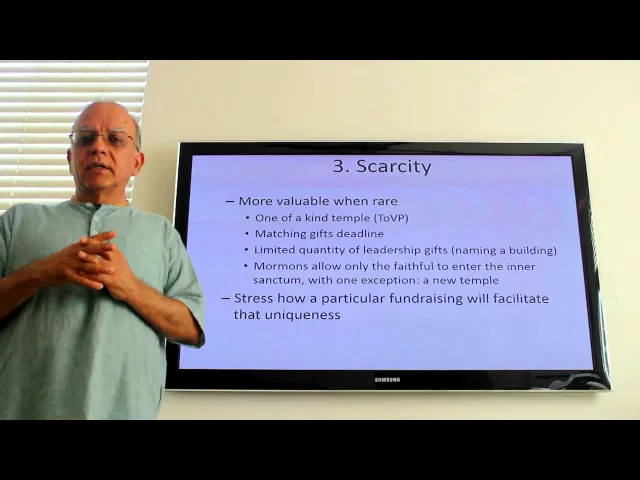
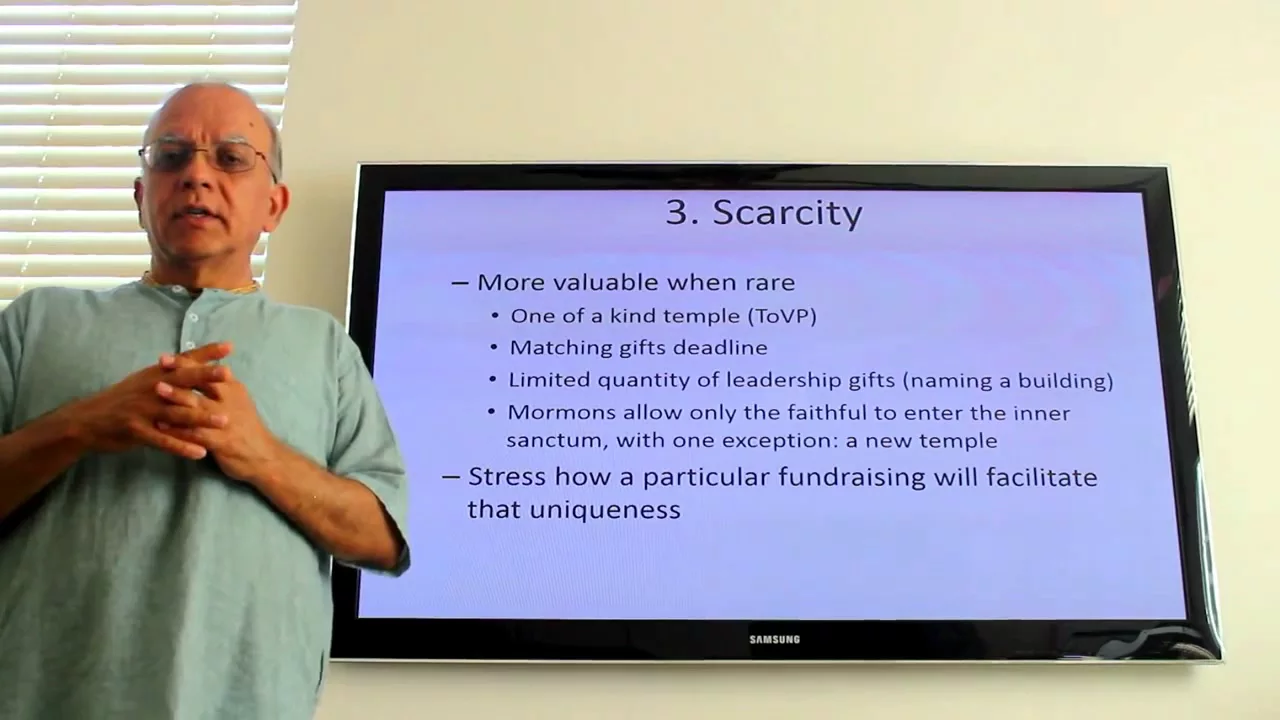
them make a commitment to go on this fund drive even in a hypothetical situation because they committed then they actually went out on this fundraising drive ok the next principle is of scarcity when we present the fundraising opportunity or whatever your project is as of a scarce nature for example one of a kind temple like the tea ovp temple and this is what they're saying in their fundraising drive that this is one of the kind it is indeed one of the kind temple so this is a rare opportunity to support so people would like to
support would like to donate more when they see this opportunity or perceive this giving opportunity as a unique opportunity when we when we present a deadline for matching gifts say if we raise so much money by a certain by a certain date then we are likely to get a matching gift then it becomes kind of also a scarce unique opportunity that we have to do it by the state people feel the pressure it's available only till this state so they will go out and give more and on the same lines when we have a limited
quantity of certain opportunities available for example naming a building after a donor come it's perhaps can be only one donor that we can name this building after so that's a rare opportunity or when we say that there are only ten platinum coins available to support your tea ovp that is presented as a rare opportunity so people are more likely to avail such opportunities when they are unique and rare an example from a different faith Mormons generally do not allow people of other faiths to enter their the inner sanctum the inner chamber of their temple but
they have one exception when a temple is renovated or when a new temple is built then everybody is allowed to go visit the inner inner chamber in a chamber so when such an opportunity is advertised then people consider it rare because we don't know when a another temple will be built in that neighborhood where you live or in that city where you live so you want to go and visit the temple so we should think of them think of we should think on those lines how we can how we can create a unique and rare
opportunity to inspire people to give and we should also stress that a particular fundraising drive will facilitate that uniqueness further for example if you are raising funds for this temple of vedic planetarium which is a rare kind of a temple then this fundraising will help that uniqueness or you can find other projects that will be a similar nature and you can have one or multiple drives to support that unique project the next principle is that of credibility and you know very well the four cores of credibility from the situational leadership and from the action learning
projects that you did in the first week the four cores of credibility are divided into two categories character and competence under character we cover integrity and intent and under competence we covered capability and results so just a recap integrity means honesty be congruent and being truthful intent means our desire to not deceive others with no hidden agenda no hidden motives and the capability is our credentials our expertise knowledge talents attitude skills etc and the results is having a good track record of actually walking the talk and having shown results in the past having demonstrated our
capability to put things into practice and do it in an effective manner so when we are perceived as credible people as credible fundraisers then the donors are more likely to give to that cause then they're in addition to these four principles there are two commonly used all too commonly used rules by most nonprofit organizations and these rules are social proof which follows the principle of the third a with ro Jenna that whatever a leader does a common man will follow or in other terms whatever people who look like me they do I will do so
in this case if other well-known members of the community are giving then I will get to the last rule is called the liking rule which is that when a fundraiser looks like a donor then the donor is more likely to give so for example if it Pierre is asking if a colleague is asking if if a coworker is asking if a friend is asking they are kind of like me they are there in my carer so I'm more likely to give and they are asking okay so these are the six rules that we talked about
now how do we apply these six rows or six principles first thing is we have to understand what these principles mean and I hope you have then we have to know how to harness their force how to actually capitalize on their strengths how to put them into practice and then we apply them with honesty with integrity and with ethics okay the last thing that I want to talk about is lifetime value of it owner we should consider a donor for what he or she is worth for his or her life again we are not after
their money our goal is to make devotees and to keep these devotees we want to be the association of devotees unless we make devotees and keep devotees how can we ourselves being the association of devotees so fundraising is about developing relationships it's not about only asking for money so we should consider long-term results in this in this case the longer-term result is a good devotee friend a good devotee supporter of the temple who will not only give a one-time gift but will give his or her life to the movement so when a person becomes a
lifetime devotee then he would have given his life for her life which is worth billions of dollars so what more can you ask for when you are doing a fundraising okay that's all for fundraising array Krishna