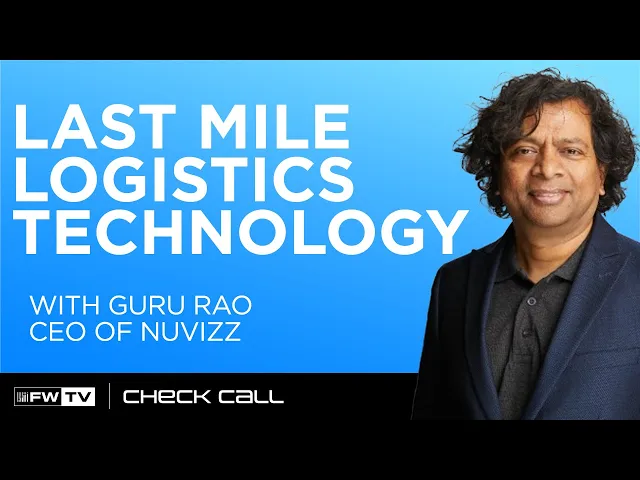
the future of freight Festival in Chattanooga Tennessee is the event of the Fall subscribers to check call have a special discount code for f registration this is going to be one of the best deals on F3 tickets use the code check call f324 at checkout to take advantage of this offer see you in chattan [Music] Nuka welcome back to another edition of cck call don't forget to subscribe to cck call the newsletter Onre waves.com if you haven't already today we welcome back the one and only Guru R CEO of new Vis welcome back Guru thanks
Mary appreciate it's great talking to you again I am um I'm kind of excited we get to revisit Last Mile um which is something that we talked about a couple times on the show but uh we haven't touched on it in a hot minute and uh turns out last mile temperature controlled uh isn't as uh easy as it seems although I don't know it technically seems that easy but um so it's something that everyone's kind of talking about as we see this rise in e-commerce temperature controlled Freight um it seems like I could get I
don't know like a something cold delivered from anywhere uh like all across the country I know there's an entire service who all they do is deliver like cakes and cookies and like other food from a restaurant to your like door but it could be like over a thousand miles so that's really cool um that we're kind of like seeing this availability of things but when it comes to like getting things there obviously there's a fair bit of tech that comes behind that has anything changed in how companies are looking at these solutions for Last Mile
challenges um specifically like in the technology world because everybody loves good Technology Innovation but is it actually going to help that's the real kicker oh yeah no that's a great question like you know you just just like you stated right you talked about getting food at your door step and you rightly pointed out it could be coming from thousand miles away from where you are so that is still considered Last Mile right generally when we talk about Last Mile we think it's a short distance you know you're just covering you know a few miles to
get to your door step but that is not always never the case right it's always coming from a distribution center through uh AC cross talking facility it changes hands with you know through multiple carriers before it get gets steed door step so that is a big realization and uh you know what people have come to realize that last pile is not just about you know bringing that last you know box to your doorstep and everything that culminates with the product showing up at your doorstep right so and now as more and more of that is
happening right throughout the nation and you know everything and everybody there is nothing in the world today that you cannot get delivered I mean theoretically right there are few things maybe but for the most part right um so when that is happening right this acceleration of this last mile the growth has taken off and I know we don't see that uh slowing down anytime soon because more and more is moving towards that so as that is happened in the last few years and increased to happen now you we are dealing with more and more of
those transactions and now the people who were kind of still waiting in the wings thinking about okay we can still manage this with our traditional Technologies and with throwing more people and what have you they have come to you know re come to the realization that they got to have better technology to be able to manage this right so that realization will then translate into action in terms of what type of Technologies I need to be looking for and how do I make this efficient and the whole nine yards right it's not just about uh
what stakeholder or the other it's every stakeholder that's involved in this ecosystem from the manufacturer to the distributor to the you know the shipper and the carrier and the 3pls and anybody in between involved and you know finally the customer right so that you know with that realization the technology penetration has taken place and uh what I'm you know we are seeing specifically in the last two three years is now we are seeing this you know second or third iteration of the generation of Technologies in the last mild space specifically right there were Technologies 20
years 30 years ago to deal with this kind of Last Mile but they were all designed to the physical ecosystem that existed at that point in time and they have not changed the whole lot whereas the world has moved on right and that is the biggest realization and that's where the technology uh you know is coming into play and to and now when you look at the transactions and number of stakeholders the realtime nature of it the dynamic nature of it and all of it then obviously you look about how can we leverage that's why
this whole talk about AI machine learning and the whole n yards and they you know we're not talking about it for nothing right there is a reason behind it and you know when you want to chunk when you want to crunch you know huge amounts of data you got to rely on these uh you know latest and greatest Technologies machine learning and you know all of those to be able to leverage that and run your businesses better so that is going to that is going you know definitely a big uh topic of conversation and of
course you know like I talked about real time you know there's you cannot stress enough on the importance of being real time because now everybody is living in you know in the at the moment in the moment right with everything in our lives right so obviously then you know to be able to um satisfy that need insatiable I would say need right you got to you got to have these technologies that are operating at the microsc milliseconds uh you know range right and obviously adding to that is automation how can I take out inefficiencies how
can you know with the labor and everything you know that's going on and how can I bring in you know Robotics and other um automation capabilities to make all of this and run smooth smoothly right so that's kind of what's you know happening and it's not a new thing and it's just the a do option has accelerated if at all in the last few years and then it's going to take you know even much more exponential acceleration right in the coming years I think that touches on a really interest or really important component is um
there's been some you know different research studies that have come out and said that shippers are actually using their logistic service provider as a way to like increase their technology and kind of be more um Tech forward without necessarily having to do that investment and have those Integrations themselves they're relying more and more on their third party Logistics Partners or their carriers or anyone that they're working with in that Network and I think that that is a very interesting component for those um carriers that are saying ah well you know we got tracking like we're
good we don't really need to go that far te back forward um but you do because shippers are wanting it and shippers are starting to look for that from their providers and I think that those that are kind of hesitant I'm not saying that you need to you know go by all autonomous trucks driven by robots and have a warehouse completely done by robots and everything is like Cutting Edge um but just having more isn't always a bad idea in this situation because that's what shippers are looking for and you know if you're worried about
customer turnover or churn or anything like that it's important to you know actually listen to what your shippers are looking for and what they're wanting and then also when you go out to Source new ones get a really good grasp on what they're expecting from you because what they're expecting for you now should not be the like if they're expecting something here your technology components shouldn't stop here it should be a little bit above so that way you have room to grow to keep up with their expectations and still be able to innovate with them
um which I think is very interesting I don't want to say predicament but it kind of is a predicament that everybody is in right now no it's it's a good point I mean actually I'll give you another side of the same kind of the same uh topic but from Another Side what we are seeing especially from large shipper end of it right what you said is is absolutely true when we are talking about smaller shippers right that don't have a whole lot of Leverage with their carriers they are you know pushing that onto the carrier
and expecting the carriers to give you that level of visibility that level of Technology sophistication and all that but when you when you talk about larger shippers who have leverage with their carriers what we are seeing happening is they are taking a proactive role in the technology with what their carriers are going to be using because they have the leverage I'm talking about 100 150 billion dollar kind of shippers right so they have the leverage because you know in lot of the instances lot of these carriers is the big part of their business is this
shipper right so they have now the the good part about that the traditional challenge for the shippers in the in the current world has been that like to your point if they leave their Partners to use te whatever technology they bring to the table and use it now for shippers it becomes a huge headache in just rationalizing all of the data because I'm not using as a big ship or I'm not relying on just one or two carriers I'm you know relying on you know tens if not hundreds of carriers so when I am in
that ecosystem I cannot afford to let my carriers use different Technologies and then bring the data and and try to rationalize that information so what we are seeing on the flip side with large shippers is they are taking ownership of the technology and saying you know to their carriers hey this is our technology this is the technology you should use to participate in our ecosystem so that that way I don't have to realize I I don't have to bring the data back and try to rationalize everything that you do you do and every one of
my carriers do is in a single place in the same format in the same place at the same time in real time so that takes away the lot of headache and they can also get closer to their customers because that establishes the transparency right because there is nothing about you know I'm going to do it I'm going to send you the data later no what whatever you're doing I'm see right now right so it it establishes the transparency and that's where what we are seeing in you know especially in the larger shipper ecosystem and in
the you know second tier and the lower tier shippers you're right the bigger carriers are taking on the technology ownership and providing that visibility and all of that to the their shippers so it's it's an interesting uh you know a way of looking at the same thing from different perspective you know where where you sit in terms of whether you are large shipper or a large carrier I think that makes a lot of sense because if you are that Mega giant Enterprise shipper you have like I don't want to say you have billions of dollars
to spend on technology for your Treet carriers but you have a little bit more money that invested to make sure that what you're getting back is actually actionable data you can make um good decisions from yep again to that cost again adding to that cost perspective right the point is way shippers are able to do it is to your point it is nowhere near to millions of dollars of expenditure the technology is getting cheaper and cheaper as we speak right and they they're you know typically talking in terms of cents per transaction right so in
that world when you are when you're $150 billion company $2 million spend on a transportation to be able to really get closer to your customer is is really you know nothing in the grand scheme of things right so from that standpoint really cost has not been uh shouldn't be at least in my mind you know tumbling in a stumbling block for shippers for the benefits that they would gain in everything everything that they get by from having a standardized technology yeah I think that that what you gain is because also the other thing to think
of is you don't have to have a whole team that their whole job is just sitting there going okay well I got this data from shipper a this from carrier B this from receiver d and I have to shove it all together and like that's someone's whole job that's an entire team's worth of people just sitting there trying to rearrange data to make sure that it hopefully all agrees right and hopefully everybody's catching the same thing that is so much extra time wasted whereas if you could if you have the ability to just say here
you go everybody's using this move on yep you you're abolutely right now I'm I'm right now looking at data that is reliable that is real time I can rely on it I don't have to go back in the you know and try to see if it is correct or not and you know it's correct data now your people are going to be spending time in doing valuable work then manipulating data you know combining data and you know all of that now they can get into the integrities and try to see where they can bring in
efficiencies who's doing well who's not doing well what what do we can what can we change and all of those value added work rather than the mundane spreadsheet management work as someone who used to do that mundane spreadsheet management work um it's it's not fun zero out of 10 recommend I would much rather be solving problems versus just trying to get spending days trying to get something to to line up it's it's not fun um but speaking of things that are fun um you know we have this we have kind of the the evolution of
Last Mile Over The Last 5 Years even has been night and day like if you looked at last m stuff five years ago it would it's considered kind of archaic for the most part um so compared to the last five years to now and then maybe five years in the future what do you see is kind of that prevailing theme outside of just you know making sure you're collecting good data what's kind of that thing that you see a lot of people that could be focusing on right I I think you know again going back
to the acceleration of this is not going to slow down right and so when I go from you know first gear to second gear you talk about automation right that's that will squeeze out you know 80% of your inefficiencies right um you know the low hanging fruit as we as as as we say you can easily take that out by bringing in automation a lot of it but then when you go want to go from 80 and the next 20% achieve that then you got to bring in a lot of new technologies and new uh
you know Innovative things so again you know what I you know we talk about from a technology platform standpoint is we are beyond the automation phase so the delivery is going to be more towards an autonomous delivery ecosystem not an automated delivery ecosystem automation is one level but the next level is creating an autonomous delivery ecosystem which kind of runs by itself a lot of it can happen today and you know you know I'm sure you you know you probably have heard of us uh seeing the whole Robo taxi conversation right so think about it
right if if in the next two three years it is going to be uh there right when you look at Robo taxi kind of concept that is very amenable to transporting goods than transporting people it's less risky right all you need is a vehicle that starts from point A and can independently autonomously Go to b c d by itself and then come back right those that technology can do that and all you need is people to load it and people to unload it at the other end of the chain and no you don't need to
have a physical person sitting with the goods all along right so that is one example of what we can see now in front of our eyes right that could happen in the next 2 three years and goods transportation is you know is a perfect example perfect case for that because now I'm you know it's less risky like like I'm not dealing with people's lives per say right and uh and then I can I can take over the biggest biggest cost of the transportation so it's amazing how uh you know the technology is is you know
of course it's been evolution is happening over 100 200 years right as long as we have known but the the the rapid Pace at which that is happening right now it's just amazing right the Cycles are coming so fast right and you know things that used to happen in the 10 20 year periods now they're going to happen in the two three years periods and then even shorter periods as we go down so that is that is where you know I personally see this heading right I mean it's not a distant dream for sure and
it is going to be reality and the Technologies need to be able to you know uh take care to those Innovative things I think one of the things that is going to kind of be the determining factor in the future when it comes to that wide adoption of technology is kind of that cost because obviously you know we love the idea of a fully autonomous Warehouse where it just there's a it's all dark a robot goes and picks it all we've seen it it's really cool however it's not overly practical for every kind of application
because you still have some of those warehouses that were built in like 1960 which you ain't going you ain't going to get a Rob doing that in there because that it's a well-loved warehouse we'll put it that way um but then also um but then if I'm building a brand new state-ofthe-art warehouse and I more or less not have a blank check but I can afford to splurge on some areas you're going to see people splurging on those um kind of advancements so I'm very curious to see how we Bridge those um how we bridge
that gap of taking something that because we do have a fair amount of older warehouses around that you know they could use some love they could use some love and everyone's kind of but they're still operating so I'm kind of curious as to how those are going to like kind of play in because the obviously the things you can do in a warehouse built three or four years ago and this is just one side of automation just the warehousing side um something that was built a couple years ago you have a lot more choices than
something that was built in 1960 um which is fascinating to me that we are going to have these two opposite ends of the spectrum because we're still going to need if I'm a carrier I'm still going to need to have that visibility to have that transparency to be able to collect that data for my shipper that I can in a warehouse that's three years old versus a warehouse that's much older and um so I'm very excited to see kind of how that evolution is there because it's really easy to do when everything's brand new but
how do we how do we get it to work with as400 is the the question that I always come back to you're absolutely right I mean if you think about you know like autonomous vehicles right one of the challenges Aon Vehicles is not are they reliable can they run by themselves can they make all the decisions that is not the question the question is can they Co in coexist within the ecosystem where you have humans also that are in the middle of it so if I have a city with just autonomous vehicles I'm I'm 99%
sure everything will run smoothly right so that is that you know that's not going to be the case to your point right so it's the same thing if I build every new Warehouse starting from today right with all the newer Technologies and all that that is going to be a completely different conversation what you're going to put in there is completely different because you're going to be catering to all of these new potential you know autonomous uh ecosystem but you know we have the Legacy technology Legacy infrastructure that is going to continue to exist for
another 100 years right so uh and you know that's another part of what people are trying to solve obviously I cannot gut it down and rebuild the whole thing that is not going to happen right so within the existing infrastructure how can we you know bring in a automation right without making it a completely ground Green Field endover right still getting that so you know to my earlier Point by doing that I can still get 80% that is how we efficient these some of these are right so it's better than you know better better to
get 80% than being at 0% right so that is you obviously there's lot of that conversation you know a lot of the conversation from a technology standpoint that's happening is also to how can we refit or retrofit right newer technology into existing ecosystems so it's it's obviously a a transitionary period right that is always with any new innovation you got to take some time to transition from where you are to get to the new place and before then you realize there's something else and you continue to transition right that's circle of life and you know
that's not going to end uh in any time yeah I think it will you know it could end when Last Mile ends um but if Last Mile ends then we have a very different conversation to have um so that being said we have a couple minutes left and before I get your hot take on the hottest question of the hour um I have what is something that um you are probably kind of the most excited for whether it's a real product that's happening or just something that you have a dream that someday it would happen
what's something that you're most excited for for Last Mile in the future wow there are so many things uh you know I always look at it as two different perspective right one is uh you know we how can we work with the existing it's a spectrum solution is never a zero or one right because technology lives in a spectrum or customers live in a spectrum of different capabilities and different maturity levels and all that so we have to be able to cater to all of those type of customers over that Spectrum so for us the
challenge and you know what we are excited about is how can we you know uh catered to the customers and um partners that exist in that entire you know spectrum of requirements from the most mundane to the most sophisticated right so if I'm catering to just one end of the spectrum that's lot easier that I'm thinking about uh you know I got I got boundary around my problem but with this spectrum it just opens up right so how do we effectively and efficiently serve all of those needs is our goal in life and that's what
keeps us excited and that Spectrum gets you know extended on the other side the sophistication side and then on the lower end of the side the Spectrum gets pushed and people get you know further and further using our Technologies right so that's in a in a nutshell that's kind of how we look at the overall customer spectrum and it's not a single solution one solution for type just one type of customer and nobody else right so that's kind of the exciting thing for us that keeps us uh you know up all night and thinking about
catering to that uh you know spectrum of customers yeah other than that Innovation and new things is just like I said it's it's a never ending uh conversation never ending thing that happens every day yeah I like uh I it's it is hard to kind of cater to that Spectrum um but that being said I do like some of the razzled Dazzle that comes out of some of that new Innovation you know we like some of that shiny new we like some of those shiny new toys and um I'm excited to see what people kind
of come up with next uh that being said we are coming to the end of the show and we got your opinion on serial is soup last time but this time I'm gonna need your best cheesy dad joke oh wow okay I don't know it's the best but yeah because we're talking about supply chain and Logistics you know I can tell you a supply chain joke but you might not get it for a while but uh they're going to need to improve their last mile operations then bring it full circle I absolutely love that um
if someone wants to share their best cheesy dad joke with you or if they have questions on that last mile component of things where can they find you outside the show uh I'm on LinkedIn that's my one and only social media exposure I leave all the others to my wife and my kids and yeah you can always find us at news.com our Guru news.com and on LinkedIn awesome thank you so much for joining us today thanks Mar appreciate it great talking to you again fine chat call the podcast anywhere you get your podcast like Apple
podcast and Spotify don't forget to check out all the other incredible freightwaves shows and don't forget to subscribe to the newsletter on freight waves.com call see you on the internet [Music]