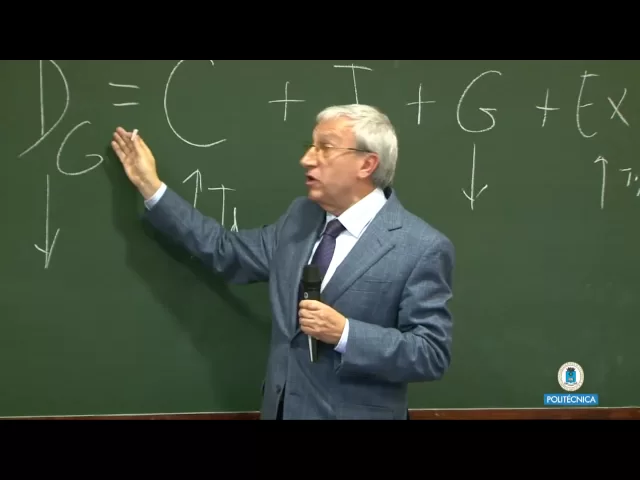
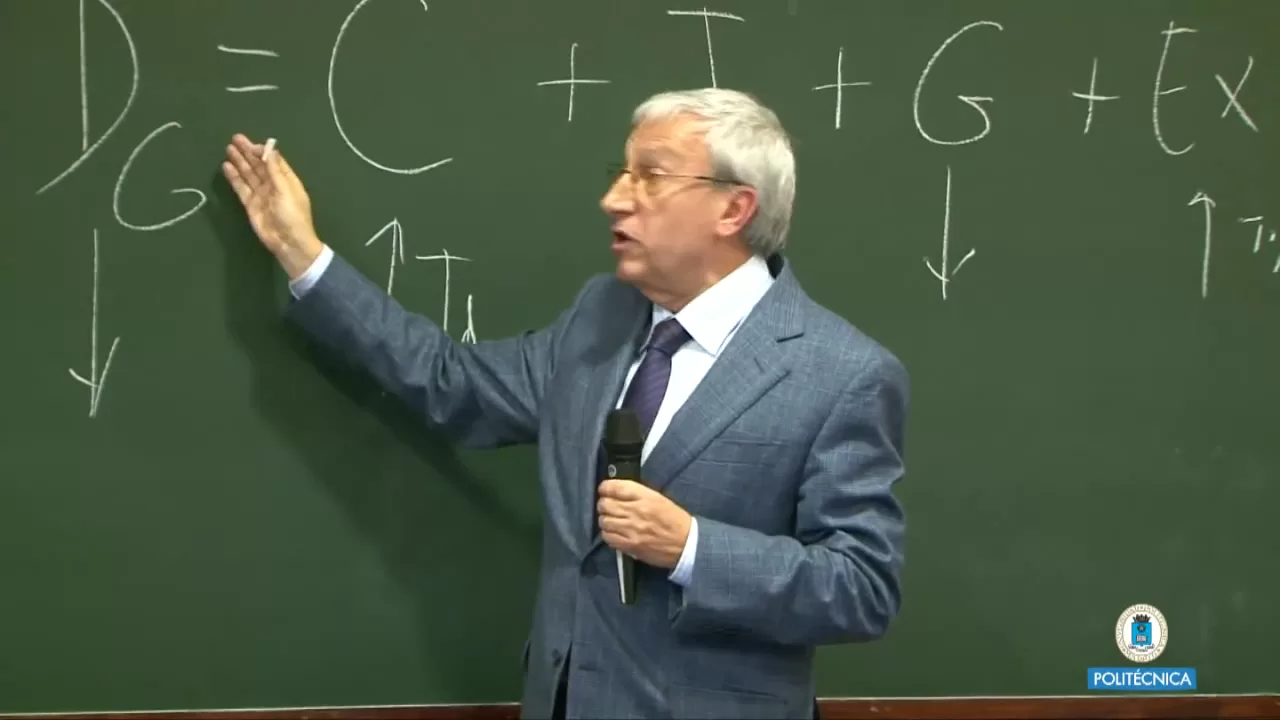
If we talk about Keynes’ resurrection we must first explain Keynes dead And for this we will build on what were the fundamental contributions of Keynes' economic policy The Keynesian economic policy is based on the consideration that the key variable that drives economic activity is what he identified as the "global demand" And that global demand is made by the consumer demand of households the demand for investment goods by companies the public sector demand through public spending and the demand of international markets, through of exports This simple formula, from an economist born in 1883 curiously the same year another great economist, Schumpeter, was born Curiosely, Keynes and Schumpeter were born on the same year In 1936, a really bad year on our history, he writes his general theory And that basic formula can be used to combat the two major problems of any economy which are unemployment and inflation. And what did Keynes say about dealing with unemployment? Well, as unemployment comes mainly due to a failure in this global demand what you have to do is raise the global demand And how do you rise global demand?
Stimulating consumption And to stimulate consumption you have to lower taxes lower interest rates -in this case direct taxes- so families have more money to consume Or lower interest rates, lowering the cost of money for businesses to invest more Or increase public spending through the government and the general state budget so that they build more schools, hospitals, etc. and promote exports through a lower exchange rate These are, say, basic recipes to combat unemployment How do you fight inflation? You do the opposite inflation comes because the demand is excessive prices rise because demand rises And what you have to do is articulate measures to control this global demand, to lower this global demand And how do you lower the demand?
Lowering consumerism And how do you lower it? Rising taxes Restricting the inversion, rising the interest rates reducing public expenditure and promoting the exchange rate to rise Keynes also argues that unemployment and inflation cannot coexist because logically if unemployment is due to a lack of demand, prices tend to fall So unemployment with deflation, that was the model of Keynes If there is excess demand, demand pulls from the offer and the offer pulls employment Therefore there can be no inflation with unemployment, it's an antunomical sutuation These Keynesian recipes worked perfectly from 1945 to 1973 What happens in 1973? The oil crisis And with the oil crisis what happens is that for the first time in modern history inflation and unemployment coexist, which Keynes had not anticipated And how is this possible?
Because inflation in 1973 is inflation based not in demand, but in costs Prices go up because energy prices, oil prices, rise And those costs, which make a barrel of oil rise from $ 2 to over $ 35 a barrel meaning costs pulling prices and, without demand or economic recession, prices keep rising So demand inflation has become in costs inflation which Keynes didn’t provide the answer for and there are also coexisting problems of unemployment and inflation, so Keynes is cornered Keynesian policies are replaced by liberal policies, mainly from Milton Friedman the so-called supply-side policies, which consider the state budget must be neutral only interest rates should be handled to improve the economy and especially the emphasis should proceed from macro-economical to micro-economical That is, if we are to combat cost overruns, production costs should be fight at a company level We must fight the rise in wage costs, higher production costs through innovation through productivity, improved competitiveness, improved quality, after sales services, etc. We enter the economics of intangibles and the productive economy at the company level therefore we find that the emphasis of economic policy changes from macro to micro Milton Friedman becomes the reference of the economic and Keynes is cast aside Keynes’ Death But come 2008 and Keynes resurrects. Why does Keynes resurrect?
Because the new situation created makes unemployment coexists not with inflation, but in a deflationary situation Currently there is deflation with unemployment, unemployment coexists with lower prices and deflation can be as dangerous as inflation, because deflaction although it creates an expectation that prices will go down, it delays consumption so it can lower prices to fall much below the production costs companies come in losses, and there is an extraordinary economic risk So as unemployment and deflation are the basis of the current problems Keynes does have the answer to combat the two problems simultaneously: to stimulate global demand So if we must stimulate the demand, lets lower taxes, lower interest rates, raise public spending and reduce the exchange rate to make exports more competitive This would be solving 2 problems at once Keynes has resurrected And finally, what are the limitations of the Keynesian model now? We are seeing them in Spain It really is not the same fight as in the previous Keynes’ era where the main problem was inflation inflation as in the 50’s and 60’s there was a practical situation of full employment because fighting inflation requires budgetary measures of tax increasing and public spend lowering So we really need restrictive budgets disciplining public spending and raising taxes. No deficit, no debt But if we are to combat unemployment and inflation, the problem is that with lower taxes and higher public spending we are generating deficits and public debt And in the current situation countries like Spain and all members of the European Union can no longer use monetary policy instruments used by Keynes, because Spain has no control over interest rates, or on the exchange rate .
Therefore, the only economical policy instruments at the disposal now of a European Union Country are tax instruments: taxes and public spending if we lived in an interdependent world and Spain was not in the Euro or the European Union we could possibly maintain indefinitely a policy of lower taxes and higher public spending increasing the deficit and public debt grow indefinitely. But we are in the Euro and we have signed a stability pact and this means that the European Union obliges us to discipline our public spending and our public debt And then we really cannot use expansionary policies from the fiscal point of view indefinitely And this is the scenario where we are today From the employment point of view, with 20% unemployment, Spain would need expansionary policies sustained in time with tax cuts and higher government spending to stimulate the economy But the European Union membership limits these possibilities and we are already seeing hints of attention we are receiving from the European Union, as the next speaker will explain, saying "hey, you can run expansionary policies during a given time, about 2 years, but they can’t really be maintained indefinitely" because we must return to the discipline of economics and public deficit must not exceed according to the Stability Pact, 3% and 60% for public debt It turns out that this year we're almost at 12% deficit in Spain So we have an unemployment that would require us to implement expansionary measures in accordance with the Keynesian measure but where the economic waste in public expenditure made during the previous years with measures like the 400€ one or "baby check" have made public spending rise unstoppably and now we have to discipline ourselves And then you observe that if we have to do according with the European Union is raising taxes and lower public spending, we are generating more unemployment And this is the Gordian world in which now the Spanish economy finds itself and it’s difficult to solve because they according with economic orthodoxy, we should have expansionary policies but according to our commitments to the European Union, we must have restrictive policies And so much for the theory, it’s politics time now. Thank you very much.