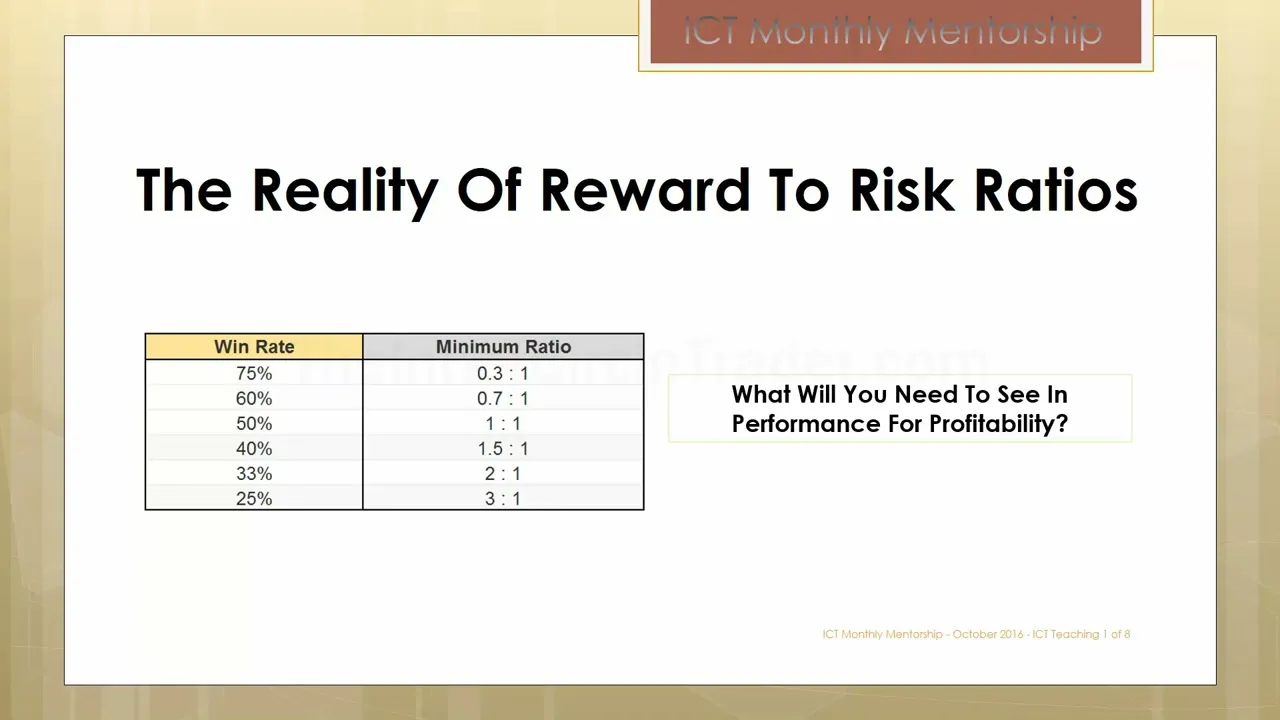
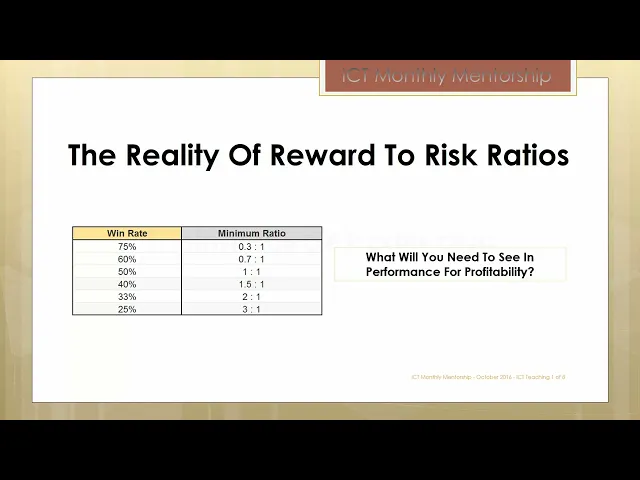
welcome back folks this is month two of the ict mentorship this is teaching one of eight of the second month of 12 and we're dealing specifically with growing small accounts without high risk now before we start obviously we need to know what it is that we need to avoid the first thing you need to do is do not try to rush to make massive gains in either pips or percent returns i can tell you i fell victim to this as my as a new trader i went in thinking i can get rich really really quick as a trader after i started seeing how fast profits can come uh it kind of makes you think that it's like the lottery every single time you sit in front of your computer and it's not the case okay so as a new trader the first thing you want to do is kind of suppress that desire to try to chase massive gains and it's either in a total number of pips because it seems like it's a trophy thing to tout that on the internet or on forum or mediums like twitter or or instagram and facebook it's not important how many pips you have and it's not important how much money you make it's the percent returns to actually make uh consistent wealth building and it don't chase high percentages you don't even really need high percentages to build wealth do not open yourself to large risk in hopes of equally large returns or profits it's not necessary for you to have very much risk on your trades to make a lot of money it's rather myopic and it's a misnomer for new traders when they come into this industry they think they have to have a lot of money and they have to put a lot of risk to make money well that's not true and the only reason why they think that is because they're trying to make money quick lots of money real quick do not assume taking small risk defined trades will not grow your account this is one of the lessons it took a while for me to learn early on in my career i thought i had to have a lot of risk on the trades and otherwise i wouldn't see my account grow and that's not entirely true once i understood the compound interest factor it doesn't take much time at all for your money to grow and it doesn't matter how much you start with you can start on a shoestring budget even as little as a hundred dollars a hundred dollars can grow exponentially over time if you submit to it and now think if everyone would start with a hundred dollars number one you would never be broke if you made mistakes initially secondly who says that you can't add more money to it once you become more confident see that's the part everyone jumps ahead they want to take everything they're willing to risk and lose but not really lose it and they put it in their account and they put it all in one or two trades and hopefully they get a lottery win you don't need to do that you don't need to do that at all you can actually define your trades with very very low risk in terms of total equity and then watch it compound over time that's how you grow an account do not sacrifice trading equity for poor planning or lack thereof like i just mentioned in point number three it's very important that you understand that there is not a necessity for large risk to build wealth you need to have consistent parameters though that'll allow you good risk models for each trade with well-defined low risk parameters the setups need to have well-defined risk two percent ideally if you're a new trader but no more than two percent on an average you don't need to have any more risk than that to build wealth what do you need to aim for what specific things should you be focusing on going forward if you have a small account and how to start building it up well you need to determine how realistically you can anticipate a favorable reward to risk model what does it look like we're going to talk a little bit about that in this specific teaching you're gonna have to learn to respect the risk side of the trade setups more over the reward it's too many times and i did this to as a new trader we don't we don't think about losing money you know because after all we're always to be right the fact that we think about the profits solely and we don't really concern ourselves or respect the fact that we could lose on every single trade how many times have you started a trade as a new trader now maybe you were nervous when you when you first got in it but when you first put the trade on greed puts you into that trade greed puts you into that position where you're trying to make money but once that transaction starts and you're in the marketplace that greed transfers into fear i hope i make money what if i don't make money see when we first put the trade on we're not necessarily fearful unless we're fearful of missing the move it's greed that puts you into the trade as a new trader but you need to learn to respect the risk side before you take that trade and execute on it because if you don't focus on that side that's the part that hurts you nobody gets broke by taking profits but they all go broke by taking too much risk identify trade setups that permit three reward multiples to one risk or higher it's very important and we're going to talk about specific numbers and how it's actually measurable in terms of odds but you want to look for trade setups that have three to one payouts and for every one dollar you're risking you hope to make three dollars frame good rewards risk setups to have little impact if unprofitable again that gets back to having very small risk if you have very small risk well-defined trade setups you're never going to worry about well you might get a loser here and there you might get a string of losses but it's not going to take you out of the business it's not going to take you out of your career of choice you came into this industry to make money you want to obviously change the course of your life in terms of financial fluency and even if you're not trying to get rich if you're just trying to have a passive income maybe you're trying to supplement some of your uh your uh your bills your monthly costs of living you know you came in here with a monetary desire so keep that in mind you want to do this for a long time not just get lucky for a short period of time and make a lot of money because that doesn't happen no one does that 4x is not the lottery all right the reality of reward to risk ratios okay what will you need to see in performance for profitability now everyone thinks they're gonna never have a loss when they first start out everyone's superman they can't go wrong their system is going to be the best thing since slight spread don't worry about it you'll never have a loser kid no one starts in this industry with that as a hit the ground running you never have any losing trades you're going to encounter that so when we talk about accuracy accuracy is not even necessary in terms of high end accuracy to make money you don't even need high accuracy to build wealth but you do need time time is the missing element and that's the secret that's the holy grail to allow compound interest to do its magic so my question to you is this do you think that you're a 75 percent win right trader in other words every trade you get in is 75 percent of those trades winners if that's the case your win at 75 percent that is actually very high and your ratio terms of what you're hoping to make in terms of your risk it's really low you don't need to have very much in terms of risk to make one dollar if you had 60 percent you have even still you have less in terms of what you have to take on as risk to make one dollar but when we get to 50 50 you got to start risking a dollar for a dollar then at forty percent you the ideal ratio would be you're trying to make a dollar fifty for every one dollar be profitable when you're only 33 accurate ideally the minimum is you want to be looking for trades that pay you two dollars for every one dollar risk at 25 accuracy now folks think about this if 75 of the trades that you take are losing trades the minimum ratio for profitability is you have to look for trades that pay out three to one now think about this for a moment if we look at the low end objective in terms of accuracy that means 25 accurate we're looking for trades that are gonna pan out hopefully three dollars reward for one dollar risk so if we have that scenario and we are able to take a trade and risk one dollar and make three dollars in return we can be wrong 75 percent of the time and still be net profitable now think about that if you grow in your understanding of the things i'm teaching you say you become profitable to the degree where half of your trades are profitable that means the ability for you to find three to one trades more than doubles it more than doubles so that means your accuracy grows but your reward to risk ratio if it just stays three to one you're gonna have more trades that pay out three to one therefore your equity is going to increase exponentially now what happens when your win rate goes up above 50 percent what happens if you have a 65 to 70 percent accuracy and you're looking still for three to one trades your money grows exponentially what happens when you start looking for reward to risk ratios of five dollars paid out for one dollar risk and you have a seventy percent accuracy suddenly wealth is not that far out of region now looking at an example of trading with statistics behind it i think everyone would agree that to make a percentage increase of 50 inside of one month is actually a pretty good feat now i'm not advocating that everyone's going to be able to make 50 return in one month it's not going to happen um that if we have an account that would be relatively small and i'm going to say for the benefit of an example that we're going to say 5 000 is something that everyone's uh able to do once they understand how to trade we're gonna say that everyone is willing to put five thousand dollars into a trading account and you'll determine when you're gonna do that i'll never tell you when that's gonna happen you make the decision on your own but let's say for instance you put 5000 in account and you use some some of the ideas that we teach here and you you're able to find big payouts big reward to risk ratio trade setups to make a 50 return on your account in one month it doesn't take many trades to do that but it does take highly selective setups and you have to do certain things to make this um pan out and here's the thing once you get one or two of them in your month in terms of trades you can now start lowering your risk to reward ratio trade setups if you want to stay busy you can still do very well by adding more percentage-wise on your account but you don't need to go out there every single time looking for big payout trades you can get bread and butter scenarios whether it's two to one three to one scenarios where it's easy to get these uh payouts so if you started with five thousand dollars and you're able to find setups to do these things and that's what i did in my effects book for this mentorship i show over 50 percent return and i didn't do many trades at all it wasn't many trades at all they actually brought this type of return the profit actually grows over twenty five hundred dollars and that's not bad for for an account that would start with five thousand dollars not a whole lot of trading in the first month that is what is possible but not a standard do not expect this as a normal every single month type thing but think about this if you could show a 50 return just for the year how amazing would that be if you were able to take your money and compound it where you had a return of 50 per year that blows away every money manager's goals out there uh it certainly blows away any kind of uh stock return you know ira or anything like that it it you would be outperforming every asset class that's available to you and you think about what you're able to do you can do that in a month if you could do that in one month looking for high payout low risk imagine what's available to you this is the one that you want to pay the most attention to and i said you have to respect this side of it because the draw down is what will hurt you it'll hurt you psychologically and it will hurt you monetarily so as you can see what we're going our goal is is to have little to no drawdown now you're going to have drawdown this account will have drawdown you will see it uh it's not my goal to show you massive drawdown so you can see how it comes back from it the idea in this mentorship is to avoid large drawdown and obviously in one month taking 10 trades i tell everybody my average goal for the week is 50 to 75 pips a week and you can see here the average win is 51. 80 pips and with 10 trades a total haul of 518 pips for the month and i think that's uh pretty consistent for what i'm able to do on a month-to-month basis i don't try to do anything more than this this is like my sweet spot for my performance and i try not to do anything above this every time i try to do that i get a king kong feeling and you know having king kong and the movie he fell off the empire state building and didn't live too much longer after that so i learned that lesson as well in my trading all right so what should you focus on initially that's right six percent six percent of what six percent of your equity compounding per month now it doesn't sound like much it doesn't sound sexy it doesn't give you the willies well guess what it only takes you 20 pips per week to do it and it only requires one and a half percent risk and it only requires one to one ratio to do it that means if you find a trade that pays out potentially 20 pips and you can frame the trade where you're only taking 20 pips risk guess what that's all that's necessary and they happen every single day now i'm not advocating looking for one-to-one ratio trades but i'm going to show you by example how easy it is to get that once your accuracy increases and you're understanding a price action these setups are there every single trading day now again i am not i preface it again i am not trying to instill an action warrior hero where you go in there and you're trying to prove to the world that you can trade every single day and get your 20 pips 40 pips or whatever you're trying to do every single day i don't think it's something that can be done consistently every single day um if you do you're inviting losses and there isn't a trading day that doesn't look good initially and goes sour quickly you want to be trading in highly selective conditions and when you do that even with low reward to risk ratios to one you can still find one and a half percent return payouts per week one trade that's all you need and you're actually gonna have a little bit more than six percent but what does six percent do compounded every single month it doubles your money every single year and i don't care what your equity size is that you start with now account with a thousand dollars your risk for trade is gonna be one and a half percent or fifteen dollars that's it you're only risking fifteen bucks now if you lost fifteen dollars and you had a thousand dollar account are you gonna go home and take it out on your family no most people wouldn't do that and if you would then you're probably not meant for trading so what you'd be risking is 20 pips from your entry price and your profit will be taken at 20 pips for a one and a half percent return but here's the thing it's easy to say this in number form but how does how do we find it where did where do these setups occur well the six percent per month setups they form specifically and the easiest ones to find are looking at your daily chart and they make it easy to do was it what is it specifically you're looking for well you're going to be looking for the things that i've talked about in the very first month of this mentorship one specific is an order block where there's a price point at which a move quickly moves away from a level if in this case it's movement up we find that down candle right before the move goes higher when price goes back down into that down candle we have a really good probability especially off of a daily chart that you're going to get a 20 pip or more price swing now magnified and zoomed in we can see that that order block is noted with the two arrows drawing your attention to it we're looking at the body of the candle which is the opening on the down candle up to the high of that candle okay and that's a fair value gap price you can see trades right back down into that level right here as price hits that on that particular day that's when you'd be looking for a trade you'd be looking to go along there okay but not just simply as it hits that level we're gonna wait for something to give us confirmation obviously the same thing occurs on a lower time frame we look for the order block we're just going to scale down because everything in price is fractal so we're highlighting specifically the 0. 7512 level okay so we have a one hour chart we're zoomed in and you see price shows an old low right here and below old lows we know there's going to be cell stops resting below there and the price drives down below that taking out an area of cell stops or running into a liquidity pool but it goes specifically down into that one level that we identified on the daily chart being 0.
7512 price trades down into that level and slams right into it now we are in turtle soup conditions that means a break below an old low we could potentially expect this market to run higher when it hits this level on an hourly chart we can simply wait we're going to wait for confirmations the market wants to go higher from that level in other words we're going to wait to see if the bank sponsors that level if they do we already know by looking at what we've learned in the first month there are buy stops above these equal highs right above here there's equal highs and i'm going to ask you before i show you again where else would you expect buy stops above the market place to be residing in this chart that's right right there so buy stops are above us so we can map out areas at which we can look to take our profits before we even put the trade on that's important you need to know where you're at in terms of risking and rewarding where are you going to take your profits where do you think the market's going to be drawn to and why should the market react at these specific levels by looking at that 0. 7512 level that's important because we know our our traders our trade is being framed on the daily chart it's not a five-minute setup it's based on a institutional level on a daily chart now here we have the market trade up through the down candle right in here that's the bullish order block price trades through it here once it happens we identify the opening and the high on that candle that's where the buy would occur okay so in this area if we use the opening on that candle we're going to add our five pips spread to it okay and build that in you can see our order would be around point seven five four two that would be our limit order so we would be long there when this candle drops down into it we would reasonably expect to see our entry to be uh filled at that price point now obviously if we're going to be long there the the parameters for trading with six percent setups because our aim is to first get ourselves in sync with trying to double our money over the year not this week not this month we're trying to double our money over the year that's low hanging fruit that's easy for a new aspiring trader to grow into it doesn't give you the pip drunk mentality you're not trying to force a million dollars into your account right away it's gradually adding a fluency so you're going to define your risk by saying okay i want to take a stop at 20 pips okay and guess what that does it puts your stop below the middle of that down candle so you have a good risk model here and also it's framing it really well because we don't want to see price go down below the midpoint of that down candle again it's already shown a willingness to drop below here and take the stop so it wants to obviously want to go higher if it's going to go higher it won't come back down below the middle of that down candle or bullish order block so our stops at 75 22 our entries at 75 42 we have a 20 pip stop loss and obviously as soon as we get to this level here we're already at one to one so at this point we could be long here right here we're already at guess what one and a half percent profit now once we get to one and a half percent profit does that mean we collapse the trade we can absolutely we can that's a one to one gearing and we would make our one and a half percent return and it's that quick you're over in a couple hours you're done for the week but what did we first start this trade with we framed it with the buy stops up here and the buy stops up here so when price goes to our first profit we can start taking our risk and reducing it taking some of it off in fact we could probably do this we could take half the position off and guess what we'll do we'll make point seven five percent return on the trade once it gets to this level here right up here that's first objective so now we've already banked . 75 or three quarters of one percent and we are allowing the price to expand up to another level so now guess what as soon as we get to this level here we're back at one and a half percent we made another profit objective here at a multiple of two so now we're at one and a half percent again but we've already banked three quarters of one percent now mind you the 100 is open profit it's paper still hasn't been realized yet but have we reached into the buy stops yet no we have not seen anything in terms of these buy stops over here being reached into or swept guess what happens multiple three comes in here now we've added another 20 pips of profit and we cleared out the stops we can take another portion of our position off we can take a quarter of it off we can take a uh uh a half of it off whatever it is that you want to do i'm not giving you any structure yet but i want you to think about paying yourself right here okay and you would have done well over what would be necessary to make 1.
![Power Automate Beginner to Pro Tutorial [Full Course]](https://img.youtube.com/vi/1p5kI7SYz4Q/maxresdefault.jpg)