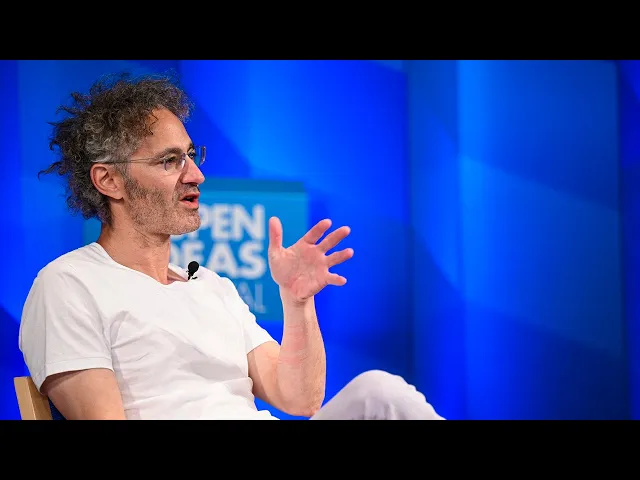
Good afternoon everybody. I'm Andrew Ross Sorcin. Thank you so very very much for joining us uh this afternoon. I can see a couple people uh still taking seats. So we will begin uh in just a moment. It's a privilege for me to be here this afternoon with Alex Karp who's the CEO and founder of Palunteer. This is one of the most remarkable companies that I would argue uh has been created uh in the last call it generation of tech but a very different kind of tech company. not the kind of uh consumer Silicon Valley company
that so many of us have become accustomed to. This was a company that was born uh in the aftermath of 9/11 uh to help the US government initially uh tried to track terrorists uh and has built a remarkable business uh over the past now decade and a half um doing that on behalf of the US government uh and uh our allies as well as corporations around the world. So uh welcome Alex. Great honor. Thank you. Um there is so much to talk about with you uh about where we are in this country when it comes
to tech, where we are with our defense, u what's going on in Silicon Valley, so many of the social issues that I want I'm hoping uh that you will touch on. But I'll tell you where I want to start this conversation uh this afternoon, which is that you took a trip uh which I think uh is a milestone historic in that I believe you were the first American CEO uh to take a visit uh to Ukraine um about a month ago and I was hoping you could maybe take us behind the scenes of that visit,
of meeting with Zalinsky and what that was about. Well, um yeah. No, it was it was kind of a culmination of a lot of stuff and it was kind of a very gratifying when you're building something. But it it really the trip began we we were in Davos and we did this Switzerland, right? Yeah. Interview and um there were a number of people from the Ukrainian mission there. um our product some people know our product well there's some part some of our products are well known but um we we bu we started off by building
a product for in the anti-terror context which brings allows you to bring together large data sets and uh in such a way that it's easy to find people what made it special was a despite what people believe a very heavy focus on data protection and that meant you could also use the environ this product in in war zones where People have different level of access. One of the things one of the there are a lot of things that kind of lay people don't understand about war products. Typically we think oh people involved in spying and
war won't care about data protection civil liberties and maybe they don't in the conventional sense. Many do in the conventional sense. There's more of a political divide than people realize. But actually purely empirically in a war zone you can't use a product that doesn't track the pedigree of the data because you have very different uh access to what's going on in a war. So most people in the war don't know where your your your data is coming from, how you're figuring out where the enemy is, what your human sources are. That all has to be
protected while collaborating with people. You can't do that unless you have a product that both organizes the data and protects an has a rigorous access control model that can be changed to allow people to come in and come out. So we had built a product like that and we had also this was this was two almost two decades ago. It powers most of the western world, not all of the western world, but especially Europe. Uh, and has been very, it's been used typically by Intel people. Um, and then we have a number of other products.
A lot of what our products have been used for can't really be discussed in public, but we have a product uh that will allow you to get data from a satellite and put it in the hands of a war fighter, map what allow the war fighter to figure out that's been used by special forces for a long time. Um, and as we can imagine, um, if you are in a war situation where you're fighting a large conventional, uh, uh, adversary, you would want these products. What, and I'll get, but what's particularly interesting about this war
situation is it turns out that hybrid war, meaning software plus lowgrade munitions plus heroism, uh, outperforms conventional war, which is one of the big lessons. and we've been in the background on this on the the software side. So, um I met with people who knew our product very well and then thought it would be both important for my company but also honestly it I didn't realize at the time but I was the first uh I think non-government person CEO of any company to go. Uh, and there's some reasons it's actually uh can be dangerous. Although
the the major cities are open for business and like kind of look like Aspen except for there maybe there's a bombed tank. Uh, and um, but then there are there's like a lot of war action going on. So, uh, and then yeah, there was a lot to this visit. Um, another thing I was mentioning that isn't well documented is, you know, people measure based on their own skills. I was mentioning this before, but like um you know the president is often it was it was honestly an homosy more like a half hour 35 minute meeting
but my impression of him he's portrayed as a pure media person but I think that's because people meeting him are in the media. My my uh my impression of him was uh you could run into someone like him running a business uh and it would be very plausible which in my very unusual among political leaders and in my context of my business I've met nearly all of them. I want to get more on that in a moment because I think there's a larger question to talk about in terms of the context of how government and
our government in particular deals with technology to the extent it runs efficiently like a business or not. But to the extent that you can tell us, and I know there are certain things that you cannot tell us, um, when you see the war that's taking place with with with with Ukraine and Russia, play out the the dominoes for us. What are the permutations with which you think as somebody who's actually involved in this behind the scenes it could the various permutations it could take? Well, um you know, it's a very hard question, but um first
of all, we we at Palunteer, I thought this would actually happen, and so we were So that's already I mean, it's interesting. One of the interesting things was the American intelligence organizations got it right that it would happen. Many didn't. The Europeans didn't. Although I think their general consensus of how long it would happen, the duration has been pretty wrong. I mean, just in general, um, I think this is going to be very hard to resolve. First of all, I think both sides believe that they have advantages and could win. So, that's always in any
negotiation, it's very hard when both sides believe they could and are winning. Given that you you I think understand the technology that both sides have, do both are both sides, right? Well, the Russian the Russian advantage. So, so a different variation on this is why did the Russian so clearly the Russians miscalculate in the beginning and so the Russian view I think is we miscalculated in the beginning but we're willing to spend lives in the way the West isn't uh we care more and therefore we'll win um and one shouldn't underestimate the Russian ability to
fight. If you read history it's it's very they're very good at that. Um and um the miscalculation on the Russian side I think was in my view I is they America spends 800 billion roughly on defense. They spend I think like 5565 billion. Their view of us I think was but our 65 billion is worth the American 350 billion because they misunderstood the amount of corruption in their system and they viewed some of our spending as being wasteful. um where I think they just really miscalculated again slightly self-s serving is uh but America um some
of that spending went to things that are only being built in America not just my products but information systems and Christian technologies targeting technologies high-end hybrid hardware software products uh that are even if it's a small portion of the American spend uh has a very very high alpha just the same way in act investment in great technologies in America doesn't explain the radical output of American companies compared to any other company. I think they very significantly underestimated the willpower of the Ukrainians. The Russian narrative is that it's not a real country. It turns out that
I think that's where Sinsk's also played an enormous role galvanizing it into a nation state. And then they underestimated uh greatly the effect of maybe three four percent of a budget being spent on next generation things as opposed to a 100% probably less of a budget being spent on this generation things. um the the I believe a lot of what will happen will come down to the health of of the president like I I don't want to reduce you know a lot of times obviously you have you look at things from the prism of what
you've done and in tech in general you can reduce the company to the founding team doesn't mean a great founding team will win but any idea will not work without a founding team that's creative and interesting and and has business acumen so I I'm very indexed on him uh and Uh, and which president are we talking about here? Uh, the president of the Ukraine. President of Ukraine. Yeah. His personal health. Yeah. I think I think um yeah, I I would tend to look at this if he stays alive. You know, one of the things I'm
not allowed to talk about is how many times they've tried to take him out, but it's not small. And when you meet him that the security around him, I've met in it's like in if you're working with 60% of our revenues from governments, our practice used almost every western government in one form or another. So, I like hanging out with my engineers, but I get rolled out to meet important people. Um, I've never seen security like this. Like, you meet the president of the United States, you go through, you go through medical uh metal detector
once or twice. Before I met with him, he talked to a number of our clandestine clients. I'm relatively known figure. I only know that's because they kind of told me. Um and then everyone in the meeting including his senior people went through the same security I did just like you meet a president president of any country their adviserss don't go through the metal detector too. Um so I think a lot comes I also think uh and our we've provided a lot of generous aid but it is crucial what kind of aid arrives there under what
conditions and how timely it is. Um uh and I think uh and then uh and then America, you know, for better or worse, I'm fairly patriotic understanding there are a lot of things to fix, but America just I'll tell you another thing that's interesting that is not well that surprised me. The American brand, British brand, and actually Israeli brand are um the highest I've ever seen. like it the fact that our product at a general level is used in some of the countries I may have mentioned uh that's what matters to these to Eastern Europeans.
If you go to any Eastern European country and you're selling a software product, they just want to know who uses it in those countries. So let me ask a question. If you were advising uh President Biden or President Zilinski, what's what's the or or or the Europeans, what is the playbook with which you what would you do make we're going to make you for the day? Well, you don't want that, but I don't want that. But uh um and humanity doesn't want that probably, but uh um I would call my first call would be to
Putin. I would call him and say, "Look, I I want to meet with you. Um, but just so you know, we are going to fight to win. We can negotiate the terms. Then I would call the president of Ukraine with uh and figure out exactly what they actually need operationally. Uh, then I would make sure it's actually gets there. Uh, then I would set a meeting with uh all three in person, but like with a stance of we will fight to win. Um, and fight to win doesn't mean fight to humiliate. There's a distinction there.
I What do you mean? Well, you know, you have to we have to find a way to to win in the Ukraine does not mean uh poking uh Putin in the eye publicly. Like this is just a different thing like the same thing I would do with China and other adversaries. We will fight to win, but we can win quietly. Um, and that means no expansion of Russia into NATO, no expansion uh figuring out exactly what the borders would be in the Ukraine, original borders would be my preference. Um and uh I think it's a
combination of proven resolve uh and uh dialogue actually gets is where what you need to do when you worry about stuff and I know you worry about life and things and we talk about politics and what's going on in our country and this and that. Tell me what you worry about when you think about the word war. Well, you know, there's a general conception that we all have intergenerationally that the, you know, the world people believe there's structures for how war would be fought uh post World War II. I don't believe those structures actually exist
the way most people do. So, it's like, what do you mean by that? Well, there's an escalation path and then we have this discussion. It can't escalate this way. I don't believe there's real dialogue around escalation paths the way people would believe and therefore I think the calcula it's very hard to calculate where something would go once it starts and so you know if you're trying to figure out okay you're making a decision a lot of it is al is risk allocation right so I make x decision what is the adjusted risk on that return
man know maybe in like our case we believe we built a lot of our products based on belief so therefore we disagregated the risk miscalculation. What do you mean you you made products based on belief? Well, the products that are being used in in Eastern Europe, but I can't discuss more than that, were built, you know, the they were built 101 15 years ago. Some of them were built in the last couple years that we had cons no one would invest in our company in Silicon Valley in uh the we heard that the total addressable
market for uh producing value from data was a hundred million dollars. And I told the person who told me I was like, "But our bookings are hundred million dollars." So bookings are one-third of of uh it's like three to one. So that meant we had one-third of the total addressable market in the world. So obviously you wouldn't want to build a business around that. Uh but we believed I believe that um that some of what we did would actually be aative for the world and we were able to convince the world's best engineers. And so
that was primarily and that's one of the things I think is unique about tech in this country. You can build a company around an idea. Of course, an idea at some point has to be something you can monetize otherwise it's purely academic. I left I was in academia. I left academia because I think that's kind of a little bit self uh pleasuring uh and that's not exactly I think sustainable beyond adolescence. And um uh and so um we might have some teachers here who have some other views, but let's uh let's take the conversation out
of out of war for a second. And I do want to return to that concept and topic in a moment, but here's where I want to go. You mentioned the US defense budget in the United States, $800 billion roughly. You spent a lot of time trying to understand that budget, where the money goes, how it works, what happens. Given what you do for a living, are we spending it right? Well, we're spending too little, too much. What's going on here? Um, there's like it's both, it's a complicated question, very good question. Um the the thing
about so when we got into this business I'll just stick to the software part because I don't want to get into how many aircraft carriers a country needs but and it's not my area of expertise although I do think the Ukraine war shows decisively you want kind of mortars plus software plus heroes. Um but um when we got into the the software business um you sold software to the US government by filling out a 1500page thing that was wr the specs written by a non-technical general uh often with help from people who would then go
work for integrators and if you buy software that way you will spend billions of dollars and it won't work. We I had the mo a number of the most prominent honestly all the most prominent adviserss in national security come into my office and literally say if you sue the US government because of this uh you will never sell your product again and everyone will think you're an um meaning not think you are um and we sue the US government twice not to buy our product but to change the way procurement happens from a 400page fantasy
uh document written by people who don't know what software looks like and are believe they do because they watched 48 on TV um to something where you have to actually show it working in practice and um and that change has given America uh in all modesty, but we didn't say to buy my my company's product. That wasn't what we sued about. And then the government appealed, which is insane. Um and uh uh and we appealed again. Mind you, we were a small company. This was a large part of our burn. We hired the best lawyers.
We managed those lawyers. It took a lot of time um and money. We we really meant a lot to us at the time. And um uh um if you compare America's procurement to say I spent a lot of my life uh in in in growing up in Europe. You may not know but any case I wrote my PhD University of Frankfurt. Um and uh but you compare our the way we procure software to the way most companies procure software. They're still doing what America did. And that basically means you will get at best the software
from your cousins nephew's buddy. the best software they have to provide as opposed to the best software. And this all a lot of this comes down to who has the best software and you have to show the software working in action. By the way, there's some nuance here because in Europe on the data protection, what we would call civil liberty side, you actually have to show it in action, which is how we ended up with such a big business. But on the operational side, meaning how do you defend your country and kill your enemy side,
that can be a 1500page document filled with jargon no one understands. But you did stay at Motel 6, so Uh, so back back to the 800B gorilla again, king for a day. Maybe not good for society or not, but I'm I'm putting you in the in the position. Do you think we should be spending more? Do you think we should be spending less way you would spend it differently? I I wouldn't fight the battle more or less because then your whole day is gone. I and you've accomplished nothing. What I would do is focus on
these are this is the methodology for buying what software all software has to be proven in action before it's bought but and then just then you pay fairly because the person building it is absorbing massive risk and and this not just you know like every program every software program uh and and there'll be a transparent way to show this which will immediately mean more people will start doing it when you look at our technical capabilities software, but also the hybrid hardware piece of this and everything else. Where do you think we rank relative to China?
We've been talking about AI here for the last three days. People are talking about where China's software is versus ours, where Israel is, uh, given some of the things you were just talking about, the reputation they have. Um, there's one tech place in the world and it's in America mostly on the West Coast. And there's the number two. We I'm pro-Israel and we have a business there is number two which is amazing because there's 8 million Israelis and and like 350 million Europeans and it's the number two clearly the number two tech place in the
world. China on you a lot of most AI discussions in America focus around either AI in the consumer area which is still by and large machine learning or they focus on fears around China where China has been very very strong is on domestic AI stuff we wouldn't build like you know what have you done for the last five days who did you talk to where have you gone who have you not who have you seen have you not seen and there I think China is the dominant player in the world um and will probably remain
the dominant player in the world. What I'm interested in is AI or m machine learning enhanced machine hybrid software in the in the military warf fighting context and there of course there's more America should do. Uh but I think America is is is in the lead. Um now part of that's because Europe is not engaged at all. So it's and Israel Israel has a lot a number of interesting companies but it doesn't have the scale we have or the tech research. Look, we've had a problem historically in America because many people in Silicon Valley thought
it's their job to enhance the carcinogens that uh are uh distributed on consumer internet and it was somehow a bad thing to help the US government. I've had my house protested for years by people who are working at large consumer companies because we support the US government in AI and in war fighting context. And that has been a bias in Silicon Valley that's changing, but probably not as much as the leaders in Silicon Valley say publicly because in order to really change it, you have to say, "Hey, if you're not willing to help the US
government, you should work somewhere else." And they're not. And just to be clear, we're talking about Amazon. We're talking about Google. We're talking about some of those some of the very public projects and maybe even private projects. We don't even not so much Amazon. This was the Google problem. Maybe they've cleaned up I think they've publicly cleaned up their act and we we work with all these people but there was this famous project Maven uh where you know which was is America's most important AI effort uh which somehow no one in Silicon Valley was willing
to support besides us. Now there there has been a shift in Silicon Valley um uh and uh around supporting the US government. There were a lot of people inside Google, but I was and I was referring inside even Amazon. There was a protest. Um there were protests inside number of other like you know I'm neutral but I think do you think Bezos had a different view of this? I think oh I think Jeff Bezos personally had a very different view of this but I think interestingly the the employee uprising that was taking place within tech.
You have you have a problem in in my view. Look there are lots of interesting and problematic things about American society which get discussed a lot. Um but you know that's different than basically not willing being willing to support the US government and being willing to support adversaries and that is a position that many people in the work and file in Silicon Valley still support and that makes it hard. We don't have as much of a problem at Palanteer because if you have that view by the way I support people who disagree with me you
just don't work at Palanteer. So tell me though about the the what is the culture of Palance here relative to these other firms especially by the way given that a lot of companies are now taking uh more social positions uh political positions on different topics. By the way you have to take political positions yourself in some ways in terms of which allies for example or or which countries you decide to do business with and who which company which countries not to do business with which is a hard decision. We take a lot of we take
positions on any issue involving us basically. So we were the first I believe I was the first person to say we wouldn't build a Muslim database though no one had asked us because we would have said no we've taken you know we were we were very involved in who you know this debate as discussed around you know who supports the US government under what conditions. Um but I would say the primary and the internal culture of Palunteer is we people have always thought we were batshit crazy and um and uh uh but we are known
for having the best talent primarily technical in the world and that we get that talent because we have an environment where everyone gets to say no and and there's a lot of kind of what you would call critical discussion around issues. Uh and that critical discussion means uh there just a lot of things we end up saying no to uh that um one would not imagine. For example, governments who would give us large contracts who are on the allied side. So we've never worked in China or or Russia. But then there are a lot of
uh governments that are in the gray zone. They're pro-American, but they might do things with our software don't we don't support. Uh then we've had internal discussions around, you know, so that that's So where is the line? Help. No, I'm I'm actually very curious. take us inside the room if you could to a to a conversation around you know which country you you want to help which country you don't that is that would live in that sort of gray area. So some of it's easy because if you're not an ally, if you're an adversary of
America, we're not. But that by the way was not easy because we had investors were like, why aren't you, for example, why aren't you working in Russia was a real discussion and you know their version of is well software multiples are, you know, whatever they're very large and you turn away $50 million. you're you're stealing a half billion dollars from me and so it's like um the more complication many many many times and uh and many people who passed on investing in Palier because of that and they should have passed because we weren't playing around
um uh and then internally it gets more complicated just if you take like this is an exact example without mentioning name large country very wealthy country uh there are certain things I would gladly support them in their efforts to do like defend their country against attacks, but we were worried our software would be used to target religious minorities and those religious minorities might be tortured. So, we didn't sell the product. Um uh um we we've had examples in this country where we've faded contracts out not because I thought they were doing something bad, but because
it wasn't exactly the way we would do it. Um we've had commercial contracts that we haven't taken on or where we've left very simple things. I mean profiling is, you know, not something that one does in America, but there are many countries where that's perfectly acceptable. The credit score based on profile is not a controversial thing. We we we've walked away from contracts on that. Um so you won't so so even if it's a country where it's legal in their country, it's not only legal and that that would be that's the easy example, it's also
ethical in that country. You would not have a debate. Um and and for example, the contracts we've walked away from, we've never it wasn't just it's legal in that country as a standard. It was legal and ethical in that country and it was not something we wanted to support. And by the way, to the extent I wanted to do it, which mostly I didn't, uh the RA my palunteerians, you'd have to stand in front of that vicious crowd and explain why. And it's like try that. It's very hard. I mean, I have defended certain things
and and put them, you know, um, you know, uh, and and and for and and forced us to work in other environments where I thought were important. And and that was the other thing I was going to ask just about the culture. One of the things that we've seen over the last decade, especially in Silicon Valley, is a culture um that is very egalitarian, let's call it. I don't know if if that's the the right phrase um or word choice, but when you make a decision, is the decision made? That's a really good question. Um
and I'll tell you, so we work on um a culture and you could call it war fighting, real war fighting cultures are actually consensus driven. People don't believe that but if you look at the original special operators it was consensus plus there's a term in uh the German alk which means you get a mandate which means you have an abil you get this slice of responsibility and in that slice of responsibility you decide um and what you find in in in many large institutions is the person the leadership at the top believe this decision's made
and the advantage is the decision is made quickly because one person decides. The disadvantage is the decision is not actually made. It actually doesn't happen on the ground. And this is a is a plague that uh on many large institutions in the world. Uh at Palanteer, you have a little bit of a different problem. The decision is usually not made until I've convinced the person convinced uh the person who's got the mandate that they should actually do what I think they should do. uh and I've tinkered with how they believe the decision should be executed
on the product front especially because otherwise it it just doesn't happen. So we have a but the advantage of our system for example if you're vaccinated here I hope you are your vaccination was distributed in our product if you're British 17 other countries distributed in our product if you're European and your country is not goostepping around it's because of the terror attacks that were stopped in Palanteer um there's uh there's a lot of it has an advantage that when we decide to do something we can move crazy crazy fast because the responsibility is really at
the edge. Let me ask you, as a business leader, one of the things I think all business leaders in the United States in particular are struggling, challenged by trying to figure out is when to speak out on all of these very hot political issues and often times because employees are pushing them to do so. Well, you know, it's a very difficult thing, but but they there is a slight admit we we have a narrow but deep focus. So if it involves broadly speaking national security but including uh civil liberties, data protection, building a database to
profile a population, uh we speak out. We've spoken out over 20 years. If it in involves general idiocy in in implementation of these things, we speak out. We yell in public. We yell in private. Uh if it speaks out, we've spoken out against Silicon Valley. Uh we the first people to move our office. We spoke out with our feet moving to Denver. Um I and we do speak out internally on lots of issues where I'm more on the progressive side, but you know uh I win I hope by debate. Um but I think general companies
have a problem that they it's very hard for them to tether their what they're producing to a higher mission and therefore they cannot exactly adjudicate where they have to speak out and where maybe they they don't have to speak out. Then there's just general issues of, you know, again, if you're gonna use our product uh for things we don't support, we feel like we have to speak out. What about this? Right now, obviously, the the road decision last week has uh created a a stream of companies not speaking out, but publicly saying, for example, that
they're going to pay for their employees to to travel to other states, uh if if that's the case for abortions and the like. uh but very few of them have actually publicly come out and denounced uh the decision. It seems in large part because of the worry of blowback and I'm not sure it's blowback from consumers that they're worried about. I think it's blowback from politicians and given that you are in the business of doing business effectively with government how you think about that. Um well again first of all I I would like so we
have internal policies around I mean I'm I'm pro-choice um I've viewed um the the choice not choice argue thing as in in America as decided um but we have a lot of people probably at Palanteer who believe have different views than me. Um at Palunteer we provide we've always provided for people to leave states or go to places where they their rights are protected and we pay for people and their uh their families to move if they need access to medical treatment or abortions. Um I I don't see it exactly that way. The way I
again I do think if you do not have a general focus. So if you're ex company and your product is why then you may not know when or when you should not you should speak out where we speak out always and again not in our interests. It it was not in our interest to say we would not build a Muslim database. It was not in our interest to tell governments by the way some people a lot of times it was American allies that want us to work in these countries. Um and we have offended politicians
on both sides uh very readily. Do you feel though that you have to be particularly I mean given that you work with the government given that the department of defense is is your arguably biggest client that you have to worry about uh what is said. Uh Elon Musk by the way who by the way has a business with the department of defense uh uh or department of transportation through through SpaceX doesn't seem to care what he says about the president. So it's it's all kind of fascinating. Um, I should probably look, we have all these
people that tell me I shouldn't speak publicly on lots of issues and I speak pretty freely on all sorts of things that could get me into trouble. And I think our clients are pretty tolerant of that. But they also know that, you know, like I I'm in the business. I have I think the most important issues of the of of of the time right now are issues I have some monocum of expertise in. What will the world look like if it if our adversaries win or if we win? Under what conditions will software be implemented?
Will that software rob us of our civil liberties? How can that software protect our civil liberties? Um, and on those issues, I speak out all the time. Help us with this. And, and some of the audience may know this, your co-founder of the company, uh, was Peter Teal. Peter is on the other side of you politically completely, it seems. How do you reconcile that, especially given the issues that I think that you support and that I know that he supports? Um, well, you know, We Peter and I have been friends for almost 30 years. We
met um at Stanford. Uh he was on the right side of many issues. He's a little more eclectic I think than PE but mostly on the right and I was mostly if not exclusively on more kind of a progressive side of things. Um and I think it I look I think one of the problems in this country is there are not enough people like Peter and me like we've been fighting about things for 30 years. So you have to take the political dialogue which is super generative but and then the business dialogue the business dialogue
we tend to have similar assumptions but not always the same interpretation and and like it's just a very productive relationship and he's a I would call him a good friend. Um and yes we don't agree and we have a great division of labor. He's you know I I I'm I'm a look there's a Yiddish term called schmatas which means rags. I'm a designer uh and purveyor of digital smatas. I'm an operator. Uh and uh uh that's what I do for a living. And uh I I am very focused on that. I'm not without talent in
that area. And I really enjoy my discourse with Peter on areas where I think he's the best in the world. And we don't agree politically. And by the way, I felt very free. I mean, I got in trouble for calling. was a public tape you can find where I used four-letter words to describe Trump. But I'll tell you, in part because of the dialogue, I warned my Democratic friends and colleagues that Trump was going to win. And part of the reason I knew he was going to win is I'm in dialogue with people who liked
him. And I knew why they liked him. And a lot of my friends thought that was an asinine, stupid and improbable position. And maybe if they had listened that would be a different world, but they didn't listen because they're only talking to people agree with themsel with them. And I think that's a huge problem in our society. Like I don't I know what I think. I'd like to hear what someone else thinks. And by the way, I kind of think I'm right. So if you have your argument, we can argue about it. Like I don't
I think a lot of my progressive friends have a little bit of an inferiority complex if I am allowed to critique my progressive friends. If you're if you're right, why do you care that you're in dialogue with someone who's wrong? I like that. I have pretty strong opinions. Prove me wrong. I'd love to hear it. Um hard to know where to go from there. Let me follow up with one just one other related element because I was thinking about this when I was thinking about Peter. Your success oddly enough finances his success and his ability
to push the political and a lot of the political views that he has. How do you think about that and reconcile that the say but our success finances my ability to sit on the stage and convince everyone that I'm right you wouldn't be sitting here with me as much as I like talking to you in the same format if I wasn't quote unquote successful although it's important for you to know my parents wanted a philologist who teaches at Wesleyan and according to that definition I'm not successful but according to conventional definitions I belong in in
a dialogue with a very successful person and I wouldn't be in that dialogue if I wasn't building if I hadn't if I wasn't in the process of building what I think will be is already you know a truly transformed company what will be the most important software company in the world. Okay. Okay, I have one final question then I do want to open it up to questions in the audience and this is this is where I wanted to go when it relates to war game theory out for us the possibility of nuclear war in our
lifetimes. What do you think the you know I think for so many years we thought this was off the table and I have a fear that you think that that may not be the case. Oh, I don't think it's the case at all. Um, it depends on the like you just, you know, in in anything any actuarial thing, it depend the lot depends on duration and the the longer this war goes on with the Ukraine, uh, the longer the the more chance, you know, it's like the larger chance you have for miscalculation. And so, and
then again, I don't think we're quite as tracked on these things as most people believe. and the the risk that that communication breaks down that something happens that there's an escalation is just much greater than probably even in the cold war. And then you have just you know uh you also have these weird things that we don't pay a lot of attention to because America like I think something like 66% of the uh top market cap companies in the world are in America. We're just very dominant in certain areas. uh but then there's a way
in which uh China and Russia see their positioning as better and again where both sides have a narrative to I'm going to win you have a lot of room for miscalculation. Uh and then you know I I've spent a lot of my life abroad um I did a PhD abroad um 40% of our revenue comes from outside of America. Um it always is astonishing to me how much of a translation function I have to play where like for example we have our military intel products. There is no competition to our product and still I believe
a lot of nations that use it to power the country would not have bought it except for that I might speak their language or definitely under have some understanding of their culture that is highly differentiated from what a tech person in the valley would know. And so there's just like there's just the the risk of miscalculation, miscommunication is much much higher even in my business, right? Arguably my business is buy this product or don't. It's not, you know, this is in the context of Ukraine. I'm thinking even more broadly than that, which is to say,
how do you think about China, for example? Is China an adversary of ours that you would worry about? How do you think about those who have nuclear abilities that are in the Middle East right now, for example? Yeah. Well, I mean these are all very different scenarios. You ask the aggregate risk and so if you take the aggregate risk of a miscalculation or you know in Iran you take the aggregate risk of or a or a calculation in Iran that that makes or you take the you take the aggregate risk of of countries that just
take countries that define themselves as adversarial to America. Forget what we think. So then you get Iran, China, Russia, they define themselves as adversaries. We can debate how we define ourselves to them um visa v them. Uh they have a narrative where very similar to the miscalculation on on the Russian side where they are more potent and on the more of the winning side than we might see it. And in each one of these cases they have access to you know weapons of of mass destruction. not just nuclear weapons but you know uh biological weapons
and other kinds of weapons and um and so there we're we're living and because of that it's just a very that's why again I don't want to like it's not just my software but that's why the efficiency of how we deal with pandemics how we deal with understanding where people are positioning their weapons how we understand where people are positioning their military satellites how we understand what people are actually doing on the ground which is largely a human problem combined with software uh and uh sigen problem meaning what humans know what satellites know how it's
integrated in software has to be world class because the risk of an absolute disaster is very high and this is the only thing where we have a structural advantage over other countries and it's significant let's see if we can sneak in two quick questions I know we don't have too much time uh I saw a hand go up right there why don't we um yeah uh uh topic of China. Uh I was wondering if you have any assessment of the probability of China Taiwan conflict in the next five years and then also when you look
at the capabilities of Taiwan relative to Ukraine and China relative to Russia, what you think about that? Um very interesting questions. Um you you know what made the Ukraine special was the hero willingness to fight to die. This is a very important part of the equation. I don't know And so, and then access to um uh heavy weapons and an ability to figure out tech things very very quickly that usually would take years and just a lot of tech tech talent there and an ability to identify what they need and to some extent get. I
think there's more we could do to help Taiwan figure out what they would need to defend themselves. Do you think the dynamic is a little different? The probability I think is higher than most people. I don't um but the probability that that that China has to take over Taiwan or some you know I it turns out I I have it's like there's a very that there's something happens there that amounts to you know uh an attack. Um there's just so many ways to do these things. There's cyber way, there's a blockade way, there's isolation, there's
um and you know uh um and I uh but the the negative side, the thing that's made it a little less likely than I thought it was before is just you know the outperformance of Ukraine in the beginning of the war and the way in which sanctions actually uh look like they could work and the fact that like you know the vibe towards America and the world now has shifted quite a bit to the positive side. So, while we're I, you know, in a state of derision, uh, I think most people who might have been
slightly irritated or very irritated about us kind of are back to liking us. And that that's a scary thing for our adversaries. Now, what we do with that, there's a there's a lot that I imagine we could do better. Let's try to sneak ma'am. Right. Right there, please. We'll come down. Fascinating. Uh, I didn't start following your stock until you hired Laya. Now I want to know how much time do you actually spend on the business part? How do you define business? Getting contracts, being sure your margins are holding if not increasing. Uh cutting expenses
perhaps. Um Chris uh you know the simple answer is Palunteer for better or worse is my life. Um and if you want to survive you're very focused on but software business the enterprise software business is is structurally different than I believe any other business. The most important thing in a software business is what are the quality of your products and have you build a product no one else can build uh and get can you get that product delivered into the market where that market where the product transforms people's tastes. So the most I was saying
the most gratifying thing about going to these war zones is they know our products and we built the product. We've changed their taste. By the way, we've done this with our commercial products. I have no reason to pitch you on this. Our commercial product is the single best product in the world. People will not realize this for another couple years because they're in the process of learning what it means to interact with non thin software that's largely been built so that you can tell some person on Wall Street that it exists. And the products we
build, they will people are beginning to understand, but they are actually years ahead. And that if you want to just leaving me aside, you want to make you want to make money in software, you have to understand how good is this product and how good are they at sustaining a culture that can maintain at this product and build new products and can they get people to actually pay for it? The to the margins and other questions uh margins flow in software. Margins in software are quite hard. I mean there different kinds of margins. There's uh
operative margins. There's margins that throw off credit free cash flow. There's um contribution margins, but you could reduce it all to is this product sticky and is it being reused for similar use cases in a way that's efficient for the customer so that customer and client win. And in my business, um why does a customer, we have some of the largest purchases in the world, why do they pay so much? Because it would take them a billion dollars to build it and they pay $10 million. So that's what you want to look like look for
in a software company. Um what you do not want to look for in a software company at least you're going to hold this for a long time is uh the software person in charge would be very popular with Wall Street hedge funders because in fact what that person is doing is selling sales to Wall Street people and these companies disappear. they all go away. Literally, they will be gone. And then you have to have the patience to invest and hold. Um I'm very bullish on Palunteer. Uh but it's because I know of no other company
in the world that actually builds software products before they're they're useful. And uh we have five of the coolest products in the world. We got to leave the conversation there. She's going to be joining me tomorrow on CNBC as my co-anchor asking questions about margins. And Alex Carp from Palunteer, thank you for the conversation. Thank you so much. Thank