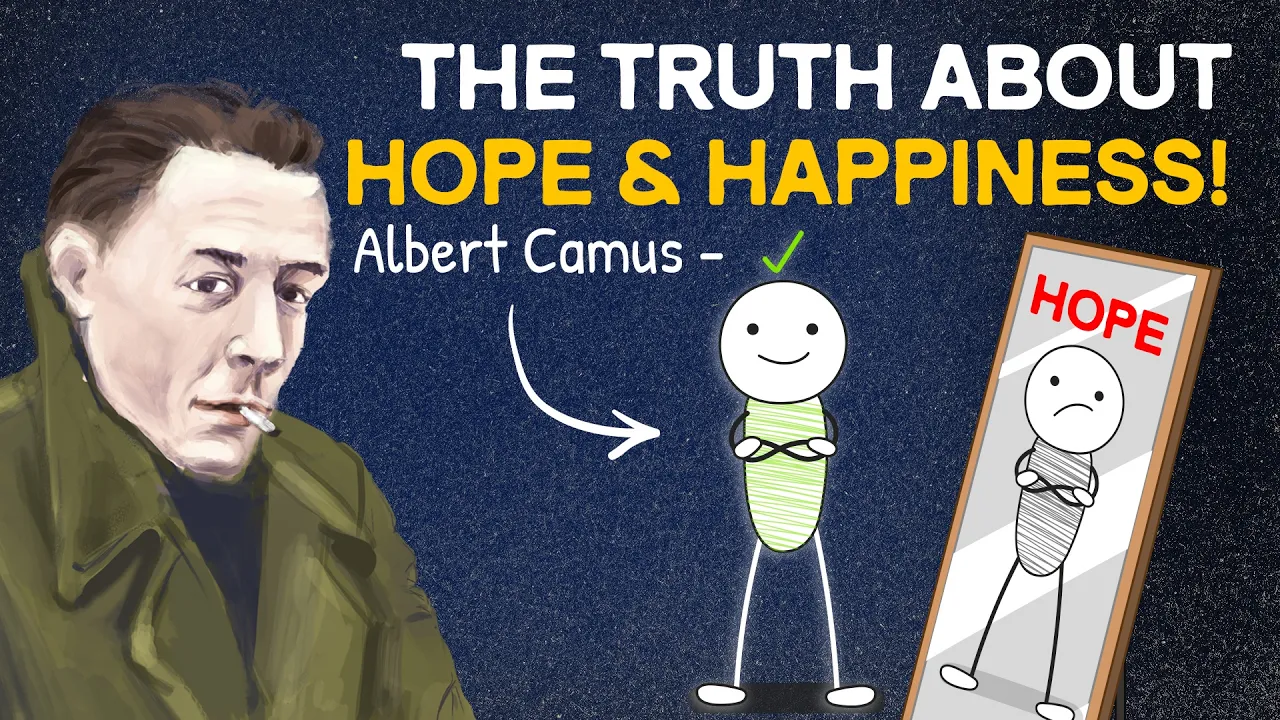
Albert Camus was a French-Algerian philosopher, writer, and journalist best known for his ideas on absurdism—the belief that human beings naturally search for meaning, yet the universe remains silent. This tension between our need for purpose and the world’s indifference is what he called "the absurd. " But rather than seeing this as a reason to sink into despair—the feeling that life is hopeless—Camus argued that we should accept it and focus on living fully in the present.
His most famous books—The Stranger, The Myth of Sisyphus, and The Plague—challenge the way we think about life, purpose, and hope. Now, what is hope? It’s the belief that the future will be better than today.
It keeps us moving forward, setting goals, enduring hardships, chasing something—a better job, a loving relationship, or that moment when we finally feel like we’ve “made it. ” But while hope gives us direction, Camus questioned whether our obsession with the future actually pulls us away from the life we have right now. So what’s the alternative?
Instead of waiting for something better to come along, Camus urges that we should embrace the present—to stop looking for meaning in distant dreams and instead find it in the small, everyday moments of life. And let’s be clear—this isn’t nihilism, the belief that nothing matters at all. Camus doesn’t want us to give up; he wants us to let go of the illusion that happiness is always somewhere ahead.
When we do that, we rediscover the richness of life as it is. By understanding Camus' insights, we can learn how to live without hope and still find joy in the here and now. 1.
Accept Life’s Lack of Ultimate Meaning Camus says “The absurd is born of this confrontation between the human need and the unreasonable silence of the world. ” The first thing Camus teaches us is this: accept life for what it is—without expecting it to follow some grand plan or hidden purpose. From the time we’re kids, we’re told that life is supposed to have meaning, that we each have some higher purpose just waiting to be discovered.
But Camus pushes back against this idea. He says that if we keep expecting life to hand us some clear answer, we’ll just end up frustrated. We’ll spend years searching for something that isn’t there.
At the core of his philosophy is the idea of the absurd—this uncomfortable truth that we want life to have meaning, but the universe doesn’t seem to care. We look for order, patterns, purpose, but the world doesn’t provide them. And honestly?
This can be a hard pill to swallow. Some people deal with this by turning to religion, some throw themselves into their careers, some set huge life goals—always chasing something that promises fulfillment. But Camus says instead of running from this reality, we should face it head-on and learn to live with it.
So how do we do that? He gives us three basic ideas: Acknowledge it. Life doesn’t come with a built-in meaning.
Searching for a final answer will just lead to frustration. Accept that. Let go of false hope.
Stop waiting for happiness to arrive in the future. We always think that once we get the perfect job, the perfect relationship, the perfect whatever—then life will finally feel meaningful. But Camus is saying, don’t fall for that trap.
and Live fully. Stop treating life like a puzzle that needs solving. Meaning isn’t something you find—it’s something you create.
Enjoy the little things, because that’s where life actually happens. Now, think about how we go through our days. We wake up, check our phones, rush to work, stress over deadlines—always telling ourselves that once we finish this task or hit that goal, we’ll feel accomplished.
But that feeling never really lasts, does it? There’s always another task, another goal, another thing to chase. Camus wants us to step off that treadmill.
Instead of constantly waiting for life to become meaningful, he’s saying: just live. Let’s put it this way—imagine going through your day without trying to control every little thing. No expectation that everything has to go perfectly or that every moment has to be deep and meaningful.
What if you just took things as they came? That shift alone is powerful. It’s a reminder that meaning isn’t handed to us by the universe—it’s something we create through how we live, how we treat people, and how we experience the world.
Camus talks about this in The Myth of Sisyphus. Now, you probably already know this one, but Sisyphus was condemned to roll a boulder up a hill, only for it to roll back down, over and over, for the rest of time. On the surface, it might seem like the most depressing metaphor for life.
But Camus comes to a surprising conclusion: “One must imagine Sisyphus happy. ” His happiness doesn’t come from escaping his fate—it comes from accepting it. He finds freedom in realizing that life doesn’t need some big final purpose to be worth living.
And the moment we stop demanding that life give us meaning, we’re finally free to live it. 2. Finding Meaning Through Actions, Not Answers In the words of Camus; “I rebel—therefore we exist” Camus believed that because life doesn’t come with built-in meaning, it’s up to us to create our own.
But that doesn’t mean pretending life has some hidden purpose waiting to be discovered or ignoring how random and unpredictable things can be. Instead, it means looking life in the eye, accepting it for what it is, and choosing to live fully—even when we know there’s no final reward. Hope is often tied to the idea that something better is coming—that our struggles will be rewarded, that one day things will just "make sense.
" But Camus warns that this kind of thinking keeps us trapped in the future, always waiting for happiness instead of experiencing it. He challenges us to let go of this illusion and see that life doesn’t need hope to be meaningful. Let’s take a quick look at his novel The Plague.
It follows Dr Rieux who treats the sick, knowing full well that he can’t save everyone. His work doesn’t erase suffering, it doesn’t fix the world, and it doesn’t give him some ultimate answer about the meaning of life. But does that stop him?
Of course not! He keeps going because he believes in doing what’s right. Through his actions, he creates meaning—not by waiting for some perfect future, but by showing up and doing what matters, here and now.
Camus builds on this idea in The Rebel. He argues that rebellion isn’t about rejecting life’s meaninglessness—it’s about refusing to let it defeat us. To rebel means standing up for what we believe in, even when the world seems indifferent.
And this doesn’t have to be some grand, heroic act. It can be something as simple as staying true to your values, putting real effort into your work or art even if no one notices, or choosing to be kind in a world that often isn’t. And it's here where Camus completely breaks from nihilism.
Nihilism says that since life has no meaning, nothing matters. Camus says the opposite. He argues that instead of giving up, we should throw ourselves even more into life—appreciate the small things, be present, create our own sense of purpose.
Because at the end of the day, meaning isn’t something we find—it’s something we build. Think about it. Maybe you take a longer walk home just to catch the sunset—not because it serves some higher purpose, but simply because it’s beautiful, and it makes you happy.
Maybe you make time for dinner with friends, because real connection matters more than waiting for life to hand you meaning. Maybe you choose to love someone even without knowing where the future will take you. Or you follow a career that excites you, even if there’s no guarantee of success.
These choices—however small—are acts of rebellion. They’re proof that even in a world without built-in meaning, we can still live with purpose, with joy, and with a deep appreciation for the present moment. 3.
Live fully, unapologetically According to Camus “To be happy, we must not be too concerned with others. ” One of the most freeing ideas in Camus’ philosophy is his call to live authentically—to be yourself in a world that constantly tries to shape you into something else. Think about it.
From the time we’re kids, we’re told who we should be, what success looks like, and what kind of life is worth pursuing. We follow certain paths, not always because they feel right, but because they’re what’s expected of us. Camus challenges this.
He says real freedom comes from breaking away from those expectations and choosing your own way—fully, unapologetically. But let’s be honest—this isn’t easy. Living authentically means asking hard questions.
Why are you on the path you’re on? Is it because it excites you, or because it’s what society, your parents, or your peers expect? Are you chasing certain goals because they truly matter to you, or because they look good on paper?
It takes real courage to stop and reflect on these things. But once you do, you gain something invaluable: control over your own life. Now, this doesn’t mean making some dramatic rebellion overnight.
It can start small. Maybe you’ve always wanted to write, but you’ve convinced yourself it’s not practical. Living authentically doesn’t mean quitting your job tomorrow—it might mean setting aside time each night to write, joining a local writing group, or even sharing your work online.
Little by little, you start making choices that align with who you truly are, rather than who you’re “supposed” to be. And authenticity isn’t just about big life choices. It shows up in the little things, too.
Maybe it’s how you dress, what music you love, or the way you speak up in conversations instead of just going along with what others say. It’s about being honest with yourself and refusing to shrink just to fit in. Camus put it best: “The only way to deal with an unfree world is to become so absolutely free that your very existence is an act of rebellion.
” But, What does that mean? It means that simply being yourself—fully, without apology—is a form of resistance in a world that wants you to conform. So maybe that resistance is saying no to a path that doesn’t feel right.
Maybe it’s setting boundaries. Maybe it’s making time for what truly fulfills you, even if no one else understands why. Over time, these little choices add up.
And before you know it, you’re not just existing—you’re actually living on your own terms. 4. Embrace Struggle To quote Camus "There is scarcely any passion without struggle”.
Camus didn’t shy away from the fact that life is full of challenges. He believed that struggle is just part of being human—and if we face it head-on, we can actually find growth, self-discovery, and even happiness. Instead of sitting around hoping for a future without problems, he urges us to see challenges for what they really are: chances to build resilience and inner strength.
Think about nature. A tree that grows in harsh conditions, battling strong winds and rocky soil, often ends up stronger and more grounded than one in a perfectly sheltered spot. The same goes for us.
The struggles we face—whether in work, relationships, or personal growth—aren’t just obstacles. They shape us. Happiness doesn’t come from avoiding struggle; it comes from engaging with life fully, even when things are tough.
So how do we apply this? It’s all about shifting how we see setbacks. Instead of treating them like failures, we can look at them as lessons.
Losing a job, facing rejection, or dealing with personal struggles—it can all teach us something… if we let it! And over time, this mindset builds real confidence and resilience—the kind of happiness that doesn’t rely on outside factors or some "perfect future" that may never come. Even on the hardest days, small moments of strength matter.
If you’re stuck in traffic or dealing with a tough conversation, try shifting your focus. What can you take from this moment instead of just wishing things were different? Camus’ words, "In the midst of winter, I finally learned that within me there lay an invincible summer," remind us that happiness isn’t something we have to wait for—it’s something we create, even in difficult times.
Camus challenges the idea that hope is always a good thing. Hope can pull our attention away from the present, making happiness feel just out of reach, as if it’s something that only happens when everything finally goes right. But that’s an illusion.
Instead of relying on hope, Camus pushes us to finally engage with life as it is—messy, unpredictable, and full of struggles. When we embrace challenges, learn from setbacks, and find strength in the process, we stop living for "someday" and start appreciating what’s in front of us. Struggles aren’t roadblocks to happiness—they’re part of life itself.
And happiness? It’s not something we have to chase; it’s something we create by living fully, right here, right now. 5.
Love life as it is In our final quote from Camus for this video, he says; “Real generosity towards the future lies in giving all to the present. ” Let’s be honest—how many of you have ever caught yourself thinking “Once I graduate, then I’ll be happy! ” or “Once I land that job, life will really start!
”? Or maybe it’s “Once I’m in a relationship” or “Once I finally take that trip to Europe”. We all do this, all the time.
Our culture thrives on the promise of a better future. We read self-help books, watch motivational speeches, and plan for the perfect life. And don’t get me wrong—having goals isn’t a bad thing.
But if happiness is always tied to some future event, we end up missing something crucial: the fact that life is happening right now. This isn’t just a philosophical idea. It’s something Camus explores deeply in his writing.
Take The Stranger. Meursault, the protagonist, doesn’t spend his time overanalyzing life. Instead, he experiences it through his senses—the warmth of the sun on his skin, the scent of salt in the air, the way the light shimmers on the sea.
In Nuptials, Camus writes “To feel the warmth of the sun on your skin is already to live. ” Here the sun isn’t just a symbol, its a force that commands you to be fully present. To feel it on your skin.
To smell the sea breeze. To exist in the moment. This is what Camus means by living without fixating on the future.
Not in a pessimistic way, but in the sense of letting go of the idea that happiness is somewhere else. Instead, he invites us to fully engage with life as it is. Not how we wish it were.
Not how it might be someday. But how it is right now. But, what does that actually look like?
It’s simpler than you think. The next time you’re eating, actually taste the food instead of scrolling on your phone. When you’re stuck in traffic, don’t just stew in frustration—turn on your favorite song, look at the world around you.
And when you’re with a friend, stop worrying about trying to say the perfect thing. Just be there. Think about the last time you were truly present.
Not half-listening to a friend while checking your phone. Not eating dinner while binge-watching a show. Just there, in the moment.
One of the most powerful ways to do this is by experiencing life completely through your senses. Sight, sound, touch, taste, smell—these are what anchor us in now. They don’t drag us into the past with regrets.
They don’t send us spiraling into the future with worries. They root us in what’s real. Take a simple moment, like stepping outside on a warm day.
Instead of just noting that it’s sunny, really feel it. Notice the heat of the sun on your skin, the contrast of cool air in the shade. Listen to the rustling leaves, the hum of distant traffic.
Smell the faint scent of grass, pavement, or someone’s coffee from down the street. This is exactly what Camus captures in Nuptials—not a world of ideas, but a world of sensation. The weight of the sun.
The salty wind. The brightness of the sea. It’s as if the world itself is demanding that you pay attention.
And you don’t have to be standing on a Mediterranean shore to do this. You can engage your senses anywhere. Eating a meal?
Slow down. Taste every bite instead of rushing through it. Notice the texture, the spices, the warmth or coolness of the food.
Listening to music? Don’t let it be just background noise. Close your eyes and really hear it—the rise and fall of each note, the beat, the way it makes you feel.
Walking somewhere? Pay attention to your steps. Feel the ground beneath your feet.
Notice the colors around you. Breathe in the air, especially after it rains. When we experience life through our senses, we stop just existing—and start feeling alive.
We don’t have to wait for some perfect moment in the future. Joy is already here, woven into the textures, sounds, and sensations of everyday life. So don’t wait.
Life isn’t going to start once everything is perfect. It’s already happening. The question is—are you paying attention?
In conclusion Camus is telling us that every day is a chance to start fresh. Meaning isn’t something you find later—it’s something you create by the way you live. The way you talk to people, the things you pay attention to, the simple joys you allow yourself to feel.
Life doesn’t come with a script, and that’s a good thing. It means you get to decide what matters to you. And happiness?
It’s not in some distant dream—it’s right here, in the way you live today. If you enjoyed this video and found it helpful, do give it a like, make sure to check out our full philosophies for life playlist and for more videos to help you find success and happiness using beautiful philosophical wisdom, don’t forget to subscribe. Thanks so much for watching.