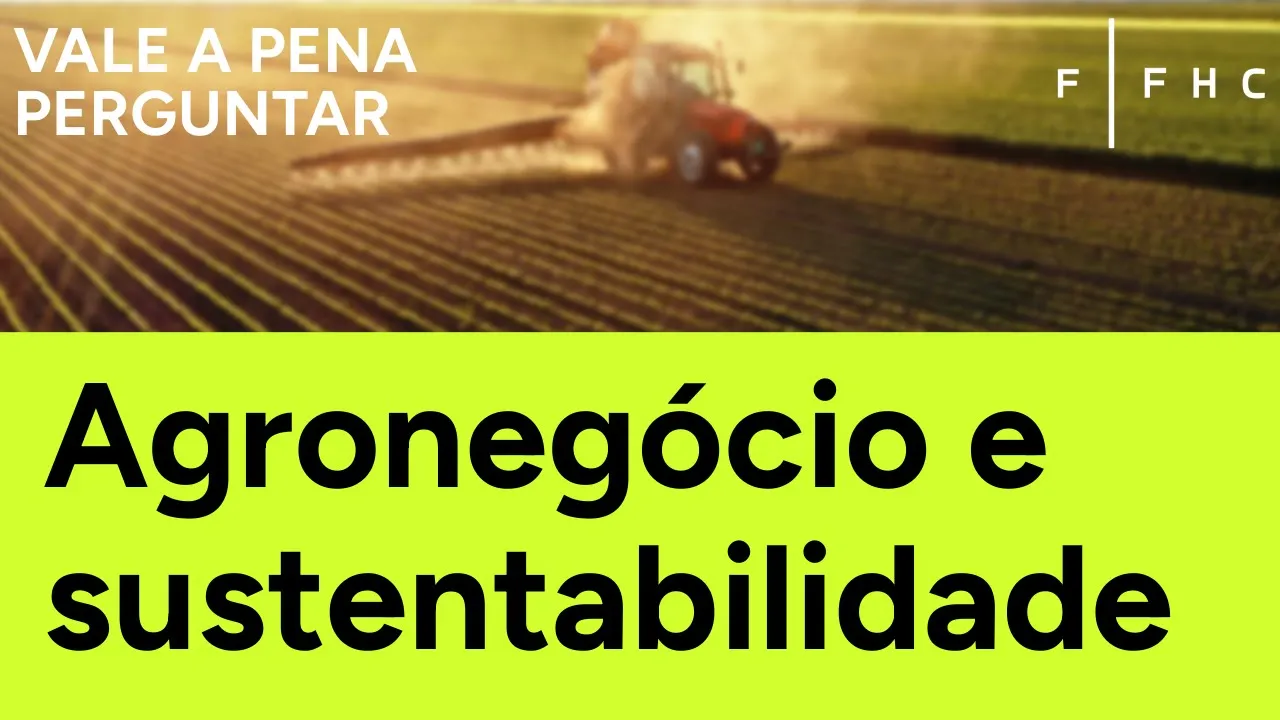
When we talk about agribusiness, people already have in mind a cotton harvester, a lot of them passing by each other. But it's not like that. Agribusiness is very heterogeneous and it has everything within it.
Before the 1970s, agriculture and livestock development in Brazil took place largely on the coastline. So we had an occupation very much based on tropical products. We were producers of tropical products.
Then we went through other cycles, a little more recently. The rubber cycle, the cocoa cycle, the coffee cycle, which was very important. Then, around the mid-1960s, some farmers began to occupy more of the interior of the states.
So we occupy the southern region, further west. When soy is introduced. Also due to a government incentive during the military era.
Brazil creates Embrapa, which is one of the main agricultural research companies in the world, a public company. During the same period, from the end of the 1960s, the 1970s to the mid-1980s, the Brazilian State created a public network of technical assistance and rural extension companies, with branches in all states, which took this technology to producers. But the Brazilian State didn't just do research and didn't just disseminate research.
It also financed the adoption of these modern technologies. Soy is the main example. It is originally from a temperate climate and was fully adapted to the conditions of the Cerrado.
Until 1970, 1975, Brazil was a food importer. There was an effort to make Brazil assume food sovereignty, And then, in 1990, we had this shock of deregulation, so there was a huge opening. And that also exposes agriculture to the international market.
Until the mid-2000s, Brazilian agriculture did not pay attention to something that would later be called low-carbon agriculture. The vast majority of producers, of what is done, is the conventional model. It's monoculture, and monoculture is the opposite of valuing biodiversity.
It's has a very high use of pesticides and many pesticides are related to the so-called limits of the planet. And then we have a piece within the scope of the Safra Plan, of the set of contributions that the Brazilian State makes to this sector, which is the ABC Plan, aimed at low-carbon agriculture. So, it's very asymmetrical, I would say, we have an archipelago of initiatives guided by the idea of sustainability in an ocean of conventional production and behaviors.
Brazilian agriculture is very complex. On the one hand, there is agribusiness. On the other hand, there is family farming.
What needs to happen in Brazil is a de-ideologization of the lagging sectors of agribusiness to understand that having a more consistent approach to the environmental agenda is a question of economic viability of agribusiness itself. The technologically advanced sector that incorporates decarbonization is not in the ruralist caucus. And one of the reasons for that is that they are successful, cosmopolitan, frontier businessmen and women and going into politics would eventually be a deterioration in their quality of life because in the company they can innovate and in politics they would have to go through another type of process.
But that could change. It is important that this sectos has representation in the ruralist caucus. There were ups and downs in the relationship between environmentalists and the agricultural sector in Congress.
There were moments of more closeness and moments of more conflict. More recently, I think we are seeing an apex of conflict. We have been making gains in terms of the importance of the agenda, of sustainability in the public debate, but we are far short, both in terms of volume, intensity and in terms of the speed of what is necessary given the pace of climate change.
In the Cerrado it is much more difficult because most of the deforestation is legal, because the forest reserve area of each property is only 20% in the Cerrado, in the Amazon it is 80%. It is easy in the Cerrado to control illegal deforestation, but legal deforestation would mean changing the Forest Code. And obviously the ruralist caucus will not allow this.
What is Brazil's profile regarding emissions? It's a very peculiar one, because 49% of our emissions come from changes in land use and forests. This is deforestation.
The second source of greenhouse gas emissions generation is agriculture and farming, with a large weight in livestock farming. It is entirely possible to reconcile agriculture and farming and the reduction of deforestation in Brazilian biomes. And who says this are the agribusiness leaders when they draw attention to the fact that a good part of the increase in production in Brazilian agribusiness in the more recent years comes from increased productivity and not from the expansion of the area.
Our average livestock productivity is very low. Brazil has the potential to increase livestock productivity by up to 400, 500%. I think it involves compliance with the Brazilian Forest Code.
It is a legislation that induces the modernization of agriculture because at the moment it determines the legal reserve, an area that has to be preserved, it ends up being an inducer of productivity. So I want to believe that in a short time it is possible for agribusiness to become more sustainable, because technology is already available. We must change the direction in which money goes, so it goes where it needs to.
Think about a producing farm, recover water sources, maintain the areas that the Forest Code requires for ecological and animal health reasons, to keep green or keep protected, use less chemicals, carry out sustainable agricultural production that in a short time much of the status quo can be reversed. Another way is to keep the forest standing. But what will make a producer keep the forest standing?
It needs to be a business for him/her, more attractive. In addition to what the law requires. But that needs to be a more attractive deal than deforesting as much as possible within the property.
But, although we already have legislation on payments for environmental services sanctioned in Brazil, we still lack financial instruments that actually give traction to keeping the forest standing, Industry needs financing, agriculture needs of financing. So, if the financial sector adopts stricter sustainability criteria, this will force an adjustment in the behavior of several other agents. Agriculture itself, in a certain sense, needs to reinvent itself.
here are actors and sectors in agribusiness that are doing this. They need to have more strength. Crop-livestock-forest integration is growing a lot when we talk about crop-livestock integration, there are still many doubts on the forestry component.
For example, how much space is needed between trees so that the machine can pass to harvest? There are paths. Maybe a law isn't needed for that, it has to be planned .
And it could even be a pact with the ruralists, a kind of more ambitious ABC schedule, that says: "in two years, 40% of public resources for agribusiness have to be ABC. Then 60%". There are some figures from 2022 that were circulating in the newspapers that the ABC program in the Safra Plan didn't amount to 2% of the resources.
Brazil as an agro-export country is exemplary in quality, in volume, in logistics. It's no surprise that we are the biggest exporters. We are food providers for the planet.
And it won't take long, I think, for Brazil to be a sustainable agro-exporter, because many of these groups have already understood or already come with this DNA. So we have excellent examples coming from this sector. So, good news.
We have a small group, I would say, that didn't follow these trends, that didn't care, that is the predatory agribusiness that is the agro that is living that usurping colonialist mentality, that still has a voice, that still has political weight, that still elects a lot of people to Congress, who still elects executives, and that still has a short-sighted mentality.




![Agrofloresta - agricultura recuperando o meio ambiente [2019]](https://img.youtube.com/vi/uSiuV0CkREM/maxresdefault.jpg)

![[Home gardening] Stop buying tomatoes. Grow them at home You Will Be Surprised!](https://img.youtube.com/vi/Em3renW616U/maxresdefault.jpg)