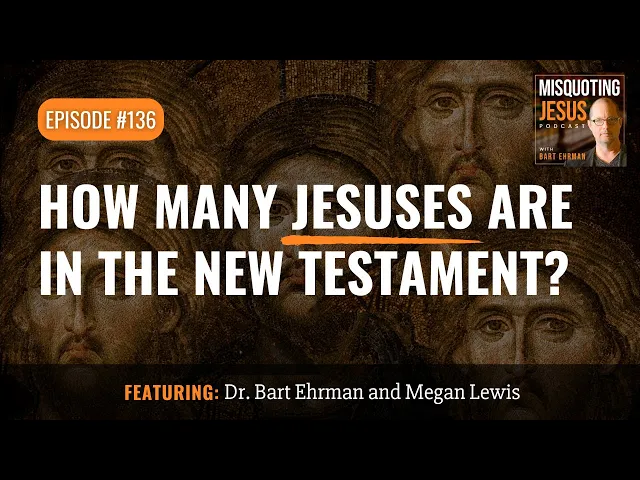
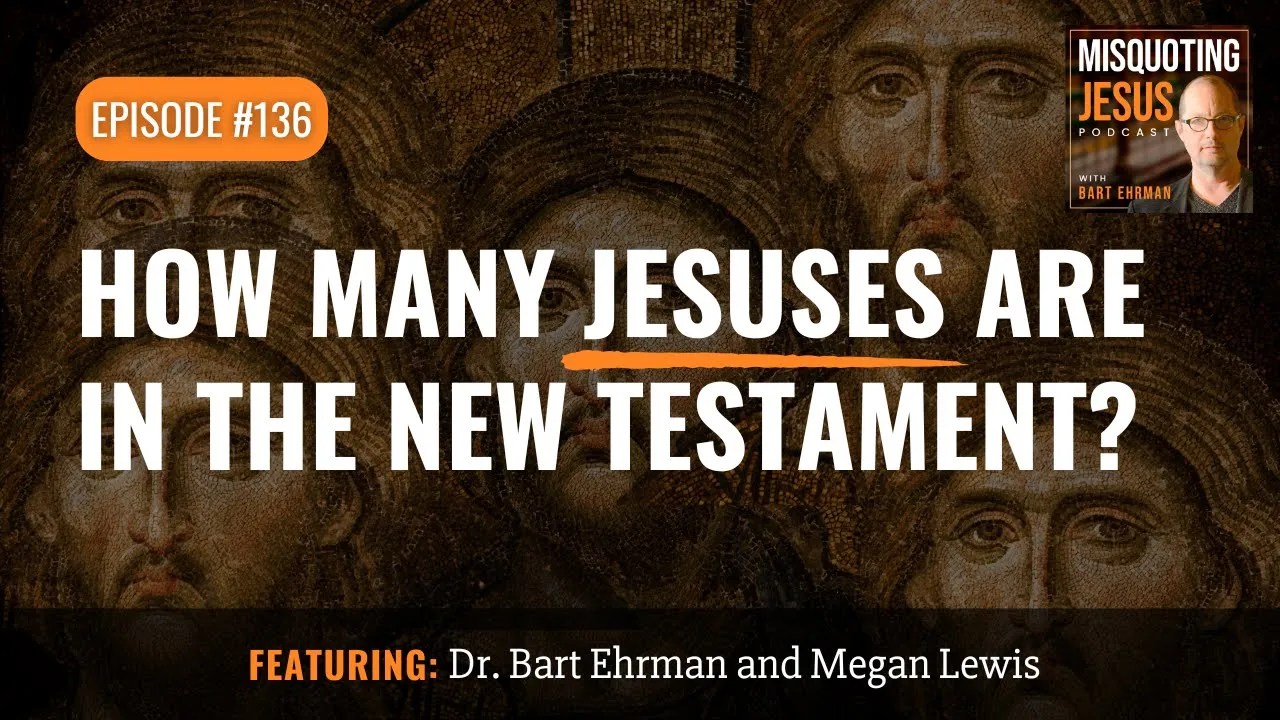
Today's title may seem a little bit odd. How many Jesuses are in the New Testament? I'm sure there are going to be several comments on YouTube from people who didn't stay to watch the episode because the answer is very clearly one. For those who want to see where we go with this, Dr. Bartman is going to be answering my questions on the different ways early Christian writers of the New Testament viewed and understood Jesus and whether all of those views and perspectives can be embodied in a single figure. Welcome to Misquoting Jesus with Bart Urman.
The only show where a six-time New York Times best-selling author and worldrenowned Bible scholar uncovers the many fascinating, littleknown facts about the New Testament, the historical Jesus, and the rise of Christianity. I'm your host, Megan Lewis. Let's begin. Welcome back, everybody, to Misquoting Jesus. Today we are talking about the myriad of ways Jesus is depicted in the New Testament. Before that though, but good morning. How are you? Yep. Doing well. Um in uh getting uh getting into a travel season for me. We uh we t we tend you know Sarah's English so we as you
know we tend to go over there every year and uh we're going to be doing that and doing some other trips. And so it's a it's a very uh you know for you and you you and me both life's very busy but busy in different ways and um when when I travel I always work. So it sounds like it's all going to be fun which it is always fun but you like yeah I'm always working on something. So it's not it's not like I'm just I'm not kind of a sit sit on the beach you
know for a month kind of guy. How about you? You don't look like you're a sit on the beach person either are you? Uh I am. I am very bad at sitting still. Um, even if we're just sitting and and watching the TV, I've usually got sewing or knitting or a laptop in my lap. Um, it just it does not I get very fidgety if I don't have something to do with my hands or my brain. Um, yeah. Well, these aren't value judgments, you know. It's not like one one way is better than another. It's
just people who they are. And I would I would love to be able to just sit still and rest, but my brain is is not a fan of either of those things. Actually, I get it. Even the sitting still thing. People will notice when we do our interviews like I'm wiggling on my chair. I'm put picking my legs up and putting them down again and like shifters. It must be exhausting to watch. And I I do apologize to everyone and thank you for your your patience with me. Well, I think I think next time we
do one of these, we should, you know, your camera should focus on your legs so we could just kind of see how how like I they're just switching all over the place. That would be an an interesting show. All right, so I did the the topic reminder. We're talking about the ways Jesus is depicted. We have listeners questions coming up and then I'm going to put Bart on the spot and ask him to give us an update on his book after all of that. But we're going to open as we always do. But how did
you first start to think about how many Jesus's gi let's go with Jesus's are depicted in the New Testament? Um yeah. Well um you know it was in graduate school. Uh, I uh I obviously always knew that Matthew and John were not the same gospel and that John had a different portrayal of Jesus than Matthew and that Luke and Mark were different and Paul had I mean I realized that there were different emphases but I think I always uh understood it as different emphases rather than distinctly different portrayals. Um, and it wasn't until I was
in graduate school and I started recognizing not just that there's like a contradiction here or there in the gospels, but that that the overall messages uh were were not the same. And I started noticing that Paul for, you know, Paul doesn't talk about Jesus teachings, you know, like it's not a big deal. He mentioned he like quotes two of them. And so um and so uh I I realized you know his view isn't the same as Mark's because Mark spends or you know a lot of time on Jesus miracles and Paul doesn't talk about Jesus
miracle. Matthew has long discourses. Paul doesn't have discourse. And I started realizing it's not just that one is emphasizing something. They actually have a different thing they're trying to say about Jesus. They have a different portrayal of Jesus. And eventually I came to see that they actually these different authors on a deep level actually have different understandings of both who Jesus was and why he was important. And that strikes me as that's significant because it isn't that the New Testament portrays a unified figure Jesus. There are different portrayals and they you know it's not that
you should reconcile them. You know, it's not that like you try and mush them together into the 27 portrayals into like one portrayal because then you just, you know, you're not accepting the portrayal of any one of them. So, before we get into the New Testament specifically, was there a lot of variation in how early Christians understood or viewed Jesus? Oh boy. Yes. I mean, I mean, it depends what period you're talking about, but uh almost any period there are differences. I mean, when you in the second century, you have you have these wildly disperate
views. You, as we've talked about before, I mean, you have you have pe you have people in the second century saying that Jesus was a human being born to Joseph and Mary who had had, you know, they they they had sex and Mary conceived him as a child and he was a righteous person who was more righteous than the rest of us, but he was completely a human being up down the line. And you have other people saying Jesus was not a human at all. He was a he was a divine being. He was God
on earth. He didn't really he didn't really, you know, have to eat, you know, he didn't really have to do anything. He was just here as an appearance and he wasn't really a flesh and blood human being. And yet people who said, "Oh, yeah. Well, Jesus Christ is actually there were two things. There's this man Jesus and there's this divine thing, divine element that came into Jesus and and inhabited him and and there were two beings, Jesus and Christ." And and so those you know those are some of the extremes but you have like you
have all sorts of options by people in the second century. And so the big that that has been long known and recognized by scholars but the big issue ended up being in the last several hundred years is whether the whether the variety you find later can be represented earlier. You you don't have these extreme views earlier but do you have different understandings of who Jesus is even in the New Testament? So do we see this same range of understandings within the New Testament or is it a more coherent unified vision? It's uh you get a
range you get you get a definite range that is uh there are striking differences. I would say that the differences get exaggerated over time um as people will kind of take take the ball and run with it in different directions. But you clearly have very very different views of Jesus throughout the New Testament. I mean uh I mean you like where do you turn? Suppose you take the first and last books of the New Testament. You know the book of Matthew and the book of Revelation. Matthew Jesus is a pacifist who teaches that you have
to love others and sacrifice yourself for others and it's all about loving others and and it's it's nonviolent and that Jesus is is a pacifist. There you get to the book of Revelation and the Revelation is about the wrath of Christ, the wrath of the lamb who not only um destroys himself, most of the human race, but in in passages actually tortures people for months. He he sends torments on earth that torture people hideously for five months with so much pain that they can't stand it, but they're not even allowed to kill themselves to get
get rid of it. That's Christ doing this in the book of Revelation. And so, well, uh, you could say, well, that's two sides of Jesus, but I'm saying these are not the two sides that can be reconciled. This is, you know, uh, in my view, I and the only reason you would be tempted to reconcile them is because you find them both in the Bible. If you had these two books outside the Bible, nobody in the planet would think this is the same person. Um, it's only because later church fathers put these within the same
scriptures that you think, well, they've got to be reconciled somehow. Now, we've talked before on the podcast about the ways in which each of the gospel writers emphasizes different elements of Jesus' story or maybe his personality depending on the point that they're trying to make within their writing. But I think it's probably worth briefly recapping for people who haven't heard those specific episodes. So, I wanted to ask you to just start with Matthew. What does Matthew say about Jesus? How does he portray him? So um Matthew's big emphasis is that you have to understand Jesus
as the um as the fulfillment of scripture and that he is he's portrayed in a very Jewish way. Um Jesus is um uh his birth is predicted in multiple ways according to Matthew. He specifically quotes scripture that um he was supposed to be born of a virgin according to the book of uh Isaiah. uh 7:14 he's supposed to be born in Bethlehem according to Micah 5:2 he had to go down to Egypt to flee the wrath of Herod because of Hosea 11:1 and that and that already at the beginning of Matthew it's all in order
to fulfill scripture because Jesus is the Jewish Messiah um as predicted and as the Jewish Messiah he's very he's portrayed as a very is as as a Jewish teacher um he's portrayed like Moses when you see how Jesus is born that the narratives themselves are uh align with the life of Moses in the book of Exodus where you know he's he's um the the the king is out to kill him. He has to be hidden away. Um there's um you know he goes through the water of baptism as opposed to the the dead the the
Red Sea. He goes up on a mount. He gives the law. He's he's he's being portrayed as a Moses figure. He gives the law to his people as uh Moses gave law to his people. Um and Jesus affirms Moses. He doesn't set himself up as an opposition to Moses in Matthew. He's he's like Moses again. And he tells people how to follow the law of Moses that Moses said this and to to do what Moses says, you have to do that, you know. And so, um Moses said, "Don't commit adultery." And I say to you,
don't even lust after another person in your heart. Moses said, "Don't kill." Bill, I say, don't even get angry. He's not contradicting Moses. He's he's showing what Moses really was all about. He tells his followers, they have to keep the law of Moses. You have to keep it better than the scribes and the Pharisees. You in fact have to do what the Pharisees tell you to do. Uh don't do what they do because they don't practice what they preach. But what they tell you is right. And so this is a very uh it's a very
Jewish portrayal of Jesus. And but it does climax with him um dying on the cross for the for the sins of others. And so he is he's the fulfillment of uh everything in the Old Testament as God had planned and his death brings brings salvation to the world. Thank you. Now, how about Mark? What is Mark emphasizing with his portrayal of Jesus? Well, you know, Mark was written before Matthew. And so, in some ways, when you compare Matthew and Mark, what you really you're really compar doing more is you're comparing Matthew Yeah. You're not comparing
Mark to Matthew so much as Matthew to Mark, if you see what I mean. because uh Matthew came later and actually used Mark as a source. One of the striking things about Mark is that many of the ethical teachings that you find in Jesus, most of them, most of the ethics, most of the parables that you find in Matthew are not found uh in Mark. Mark is a lot more action and a lot less teaching. Um there's no there's no virgin birth in uh Mark. There's no account of Jesus uh birth at all. He shows
up uh as an adult. Um he does fulfill scripture, but it's not an emphasis uh of Mark uh at all. The Jewishness of Jesus is not as uh present uh in Mark. Mark's Mark's overall portrayal um in many ways is like Matthew's. Uh, one distinctive element of Mark that you don't find emphasized in Matthew is that that in Mark Jesus is this Messiah who has to be crucified. And it's not that that because that's fulfilling scripture. Uh, but it but the thing is that nobody can understand him in Mark that he he is the crucified
Messiah, but nobody can figure out why he has to be killed. Um and uh Jesus tries to keep his identity secret in Mark. He doesn't want anybody to know who he is. Um in uh Mark's gospel, this is somewhat true of of Matthews as well. There's no word about Jesus being a divine being on earth uh while he's during his ministry. Um and so there's no there's no sense that he is like a god man. He does miracles in both. Uh, and people say then, well, if he's doing miracles, he must be God. But of
course, that doesn't make any sense because people think today that people can do miracles. It doesn't make them God. And everybody recognizes that in the Old Testament, Elijah and Elisha and other people do miracles. It doesn't make them God. Jesus does miracles in these books, but when he preaches, he doesn't preach about himself as being a divine being. He never talks about himself as being a divine being. in Mark, he's not he's not born of a virgin. Uh, and he's there's nothing about his his miraculous beginning. Um, and in Mark, he really he um he
seems fully human to the end. Um, he he goes to his death in despair. Um, when he's hanging on the cross, he's he's abandoned by everybody, forsaken by everybody. Uh, people are mocking him while he's on the cross. And at the end, his only words the entire time on the cross are, "My God, my God, why have you forsaken me?" And people try to get around that that he's wondering why he's forsaken. They they have explanations for it. But if you just read Mark, that's what Mark wants to emphasize. He feels forsaken on the cross.
And then and then he dies. But the death ends up bringing salvation because when he dies the curtain in the temple rips in half uh which shows that God now is not isolated from his people. The curtain was separating the holy of holies where God dwelt from the world and now the world has access to God because the curtains ripped in half with the death of Jesus. So in Mark, you get an emphasis less on him being the um you know the Jewish Messiah who's like Moses who gives the law, wants you to be Jewish,
wants you to keep the Jewish law. You don't get that. You get that he's trying to keep his identity a secret and that um but that even though uh it's mysterious and people don't know it, God's working behind the scenes to bring salvation through his life. I would say with those two gospels, Matthew and Mark, um it is not it's not as difficult to reconcile those two portrayals as it's going to be with the others. We're going to be getting to those other two gospels just in a brief moment. We're going to take a break
and we'll be right back. How well do we really know the gospels that shaped Christianity? The New Testament books of Matthew, Mark, Luke, and John are the cornerstones of our understanding of Jesus. But how reliable are they as historical documents? In the Unknown Gospels, Matthew, Mark, Luke, and John, join Bible scholar Dr. Bart Urman as he takes you on an illuminating journey through these ancient texts. Across eight captivating lectures, you'll explore the origins, authorship, and historical accuracy of the Gospels in an online course. Are these accounts based on eyewitness testimony or are they a mix
of history, myth, and legend? What do historians see that most readers miss? This course is an opportunity to dive deep into the stories that have defined a faith, questioning their origins and understanding their impact. Ready to uncover the truth behind the Gospels? Visit bartermanman.com/gosspels to learn more or sign up today. Use discount code MJ podcast at checkout for a special [Music] offer. Welcome back everyone. We are talking about the different ways in which Jesus is depicted in the New Testament and whether these depictions are reconcilable or if these are just completely different figures. Bart has
already talked about uh the portrayal in Matthew and Mark and a bit about Revelation. So, we're going to head on into Luke now. How is Luke depicting Jesus? I think once you get to the third gospel, Luke is where you start finding some significant differences. Not not just like differences that um you know different emphases, but differences that are really hard to reconcile with what you find uh in in Matthew and or Mark. Um Luke like Mark has a birth narrative uh where Jesus is born of a virgin in Bethlehem. But if you compare carefully
Luke's stories with Matthew's stories in the first two chapters of the birth narratives, they're very different in significant ways um just to give you one. For one thing, all the stories are different. If you read what Matthew has to say about Jesus' birth and what Luke says about the birth, the they're just different stories up and down the line with the consistent themes of being, you know, ver virgin birth in Bethlehem sort of thing. Um but the stories are different, but they're not only different, but they have they have different understandings of Jesus. If you
ask Matthew, why was Jesus born of a virgin? It's quite clear. Matthew says Jesus was born of a virgin to fulfill the prophecy of Isaiah 7:14. It's to show that he really was the Messiah. Luke doesn't say anything about that. What Luke says is that Jesus was born of a virgin to show that he really was the son of God. God got Mary pregnant. That's why he's born of a virgin. Well, that's a different view. And that's not necessarily a contradiction, but it is it's a different view. And neither gospel um alludes to the other
view. So Luke is trying to say one thing, Matthew's trying to say something else. And you get that throughout uh throughout Luke's gospel that there are differences. Um and some of them actually do seem to be differences that matter. I'll give you two. One is um I mentioned that in Mark uh and Matthew agrees with this that at the end Jesus feels forsaken at the end that he's uh in despair. Um in Mark's gospel when Jesus is condemned to death. Um he's not he's silent throughout his entire trial. He's silent. He's sent off to be
crucified. He's silent on the way to crucifixion. He is silent while he's nailed to the cross. He's silent while he's hanging on the cross. He's silent until the very end and the only thing he says the entire procedure is, "My God, my God, why have you forsaken me?" He dies. Luke has a very different way of portraying Jesus going to his death. Jesus on the road to crucifixion in Luke is not silent. He sees these women by the side of the road weeping and he turns to them and he says, "Daughters of Jerusalem, don't weep
for me. Weep for yourselves and for your children, for what's going to happen to you." And so he's feeling more he's feeling sorry for them and he's telling them and he's you know he doesn't seem to be at all you know upset about what's happening to him while they're while he goes to the place of crucifixion. They nail him to the cross and he's not silent. He prays father forgive them for they don't know what they're doing. Okay? So he knows what they're doing. He's hanging on the cross in Luke's gospel. In Mark's gospel both
of the other robbers mock him. Both the other criminals being crucified mock him. In Luke, only one of them mocks him. The other turns his head to Jesus and he says, "Lord, remember me when you come into your kingdom." And Jesus says to him, "Truly I tell you, today you will be with me in paradise." So he's not feeling forsaken of God. He knows what's happening to him. He knows why it's happening to him. He knows what's going to happen to him after it happens to him. He's going to wake up in paradise and this
guy's going to be with him. And then at the end, maybe most telling of all, Jesus does not cry out, "My God, my God, why have you forsaken me?" He doesn't say that in Luke. He says, "Father, into your hands I commit my spirit." He dies. So, it's a it is not the same portrayal. And what people do is they take Mark's portrayal and they take Luke's portrayal and they smash them together and then they come up with like a different thing. And then they add Matthew and they add Luke, John. They end up with
the seven last words of the dying Jesus which are found in none of the gospels. And if you have Luke's calm and controlled Jesus who knows exactly why this has to happen to him versus Mark's Jesus who's just wondering what is going on? Why is this why am I forsaken? You know they if you pretend they're saying the same thing, you don't understand either one of them. So what then is the the second thing that Luke's doing well at the crucifixion scene? So again, you know, there are lots of differences between Luke and the others.
So, I'm just pointing to these as kind of two that really strike me as very um compelling and interesting is Luke uh unlike Matthew and Mark, this will sound strange. I'll admit it sounds strange. Luke does not have a doctrine of the atonement of Jesus' death. That Jesus Luke does not have the idea that Jesus death is what brings an atonement for sins. Um so, let me explain that for a second. The idea of atonement is that that Christ died in the place of others. So that other people uh had uh needed salvation because they
sinned uh and they God required a price. Somebody has to die for your sins. The wages of sin is death. And so and so you somebody has to die. Jesus dies in your place. And you definitely get that in Mark and in Matthew. Mark, for example, has this line in Jesus ministry where he says that the son of man came not to uh be served but to serve and to give his life as a ransom for many. He's dying for the sake of others. Luke omits that verse. That's weird. At the last supper in Mark,
Jesus is uh gives him the bread, says, "This is my body." He gives him the cup and says, "This is the cup of the new covenant in my blood that is given for for many." He's going to shed his blood for many people. Luke omits that bit. Doesn't have Jesus saying that he's shedding his blood for many. In Luke's Luke's crucifixion scene, I said that in Mark when Jesus dies, the curtain rips in half, showing at at his death, people now have access to God. In Luke, Luke has the curtain ripping, but it happens before
Jesus dies. It's not showing that his death is what brings salvation. In Luke, it's trying to show that in fact, Jews have brought the judgment of God upon themselves, that God's going to destroy their temple because they're killing their Messiah. But the death of Jesus does not bring atonement. And the the clearest ev ev ev ev ev ev ev ev ev ev ev ev ev ev ev ev ev ev ev ev evidence of this is that Luke has a second a second book the book of acts which talks about the spread of Christianity through the
ancient world. And it has the apostles giving preaches to convert people and it happens chapter 2. It happens in chapter 13 through whether it's Peter whether it's Paul everybody they basically have the same message which is that Jesus died and he was innocent. That just shows how guilty people are. or how badly they sin. They killed this innocent man. And when people realize that this horrible thing has happened to somebody who's innocent, they feel guilty for their sins, for their own sins, and they turn to God and they ask God to forgive them. And if
people repent for their sins, God will forgive them. It's not that Jesus death pays the price for someone else. It's not that the death is an atonement. The death is a motivation for people to repent so God will forgive them. Forgiveness does not require a payment. Forgiveness is when you just let it go. Atonement is when somebody has to pay a price. Mark and Matthew have a doctrine of atonement. Luke has a doctrine of forgiveness. And it's not the same doctrine. That's a rather significant difference. It is. And now, so we've done the the three.
What about John? How does he differ from the others again? Well, you know, um, scholars have long recognized that Matthew, Mark, and Luke are so similar that you can put them in parallel columns. They tell the same many of the same stories in the same words, and you can kind of compare them line by line almost. And John is different. And so they call Matthew, Mark, and Luke the synoptic gospels, the ones that can be seen together, synoptic. And John is always been understood to be a different different kettle of fish. Um, John is very
different in many ways. It has the basic structure. It's it's about Jesus ministry, his miracles, his teachings, his death, his resurrection. And so the broad out the broad things it talks about are the same. But the stories are uniformly different. And when they have the similar when John has a similar story, which is fairly rare, but when it does, um, it's told in very different ways. One of the most key and striking differences is ma major differences is what it is Jesus actually what his mission is and what he's teaching about. Um and in Matthew,
Mark and Luke, all three gospels, Jesus is talking about the kingdom of God that is soon to come and that people need to prepare for it. They need to get ready for this coming kingdom of God because a major catastrophe is going to happen and God is going to destroy everything opposed to him. and he's going to bring in a good kingdom. You need to get ready by turning your life around. John does not have that message. John does not have Jesus teaching about the coming kingdom of God at all. Um in John's gospel, Jesus
teaches only about who he is. That he is a divine being who has come down from heaven in order to deliver the truth so that people can be saved by believing in him. If they'll believe in him, they will have eternal life. and he has come into the world uh from above in order to deliver deliver this message. And once it's delivered, he's going to return whence he came. That is never taught in the Matthew, Mark, and Luke. Matthew, Mark, and Luke do not have Jesus declaring himself a divine being who's come from above. Um
they they are about Jesus preaching about the coming kingdom of God. He doesn't teach about himself in Matthew, Mark, and Luke except to say that he's going to Jerusalem and die. In John, all he teaches about is himself. Basically, he talks about who he is, where he came from, where he's going. And that salvation does not come by uh, you know, by preparing yourself for the coming kingdom of God. It comes by believing in him, believing in Jesus. This affects Jesus miracles in John as well. In Matthew, Mark, and Luke, Jesus will not do any
miracles to prove who he is. He won't provide a sign to people to demonstrate that what he's that what he's talking about is true. He will not do it. In John, that's all he does. His miracles are not called miracles. They're called signs. And he does the signs in order to prove that he really is the man who's come down from heaven to deliver the truth so that people can believe in him for salvation. This is a it's a radically different gospel. Uh not just in its tone and its emphasis, but in its very understanding
of Jesus is entirely different. So, as you've been talking, you've been pulling out differences between these various depictions. Do they necessarily show us or point us to seeing four distinct figures or do you think it can be convincingly argued that the writers are merely emphasizing different aspects of one individual? Um, I would say most most readers assume that they're all have the same portrayal. Um, and most readers assume it on kind of mechanical basic mechanical basis that that um, you know, they're all within the same two covers. It's the same book. If it's the same
book, it's basically the same thing and there'll be different emphases. Christian who are more theological oriented would say that you're getting four distinct portrayals uh, of Jesus that are not contradictory, but that they're complimentary. Um, they're and that to get the full picture, you have to put the four together. Historical scholars tend to argue that differently. They argue that you actually have four different portrayals and your only reason for trying to reconcile them is because you think they need to be reconciled. Um if you have four biographies of say Thomas Jefferson um or say Barack
Obama or say whoever um and they are they not only contradict each other in details but they have different understandings of uh who the person was, what the person said, what the person did and what the meaning of the life was. um that if you had these four portrayals, you would never ever think that the way to get to this is to make them all harmonize because if you harmonize the four, then you're not understanding any one of them because you're making this biographer the same say ultimately the same thing this other biographer is saying.
And that, you know, nobody writes a biography of Abraham Lincoln wants you to think that he's writing the same thing some other biographer wrote because he has a different perspective and it and they're different. But you do that to the Gospels just kind of automatically. And I think it does an injustice to each of these authors. Whoever wrote Mark was not planning on you interpreting this in light of John. Just that isn't what he was thinking. He wanted you to accept his portrayal. So my final question then for the interview is how many Jesuses do
you think are being depicted in the New Testament? Oh, you know that's a great question. I don't think I've ever added them up. This question bringing you basic arithmetic on I think um you know even within the writings of Paul Paul has uh different different understandings of Jesus. If you just if you just kind of take what he says in one verse versus what he says in another verse, there seem to be differences. There are differences within Luke and the book of Acts. I'll just give you I'll just give you one example uh to to
explain why I have trouble counting apart from the fact I wasn't a math major. Um um in in the book of Acts when you have one of the apostles preaching um you'll have something like in chapter 2 or chapter 13. In chapter 13 uh Paul will be preaching a sermon and say that um or in chapter 2 Peter will be preaching a sermon and they'll say that God has fulfilled the promises um that he gave to the fathers by raising Jesus from the dead. Um uh this is in chapter 13 where he'll say um uh
the promises was that um you are my son today I have begotten you. Okay, he's the son go Jesus becomes the son of God at the resurrection today. He's raised Jesus from the dead today I have begotten you. But wait a second in Luke's gospel Jesus is born of a virgin and he becomes the son of God at that point. Then how's it become the son of God at the bapt not only that but at the baptism in Luke the voice comes from heaven when he gets baptized and the voice says you're my son today
I have begotten you. Well how many times does he become the son of God? I mean it depends you know which of these passages and um in in Peter's sermon in chapter 2 he says that when God raised Jesus from the dead he made him Lord and Christ. He made him Lord in Christ. Because in when Jesus is born, the shepherds learn from the angels that today he's been born to you a savior. He's Christ the Lord. He's Christ the Lord at his birth. So has he made Christ and Lord at the resurrection? So just
within Luke and Acts, same author, you have like these various things going on. So how many how many understandings of Jesus are there? So in rough terms, I would say that Matthew, Mark, Luke, and John all have different understandings of Jesus. I think Paul has a different but various understanding. Revelation has a different understanding of Jesus. Hebrews has a different understanding. So I don't know I can't add them up but there I would say what you do is you have to read each author for him himself and each author uh no two authors has exactly
the same view and some of the views I would say are uh are not are not reconcilable really at the end of the day. I don't think that the Matthew the that the the Jesus of Matthew uh can be reconciled with the Jesus of of John and I think that Luke's understanding of Jesus ultimately is different from Mark's etc. Thank you very much audience. Thank you so much for listening. We are going to have a quick update on Bart's book project and then we've got some listeners questions coming up. Welcome to our upcoming highlights and
events segment where we catch up on BART's courses, community updates, and all the latest news from the Biblical Studies Academy and [Music] beyond. Now, but we've talked occasionally throughout this last year, few months, I'm not sure, about the book that you have coming up on uh Jesus and his impact on Western ethics. How is that going? You know, I think people don't understand how it works to write a book because why would they understand? Sarah and I talk about it all the time because she also has a book in press, a Shakespeare book. And um
and you know, you would think that you finish writing a book and you're done. And man, you are not done. And so, you know, so just I'll tell you where I am in the process, but first I have to explain the process. You finish your manuscript, you send it to your editor. Your editor writes back, they want these changes, these changes. sometimes like thousands of changes like little words sometimes just changes. So you make those changes or you decide not to make those changes then it goes back in and then they send it to they
decide whether to agree with you or not. If they don't then you do it again and then they send it to a copy editor who actually corrects your grammar and makes it in the style of the house style whatever the publisher style for things grammar and punctuation. They send it back to you then you correct that make sure that that's okay. Then you send it back. Then they set that they send it to you in the proofs the way it's going to be in the book and you have to read through the whole thing word
for word to make sure there aren't any mistakes and then you send it back and then they then they start producing it and it takes a year before the thing comes out. So I'm at the point now when this is being played where uh it's gone through all of those stages where it's been uh I've got the editor changes. I've approved those or changed them and gone through the copy editor, done those, and now uh it's at the proof stage. And so I'll be reading proofs soon uh to make sure that it's all okay and
then it'll go in production. It'll be it's not going to come out until probably March of 2026. Um so it's kind of it's kind people get a little bit frustrated because think you wrote the book, where is it? You know, well look, it takes a year. I'm sorry. It just takes a year. It's not my fault. It is officially out of your hands now. It is out. So, and when you talk about it, you're supposed to say if it's if it's forthcoming, that means that it's in the process. If it's in press, that means you're
done with it, and they're just like trying to crank it out now. So, mine's in mine's virtually in press. Uh, excellent. I it's a definitely not something that I really considered before I started academia as a as a a whole coherent process exactly how much goes into it and uh I've done some editing I've done some copy editing and just the time it takes to go through and make sure you catch everything I never catch everything do my best it's just it's crazy it's crazy hard and it's not you know writing A book is crazy
hard anyway. If you write, if you write a decent book, I mean you can I mean if you write a really like a serious book, it is really really hard. And most you know most academics in their lives usually, you know, might write two or three books like serious academics in major universities. Two or three books would be fairly common. Some will write four or five, but but it's, you know, it's so hard is people say, "God, do I really want to do another one of those?" Most people say, "Yeah, no, that's enough. Is the
process the same for writing uh like a scholarly academic monograph and what we would call a trade publication, a trade paperback? Um the procedure is roughly similar, but there are there are very big differences with the scholarly book. Of course, um there is uh there's a lot more like footnotes and uh detailed things that happen that make make proofing it harder, making uh copy editing harder and everything else. The basic process is um is similar. I'd say most time though with academic books, you don't have editors who are really going over it uh in terms
of um style and redundancy and things like that. they, you know, and they're not they they are um they they have to trust you that you know what you're talking about. But with academic publishing, the other difference is if you submit a manuscript like if I write if I write my book like uh Journeys to Heaven and Hell, which was published with Yale University Press. It was an academic book. If you write an academic book, normally the press sends it to a couple of outside readers who are experts in your field to evaluate it, whether
this this is problematic and if so, why? Because they want to make sure this scholarship is right. With trade books, it's not like that. They don't really send it out. They trust you, you know, they've asked you to write because they trust that you actually know what you're talking about. What they do is work more on the style because they're they want it presented in a particular stylistic way. So, that would be a difference. But the basic process is the same. It takes about a year in both cases. Excellent. Thank you for explaining. All right,
we're going to go to listeners questions now. Now it's time for questions from listeners where Bart answers real questions submitted by Misquoting Jesus fans. If you'd like to submit a question for future segments, please visit barterman.com/askbart. [Music] Okay, listeners questions are opening with a question on language which I always enjoy. Is New Testament Greek the same as or similar to classical Greek? And how similar are they to modern Greek? Would the differences be as marked as for example those between the English of Chaucser and modern English? Yeah, it's a very good question. I mean, every
language does develop. Um and with Greek, you know, we have very ancient roots. Um so I think um I think most people when they think about ancient Greek think uh broadly in terms of three different kinds of ancient Greek. They're dialects. They're ancient Greek dialects that I'm not going to be referring to here. Like in different parts of the Greekeaking world, they had different dialects um of Greek that were mutually recognizable, but but some differences. um but three broad categories people talk about um homeriic Greek that's the Greek at the time of Homer in the
8th century BCE that is very different from the Greek of classical Athens uh classical Athens would like the fifth century uh Athens where you've get the um the Greek tragic writers um uh Uripides and Sophocles and Escilis and you get Plato and you get Aristotle That kind of Greek is called Attic Greek. Attic meaning coming from Athens. Uh and so that's different from home Greek. But it's if you learn Homeri Greek, you can you you know there are some differences when you get to Attic Greek. Uh it's uh but if you just know Attic Greek,
it's hard to read Homeri Greek. Uh it's more complicated. Then uh after the conquest of Alexander the great uh in the uh in the 4th century going for centuries after that Greek spread throughout the Mediterranean and there developed a kind of common Greek and so it's called coin a coin a means common Greek and so it's more broad broadly spoken Greek and and written Greek and it too is different uh it's it's a little bit easier in many ways from addict Greek which is a little bit easier in many ways than homeriic Greek um the
New Testament's written written in coin a Greek. Um it's not written in a special New Testament language, you know, it's just it's it's coin a Greek. Um if you learn coin a Greek, you will not be able to read Uripides. And if you read Uripides, you will not be able to read Homer. And so so if you're really learning Greek, you need to learn basically at least those three kinds of Greek. We were all trained in coin a Greek. Many New Testament scholars just have what they call New Testament Greek. they can't read coin a
Greek they can't read coin a Greek outside the New Testament um and because for various reasons but then what happens is Greek develops over the centuries as well so modern Greek has similarities to ancient Greek if you know coin classical coin attic or and homeriic Greek you can you can probably make sense of about half or twothirds of what if you go to Greece and you read billboards you can get about twothirds of it maybe but if you just got coin Hey, Greek, forget it. You're not going to recognize much at all. And but the
problem is that modern Greek, people who speak modern Greek assume that they understand the ancient Greek and they can they can understand lots of it, but they don't understand how words change meaning over time. Sometimes like people I'll show like something to, they'll say, "Oh yeah, this means this, this, and that." They pronounce it differently and they can get the gist of it, but they really don't understand the nuances of the ancient language because it's, you know, things have changed over time. Just like as this person says, Chaucer to today, the language changes. Thank you.
Uh, keeping with looking at the the language of the text and and how people understand things, the next question says, "The misquing Jesus series often discusses contradictions and problems in the text. How aware were early Christians or contemporary pagans of of these problems, and did they attempt to address them?" Um, okay. So, it depends. I'm not sure if this person's asking about um changes like in the manuscripts or if they mean differences in the meaning of the text. And so um I'll just say something quickly about both. Ancient ancient Christians who were scholars did recognize
that manuscripts had differences in them and they comment on them. And so church fathers like Origin or Jerome will notice that some manuscripts don't have this verse or some manuscripts don't have this word, they have this word instead. and they and they try to figure out well you know what did the author probably write originally or they'll say well you know actually both both readings are inspired by God both the original and whatever the difference is and so they they know the differences of the manuscripts some of them do some of them do they um
some uh some readers also notice the differences in the content you know contradictions between Matthew and John for example or Acts and Paul they sometimes notice these things. Um the biggest issues involved the gospels um where ancient people did realize you had four different books here and there were different ways of dealing with it. Um sometimes some church fathers would prefer one or another gospel. Sometimes um people would reconcile the four. There were efforts in antiquity already to harmonize the gospels in a written form where you take the four gospels and you put them together
and you actually produce the gospel the big gospel. So there was a gospel called uh the datesseron produced in the middle of the second century by a scholar named Tatan who took the four gospels and harmonized them into one big gospel. So that in Syria where he came from that's for centuries they used the datestron the one gospel datestron means through the four and so you have the one gospel they didn't use the four separate gospels and so they definitely recognize these problems and there are different approaches to them. Some some scholars would just say,
"Yeah, they that's a contradiction." And that means that since it's a contradiction, God meant both of them. And it means you have to figure out the figurative meaning, the spiritual meaning of this because the literal meaning is a contradiction. Thank you. Uh, last question for today. Are you familiar with Elizabeth Shredder's theory that the sisters of Lazareth, Maria, and Martha may have originally been Mary Magdalene in earlier traditions of John? Uh, yes, I am. Uh Libby, she goes by, was my student um and uh I didn't direct her dissertation, but I was on her dissertation
committee and she worked with me and so she's very bright and she has um um and she knows a lot and she has interesting theories. Uh I think this particular uh idea is is not convincing. um she has a particular u emphasis on Mary Magdalene in her writings that I think um are useful because they they help us rethink some of the issues. But I think when you actually look at the evidence, I think it's I think it's very thin. Uh and so I don't I don't think it's right. Thank you. But before we now
finish for the week, would you mind just summarizing what we spoke about today? Well, we're talking about whether you have one Jesus in the New Testament or different portrayals of Jesus. In fact, whether you should talk about different Jesuses and my view is that just as you talk about different gospels instead of the gospel, each gospel has a different portrayal of Jesus. And recognizing that I think is very important because it allows each author to to say what he wants to say about Jesus. And also, I think, as I was alluding to, uh, if you
take the four and you harmonize them into just one Jesus, you're misunderstanding each of the gospels. And if your goal is to understand what each author is trying to say, which is normally what you do with an author, you try to understand what they're trying to say, then you have to allow them to have their own say rather than rather than assuming they're saying what someone else is saying. And so I think you have to take each of these portraits independently of each other. Audience, thank you so much for listening. I hope you enjoyed the
show. If you did, please subscribe to the podcast to make sure you don't miss future episodes. Remember that you can use the code MJ podcast for a discount on all of Bart's courses over at www.bartman.com. Misquoting Jesus will be back next week. Bart, what are we talking about next time? Well, next week we're dealing with one of the four uh gospels, the Gospel of Matthew, who has many notable features, but one of which is he's the only gospel that has the sermon on the mount. Uh Matthew chapters 5,6 and 7, the best known sermon of
Jesus, may probably the best known sermon in the history of the world. And uh but the question is if it's only in Matthew, did Matthew invent it? Well, we'll find out. Join us next week. Thank you all and goodbye. This has been an episode of Misquoting Jesus with Bartman. We'll be back with a new episode next Tuesday, so please be sure to subscribe to our show for free on your favorite podcast listening app or on Barterman's YouTube channel so you don't miss out. From Barterman and myself, Megan Lewis, thank you for joining us. [Music]