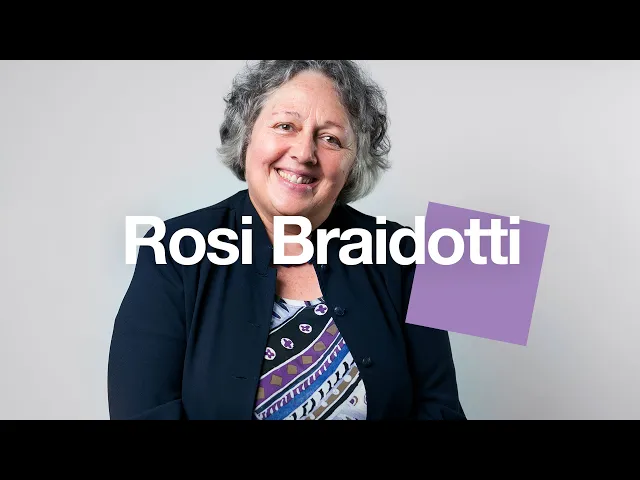
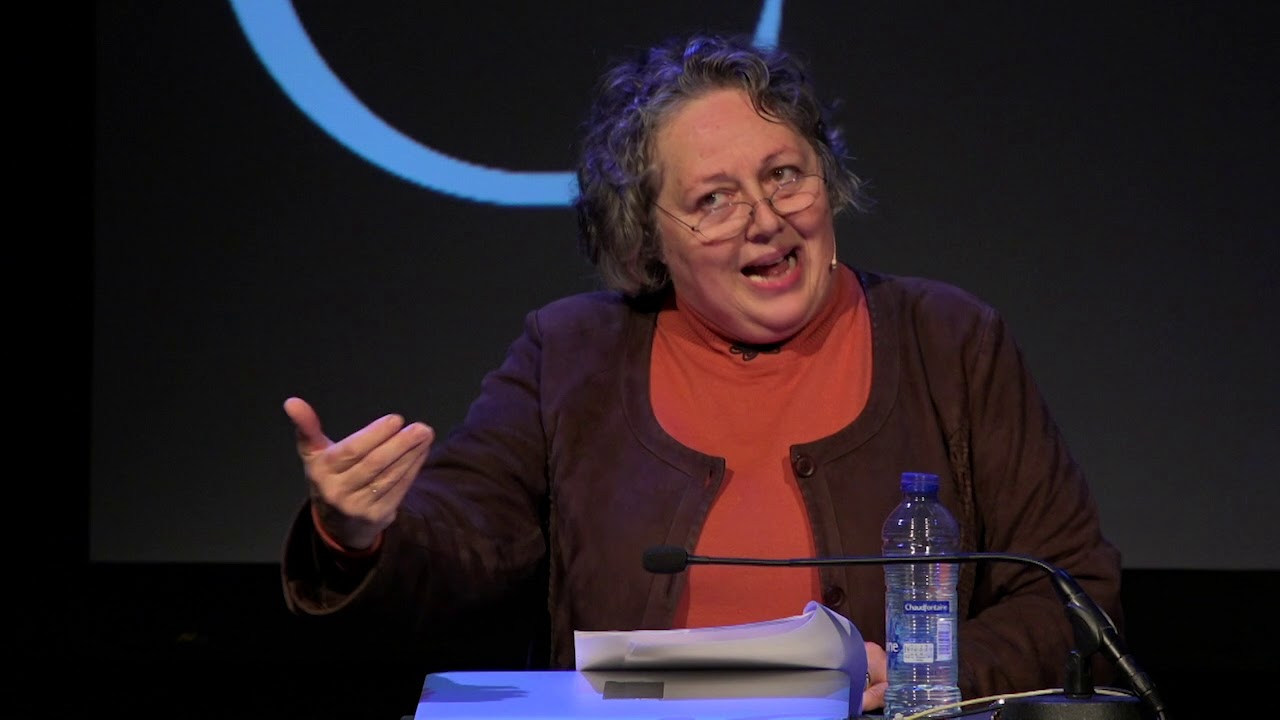
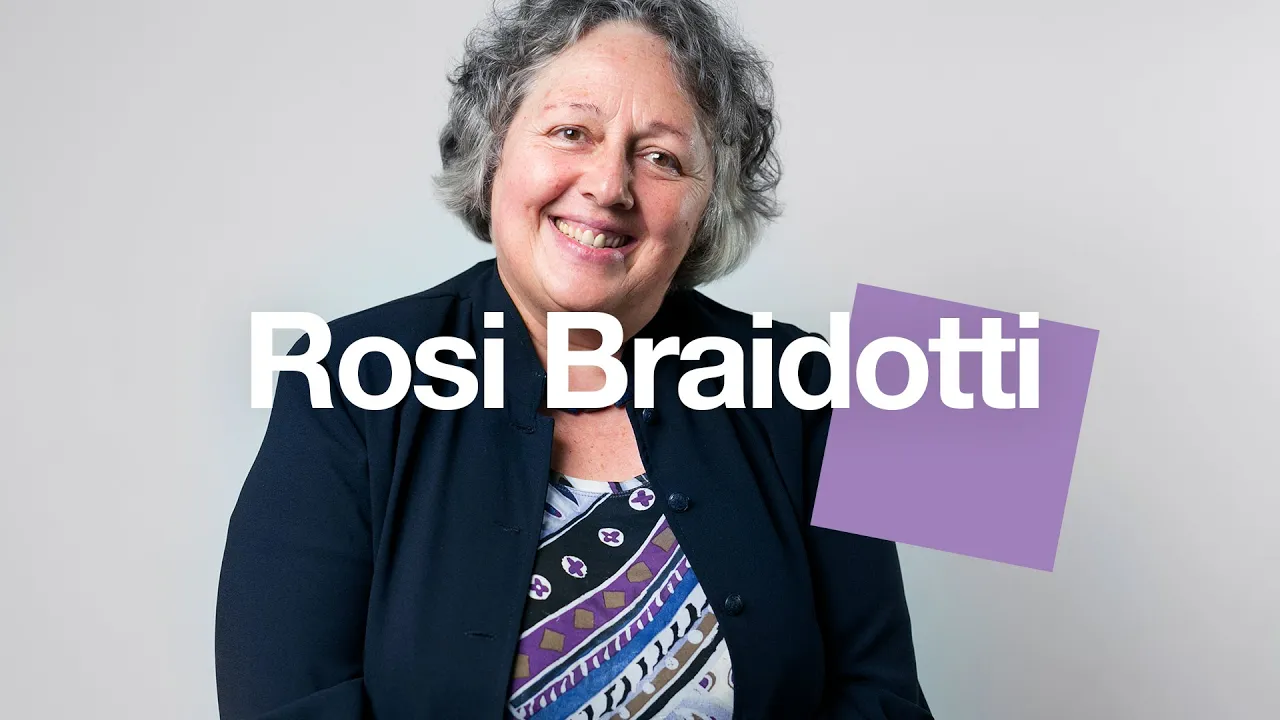
I am Rosi Braidotti, born in Italy, grown up in Australia, did my Doctorate in Philosophy at the Sorbonne in Paris, in the late 1970s. I am very much a European philosopher, a continental philosopher. I studied with Foucault and Deleuze, and my question has always been to try to figure out what forms of knowledge are being produced around us, how they connect to power relations, and how do they connect to possibilities of political and ethical resistance, and the creation of alternative, better ways of living together.
Being human today is an open, contested field. To tell you the truth, I am not sure that there ever was complete consensus as to what a human is. The Enlightenment gave us the Universal Declaration of Human Rights.
Men got human rights, but women didn't get human rights. Jews, blacks and children didn't get human rights. During the French Revolution, when Olympe de Gouges wrote the Universal Declaration of Women's Rights, you do know what happened to her: she was sent to the guillotine and killed immediately.
So this "human" has always been loaded with relationships of power, inclusion, and exclusion. It never was a neutral term. It never was an inclusive term.
I don't see the posthuman as something that will happen in the future. It is not the science fiction of "Blade Runner" and "Mad Max". Nor am I a Silicon Valley transhumanist who believes that we are going to be able to load our consciousness into the computers and become superhuman.
I see the posthuman very much as an index of where we are at. "Posthumanism" is not a great term, I don't particularly like it. But we don't have anything better, for the moment, as an interim term, to designate this turmoil of questions, investigations, and also experiments.
And both universities and arts and cultural centers are at the heart of new ways of thinking about what we are becoming, what is becoming possible for us today, with gene editing, with all the stem cell research, with all the amazing things that we have developed and discovered. And yet our values, our representations, our forms of self-understanding are still attached to older visions of the human. So we have to be a little bit brave, and together, as a community, in a democratic and critical manner, discuss together what we want to become, what we are capable of becoming.
The concept of "becoming" is the essential part there. The idea that we need to open up our sense of identity to relations, to a multiplicity of other axes or entities. It's in opposition to the idea of identity as something completely closed and fully formed, and static forever.
We are always subjects in process, always becoming something. But, also, this is a very difficult political era that we are going through. The big changes and transformations are making a lot of people unhappy and angry.
It's an era of populism, of anger, of political violence. It's an era where theory is not highly regarded, and people who do theory are considered speculators and useless people, whereas the rest of the population is flooded by fake news and alternative facts, but that's OK. But the reputation of thinkers and academics is very low in populist times.
We would need to stop this attack on the university, on the intellectuals, on academics, on "experts". It seems to me that the political classes at the moment are doing the opposite, making it very difficult to hold these discussions, lying through their teeth about facts and figures, and exploiting the discontent that rightly comes from the negative effects of the Fourth Industrial Revolution. They are exploiting those effects to feed the populist politics, when in fact there is another side to the story: the extraordinary, positive developments of these very same technologies.
We need to look at the positive and the negative aspects of this great technological revolution. We need to first make an effort to understand what is happening to us. How capital functions.
And from there, then, have a discussion on how we can redistribute the wealth. We are still talking about capitalism, but it's no longer within the Marxist and Hegelian frameworks. Contemporary capitalism makes money out of the knowledge of living systems.
Life sciences, neurosciences, information technologies, codes, biogenetic codes, algorithmic codes is capital. It's not the capitalism of Karl Marx, it's a different capitalism. Even understanding how this system works.
. . Even to understand that is a point of discussion with the Old Left.
And people come up with schemes for the reform of the economy that do not describe the current economy. It's a very specific moment that we are in, with capitalism farming out new life forms. What we have learnt since '68 is that capitalism doesn't break, it bends.
It adapts and adopts any modality possible, simply because it is just a code of short-term profit. And the reason why this code works is that we are all caught into it. We are part of the problem.
So we are all caught in a mode of consumption that keeps the system going. The idea is very simple: if we are part of the problem and consequently must become part of the solution, let's work together to see what margins we have. I think there are ways in which we can concretely disengage ourselves, take a little bit of critical distance from our own modes of consumerism while acknowledging that, contrary to the Marxist-Leninist idea of a global revolution, the changes that we can make are step-by-step collectively, by taking distance.
Look at how feminism has trained us to take a distance from masculine violence, how racism has trained us to take a distance from white supremacy. Distances, disidentification, step-by-step. .
. I call it almost a detoxing exercise. You are detoxing yourself from bad habits of consumption, of thinking, of relating to each other.
"Optimism" is not the term that I use. I use the term "affirmation". To create together affirmative, generative values.
I see that as a political praxis. In other words, what we need to do together is to discuss the negative conditions, discuss the problems, not be a stupidly optimistic type of person that denies the problem. The problems are real, but they are only part of the picture.
There are so many aspects where we would need to sit together calmly. And this is exactly what our political situation context does not allow. A bit of calm so that we can discuss the issues, instead of polarizing them.
So, for me, affirmation is creating relations that allow us to actually have these discussions, instead of shouting insults and abuse at each other. So I am very skeptical. But radical change and transformation on the model of feminism, anti-racism, anti-fascism, yes.
The deep transformation of what kind of subject we are. And that can only happen together. Collective assemblages to redefine what we are capable of becoming.
Oh, yes, that is the project.