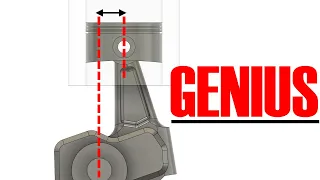
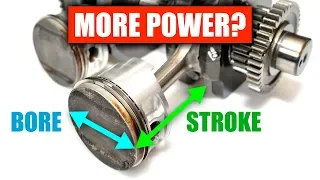
cylinder offset is a small detail Innovation that makes a big difference cylinder offset refers to a design where the engine cylinder axis is deliberately not aligned with the Z axis of the crankshaft and piston the purpose of this Arrangement is quite ingenious because by Shifting the position of the cylinder we can reduce the friction between the piston and the cylinder wall as the Piston moves up and down furthermore it is not just about reducing friction but also about improving the overall efficiency and performance of the engine at first glance we will not find any significant
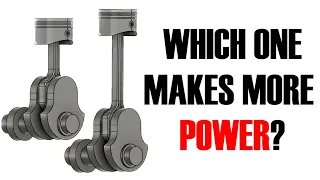
difference between an engine without a cylinder offset and an engine with a cylinder offset they have the same crankshaft the same connecting rods the same piston pins and the same Pistons however the differ between the two is that on one of these engines the center of the cylinder is slightly shifted from the center of the crankshaft meanwhile on the engine next to it the cylinder Center and the center of the crankshaft have perfectly aligned points but with a small detail in the form of a cylinder shift on one of the engines it will make the
two engines different cylinder offset will affect many factors including power fuel consumption efficiency engine size production costs and more furthermore for the mechanism of action cylinder offset will also affect the balance of the engine even affecting the steps experienced by the Piston how is this possible we will first describe the engine configuration that we often find or non-offset for the simulation the pressure generated by the power process will create a significant force that pushes the Piston down this force is then transmitted through the connecting rod to the crankshaft but what is an important point at
this stage we will get the position of the connecting rod which was previously in an upright position now tilts at a certain angle and with a force that moves straight the power transfer process that passes through the connecting rod will have a twisting effect the side effect is that the power generated by the Piston will push it toward the cylinder wall res resulting in increased friction the steeper the angle of the connecting rod the stronger the force pushing the Piston toward the cylinder wall and the greater the friction thus the cylinder offset is expected to
reduce and minimize the connecting rod angle when the Piston is in the middle of the cylinder this aims to reduce friction of course when the friction is reduced the engine will produce more energy that can be used to process power now let's let's continue on how cylinder offset can affect the power cycle in a fourstroke internal combustion engine in a non-offset engine each piston completes one stroke from top to bottom or vice versa every 180 degrees of crankshaft rotation for 720° this design is straightforward and easy to understand however unlike the cylinder offset engine the
top dead center is not 0° but at 9° similarly the bottom dead center is at 202° this means that the intake and power steps have a duration of 193° of engine rotation consequently the compression and exhaust steps occur at only 167° why does this happen the fact is that engines with shifted cylinders have a slightly longer stroke during intake and Power Stroke the reason is that the connecting rod will move on the crankshaft at a slightly more favorable angle depending on the engine type specifications and Anatomy to make it easier to understand let's look at
a specific example to see what happens next in non-offset engines starting from 0° to 90° of crankshaft rotation the connecting rod will move from standing to tilting this can also mean that the connecting rod becomes shorter and will provide acceleration when the Piston moves towards BDC affecting the dwell time assuming both engines have a square engine stroke ratio configuration with a stroke and bore of 72 mm moving the crankshaft to a point of 90° results in the naked eye being at 36 mm of the stroke length but upon precise calculation the non-offset engine is 43.5
MM while the offset machine is 41.3 mm furthermore there is a noticeable difference in the position of the connecting rod between the two engines the offset engines connecting rod is not tilted too much in contrast the non-offset engine's connecting rod is tilted very much and as previously discussed this slope can cause friction between the piston and cylinder wall reducing dwell time during the power process if we then rotate the engine from 90° to 180° in a non-offset engine the rod will return to an upright position whereas in an offset cylinder engine the rod will only
appear to be slightly tilted this means that overall from TDC to BDC in an offset engine the rod has less effect on the stroke traveled by the Piston but it will be very different from BDC to TDC we can see that the offset engine causes the rod to take a very sharp angle and then the rod starts to go from this very sharp angle to a perpendicular one from that we can understand that the crankshaft will take the Piston from BDC to TDC in just a short time this is why there can be a degree
of difference in the steps on an offset engine an offset engine has a longer power stroke and a shorter compression stroke this allows the engine to optimize energy from power and reduce energy waste during the compression stroke now we come to the last discussion engine balance after hearing the explanation earlier we might think that an engine with offset cylinders would be great for power and efficiency but what if we talk about engine balance first we will talk about the primary balance as we know the piston has its own mass and movement then as the engine's
RPM increases and causes the Piston to move very fast we will feel these forces as vibrations and these vibrations are referred to as primary force we will simulate it like this when the Piston goes to TDC or performs the compression process we will see the piston stop for a moment and exert a force towards the top then when the power process occurs due to the power thrust the piston will suddenly accelerate down from TDC to BDC of course the state of the vibration Force generated by the Piston will also repeat as the Piston moves from
TDC to BDC the Piston will exert a large Force towards the bottom of the engine when it reaches BDC and the cycle will continue to repeat along with the vibrations generated by force therefore a balancing shaft is needed which functions as a counterweight that is able to damp the vibrations produced by the Piston unfortunately the use of balancer shafts on an engine with offset cylinders is more complex due to the cylinder offset engines the use of balancer shafts that are paired as on General engines will not affect the engine with offset cylinders this is because
the balancer shaft typically used in the non-offset engine will not be able to withstand the vibrations caused by the Piston as in the non-offset engine so can we then eliminate the primary vibration produced by the offset engine of course we can as evidenced by the fact that offset cylinder engines are still in production especially by Yamaha however achieving this balance requires extra effort whether in the form of a balancing shaft an offset flywheel an offset crankshaft pulley or perhaps other balancing methods these are all engineering additions that add complexity effort time and of course cost
next let's talk about secondary balance for example in a non-offset engine when the Piston goes from TDC to 90° the connecting rod shortens and the force it exerts pulls the Piston downwards so the secondary force is downwards then from 90° to BDC the distance from the connecting rod to the cylinder becomes longer pushing the Piston upwards and the secondary Force generated is up Wards from BDC to 270° the connecting rod becomes shorter again so the secondary force is again downwards finally from 270° to the top dead center the connecting rod becomes longer again and the
secondary Force points upwards if we draw it on a graph it will look more or less like this just like the primary balance this line of oscillation can be balanced by using a balance shaft which creates an opposing Force to neutralize the secondary force and reduce vibration but when we move on to engines with offset cylinders things get even more complex first the connecting rod pushes the Piston up briefly then pulls it down again then stabilizes at a certain angle then the rod briefly pushes the Piston upwards again and finally pulls it downwards with a
little more Force followed by a brief stabilization and then a big push upwards as you can see the curve is very different from that of a non-offset engine so it would be more challenging to eliminate the secondary force in an offset engine but this strange Rod movement will later create a significant end benefit for the engine and now for the most critical part the conclusion what are cylind offsets advantages and disadvantages and how is it used in the automotive industry let's start with the advantages firstly the more extended intake and power cycle duration allow the
engine to produce a better air fuel mixture longer power cycle duration and less friction on the cylinder walls this means that this small change will impact the thermal efficiency of the internal combustion engine the second point just as yam ahaha claims with the cylinder offset will make the whole engine more compact for motorcycles because if we see the position of the cylinder which is moved to the front of the engine provides more space at the rear of the engine which can add space for other supporting components and facilitate the assembly and maintenance process on the
other hand there are negative effects the first is higher production costs this is because the cylinder offset also increases the complexity of the design and production process the second is the problem of primary and secondary forces which tend to make the resulting vibrations more challenging to overcome and thirdly with higher vibrations the engine will also become noisier okay we have just discussed the advantages and disadvantages in fact many manufacturers are implementing this small innovation in their products it indicates that this technology has more advantages for the engine in the field for example Yamaha has its
Blue Core Honda has its Earth dream engine which is used in the Honda Fit or Jazz and also in the Civic the same goes for BMW but it's a shame we don't have definitive information on who invented it and when it was first used it makes us curious is this technology collectively developed and what do you think is there anything shortcoming with this technology we want to hear your opinions in the comments section below