hi everyone and Welcome to our module on deltion syndromes in this video we're going to talk about a number of rare genetic conditions that result from partial deletion of a chromosome so this is different from disorders where you gain or lose an entire chromosome it's also different from disorders where you gain or lose a single Gene in this situation part of a chromosome is lost it may be the entire long or short arm or it may be a portion of the long or short arm most of these syndromes are believed to occur due to errors
in crossover during meiosis in the video on meiosis I explained the phenomena of crossover as shown at the bottom of the screen where genes that are being duplicated exchange genetic material so that the end product is a mixture of genes from different chromosomes what's believed to lead to some of the deletion syndromes is an unbalanced exchange of genes during crossover and meiosis such that one chromosome ends up with extraen gentic material or a duplication and another ends up with a deletion most cases of deletion syndromes are sporadic in other words they are not passed down
through families you'll see them referred to in textbooks as congenital and the key syndromes that we'll discuss in this video are kedesha William syndrome and finally thymic aplasia kedua syndrome is caused by deletion of part of the short arm of chromosome 5 so chromosomes have a short and a long arm the short arm is denoted by the letter P and for that reason this syndrome is sometimes called the 5p minus syndrome children with this Syndrome have severe intellectual disability they have cognitive speech and motor delays the reason it's called kedua is because the infants will
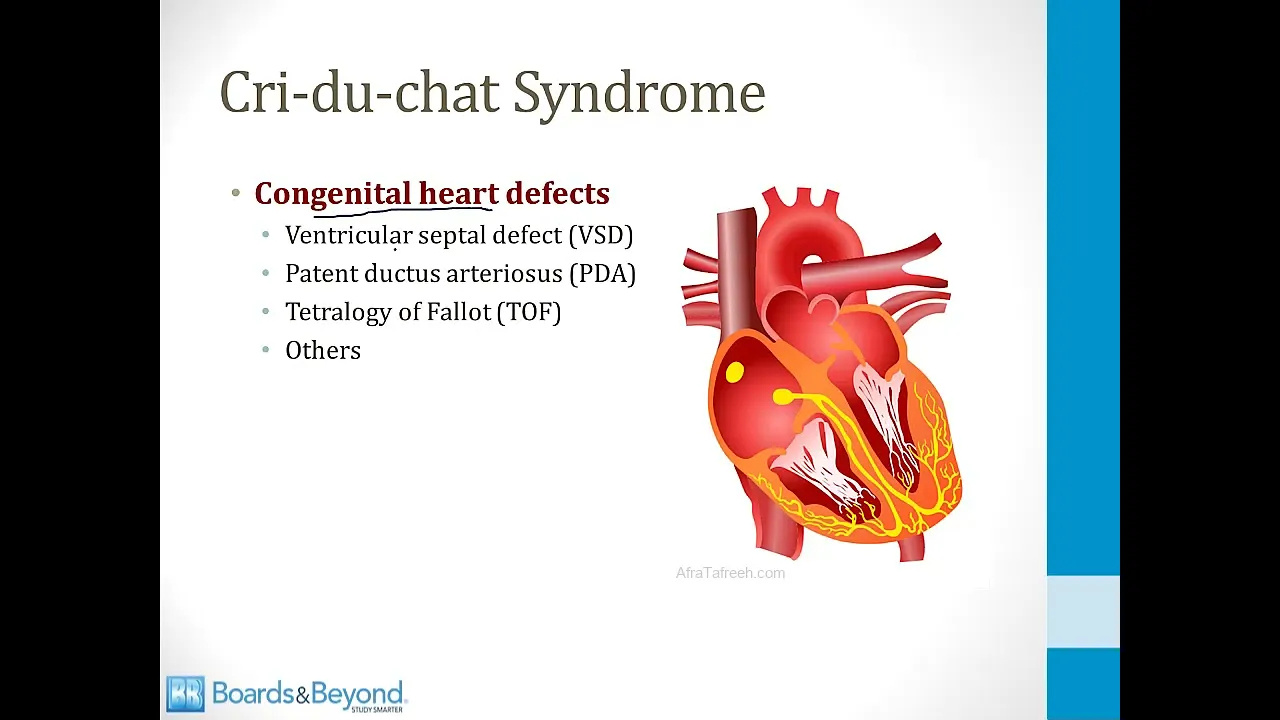
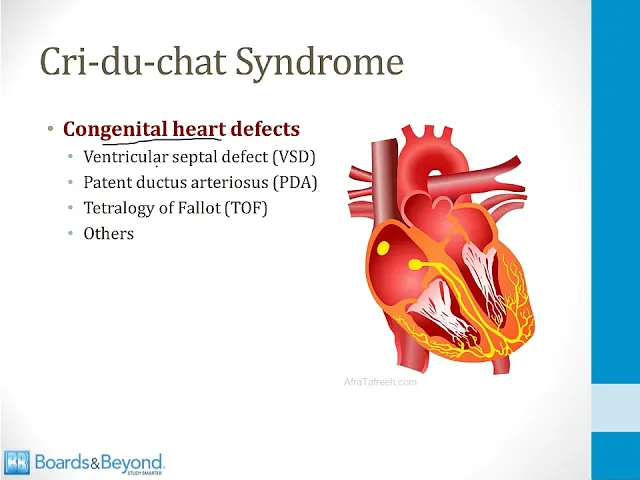
cry like a cat it's classically described as a me which is a high pitched cry this occurs soon after birth and then resolves these children have characteristic facial features which is shown in this picture on the screen they typically have a small head which is referred to as micro they have wides set eyes which is sometimes referred to as hyperism they also have low set ears a small jaw and a rounded Face children with cedusa syndrome often have congenital heart disease they can develop ventricular septal defects pdas tetrology of flow and many other congenital heart
problems our next deletion syndrome is called Williams syndrome it's also called Williams Beren syndrome this is caused by a partial deletion of the long arm of chromosome 7 the deleted portion includes an important Gene called elastin which codes for an elastic protein in connective tissue so children who have this deletion have what's called Hao insufficiency meaning because they are missing one of their elastin genes they produce insufficient amounts of the protein children with Williams Syndrome have a facial appearance that is classically described as Elfin you can Google this and find lots of pictures online of
children who have William syndrome and you'll begin to easily recognize the facial appearance they have a small nose and a small chin they also have a wide mouth and they have a long filtrum which is the length of the upper lip these ch children have intellectual ability and they often show delayed developmental Milestones however interestingly they have very well-developed verbal skills and have a unique personality where they're extremely friendly with strangers they're unafraid of strangers and they have great interest in talking with adults which is unusual for many children there are some unusual and uncommon
vascular manifestations of William syndrome and if you know these it's very easy to recognize William syndrome in a board question the first one is called supravalvular aortic stenosis this is a constriction of the ascending aorta just above the aortic valve so it behaves like aortic stenosis but it's caused by a constriction of the aorta above the valve that's why it's called supr valvular and there's a very high prevalence among children who have William syndrome in addition these children can also develop pulmonary artery stenosis and renal artery stenosis so they're developing narrowings of large arteries in
the vascular system this is very unusual and if you see these things described in a child they are probably talking about William syndrome these children also can develop hyper calcemia in general they have higher calcium than the Pediatric population there's evidence of increased vitamin D levels and increased sensitivity to vitamin D among children with William syndrome it's usually not severe it's usually mild to moderate and usually does not cause symptoms however it is thought that it may contribute to constipation which is common in children with Williams syndrome the last deltion syndrome I'll discuss is thymic
aplasia or de George syndrome I discussed this disorder in detail in the Immunology section in the video on IM immune deficiency syndromes and the reason I talk about it there is because one of the key features of this disorder is immune deficiency this disorder goes by many different names that can be confusing as a student it's sometimes simply called a 22 q11 deletion syndrome and that's because it results from a partial deletion of the long arm of chromosome 22 it's also sometimes referred to as veloc cardiofacial syndrome or spritzen syndrome or conotruncal anomaly of the
phas syndrome and the reason it has all these different names is because the clinical presentation is widely varied but some of the key features include immune deficiency hypocalcemia and congenital heart defects and that concludes our video on deletion syndromes









![All 7 Chakras Healing Music [removes negative energy, clears the aura & improves the body] 528HZ](https://img.youtube.com/vi/NF35xujl23c/maxresdefault.jpg)