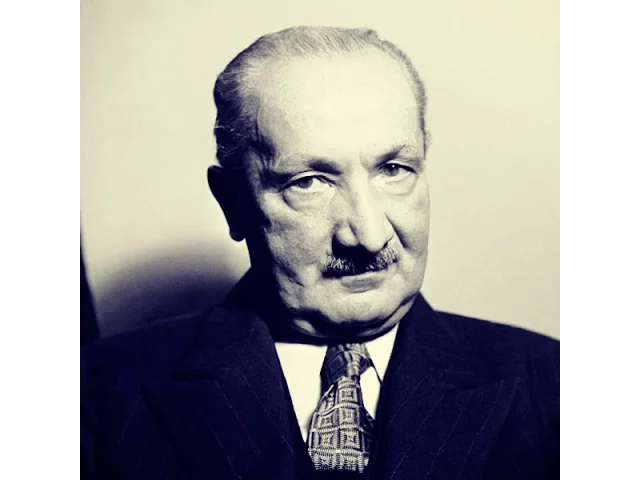
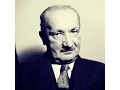
my the renowned philosopher martin heidegger lived for the whole of his life in the black forest area of southern germany he looked talked and often acted like a typical german farmer but he thought like nobody else alive the moment one reads heidegger life is different afterwards now there are lots of reasons why that's the case but it has a lot to do with the power of the argument and its novelty the i can't imagine ever having thought that before feeling it just changes the way you view philosophy as you get into it it can become
indispensable to one's own feeling of how thinking gets itself done and to those who say look this isn't philosophy i say fine i'm not terribly interested in the supermarket label call it what you will are you able to cope are you able to live with its completely new radical grasp on the world more critical commentaries have been devoted to heidegger than to any other philosopher apart from aristotle he is undoubtedly one of the most important figures in the history of 20th century thought but not everyone who mentions his name today does so with approval two
decades after his death in 1976 he is widely revered but also widely reviled and the explanation has to do not with philosophy but with politics there are two uncontestable facts about heidegger one is that he was a brilliant philosopher the other was that he was a nefarious nazi i don't really blame him for thinking that hitler was the salvation of germany lots of reasonable people thought hitler was the salvation of germany but they usually also thought that all this stuff about the jews was just you know window dressing it didn't really come to anything what
i find hard to forgive about heidegger is after everybody knew about auschwitz knew what hitler was leading up to he just pretended that he hadn't really been there or had nothing to say or something like that what sort of man was martin heidegger how did he come to align himself with the most sinister political movement of modern times and to what extent should his nazi involvement be allowed to detract from his status as a thinker heidegger's story begins in the small town of mesquier where he was born in 1889 and laid to rest 87 years
later his parents friedrich and johanna heidegger both came from peasant stock but the family were comparatively well off and young martin never went without his father was employed as a sexton at the small town surprisingly grand catholic church and religious observance played a major part in his early life he served as an altar boy and seems to have decided before the age of 10 that he wanted to become a priest he was small in stature as a child but the power of his personality was apparent even then hans jorge gadamer a student of heidegger's during
the nineteen twenties discovered as much when he visited mesquire towards the end of that decade to find out more about his tutor's early life seventy years later at the age of ninety eight professor gadamer now a world famous philosopher in his own right remembers the visit well foreign in 1909 having received a grammar school education paid for largely by the church heidegger enrolled at the university of freiburg the city in which he was to spend the bulk of his working life he started off as a student of catholic theology but his faith in god suddenly
began to weaken leading him to change his subject first to mathematics then to philosophy his interest in this field had been aroused by the work of one of his professors edmund hussell he was the originator of an important philosophical movement known as phenomenology which offered a new understanding of human consciousness hustle took the promising young scholar under his wing doing everything he could to promote his career her kindness heidegger would later repay in the most callous way imaginable before hussain's sponsorship had time to take effect heidegger found himself caught up in the first world war
not as a frontline soldier but in several less hazardous roles about while the war was still going on heidegger married the woman who would remain at his side for the rest of his life an attractive economic student called alfreda petri who soon bore him two sons in 1923 when the boys were still small the family moved to marburg in central germany where hussel had helped heidegger find himself a job as an associate professor of philosophy heidegger never talked to marburg however and whenever he could he made his way back to the black forest his destination
was a simple wooden hut he'd had specially constructed for himself on the slopes of a mountain called tottenham this was to be his spiritual home for the rest of his life somewhere he could always find the solitude he needed for his work the family spent time here as well though and it's a place to which heidegger's younger son hairman remains deeply attached remains deeply attached so here is our had a profound effect on heidegger's personality his long stays there appear to have reinforced his sense of himself as a true son of the black forest and
before long he'd begun to cultivate a somewhat eccentric rustic image heidegger's physique early on was a kind of invention of self the insistence on peasant style clothes the black forest way of speaking chopping his own wood this lonely hut high up in the hills i thought now back nothing i think would have alerted one to the immensity of the work and of the thought hansjorge is one of the few people outside the philosopher's immediate family to have visited him at the hut he vividly recalls heidegger's curious manner and appearance but he also remembers something else
on during the early 1920s having broken decisively with the catholic church heidegger also began to distance himself from his mentor edmund hussell whereas hustle was intent on illuminating the innermost workings of the mind heidegger became convinced that what thinkers like himself should really be addressing was the ordinary person's everyday experience of the world this conviction led him to write what is generally regarded as his masterpiece the dense evocative strangely worded text known as sein and zeit or to use its english title being and time this work is a tour de force of philosophical writing one
can't help in reading it to be simply amazed and astounded it also viewed historically was the moment in which phenomenology that which he the two had been the dominant philosophical uh mode of thinking was called into question but called into question in such a radical way that it became almost impossible to go back to phenomenology and continue with it at the heart of being in time and therefore of heidegger's philosophy as a whole is one deceptively simple question what is really meant by the verb to be we all think we understand what we mean when
we say that someone or something is but do we or are we as heidegger thought letting the familiarity of the word itself blind us to what is really the greatest mystery of all do we in our time have an answer to the question of what we really mean by the word being not at all but are we nowadays even perplexed at our inability to understand the expression being not at all our aim in the following treaties is to work out the question of the meaning of being and to do so concretely our provisional aim is
the interpretation of time as the possible horizon for any understanding whatsoever of being immanuel kunt no small figure he had said that space and time were equally important they were the way we organized our world the very young heidiger never forget he's writing this as a very very young man says not at all space is an almost insignificant category time is a mystery time and human existence are inextricably linked according to heidegger our being he says is really a process of becoming and this key insight leads him to reject the idea that there is such
a thing as a fixed human essence heidegger's major contribution in being in time is to show how the old aristotelian essence of man as the rational animal is in effect an abstraction because what comes first is man's own existence and existence for heidegger is nothing but this this stretching whereby we are constantly projecting ourselves into a future always expecting things always hoping things heidegger is a man who first wanted to investigate how practical action shows that we're pulled ahead of ourselves into purposes that we're trying to fulfill into tasks that we're working on think of
a farmer in the black forest for example making a barrel this is someone who has a future task that he's trying to fulfill and he has a logic operating there that shows that the human being is actually extended ahead of himself the ahead is where we really live what we desire to do what we anticipate what we want this wood to turn out to be people who live and work in traditional rural communities have an instinctive grasp of their own humanity according to heidegger they are fully absorbed in and connected to the world but they
are also a clear minority of the human race heidegger argues that most of us especially those who live in big modern cities tend to lose touch with our individuality forced to conform to patterns of mass behavior we experience strong feelings of anxiety he says and end up leading what he calls inauthentic lives most of us live what he called a life of one one is one one does this one thinks that one moves in this way and he's saying to you no the i is not one and this was in the 1920s sheer breathtaking prophecy
before the great mass market detergents of standardized life and deaths which has swept over us the the consumerism even of our deaths they don't belong to us anymore and he gave the great warning he said as this soap powder spreads over the planet of the universe it will be almost impossible for you to be you and not just one being in time was to make heidegger's name once and for all but before it was even published he started to be spoken of as an original and explosive thinker drawing on his unpublished theories he gave a
series of brilliant lectures at marburg university which had a huge impact on all those who heard them one young woman in particular found herself overwhelmed she was hannah aaron a talented and beautiful jewish student who would later achieve world fame as a commentator on the evils of nazism aaron became a pupil of heidegger's in 1924 he was immediately struck by her and before long they had embarked on a brief but passionate affair she knew that she was with a man who had a a reputation in german intellectual circles for being she sometimes later put it
a secret king of philosophy but she was also very remarkable and both of them seem to have conceptualized this relationship as a mystical event and she remained loyal to it because it had been so formative because it had been so formative when being in time was finally published in 1927 shortly after his affair with aaron came to an end heidegger became famous overnight despite its daunting complexity the book was bought and read by educated men and women throughout germany its success was due in large part to the troubled and questioning spirit of the time heidegger
existential point of departure and being in time satisfied the needs of a generation the needs of a generation that was lost in the aftermath of world war one and for which questions of of existence the wherefore and wither of human existence were absolutely central the book caused ripples of excitement not just in germany but all over the world and in 1928 heidegger returned in triumph to freiburg university taking over the chair of philosophy left vacant by the retirement of edmund hussell at the relatively young age of 39 he had suddenly acquired the status of a
major philosopher but within a few years he would tarnish his reputation forever by embarking on a calamitous political adventure on january the 30th 1933 adolf hitler became chancellor of germany he immediately launched a process of restructuring designed to eliminate so-called non-aryans from public office and clamp down on all forms of descent towards the end of april after the rector of freiburg university had resigned in protest at these measures heidegger astonished almost everyone who knew him by allowing his name to be put forward in the ballot to elect a successor he was duly elected by an
almost unanimous vote of the university's governing body although 13 of the professors who would normally have been entitled to vote were forbidden to do so because they were jews a week later heidegger delivered his inaugural address as rector to a capacity audience in the university's main hall specially bedecked for the occasion with swastika flags then on may the first a symbolic date in the nazi calendar he officially joined the party thereby winning the gratitude of all those who wish to see hitler succeed the first few months of nazi rule were by no means a sure
thing it was still a bit of a tenuous operation so the initial months were very important and this was the specific finding of the university denotes vacation commission that heidegger had played an essential role in placing hitler into the saddle by serving to legitimate the regime on the basis of his immense worldwide philosophical prestige those who had known the wizard of mesquire during his days at marburg university was stunned and appalled when they heard what he had done from god why did heidegger attach himself so firmly to the nazi cause what factors other than personal
ambition compelled him to act as he did part of the explanation seems to lie in the closeted rural culture from which he and hitler both emerged heidegger grew up a very conservative catholic in a very conservative southwest germany he was a rural man not very comfortable with urban life nazism claimed to offer a preservation of a more simple rural life at the same time as it promised a tempered move into the technological 20th century i think this was a great appeal to heidegger nazism also was famous for its anti-semitism and i think heidegger shared in
the cultural anti-semitism of his nation of that time without yielding i believe to the crude biological anti-semitism of hitler he didn't need hitler to be an anti-semite he had that already from his culture the period of 1933 as far as i can see hitler did not promise the physical murderous destruction of the jews but an elimination of their roles in society in such a way that heidegger would say yes he would agree with that the claim that heidegger was anti-semitic is one that's often denied not least by members of his family his son hermann for
instance points out that the philosopher had many jewish friends including both edmond fossil and hannah aaron however the evidence that points to him having a deep antagonism towards jewish culture as a whole as opposed to individual jews is too compelling to ignore in 1929 heidegger wrote a letter to a friend of his to say that germany now is at a crossroads either it goes down the road of the jewelfication of german culture or it continues down the other road to the restoration of greater germany now the word heidegger used for yudung is a very anti-semitic
term you will not find it in even the biggest german dictionaries however you will find it in mineconf where hitler used it in exactly the same terms another telling piece of evidence came to light purely by chance when professor reiner martin a one-time student of heidegger's stumbled across an old book about hermann goring when he opened it he was astounded to discover it had once belonged to his former tutor heidegger appears to have hero worshiped hitler and his cronies quite as slavishly as any bavarian housewife and there can be little doubt that his adulation had
its roots in a shared inheritance of racial prejudice but he also seems to have detected a strong affinity between the nazi creed and certain tenets of his own philosophy in virtually all heidegger's lectures and texts from the 1920s he'd been calling for some kind of notion of community and of course one of the linchpins of nazi ideology was the idea of a national community that would unite all germans so when heidegger put the hesitant approaches of his philosophy together the realities of germany 1933 he thought that aspects of his texts and his doctrines had actually
come to life what he seems to have done is to have broadened the notion of individual authenticity and applied it to the people to the folk and i think that this led him finally out of the university library into the streets to identify with national socialism which he thought of as the realization of his own theory heidiker wasn't sure however that nazism was safe with the nazis what hitler needed he thought was a guide someone who could ensure that the nazi revolution fulfilled its true potential someone that is exactly like himself heidegger suffered to be
sure from megalomania he succumbed to the delusion and one can only call it a delusion that uh he could play the role a philosopher king following plato's problematic precedent to hitler and the third reich he thought he could get the year of the new regime and be the eminence glees behind hitler or whoever was going to run the country and he's he seriously believed that if you got the right philosopher in the right place things might be different germany would be revitalized europe would be revitalized everything might be wonderful and different convinced of his ability
to steer the revolution in what he saw as the right direction heidegger became not just a nazi but a nazi fanatic someone prepared to demonstrate his devotion to the cause by the most underhand means prepared to demonstrate his devotion to the cause by the most underhand means we now know we didn't know until recently that he spent a good deal of time writing the most damning letters about colleagues ratting on them to the local police and even the gestapo for being politically incorrect or not enthusiastic enough about the nazi revolution or for having been pacifist
during world war one the most prominent victim of heidegger's denunciatory campaign was hermann staudinger a professor of chemistry at freiburg who would later be awarded the nobel prize in freiburg state archive professor hugo ott has unearthed hard documentary evidence which shows that during 1933 and 1934 professor staudinger was hounded by the gestapo purely as a result of malicious gossip passed on by heidegger the documents reveal that on the 29th of september 1933 the philosopher held a meeting in his office at freiburg university with a senior nazi official he had requested the meeting himself with the
sole aim of communicating politically damaging allegations regarding staulinger's supposed conduct during the first world war heidegger alleged that the scientist had been both a pacifist and a spy and that he'd handed over manufacturing secrets related to germany's chemical weapon production to hostile foreign powers as a result of these claims which eventually proved to be groundless the future nobel prize winner was subjected to several months of surveillance and hostile interrogation to ensure there would be no let up in the investigation heidegger helpfully wrote to the gestapo's regional commander informing him how he thought the case should
now be handled and of all those who suffered at heidegger's hands no one had more cause to feel betrayed than edmund hussell the man who did so much to launch his career shortly before heidegger took over as rector hussel was sent a circular letter banning him from using any of freiburg university's facilities because he was a jew when heidegger took office he could easily have rescinded this order but he chose not to the effect on his old master stories like this are shameful enough but many people are convinced that heidegger bears an even greater burden
of guilt that's because of the part he played in convincing impressionable young people all over germany to put their faith in hitler professor raymond klibansky an internationally respected scholar now aged 93 was an undergraduate in heidelberg when the nazis came to power he's convinced that heidegger exerted a disastrous influence on an entire generation of german students on the 30th of june i was there 33 he gave a speech to all the professors and students of heidelberg in which he urged the audience to abandon all these humanist and christian ideals not to let themselves be weakened
by them and to become true national socialists and here heidegger is a guilty man in the sense that he is responsible for the allegiance of a large part of the academic use to hitler in april 1934 heidegger stood down as rector of freiburg university after the war he claimed he had done so in protest at nazi excesses but his real motivation seems to have been a deep sense of frustration of the meagerness of what he'd achieved his disillusionment with national socialism is not a disillusionment with national socialism it's a disillusionment with the possibility that a
political party could enact the thorough change that he wants and which has emerged from his study of the history of philosophy chastened by his ill-fated dalliance with worldly affairs heidegger returned to the life of the mind he began once again to spend as much time as possible at tottenham where his thought gradually entered a new phase the move from the period of the record into the 40s and 50s all the way to his death is a move to poetry and to language in particular as the space the place where one should look at one's relation
to being and to history as a whole every great poet has intuited this but heidegger has said it that it is not we who speak language but language which speaks us it structures our world it structures our sense of time of identity of human relations of love of violence and so on and so when foucault very very radically and brilliantly says there is no more man there is no more ursa etc etc when deconstruction speaks of language as an autonomous inward turning game as a dance around an infinity of possible meanings these are footnotes to
heidiger from the collapse of his rectorship till the end of the war heidegger took no further part in public affairs but official records recently discovered in berlin show that he remained a member of the nazi party until the day it ceased to exist a fact few people realized even at the time the philosopher's nephew heinrich who still tends the modest grave in mesquite cemetery where his uncle lies buried was a schoolboy during the war he vividly recalls the moment he first realized that his distinguished um foreign by the time this conversation took place the pressure
was mounting for heidegger as it was for everyone else in germany the war was turning into a route and hitler's days were clearly numbered on november the 27th 1944 freiburg was subjected to a massive bombing raid and the university which sustained heavy damage had to be abandoned the philosophy department relocated all mass to castle wildenstein a medieval fortress overlooking the upper danube valley while heidegger himself was put up a few miles away by one of his favorite students princess margo von zaksen meiningen with whom he was having an affair he stayed in the princess's hunting
lodge for several months keeping well away from freiburg until he could tell how he might be treated by the french troops who'd taken charge of the city against as it turned out heidegger was quite right to be concerned within a few weeks of freiburg's surrender french officials arrived at his home on the outskirts of the city they carefully surveyed the house and its contents and then informed alfreda heidegger who was living there alone that the property would be requisitioned for use by allied personnel because its owner was known to have been a leading nazi party
member this threat was soon lifted thanks to a certain amount of string pulling by heidegger's friends but the philosopher could see the way things were going and he soon decided to return to fryeburg and face the music he duly appeared in front of a special denotification commission composed of members of the university faculty who'd been opposed to the nazi regime these are fragile he was subjected to rigorous questioning but he put up a spirited defense to all the accusations leveled at him and the proceedings dragged on for several months without any firm conclusions emerging eventually
to try to resolve matters once and for all the commission members wrote to a former colleague of heidegger's the respected philosopher carl jaspers asking what course of action he would recommend jaspers replied that heidegger's unfree and dictatorial mode of thinking meant he should be banned from teaching for five years and this is precisely what the french military authorities eventually decreed the true effect their action had on him has only recently become um foreign um heidegger was now at his lowest ebb and yet within a few years he would stage a remarkable recovery almost as soon
as the war ended he began to be cited as a key intellectual influence by several up-and-coming philosophers most notably jean-paul sartre whose book being and nothingness was conceived as a companion piece to heidegger's being and time when heidegger resumed teaching again in the early 50s the support of sartre and other existentialist thinkers helped to re-establish him as a major academic star this is deciding realized the one person other than sartre who did most to restore heidegger's damaged reputation was his former lover hannah aaron who had been forced to leave germany in the early 30s and
settle in new york there in a small brownstone apartment on the upper west side where she lived with her husband she had begun to produce the stream of writings that would make her famous as a penetrating commentator on nazism to which she would forever attach the often quoted phrase the banality of evil at the end of the war aaron wrote a fierce letter to carl jaspers calling heidegger a potential murderer because of his treatment of edmund hussell but when the former lovers met again face to face her view of him softened the meeting took place
in freiburg on the 7th of february 1950 arendt was visiting the city in connection with work she was carrying out on behalf of a special body set up to recover jewish property stolen by the nazis she sent heidegger a note telling him of her arrival and that evening he visited her in her hotel he memorialized the meeting with a poem and she said that uh conversation took up uh as though no time had intervened so i think you can see that this relationship existed on another plane as far as both of them were concerned then
the worldly uh one in which the hotel was situated she reports that he is contrite about his involvement with the nazis but not in any very knowing way that he doesn't really understand himself and he doesn't understand the significance of what he's done she'll exchange letters with carly aspers in which they shrug their shoulders and say it's his character uh there's nothing to be done about it like he's a fool and in many ways he was hannah aaron never entirely forgave heidegger for his nazi past but she does seem to have accepted most of his
explanations for what he did during the third reich at face value she worked tirelessly from 1950 onwards to promote his work in america thereby completing his extraordinary rehabilitation han aaron had publicly taken position against the nazis she was known to be jewish she emigrated to america the fact that she would defend heidegger made it look as if there was finally nothing to reproach him with what is perhaps most troubling about heidegger's post-war revival is that he never apologized for what he had done during the thirties or uttered a clear denunciation of hitler and his crimes
even the murder of six million jews was an event about which he seems to have felt no obligation to speak he resumes teaching and literally the philosophic and literary world looks to him come on speak out say something human on the horror on the show on the genocide on the holocaust nothing nothing now that's where my bafflement and rage begins when heidegger died in 1976 it was the sage who was remembered in all the obituaries not the practicing nazi but as the full extent of his involvement with the third reich has come to light over
the past 20 years a painful reassessment of his place in the history of philosophy has slowly begun it's still not clear what the verdict will finally prove to be he may well come to be seen as the greatest thinker of our age as his supporters predict but it's also possible that the grave defects of his personality his arrogance pettiness and lack of human feeling will rob him of the status he thought he was destined to achieve there are a lot of cases of bad men writing interesting books and heidegger is just a spectacular case of
that sort he stumbled into a situation that he didn't have the character to get himself out of and for the rest of history he's always going to be stuck in the trap in which he admired himself you