Throughout human history, there have been numerous artifacts and figures depicting advanced beings who came from the sky, possessing technology and kickstarting human civilization. Some of the oldest prehistoric cultures drew what they saw in numerous rock art paintings, depicting humanoid beings descending from otherworldly vehicles. They depicted them in numerous figurines and carvings as beings wearing sophisticated space suits or clear non-human features.
Were these simple myths and symbols created by primitive minds trying to explain natural phenomena, or were they literal records of encounters that defied understanding? Across continents, these depictions share striking similarities in form, posture, and technology, suggesting a shared source rather than isolated imagination. If these images are interpreted as eyewitness accounts rather than allegory, they raise the unsettling possibility that human civilization may have been influenced by visitors far more advanced than we were.
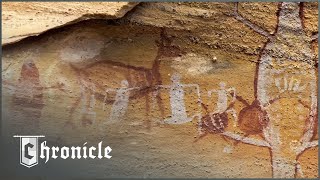
Deep inside a cave in the Charama region of India, some of the most mysterious cave paintings were discovered in 2014, dating to around 10,000 BC. The figures depicted are unlike any typical prehistoric art, as they appear to depict beings with non-human features such as elongated heads, large eyes, and they wear headdresses and costumes that resemble space suits. Even stranger is the fact that these beings are shown alongside a disk-shaped object interpreted as a flying craft in a landed position with three legs.
For these reasons, many refer to the drawings as "the Charama Aliens". Even the Indian government was amazed by the paintings, and in 2018, they conducted a study with the assistance of NASA into these paintings, with NASA sending out a team to investigate them. However, nothing was ever released to the public.
6,000-year-old Aboriginal rock paintings in northern Australia depict similar humanoid beings with large eyes and heads, pale faces, and what appear to be space helmets. They lack clear mouths or facial expressions. And to modern observers, these traits bear a striking resemblance to contemporary depictions of extraterrestrials, leading to intense debate about their true meaning.
The most well-known examples are the Wandjina rock art, which Aboriginal traditions describe as "powerful sky beings who descended from the heavens in ancient times". According to oral lore, the Wandjina were creators and lawgivers who shaped the land, brought rain, and taught humanity how to live. What's even stranger is that on several paintings, there are even flying vehicles depicted, clearly resembling modern interpretations of UFOs.
What makes these paintings particularly compelling is their repetition across vast distances and long time spans, suggesting they represent more than simple myth or artistic imagination. The figures often appear in authoritative poses surrounded by symbols linked to weather, light, and cosmic forces, reinforcing the idea that they were seen as beings from above rather than earthly ancestors. In North American Utah, we find even stranger petroglyphs that date to 4,000 years ago and also depict strange otherworldly beings with what appears to be space helmets with antennas and a UFO standing between them.
Are these depictions of an ancient extraterrestrial encounter that Native Americans recorded thousands of years ago? The beings look distinctively different, much taller than the smaller humans and animals depicted next to them. There's another petroglyph which depicts a circular three-legged spaceship with a tall humanoid being standing in front of it.
To the right, we see a much shorter human figure next to animals. Could this be the record of a non-terrestrial encounter in ancient Native American history? On this petroglyph, we see two beings with antennas, a UFO above them, and a strange box-like object before them.
Could this box-like object be associated with the strange box-like handbags depicted all across the world, from Sumeria to Mesoamerica, all the way to Asia? Interestingly, on one carving, we see this strange antenna-like object. This antenna-like object draws immediate comparisons to one of the most puzzling discoveries ever made on the ocean floor of Antarctica: the Eltanin Antenna.
Discovered in 1964 by the US research vessel Eltanin, the object appeared in deep sea photographs as a metallic, mast-like structure protruding upright from the seabed, complete with symmetrical arms extending outward. What shocked scientists was not only its geometric precision but the fact that it stood vertically in soft sediment at a depth of nearly 4,000 meters, an environment where no known human technology could have been placed at the time. Within the oral traditions of the Navajo Nation, there are recurring accounts of powerful non-human beings who descended from the sky and played a role in shaping the world in humanity's early history.
In some versions of the stories, they are associated with the Holy People, entities who arrived from the heavens during earlier worlds and guided humans through periods of creation, destruction, and renewal. Alternative researchers argue that certain details in these oral traditions resemble descriptions of extraterrestrial visitors rather than purely spiritual entities. The beings are said to travel between worlds, appear suddenly, communicate knowledge, and depart back to the sky – motifs that closely parallel modern concepts of non-terrestrial intelligence.
Importantly, these beings are not portrayed as gods demanding worship but as teachers and overseers, interacting directly with humans and animals. This mirrors how the strange humanoid figures in nearby Utah petroglyphs are often depicted alongside people rather than above them in a divine hierarchy. Could all of these encounters across the globe, or at least some of them, be actual historical accounts of non-human visitations that the ancients tried to tell us, pass on to us?
Or are all of these simple expressions of art we should just disregard? In Valcamonica, Italy, we find some of the oldest prehistoric rock carvings, the earliest of which are dated to 10,000 years ago. Many of the figures carved there depict what appear to be humanoid beings with astronaut helmets.
The beings hold some kind of devices which many interpret as technology. Even stranger is the fact that above these beings, there's a carving which many interpret as an alien ship. We can see the same thing in America with the Quimbaya artifacts, 1,000-year-old gold artifacts depicting airplanes, or the Toprakkale artifact, a 3,000-year-old figurine depicting a flying vehicle.
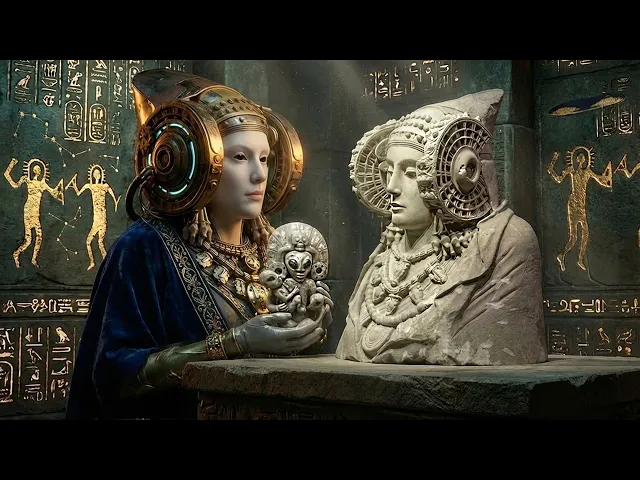
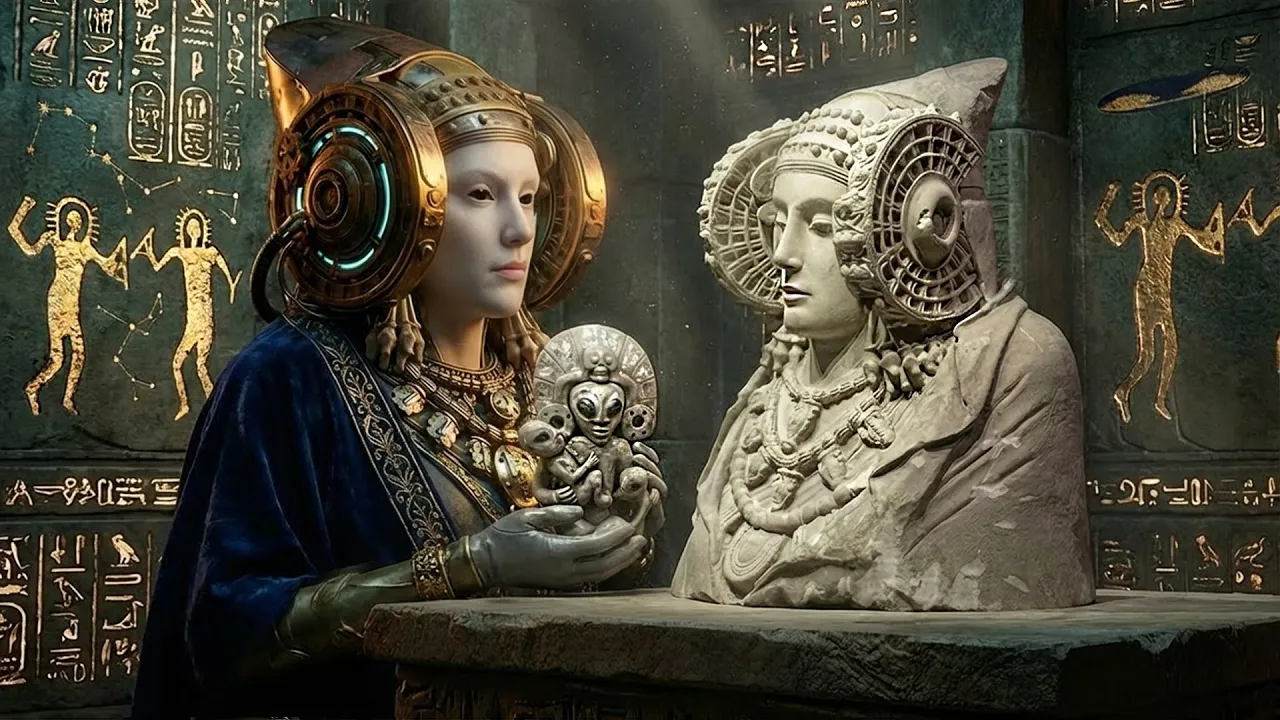
There are also the famous Vimanas of ancient India, the so-called flying chariots of the gods. In 1897, a strange and unsettling sculpture was unearthed in southeastern Spain, unlike anything archaeologists had ever seen before. Known today as the Lady of Elche, this limestone bust dates to around the 4th century BC.
The statue shows a woman with a calm and highly detailed face. But what truly captivates observers is her elaborate headgear, two massive circular objects positioned symmetrically on each side of her head, connected by complex bands and ornaments. Mainstream archaeology interprets this as ceremonial jewelry, possibly indicating noble status or religious significance.
However, many researchers and alternative historians argue that the design is far too complex, symmetrical, and mechanical to be a simple adornment. Some suggest the headgear resembles advanced technological devices such as communication equipment or life support systems far beyond the known capabilities of ancient Iberian cultures. We can see the same thing with numerous Mayan artifacts like this one, which also feature headgears with technological features.
Many interpret this sculpture as an ancient astronaut wearing a helmet. The sculpture is almost 3,000 years old, found in Guatemala. And besides the space helmet, we can see what appears to be a breathing apparatus attached to it.
It's uncannily similar to our modern-day astronauts. The question is, how was all this possible thousands of years ago? This ancient figure from Xochipala, Mexico, depicts the exact same thing: a man wearing a space suit.
And here's another one found in the ruins of a now-lost Mayan city. Are all of these coincidences? These two sculptures are even stranger as they depict non-human beings wearing advanced gear.
Did the Maya saw these? One of the greatest discoveries was the tomb of Pakal the Great, discovered in 1952 by Mexican archaeologist Alberto Ruz Lhuillier inside the Temple of the Inscriptions. Hidden behind a sealed passageway, the burial chamber contained a massive limestone sarcophagus weighing over 7 tons.
The lid was intricately carved with an image of Pakal descending into the underworld. It's a well-known image which many associate with a depiction of an ancient astronaut. Inside the sarcophagus lay Pakal's body, covered in exquisite jade ornaments and crowned by a finely-crafted jade funerary mask that depicted his youthful, idealized face.
The discovery remains one of the most significant in Mesoamerican archaeology. But the lid itself fueled ancient astronaut theories due to its strikingly mechanical appearance. Some interpret the relief as Pakal seated inside a spacecraft, hands on controls, feet on pedals, with flames or exhaust emerging below.
The depictions appear more like life support systems and propulsion rather than mythological imagery. While mainstream archaeology explains it as a symbolic depiction of Pakal's journey to the underworld, the visual resemblance to modern machinery remains one of the most cited images in ancient astronaut lore. In 2011, the model maker Paul Francis created a 3D replica model of the lid, which gave us an even more striking visual of the depiction.
The nose apparatus is known in Mayan mythology as the giver of life, which further fuels the belief that a breathing apparatus giving air is a literal giver of life. One might look closer at this Olmec carving of the god Quetzalcoatl. Note how Quetzalcoatl, which means "feathered serpent", cradles a man holding a mysterious handbag.
Does this man not appear to be sitting inside some sort of machine, perhaps at the controls of a flying device? Given the prominent placement of the handbag, is it possible that this was the energy source powering this machine? The question becomes even more interesting when you examine this carving from Veraracruz, Mexico, created at about the same time.
Does this not look eerily similar to a modern astronaut carrying a personal life support system? Here, we begin to go further and further down a rabbit hole. The first thing to understand when talking about the mysterious handbag carvings is that they don't appear in just a handful of places or in just one region but literally all over the world.
Start in Mesopotamia where the handbags appear in the works of the Sumerians, Assyrians, and Babylonians, the Mitanni and the Phoenician Empires, and the ancient Armenians. Head across the ocean, and the handbags appear in Mesoamerican works which predate the Aztecs, Mayans, and Incas, including the Olmec and Toltec empires, and the ancient tribes of Veraracruz. They appear in Asia in the works of Indian Hindus and the ancient tribes of Indonesia.
They were depicted by the Etruscans in Italy, the Hittite Empire in Turkey, and the ancient Illyrians. They even appear in the Coso petroglyphs created by indigenous North Americans and at the mysterious 12,000-year-old site known as Göbekli Tepe. We could go on, but the point is clear – the handbags are everywhere.
The question is, why? Why are all of these ancient cultures depicting the same thing? Could the handbags carved by cultures across the world really hold the secrets of some sort of advanced ancient power source or technology?
In the African country of Sierra Leone, while miners were excavating diamonds, mysterious statues began to emerge. These stone figures were known as the Nomoli statues, and no known culture claims to have made them. No definitive stylistic lineage connects them to surrounding civilizations, and no clear purpose has ever been identified.
What elevates the mystery is not the statues alone but where some of them were found in 1991, deep within geological layers corresponding to the end of the last ice age, tens of thousands of years ago. Humanity at that time is conventionally understood to be composed of small nomadic hunter-gatherer groups, not artisans carving complex figures from stone. The figures depict hybrid humanoids, many with reptilian or non-human features.
Were these symbolic representations, mythic beings, or depictions of something witnessed? The most technically disturbing detail emerges with the discovery attributed to Angelo Pitoni. Inside one of the reptilian Nomoli statues, Pitoni reportedly found a perfectly spherical metal object composed of steel and chromium.
This single detail collapses conventional timelines. Steel production is not known before the 3rd millennium BCE. Chromium isolation occurred in the 18th century.
Perfect spheres require controlled machining or casting techniques. Does that mean the statues were brought by non-human visitors? Local explanations do not frame the Nomoli as gods or animals but as exiled beings from the sky, entities whose presence preceded modern humans.
According to oral traditions, these beings could not be looked at directly, radiated intense light, and were cast down to Earth as punishment. From an anthropological standpoint, this language is strikingly similar to descriptions of divine or celestial punishment found across the ancient world. Such narratives appear independently in Mesopotamian, Egyptian, Indic, Mesoamerican, and Abrahamic traditions.
When separate cultures with no known contact describe beings descending from the heavens, bringing knowledge and later vanishing, historians must at least acknowledge the pattern. What if these stories preserve distorted memories of a real, technologically superior presence? Even more perplexing is the substance known as skystone, reportedly recovered from the same region.
Its properties, extreme lightness, resistance to acid and extreme heat, anomalous elemental composition, and the presence of unknown organic compounds do not correspond to any known terrestrial mineral. Independent tests across multiple laboratories reportedly failed to classify it. The suggestion by a modern geologist that it may be non-terrestrial in origin is not made lightly.
In science, such statements are avoided unless all conventional explanations are exhausted. What makes skystone especially troubling is its cultural context. Local legends state that when the beings fell, the sky itself fell with them, and fragments of it became stones and diamonds.
The strongest intellectual challenge to orthodox explanations comes from the Dogon people of Mali, documented extensively by Marcel Griaule. The Dogon possessed precise astronomical knowledge of the Sirius star system, including the existence, orbital period, density, and nature of Sirius B long before modern astronomy could observe it. Sirius B is invisible to the naked eye and requires advanced optics to detect.
Yet Dogon traditions describe it as extremely dense, small, and heavy, accurate descriptors of a white dwarf. The Dogon explanation is direct. Their knowledge was given by beings called the Nommos, amphibious visitors who arrived from Sirius in a fiery vessel and taught humanity science, agriculture, and cosmology.
Linguistically and geographically, the resemblance between Nommos and Nomoli is difficult to ignore. Mali and Sierra Leone were once linked under the Mali Empire, allowing for shared mythological transmission. Over centuries, stories fragment, symbols shift, and meanings mutate.
Amphibious beings may become reptilian. Celestial visitors may become fallen angels. Technology may become magic.
This is how oral memory works, not by preserving facts but by preserving events in symbolic form. Strangely, reptilian statues were also discovered thousands of kilometers away from Africa during excavations of the ancient Ubaid culture of southern Mesopotamia, a pre-Sumerian culture dating to roughly 6,500 BC. Archaeologists uncovered a small number of deeply unsettling figurines, humanoid bodies with elongated skulls, slanted eyes, and distinctly reptilian facial features.
Why would one of the earliest known civilizations portray reptilian humanoids? If the intent were purely symbolic, why choose reptilian traits – traits that recur in unrelated cultures across the globe, including all the way to Japan, where this reptilian figure was found inside a temple. The Ubaid figures are not isolated anomalies.
They appear at a moment in history when agriculture, settled life, architecture, and social stratification were emerging rapidly in Mesopotamia with no clear developmental runway. The most compelling and detailed story of ancient non-human visitors is found in Sumer, where thousands of cuneiform tablets describe beings who descended from the heavens, engineered humanity, and ruled as gods while openly recording their actions as historical events rather than myth. "The weight of the gods was crushing, their toil beyond endurance.
Let the burden pass to humankind! " It was this that was written in the oldest verses carved into clay, a fragment from the Atrahasis tale of Mesopotamia. Yet, what if these divine figures were not simply legends?
What if the stories hint at something far older and stranger than we have allowed ourselves to believe? The name Anunnaki comes from the etched symbols of Sumerian records, their lines recounting the deeds of deities who shaped the world and watched over the Earth. In the Babylonian saga of Atrahasis, the highest of these gods dictate the fate of all, while their lesser kin, the Igigi, bend their backs to ceaseless work.
They appear also in the creation hymn of the Enuma Elish and in the oldest heroic cycle we know, the Epic of Gilgamesh. We meet them again in the Descent of Ishtar to the Underworld, in the Sumerian King List, and scattered throughout inscriptions that survive thousands of years. Did these writings point to the Anunnaki as travelers from distant realms?
Could there be threads linking these gods of Mesopotamia to the divine beings of other ancient peoples? Is there a chance that archaeology itself might one day reveal that such visitors walk the Earth? Or were they no more than symbols of cosmic powers as Orthodox history insists?
These are ideas many would call speculative, even dangerous, for they stand apart from the official record. What follows is a journey through possibilities, not a demand for belief but an invitation to consider. The choice of what to accept and what to discard rests with you alone.
The old Sumerian tongue holds the key to their name – Anunna, the progeny of An, the sky god who ruled the heavens, father of all divine beings, and Ki, the word for earth, a lineage binding the celestial to the terrestrial. In the interpretations of Zecharia Sitchin, a modern reader of these ancient tablets, the Anunnaki hailed from a world apart, a wandering planet the Sumerians called Nibiru. There, the atmosphere was failing.
A slow catastrophe eroded the veil that shielded their home, and the remedy they sought was not found in any craft of theirs. They needed a substance to heal the sky. Gold, when ground to a fine dust and suspended above, could scatter the sun's glare and hold in the warmth.
With survival on the line, they sent expeditions outward. Their craft, hewn of a technology beyond our present grasp, could cross the deep gulf between stars and worlds. When they came to Earth, it was not a quiet arrival.
Their descent shook the lands of Mesopotamia, a place destined to become the cradle of civilization. And they stepped onto a planet alive with early hominids, long before the age of Homo sapiens. Sitchin placed this first landing over 400,000 years in the past, when beings like Homo erectus roamed.
In the tale of Atrahasis, the first labors on Earth fell not to humans but to the Igigi, those younger gods bound to the will of their elders. They dug into the earth and wrestled with the soil, and the work was relentless. The toil was excessive, the load unbearable, the verses tell us.
In time, the Igigi had enough. They broke their tools, abandoned their duties, and stood before the house of Enlil, chief among the Anunnaki on Earth, demanding relief. Faced with revolt, the Anunnaki sought another solution, a new worker to bear the burden.
This was to be humankind. In the Mesopotamian version, they shaped the first humans from clay mixed with the blood of a god who was sacrificed, thus passing on a spark of the divine. Humans would labor so the gods could rest.
Sitchin proposed another telling: that the clay of the myths was a metaphor for flesh, and the blood, a metaphor for DNA. He imagined the Anunnaki choosing an earthly primate, perhaps Homo erectus, and altering its genetic code. Through deliberate design, they produced a being of sharper mind and more nimble hands, one that could organize, plan, and build.
The first of these was called Adamu. The name recalls the Hebrew Adama, "the soil", echoing the Genesis story of Adam shaped from the dust. But in this vision, Eden was not a garden planted for delight but an outpost, perhaps a laboratory, in the region the Sumerians called Edin.
Here, the first humans were born not of natural evolution but of deliberate engineering. In these accounts, Enki, lord of wisdom and waters, was the patron of humankind, eager to grant knowledge, while his brother Enlil feared what an informed and empowered race might become. Once humans multiplied, they took over the digging, the hauling, and the tending of the land.
The Igigi were freed, and the Anunnaki stepped back into roles of command and oversight. The society of the Anunnaki was sharply ordered. At the summit stood a sovereign, An, whose word decided both the laws of their people and the fate of their projects.
Beneath him, his children and kin held realms of authority, often clashing in ambition. The rivalry between Enki and Enlil shaped much of the human story. Beyond mining, the Anunnaki brought the arts of measurement, of the stars, of construction, and of cultivation.
Their life spans stretched far beyond ours, their devices outstripped our tools, and so the memory of them persisted in temples, in statues, in the carved wings and great eyes of the figures we now call gods. In the stories, these beings are portrayed as towering figures, far taller than any mortal man, perhaps three to five meters in height. Their stature alone set them apart, an unmistakable sign of their otherworldly origin.
Though human in form, they carried traits that hinted at a different ancestry altogether. In carvings, their wings could be taken as signs of divinity, but perhaps they were devices that allowed swift movement between realms or even worlds. Powers such as levitation, telepathy, and control over time, ascribed to them in myth, might have been feats of technology interpreted as magic.
For many thousands of years, the Anunnaki remained, guiding and commanding. Yet even for gods, time brings change. The troubles on Nibiru, it is said, began to ease, and the desperate need for Earth's gold diminished.
Rivalries among their leaders deepened into fractures, and their once-united purpose faltered. Gradually, their craft took to the skies again, and fewer of their kind were seen walking among men. The wonders they left behind grew rare, their knowledge fading into parable and sacred tale.
Long after the footsteps of the great gods faded from the dust of the Earth, their shadow seemed to remain, not in flesh but in stone. Across continents, immense monuments stand as if defying time itself, their origins cloaked in the twilight between history and legend. Mainstream archaeology sees them as the works of ancient human hands, born of ingenuity and perseverance.
But in the speculative realm of the Anunnaki hypothesis, these structures are the silent signatures of a civilization not of this Earth. In Mesopotamia, the earliest ziggurats rose like mountains in the plains, tiered steps climbing toward the heavens. These were not merely temples but, some suggest, functional platforms for the gods' descent.
The Great Ziggurat of Ur, dedicated to the moon god Nanna, is thought by some theorists to have been a landing beacon – its layered terraces possibly aligned to stellar markers, guiding aerial craft from beyond the sky. The precision with which its axes match certain celestial points fuels the idea that these were more than ceremonial designs. Inscriptions speak of the ziggurat as a "bond between heaven and earth," a phrase easily interpreted as poetic metaphor yet equally capable of implying a literal conduit for arrival.
But Mesopotamia is not the only canvas upon which these supposed visitors worked. Far to the west, in the sands of Egypt, the pyramids stand with the defiance of eternity. Conventional history credits their construction to the ingenuity of the Old Kingdom, but alternative interpretations see the hand of the Anunnaki, or at least their guidance, in their creation.
The Great Pyramid of Giza, with its astonishing alignment to true north, the near-perfect symmetry of its sides, and the mass of millions of precisely cut stone blocks, defies simple explanation with primitive tools. In the Anunnaki framework, these were not tombs but machines, perhaps resonating with the planet's energy, perhaps serving as beacons, perhaps something far more complex – hubs in a global network. In their absence, the legends of their deeds settled into the memory of temples and the songs of scribes.
But leaving did not mean surrendering all authority. According to Sitchin's reading of Sumerian records, they placed the governance of humanity into mortal hands – but not without strings. They selected rulers to act as their voice, their will manifest in flesh.
Kingship, as the texts say, "descended from heaven. " These chosen rulers were to keep order, enforce the divine decrees, and maintain the link between the people and the gods. Some kings, it was whispered, carried the blood of the Anunnaki themselves, born from unions between human and god.
The idea of divine lineage endured, not only in Sumer but across ages and continents, where rulers were treated as living demigods. The Sumerian King List, etched into clay in the careful strokes of cuneiform, speaks of reigns that stretch beyond belief – kings ruling for thousands upon thousands of years. Before the great deluge, the first king named is Alulim, whose reign spans nearly 30 millennia.
After him came Alalgar, and then Enmenluanna, each ruling for spans of time that dwarf the lives of nations. For some, these impossible numbers mark these figures as Anunnaki themselves, or hybrids whose lifespans reflected the cycles of a distant homeworld. The theory holds that a planet with a slower orbit, like Nibiru, might grant its natives a longevity unimaginable to Earth-born life.
For many generations after the creation of humankind, the order established by the Anunnaki held firm. The Igigi had been freed from their labors, the new human race tilled the fields, mined the earth, and served their gods as planned. From the ziggurats of Mesopotamia to the outposts in distant lands, the will of the Anunnaki was carried out.
And yet, within this seeming stability, a subtle current began to stir – one that would grow into a storm. Among the Anunnaki and their celestial kin were those assigned to oversee the human settlements, to ensure the flow of resources and obedience. They walked among the mortals, taught them the ways of agriculture, architecture, and governance.
And as they did, they saw something unexpected in the beings they had helped to shape: beauty, vitality, and an innocence unlike anything on their homeworld. In time, desire overcame discipline. Some of the Anunnaki began to take mortal women as companions.
It was not only physical attraction – it was fascination. To them, these women were like living art, fragile yet full of life, fleeting yet vibrant in a way the long-lived Anunnaki could scarcely comprehend. It was forbidden by the high council, for such unions blurred the carefully drawn lines between the divine and the mortal.
But what is forbidden often draws the strongest pursuit. The Book of Enoch, preserved in the shadows of later ages, names these transgressors as the "Watchers", those sent to watch over humankind, who instead descended into the passions of the flesh. Their leader, in Enoch's telling, was called Shemyaza, and with him were 200 others.
They swore an oath together, binding themselves in their rebellion, for each feared to act alone. These unions brought forth children who were unlike either parent. The Sumerian traditions call them demi-gods or "mighty men," while the Hebrew scriptures call them Nephilim – a word some translate as "the fallen".
They were massive in stature, towering over mortals, their strength and speed beyond that of any human warrior. They could wield weapons no man could lift, move stones that would take hundreds of hands to shift, and in their early years, they were admired, even worshipped, by the humans who saw them as protectors. But the Book of Enoch paints a darker picture.
It tells of how these giants soon turned upon the very people who revered them. Their appetites were boundless – for food, for wealth, for power, and for flesh. They devoured the labors of mankind until nothing was left, and when the land could not sustain them, they turned to slaughter.
"They began to sin against birds, and beasts, and reptiles, and fish," Enoch writes, describing acts that corrupted even the natural order. Blood stained the earth, and the cries of the oppressed reached the heavens. The Watchers themselves compounded the ruin by teaching forbidden arts.
They revealed the secrets of metallurgy, forging weapons of war. They taught enchantments and root-cuttings, the use of cosmetics and adornments to inflame desire, the reading of omens and the movements of the stars for purposes other than wisdom. Knowledge that had been reserved for the gods alone now flowed freely among mortals, and the balance of the experiment was shattering.
In the Mesopotamian view, the same decay was unfolding. The Anunnaki high council, led by Enlil, saw the hybrid race of Nephilim spreading unchecked. They were too strong to be controlled by ordinary humans, and too willful to submit to divine rule.
Their wars devastated regions, their rule brought cruelty, and their arrogance challenged the authority of their creators. Even more troubling, their numbers grew rapidly. The children of the Nephilim were themselves powerful, and in some regions, they began to dominate entire human populations, establishing dynasties that bowed to no one, not even the gods.
Reports came from every quarter: human settlements plundered for sport, sacred grounds desecrated, alliances broken, and in some cases, the Nephilim turning on the Anunnaki themselves, declaring that they were the rightful lords of the Earth. The human experiment, meant to create obedient workers and caretakers of the land, had become a breeding ground for rebellion. Enlil's patience ran dry.
In the council chamber, voices clashed. Enki argued that humanity, and even the Nephilim, could still be guided – that their strength could be harnessed rather than destroyed. But his was a minority view.
Most saw only a world spinning out of control, the original design lost beneath waves of corruption and bloodshed. The Book of Enoch describes a scene of judgment in the heavenly realms. The archangels were sent to bind the leaders of the Watchers and to destroy their hybrid offspring.
They are to witness no more of the sunlight, to be cast into darkness until the final reckoning. In the Mesopotamian reading, this destruction of the Nephilim was to be achieved not merely by battles but by a cleansing so complete that nothing of their world would remain. Water, the element of life, would become the tool of death.
A flood would sweep across the Earth, covering mountains, erasing cities, and wiping the hybrid lines from the face of the land. Yet not all agreed. Enki, the benefactor of men, whispered the warning to a single human: Ziusudra.
Instructed to build a great vessel, he gathered his family and life's creatures and waited for the storm. The waters came, swallowing cities and fields, raging for days. Even the gods, watching from above, are said to have been stricken with fear at the violence of the storm they had loosed.
When the waters fell away, Ziusudra released birds to seek dry land – first a dove, then a swallow, both returning, and finally a raven that did not come back, a sign that the Earth was once more livable. This story finds its echo in the Babylonian tale of Utnapishtim, who recounts to Gilgamesh his survival of the deluge, and in the Hebrew account of Noah, who too is warned, who too sends out a raven and a dove. The parallels are many – a chosen man, divine warning, a vessel, the preservation of life, the release of birds, and a covenant after the flood.
In Sitchin's telling, the Anunnaki's destruction was not total; they chose to rebuild with what remained but with changes. Humanity's lifespan was shortened, abilities diminished, so that never again could man rival his makers. The long ages of kings came to an end, replaced by reigns measured in centuries, then decades.
The ancient glory receded, but the memory of the flood lingered in every corner of the world. The flood had come and gone, its waters retreating like a memory too heavy to bear. The world that emerged was not the same as the one before.
The cities of the Nephilim lay drowned beneath silt and stone, their great halls now the dwelling places of fish. The cries of the Watchers, bound in the deep places, faded into silence. Humanity, once spread across the fertile lands in countless multitudes, now clung to survival in scattered bands, the stories of what had been passing only in whispers around campfires.
In the high council of the Anunnaki, there was no triumph. Enlil saw the Earth cleansed of rebellion, yet also stripped of its former glory. The mines lay abandoned, the networks of knowledge shattered.
The new humanity, descended from the survivors, was weaker by design. Their years would be few, their strength diminished, their minds bound within limits that would keep them from challenging their makers again. Kingship, once eternal, was measured now in mortal lifetimes.
Enki, though relieved that life had endured, bore the weight of what had been lost. He had preserved Ziusudra and his kin not merely as an act of compassion but as a seed – a chance that one day, in some distant age, humankind might rise again, wiser and freer. Yet he knew the price: the memory of the Anunnaki would fade, replaced by shadows and symbols.
The survivors began to rebuild. They carried fragments of the old world – stories of towering beings from the sky, of cities that touched the clouds, of the day the waters rose higher than the mountains. These tales, retold through generations, would become the myths of many peoples: the gods of Sumer, the angels of the Hebrews, the deities of Egypt, the great ones of the Andes.
Some of the Anunnaki remained, though they walked among men no longer as open rulers. They became the hidden teachers, the bringers of law, the guardians of sacred places. Others departed entirely, their vessels streaking once more into the heavens, perhaps to return to Nibiru, perhaps to roam further still.
The monuments they had left – ziggurats, pyramids, cyclopean walls, stone circles – stood as the last unbroken link between the age of gods and the age of men. Many would be rebuilt, altered, and claimed by later kings, yet the foundation stones bore the mark of a hand older and stronger than human. Perhaps one day, the bond between heaven and earth will be renewed, and the descendants of the first Adamu will meet their makers face to face.
Until then, the monuments stand, the myths speak, and the question lingers in the quiet spaces between history and legend. If you're fascinated by the prehistoric civilizations missing from our history books, embark on a remarkable journey with our eBook, Pre-Historic Megastructures. This nearly 500-page volume is packed with images and in-depth explorations of some of the most astonishing and unexplained ancient structures ever discovered, monuments that were clearly built with advanced technology from a time long forgotten.
There's a limited discount on the eBook, so make sure to click the link in the description or top pinned comment and uncover the mysteries that mainstream history refuses to acknowledge.