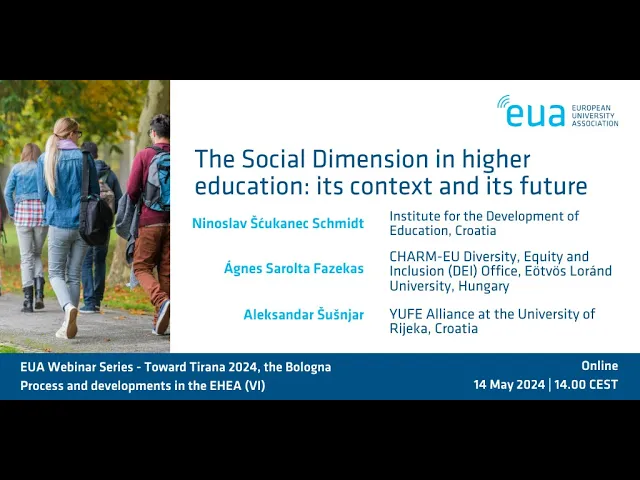
Hello and welcome to the eua webinar series toward hirana 2024 we are today at webinar number six where we will be talking about the social dimension of higher education um note to tech support could we have the slides please here we go very good so as mentioned this webinar is part of an ongoing um series of EA Webinars on the bologna process and um today we would like to talk about the social Dimension its context and its future before I start the webinar and introduce our speakers just a couple of words on housekeeping when you
joined this webinar you first came into a welcome page on our CN platform in this welcome page you will actually be able to find both the recording of This webinar as well as the PowerPoint presentations of all speakers you will Also be able to find um other webinars that were part of the series um as well as the presentations and materials offered there and this also includes a little introductory webinar that has been produced about the bologna process as you can see here in the middle of my slide on the right hand side of your
screen and there are several ways of interacting with us today and I would very much encourage you to do so first of all you have the chat function and Here you can say hello to your fellow participants tell us where you you're from which institutions with country uh you can also comment on the discussion and share your own experiences uh should you wish to do so the Q&A function however is for specific questions to the speakers of the webinar um so please if you have a question directly to a specific speaker please um say or
mention their name in uh in your question as well all participants can Actually upvote specific questions that appear in the Q&A by clicking like button uh so that they move up a little bit in the Q&A and I as a moderator will be able to easier identify interesting questions that I can pose to our speakers oh sorry that was one to4 and indeed our speakers are I'm joined here today by Alexander sush Agnes Shala and ninos slav Schmid um on our panel a bit of background Alexander is the institutional coordinator for the yua Alliance at
University of Rea in Croatia his main areas of work at the moment include the European degree label initiative the development of the educational offer of yua and the coordination of the University of rare care expert in the context of the alliance um he has a very strong background in quality assurance having conducted several internal quality evaluations at University of Rea but also several reviews at National and International level now the despite his current job title Alexander will actually provide us with an Institutional perspective on the social Dimension and present um the approach of University Rea
with regards to diversity and inclusion we are also joined by Agnes from Ator laurand University in Hungary um Agnes is an assistant professor at the Bary gusta faculty of special needs education in Budapest Hungary um since 2019 she also has been the leader of the inclusiveness team in the charm EU University Alliance and throughout her academic and professional career Agnes has focused on Universal Design educational models social inclusion diversity disability and also human rights education now Agnes will U present a perspective from a European University Alliance with regards to enhancing the social Dimension enhancing um
diversity equity and inclusion in the Context of a European Alliance um so I in addition to those institutional perspectives at the panel is also joined by Nino Schmidt and Nino is the founder of the institute for development of education in Croatia where he served as executive director since 1999 and in the last two rounds of the bolognia process together with the European Student Union Nino has also co-chaired the bolognia follow-up group A working group on the social dimension in the last round there was joined by 27 countries and five consultative members including eua and Nino
will contrast the institutional perspectives uh delivered by Alexander and Agnes and I discuss the European or the bolognia policy context on the social Dimension diversity equity and conclus inclusion I myself would like to set the scene though with a couple of words of our organizations of EA's activity on The topic of equity diversity and inclusion I just put a couple of example on the slide here these are several of our reports um that we have issued on the topic over the years I can say in summary that really um over the last let's say 10
to or five years we have seen a really um Rising interest um at our universities with regards to the theme of EDI at Equity diversity and inclusion and this is reflected also in our work when we survey Our member when They join us in projects such as for instance on the slide here the invited project uh such as our monitoring that we conduct in the trend surveys or and also in dedicated thematic projects um here's an example from the field of learning and teaching and approaches to diversity and inclusion promotion In This Very context I
put all the hyperlinks to our reports here on the slide and as previously mentioned these will of course be shared with you in the Even platform which remains open for you now as mentioned um indeed Equity diversity and inclusion are of high priority for our higher education institutions I put here a little teaser so to say of a TR report that we are actually to publish within the next month or so EA TR 2024 a survey of almost 500 higher education institutions in almost all of the countries of the European higher education area uh we
had a dedicated section on the social Dimension in this survey so I invite you to have a look into our full report when we publish it uh in the summer of this year um but just to give you a couple of examples to set a scene here um for almost all of the universities or the vast majority 90% here um Equity diversity and inclusion is indeed an explicit value universities do see it as a major priority the vast majority also then of course has strategies and policies addressing EDI in place at Their institution albit this
uh taking very different forms and shapes as we will also hear from our speakers later on um there are at 83% of the universities dedicated actions in place throughout the institution so not only at specific faculties um that um Foster the enhancement of EDI at the University and um from I think the biggest uh jump in the in support for this topic that we have seen in Trends 2024 in comparison to previous studies was with regards to To considering um EDI in recruitment of both staff but also of students so you can see here that
around two-thirds of University consider equity in staff Recruitment and almost the same goes also for student Recruitment and this of course may be linked to government policies again two-thirds uh say that their government places this uh as a high priority Topic in the context of their higher education system but this is really contrasted then by um the lack Of by well a lack of funding so to say um as you can see here in only 39% of the cases government actually provides a dedicated funding support for Equity diversity and inclusion actions at higher education institutions
um and my I would also like to reflect a little bit more um on the dimension of recruitment as we have seen such a high rise in interest in this field over the last five years or so um I did hear a little ranking um of the Dimensions that are considered in higher education institutions when it comes to students and staff with regards to their policies um and you can see here that overall there are similar Dimensions that are addressed in strategies and policy both for students and for staff disability always coming up as uh
one of the main priority areas to be considered by institutional strategies um but then it um it changes a little bit between the different Target groups so for Students for instance you have a slightly higher um focus on socioeconomic backgrounds whereas for instance for staff there's perhaps a higher interest or a higher priority set for caring responsibilities of the staff overall it is quite striking that there are vast differences between higher education systems of how universities focus on different themes of different dimensions of um EDI just to give you a concrete example um Migration Refugee
like in atris background 57% University said that they consider um um this topic in their strategies or policies for their students and which is actually also quite a high number I would say um but um this differs very much between countries so for instance um more than 80% um of universities in Finland Norway and the UK as well as all of the universities in Ireland address this topic in their strategies for diversity Uh whereas on the other end um only a third or less um considered this topic in Austria Bosnia and Herzegovina Bulgaria and Sweden
so there are definitely vast differences in the themes that are addressed and these themes indeed might be set um by government policies or linked to government policies and priorities which in turn of course are also perhaps supported or even framed by the bolog process and so I will try and give you a One minute Roundup of the 20 years of history of diversity equity incl inclusion in the bologna process of course we have Nino as a speaker later on who can go into much more detail but just to set the scene for you on this
as well um on the policy perspective uh from the EAA uh the first time that the social Dimension came up uh was U with the pr communic signed by the ministers in 2001 um there they um reaffirmed the need to take account of the social Dimension explicitly in the bologna process and this was then later further developed into a different um that uh was part of the London communic where the ministers agreed that the composition of the student body entering participating in and completing higher education at all levels should correspond to the social profile of
society at large in the EA countries on my slide here then I make a huge jump from 2007 to uh 20120 um of course Acknowledging that there has been quite a lot of activities and different minist communicates as well um trying to foster a culture of social dimension in the EA 2020 is the current status quo um this will be of course replaced very soon in 20 at the end of this month with the tyana communic um but just to let you know in 2020 the ministers adopted the principles and guidelines to strengthen the social
dimension of higher education developed in the dedicated working group That nino uh has co-chaired and will present on later on and uh in the 2020 communica ministers also committed to implement the principles um to have policy dialogue with all relevant stakeholders and then also to support higher education institutions in integrating those principles into their institutional missions and strategies so um I would like to now hear from you before I hand over to the speaker about those missions and strategies and we Have a little poll here waiting um and in this poll if you come from
a higher education institutions please let us know whether your institution actually has a strategy a dedicated strategy or perhaps an overarching one um addressing diversity and inclusion I will give you like half a minute or so please um click it's a single response okay yes if we could also already show the results as they come In yes thank you I think we can close the poll um if our support team could show the polling results um to the participants as well I think overall um our participants are quite expert on this topic uh 45% saying
they have an overarching strategy at the University that also amongst many other things addresses diversity 47 48% it keeps changing a dedicated one so very good and the remainder I'm actually planning to have one in the very near future so That sounds really good already as a president I hope that you can make use of this knowledge and experience that you have at your universities uh and feed it into good questions and comments in the chat and Q&A throughout the webinar but now I would like to hand over to Alexander to hear about his University's
um strategic approaches on this topic yes thank you and I will uh start sharing my screen in just a second Okay I hope that it works right so welcome everyone as thank you for the nice introduction uh this part of the the webinar is intended to just very briefly provide you with let's say a sneak peek into the policies and practices on social dimension of the University of Rea so we are U midsize University in Croatia with around 177,000 students and a member of the EA European University Alliance now I I start this with just
a Brief outline of the national policy framework because that is our starting point and indeed it should be our starting point so this is a brief history um of course not of all work on social Dimension that has been done in C but let's say of more explicit and intense work on social dimension of the creation National level so in 2015 the ministry established the national working group uh for enhancement on social Dimension uh of higher education And the main task of this uh National working group was to produce the first national plan for enhancement
of social Dimension that you can see on the slide was actually adopted in 2019 but before that was done uh a background document was prepared the document called under represented and vulnerable groups in creation higher education it was published in 2016 and it is basically an analytical document and synthesis of different research and Other sources of insight into the vulnerability factors of the student body in Croatia when the document was finalized it included 18 under represented and or vulnerable groups that uh that were detected here I will not list all of them here but I
will just briefly maybe mention that the list includes what I guess we can call The Usual Suspects and that and what you would encounter in probably uh each country students of low Socioeconomic status the students who are first generation higher education students uh in their family uh gender differences uh per per scientific discipline Etc but it also includes some uh some uh vulnerable groups which are specific for Croatia or at least are maybe not present uh uh throughout Europe such as the uh Roma ethnic minority such as uh children of War veterans Etc so this
was the basis as I mentioned the first national plan was Produced in 2019 and then an updated version a second National plan was adopted in 2023 it will last until 2025 uh it has 10 sections again I will not list it but it that it is interesting to mention that these uh sections or basically groups of activities were based on the European principles and guidelines to strengthen the social dimension of higher education so the document which I'm sure you're Familiar with but if not you can uh see it also at this link moving on to
University of Rea policies of course I start uh here with the strategy our ongoing strategy 21 to 25 so here we have quantitative and qualitative indicators in the strategy and among the qualitative indicators we have one which is specifically dedicated to social dimension of higher education inclusivity uh Equity diversity is also Present in the um I would say contextualization of our University strategic goals and explaining their purpose in the context of the mission and vision and finally something that I actually think is especially important is that the Strategic plan includes priorities for implementation and here
um social Dimension is present actually in three elements uh as the ones that you can see listed on this Slide now in addition to the strategy as of course an Institutional document I have to say that a really strong push at our institution a strong push for implementation of the EDI initiatives comes from our current management and here are just some brief outlines from our rector's uh program so this was part of her nomination for her current mandate which actually also overlaps with the with the Strategic the period of the ongoing strategy and you can
see Here in writing uh this uh this commitment which um I have to say is really felt uh in person every day basically at our University so for our management this is really not just a certain Trend that is to be respect expected something to pay lip service to but really in our daily work we can feel that for our management it's actually very important that we live these values I will just direct your attention to the third element where in the the Director's program a specific unit uh is emphasized and that is the University
Counseling Center because I will present that on the next slide and the the importance there is given actually to the professional staff to The Experts who can deliver these Services I move now to the to the practices to what we are actually doing and it was very difficult to sum it all up in one short presentation but as I said this will hopefully serve as a Sneak peek and if you're interested we can we can always follow up on that I start with what can be called the structural Dimension maybe even the infrastructural uh and
that is as I said the uh professional staff the experts now the Hub of expertise for social dimension for broadening accessibility uh of higher education for us is the University Counseling Center now you might have questions why this is the case why the name what the Reason is basically historical uh as as I will talk a bit more about on the next slide when we first started with implementing these student Support Services we started from the Counseling in the narrow sense and with support for for students with disabilities this was all housed under this one
Center but over time the name remained but the scope of activities uh was significantly broaden and what you can see here in creation is is just the welcome page of The University Counseling Center saying that seeking help is not a sign of weakness but of maturity part of the evergoing and very rapid shift in mindset that we can observe among our students by the way that the students are becoming more and more open about different types of issues that they encounter now just a few more words about the Counseling Center so there are three streams
of activities the psychological counseling and here as I Mentioned in move from the let's say in the narrow sense to a broad sense because really this unit is there to support students or or at least to serve as the initial contact Point as the first stop in any type of difficulty that they might encounter whether it relates to the uh to the learning process whether it relates to their life in general so uh in a time and I will talk about this uh also when we come to the challenges in in a time when it's
Almost difficult to even know in advance what what what will be all the issues that the what will be all the barriers that the students face this is kind of the entry point which serves uh which serves to kind of capture the broader spectrum of students career and academic guidance I won't go much into details about this uh I think this is quite self-evident but the part which is most relevant for uh today's topic is the student support office and this is the Office that actually started uh as I mentioned as a office for support
for students with disabilities because this was the first vulnerable group chronologic that we started working with uh I mean decades ago and then over time the scope broadened now it is effectively uh an equity diversity and inclusivity office which really deals with many different um let's say dimensions of providing equal opportunities for students and also does A lot of work which is proactive not only reactive of course now in addition to when you know when I when I try to select uh just three things that I will emphasize here on the Practical level um I
in addition to this infrastructure level the second thing that that comes to mind necessarily is these attempts at transversal integration successful attempts I would I would hope so so the way that our management sees uh our Social Dimension policies and practices is that they need to be integrated in all of our activities so what you will see here are just some examples of this that I start with the basics University of Rea study regulations an absolutely most important regulatory document that we have because uh this is really the almost the constitution of how our education
is delivered and this document outlines specific targets of students for specific adaptations of study Regulations so study regulations have certain level of flexibility for uh for the students that are in need of this on the other hand and this is very important it also puts the obligation on the University level faculty level and departmental level to provide certain additional support uh now in general uh we do not have for University of Rea specific uh list a list of specific under represented and vulner vulnerable Groups for us we in general we use uh the list that
was produced on the national level with very small modifications the additional work that we do is that we just try to contextualize that and we try to see in which types of circumstances or environments uh specific groups of students are maybe experiencing this vulnerability more integration with our quality assurance system something that's very Close to me personally as you have heard in the beginning my primary expertise is in in quality assurance and this is something I worked on so integration of social dimension uh elements Dimensions indicators in our QA system I mentioned here two things
something that's for us a gold standard in in evaluating ourselves is our study program evaluation upon graduation and we have added socio demographic characteristics to this evaluation which enables us to Compare uh how different groups of students perceive their education also we have our internal quality assurance standards because we also do internal auditing in at the University of rea uh and these standards are of course based on the European standards and guidelines but we have expanded them with social Dimension Elements which I think is interesting in the current time when there are some discussions about
the ESG revision should maybe social Dimension Feature more prominently in the European standards and guidelines for quality assurance so we have already done that in Rea and finally I couldn't talk about this transversal integration without kind of trying to capture all the the bread of uh activities that happen in a more bottom up way and yet they always include references to social Dimension from uh different actions and activities that uh and projects that we have on Sustainable development goals to uh work with student associations with our with our University of Rea Student Union where for
example recently a really interesting project on menstrual poverty was done which was then taken up on the national level we were very proud of that and our gender uh equality council's activities uh in accordance with the the with the plan where I can say that we are quite proud that University of Rea has been a front Runner in this topic at the national level but I would also say the regional level and we are very proud to be able to share these experiences with many universities in our in our surroundings and finally the last slide
I was also asked to reflect here on on a few challenges you will see three of them here all three of them are interl the first one is a very nice example of how a challenge doesn't have to be something negative it can be actually Exactly what you want but it still poses certain challenges for your work this what we can call diversification of student body and not only in what we can call the their objective characteristics but also and maybe even primarily in the way that the students perceive themselves and how they react to
certain difficulties and barriers and how they are more honest and open about it poses increasing challenges in capturing Everything uh here we have heard that Agnes will will refer to principles of Universal Design and that is something we try to live by but it is not easy it is not easy when you have such different groups with such different issues how do you tackle that when there's a smaller number of such vulnerable groups groups it's of course much easier to handle it but the mentality shift that is happening here is also to stop thinking about
them in Terms of groups in terms of categories and more perhaps in terms of specific vulnerability factors which can then interact with each other and produce a very complex intersectionality uh Network that you have to handle with if you want to be truly fair to all of these students and their individual circumstances now this is connected with the uh push to to to kind of work with such students to develop appropriate measures that's a very basic principle That I think we all adhere to but it is increasingly difficult because you're not sure always with whom
to talk to and at which level of let's say refinement which level of granularity do you need to go to to Really design specific targeted measures and finally the Outreach now the the the the image here that you can see is basically just a joke about sampling bias but I think there's a more fundamental issue there we want to talk with uh uh with with the Students who who face barriers in accessing and successfully completing higher education but if we only talk to those already at the University there's a very obvious problem here on the
other hand for a university it is very difficult to do effective Outreach and to really reach those who are not yet in our system to really see what we can do for them so these would be three challenges to outline here thank you wonderful thank you so much Alexander for this very interesting overview of the approach um of University of Rea um I see that just in a very last moment there's a question come in um and uh it comes from Neil steny I would like to pose it to you uh if I understand correctly
the C Center at University of Rea is a central unit how do you interact with individual faculties departments and so on and how do you make sure that you're visible also Amongst the student body and staff body at your University very good question thank you Neils yeah and and it's even better question if if you would know how decentralized we are we are extremely decentralized so faculties in Croatia or even their own legal entities so that is actually very spoton question however the university Counseling Center is if I would have to you know choose one
Central service at the University that Is best recognized it would actually be that one among the students among the staff Among The Faculty management everyone knows about the counseling services uh counseling center and the services that they provide specifically the one of these three units dedicated to student support so the one that's most relevant for our today's topic works a lot with the staff in uh providing expertise in for example adapting the learning and teaching Process to specific circumstances of students so there are often the first uh contact for individual teachers and the the management
when they need to do certain modifications um yeah I would and among the students really we cannot complain about the level of recognition because the students are being more and more open and really I think everyone knows about these Services very good thank you so much and Uh for time reasons I will not pick another question but um hand over to Agnes now who will present a perspective from a European University Alliance Agnes the floor is yours thank you so much and I hope that the slides are on yes I can see I hope also
the participants can see uh my name is Agnes shakos vinkovich I am coming from Budapest Hungary from the lent University and today I'm connecting the inclusion and diversity aspect Of the charm U Alliance next slide please or I can do that yes yes exactly perfect then I can do that okay and I also take the timer as well for for Access needs it's also an uh to respecting access needs for the time so the time is on so um uh what is the diversity and inclusion mainstreaming in charm EU uh mainstreaming is a key word
I will explain in a minute and CH charm EU stands for challenge driven accessible research based mobile European University and how is diversity and inclusion is mainstream is that the very first moment then when we successfully were um approved by the European commission uh one of the key aspects of the alliance was to set up uh key values and principles and mission and vision as as the charm meu uh started to to bloom and and grow and inclusion was one of the key aspects and we also cre created that text together with many colleagues also
individuals With lived experiences to really reflect on the needs and on the diversity of societies and I uh shared with the text so you can also read it but I would like to highlight key words uh open welcoming mutual respect and all kinds of backgrounds and um we are also approached this uh um this diversity and inclusion with a holistic intersectional and human rights based approach what does intersectional means in that sense is that uh henriet might also ask me That okay what are the Target groups that we are uh we are considering I will
share with you in a minute but I want to highlight here as I also highlight at my conferences or or presentations that we should see individuals in their flu full diversity and in their multiple identities uh barriers uh Privileges and uh and also difficulties that they face in societies uh also uh difficult is that Society puts as a as a barrier so these are the key approach and of course We follow um follow um relevant legislation and I also share yes let share the next slide so uh inclusiveness what is mainstream this is what what
I was mentioning mainstream means that knocking on every door uh and bringing this agenda to all kinds of fields this is the transversal approach uh in the past we were a work package but already in 2020 we moved into this opening doors policy meaning that we knocked on the door of the governance Group of the communication team of the charmi alliance Etc and since 2023 we are under the governance work package and I will explain why and then we also started to work uh from 2021 that it's not only a service approach approach but rather
a strategic approach because we would like to be a role model for social inclusion in terms of diverse and complex societies and as Alexander also mentioned my field of research is also Universal Design of Learning uh but I also wanted to ensure that step by step we approach this thing and of course many colleagues I mean many universities and many colleagues for this model still new because higher education historically has been uh has been approached by that new groups have been entered in the last 30 40 years if we look at the historical background of
higher education if you look at 1960s or after the second world war so it's quite new to have uh to have these groups so But the new approach the the Innovative new approach is that if we start something new we should consider the greatest extent of users and design the space uh as inclusive as possible from the pre beginning from the zero moment as I say and uh rather managing uh these as a re retrospective approach of course historically our institutions are not uh built like this but this is what we need and definitely time
and resources are are key for that approach and I'm also Happy to share relevant research and also relevant uh documentation that we produced in the charmie alliance and you can access under the toolkit section of the website next slide I go to the next slide yes yes let me see just one come back yes so uh Henrietta ask me okay Agnes please share what what are the strategies of course I was delighted to share and highlighted that we mapped out uh uh grounds on equality among our partner institutions mapped out National Strategies uh governmental and
National legislations across the universities and um this is how we could uh identify the target groups of course not only on the national level but also on an Institutional level with checked what are the rules and regulations of universities that are in um U uh compliance with European I mean National European even global global documents and just as a reference point to Alexander uh disability was mentioned uh Of course the United Nations have a convention on the rights of persons with with disabilities and very uniquely the European Union as an entity signed and ratified the
UN convention in 20 uh 11 yes yes and uh here you can also see our research and the key findings next slide I go yes yes I oh sorry it's too fast uh next slide what are the key um active elements of implementation first I mentioned to you that already in 202 when we have the we had in February 2020 The first inclusion team meeting just before the pandemic hit we decided that um uh besides that it's extra workload we want to open doors and co-creating with other work packages and organizational units it was a
commitment by our team and a commitment of other teams of this cow co-creation so it's not just as soay I mean it's it's not just a separate group that does inclusion H in terms of the master program we have a global uh master Program in charm and we introduced at the accreditation policies I mean accredit accreditation procedure inclusion measures at the admission process also the financial aid uh grants for the admission process and since the um additions of the Masters these are still running and actually we we are just completed this uh uh round of
admissions this year as well next slide I hope it goes yes uh we also uh mentioned or Alexander also mentioned The variety of needs of individuals uh we also carrying out A needs assessment uh which is also in compliance with um with the students needs but also considering different life situation uh even if even if they are not regulated yet but we try to be as holistic and intersectional we also support staff and students in terms of professional development sessions and tools and tips uh and also we join to the sdgs and human rights issues
in Terms of global awareness raising next slide I mean these are uh coming back for a moment in the Q&A and um uh last but not least I'm super delighted behalf of the whole charm meu community and partner organ partner universities and also highlighting the wonderful work of my team members uh and all the colleagues who have contributed uh we have uh been uh applied or we applied in 2020 uh four on or three 2023 for the uh zero com zero project uh award it's a open call for nomination of inclusive uh practices all around
the world and this prestigious uh uh um prestigious call or prestigious award was U was going through on three rounds of um uh rounds yes selection rounds and from the beginning 543 applications from all around globally not only from Europe but all around globally have been reached and The prestigious uh uh jury selected experts selected the 77 best practices and I'm delighted that we were one of them and we are very proud and I also mentioned to my colleagues that is a moment for celebra but it's an commitment for the future and basically that's it
and thank you so much and I still have 42 seconds to go and I give back the floor to Henri thank you thank you thank you so much Agnes for this excellent overview of the Approach uh within the charm U Alliance very interesting and thanks for highlighting especially how you mapped out the in the different approaches at the universities that are part of your Alliance and try to bring them on par maybe this actually a topic that we can come back to in the discussion um oh I see always at the very last minute there's
questions come in let me have a look H yes has I have a question from David cier David is from urise uh as you May know H in charge of the bolognia implementation report amongst other things and he asked has there been any change in the demog demography of students in the charm EU universities do you have data on how the target groups have changed since the adoption of your Universal Design uh or inclusion policies overall thank you David thank you so much for these questions yes we have so uh we have uh when we
introduced all these measures into the Accreditation process all the documents we are measuring uh qualitative and quantitative data the most easiest one is to measure the student coh and of course we consider also students and staff but we uh we check that who how many students have tick the we call it take the inclusion box at the admission process so we have the number there we also have the number that how many students have been um uh successfully admitted to the program we oversee the The the whole charm meu master program duration in terms of
access needs and and everything that it's during the studies and we also check out dropouts and the diploma I mean completing of the diploma so we have the measures we have the numbers I don't have here in my not here me but we have the data and just an addition we also created this 2023 when we met went to the second round of the of the chu uh that um we are now um working on a very detailed Indicator U or indicator system which helps to to map and and organize that how uh efficiently we
are working on inclusion not just the master program but the whole organizational culture so for all the work packages and organizational units we have quality and quantitative data and if I may say we will go into the just just one thing that we will go into the uh mapping part this autum so this is a good work a good good thing to to do yes absolutely no And and thank thanks for mentioning that and I think uh the indicator system that you mentioned is indeed also a good lead over to Nino's presentation that will follow
because indicators was were indeed one one of the biggest parts of our work in the bolognia process on social dimension in the last round um as a small lead over to also engage our participants again we'll just have a very quick small poll um before I give the floor to Nino um you may recall from My presentation that uh not all of the institutions that participated in our Trend survey um actually had also explicit government policy support to our tech support could we please open poll number two and so I would like to ask the
participants of the webinar whether in your country there are National policies or strategies in place um to support the institution's work in this field there uh here you can select uh as many options as you Wish and I'll give you a few seconds to do so okay slowly coming in yes I see a very mixed result actually if we could also display the results uh to the participants as they come in um I think from what I see here um for uh well a quarter of our participants or so there are dedicated polic IES for
students uh a fifth so a little bit less for staff and um only in 16% these are Also set with different targets and indicators and national funding uh only at 13% of our participating um or our participants institutions or in the National context of our participants so um this is very interesting and I hope it sets the scene a little bit to what Nino will now present uh to us with regards to the policy context of course with largely the focus on the EA level thanks Nino the floor is yours thank you henriet so um
I'm really very glad Henriet that I have the possibility to speak on the work of the bologna followup group more particularly uh on the work of the working group on social Dimension and uh as you mentioned I had a pleasure to uh co-chair the work group on social Dimension within the bolognia since 2018 and U on behalf of Croatia and I work as director at The Institute for the development of education in uh Croatia um since I would say uh 2018 European high education area uh has significantly progressed in advancing uh the social Dimension and
it is demonstrated uh through through I would say four important achievements the first one is that we have the new uh definition of the social Dimension and we created it in 2020 and it says that this is a process aimed at creating an inclusive environment in higher education in which the composition of the student body at All levels corresponds to the heterogeneous social profile of society at large and this definition encompasses also the desire inclusive environment in high education that Fosters as you can see Equity diversity and is responsive to the needs of local uh
communities so um the term social Dimension within the bologna process encompasses for distinct but still interconnected concepts of diversity equality of opportunities equity and inclusion the fourth fact is That uh the Ministers of Education uh of Bologna Pro is adopted in 2020 principles and guidelines uh social Dimension we have 10 principles and principles cover uh different areas but they are understood as highlevel statements that serve as a basis for the conceptualization of different policies for social Dimension and each principle has guidelines which are the recommendations intended to advise policy makers on how the principles Should
be implemented in practice the third important achievement that we achieved this year um is that we succeeded to create indicators and descriptors and we expect that the ministers um of the bologna process will adopt it now uh at the end of this month in Trana this document indicators we Define as tools for measuring progress in implementing the principles of the social Dimension and each indicator has its descriptor which outlines istics of The indicators in more detail providing a better understanding of the indicators and how they can be implemented this document is not prescriptive so we
adopted the toolbox approach which enables e countries to implement them in a way that suits their National high education systems indicators and descriptors are important because they enable the creation of a European level and also National level systems of monitoring progress in the Implementation of the principles and the fourth uh achievement connected with the previous three is that uh we uh this year finished what we call EA policy framework for the social Dimension uh which consists of the 10 principles and guidelines indicators and descriptors and a European and National level uh system of monitoring of
the implementation of the principles so uh I can say that the framework represents a coherent system that enables public Authorities to incorporate social Dimension principles in different strategies and policies I'm very glad that um uh we uh with the help of the U uis uh also now have facts and we can see how the countries are progressing in the implementation of the principles and here you can see uh the results of the forthcoming uh report bologa implementation report 2024 that will be published by UIC by the end of this Month just before the tyana conference
and this principle is on inclusive institutional um cultures um and uh for that purpose there are four indicators that show basically how the governments are helping higher education institutions uh in um organizing a training for higher education uh stuff uh and uh for both academic and administrative stuff or if they have created a kind of a monitoring body um that can monitor the Implementation um of um the principles so out of these four indicators uh we can see the composite scorecard indicator that shows uh to which extent the countries are implementing this principle on inclusive
institutional culture and we see that half of the countries in Europe in green progressing very well but we do have also um almost half of them also maybe that are not progressing so so well particularly those in uh red color um it is also Possible uh that we provide an um uh overview of how the countries are progressing related to a single indicator uh um so here you can see the results um related on how the countries are supporting higher education institutions uh for staff training on social Dimension and we see that some countries like
for instance Ireland they have created a national access plan uh which is basically a strategic show strategic approach to social Dimension But they have also supplemented in by targeted funding opportunities that promote teaching and learning enhancement especially in Universal Design and in Flemish community in Belgium they uh provide a support to a public organization called SEO to develop and organize training on student mental health issues so again um when we compare the countries in Europe we see that half of the countries are basically providing really support uh to their High education institutions to improve their
training on social Dimension but half of them um uh they they they just don't maybe another example related to the principle uh which says that um public authorities should engage in a policy dialogue with high education institutions and other relevant stakeholders about how the about principles and guidelines can be translated and implemented both at National and institutional uh level we See that almost 19 countries basically um have not started a policy dialogue with their higher education institutions on how to implement principles on social Dimension within their National context but then uh we see that almost
also half of them incl that they um do have some activities in this regard and at the end um maybe it's important to share also some good practices because for instance in Austria they organize annual networking conferences that bring Together a wide area of stakeholders from the higher education sector they U discuss interim evaluations of the Austrian national strategy on the social Dimension uh uh ensuring continuous stakeholder engagement and feedback so uh we see that there is certainly a space for improvement uh in uh Europe uh in improving social dimension policies and I'll just conclude
uh with one more uh fact also uh with uh uh the findings of the uh 2020 report of the uidic uh Which also shows how the countries are implementing uh the principles and guidelines U all across Europe and as you can see the result indicates that European systems have implemented nearly 42% of the policies required to meet uh the commitments related to the principles of the social Dimension so I would say that uh it shows that um the countries are engaged but certainly there is a space for improvement in the future um and for that
reason I think it Is important uh that uh the countries also follow the work of the bologna followup working group on social Dimension and on the ha info website uh they can check uh how we are progressing and all of the documents that I mentioned are there henriet thanks so much Nino for this interesting overview and also for sharing with us a bit more about the context H as well as data on progress and the room that there is for Improvement um as ever too often unfortunately we're almost running out of time I hope that
our my speakers do not mind if we if I keep them for five minutes longer so we can pick up one or two discussion questions as well um and I hope the participants are okay with that as well now Nino finished off on the progress but also room for improvement so let's talk about potential Improvement um Alexander you already mentioned concrete challenges um Perhaps I would like to start with Agnes and also reflect on challenges from her perspective in enhancing inclusion um in the context of her institution or the alliance and then maybe as a
group we can um talk about suggested recommendations of how to overcome these challenges so Agnes I'll start with you please thank you so much and this was the slide that we went through uh so I highlighted key challenges and also key three series Ser challenges and three Solutions one of the element is definitely resources limited resources that was also mentioned by the colleagues as well um and this is number one so again the solution is that strategically it should be considered how we should uh invest in in inclusion and diversity and how this value is
important for institutions in compliance with global Trends in higher education the second um challenge is uh the retrospective approach uh of inclusion Inclusive Design This is where I'm highlight at my presentation that historically it's understandable but once we create something new when we create a new study program a new master we should design from the space uh as inclusive as possible and this is the solution that we have in mind in our hearts and minds and number three is the discussion that I'm also hearing on a global level as well and also on a European
level is that inclusion and Diversity is a service or a strategy and historically again it's more a service but in charm EU we are moving towards a systematically and profoundly IM uh how to say implemented or or established strategic approach uh for this and I think that also the global challenges are also suggesting that we should should consider these so these are my three challenges and three solutions thank you thank you so much and perhaps I now give the floor to Alexander uh Similar challenges similar Solutions at your University or perhaps in the alliance that
you part of uh well um the institution level and the alliance level challenges are significantly different I would say I mean they overlap but on an alliance level we have this very interesting um interplay of different National context it means also different cultural and sociopolitical context and different cultures I would say or Mentalities in how to approach uh the these issues uh and by the way this doesn't have to be negative uh good things can come out of this interplay but it's definitely been something something to tackle um on an Institutional level but again I
think that this is a general point I think that and and yeah again it's a general point but I think it's very relevant for this issue it's that it's so important to Create organic buying organic commitment also from those who are maybe not initially predisposed to have this buying so what I'm trying to say is and I have noticed this not again only in a policies of social Dimension but in many things that we do in higher education we people who are here who are here in the room are committed we typically work on developing
those policies the toolboxes mechanisms Etc when it's time to kind of disseminate them and Integrate them in the everyday lives of our institutions I think we need to pay much more attention to the question of why why are we doing this and not only on how and what yeah we tend sometimes I have a feeling to forget that because for us it's so obvious it's automatic we don't even think about it so we go straight to how like oh let me show you this amazing tool this amazing process that we have developed but we need
to be Mindful of always starting with the why and to really try to bring these topics to people who are not currently that much into them that's for me the the the biggest challenge that I can see for good point thank you very much Alexander now um talking to only those that are in the system you mentioned or um you know having very different cultures and approaches between institutions um leading over to Nino we've seen very much different Approaches also in the data that you have presented across the EAA um would you say that um
there are common challenges um on you know really creating a culture across the European higher education area in making the social dimensional reality we at the um bfug working group of of social Dimension believe that securing the implementation of the EA new EA framework the social dimension in member states uh until the end of this decade Is crucial and I think for that purpose uh three things are important first I would say to exchange good practices among eh member states because it it will uh help them understanding how the implementation uh of the framework addresses
the various social and economic challenges facing the high education sector second the successful implementation of the framework will depend on effectively integrating the social dimension of our education with Other policy areas in higher education like learning and teaching research um Outreach governance uh quality assurance funding and the third element uh that is certainly very important is to secure regular monitoring of the implementation of all 10 principles both at the European and National level and for that purpose uh we propose to the BG to continue the work of the working group in the next three years
or if that is maybe not convenient than to um think About the establishing a uh peer uh thematic peer group uh on social Dimension because then uh it can uh speed up the whole proces also at the European level thank you canet thanks Nino thanks for this overview also on the future um of the bologna process um I hope that this peer learning will of course involve uh higher education institutions as well as policy makers I think um in the way that Alexander has presented it uh that the Way that that it has been done
in Croatia was a very interesting approach and so um I hope that in the future we will also see this in other countries I'm afraid we're running out of time um and so if you allow me unless you would like to make a final statement or comment then I would close this webinar just with my own final slide uh that I would like to ask our Tech Support to display of course I have to inform you about our next activity Which are further down hang on just a sec uh the bolognia webinar series is not
finished yet um and we have two more webinars coming up and it's sorry loading very slowly here we go um you will see us uh talking about indicators in more detail we've seen a preview today in a way from the data that nino has shown but on 11 June um we will talk with urise and ISO about what the indicators say about this state of the bologna process and then also after the Tyana ministerial conference um eua will host the discussion between leaders of higher education institutions to dis to discuss the actual content of the
tyana communic that the ministers will adopt at the end of this month um so with us I would like to close today's webinar thank you so much um for your participation to the speakers and for your attention to our participants and I wish you a pleasant afternoon but