First of all, the idea of virtual displacement. If you consider a mechanical system formed by any number of particles subject to certain constraints, to certain restrictions to the motion. In each instant, each particle of the system has a certain position.
And there are a multitude of different positions that these particles could have in a specific instant, all of them compatible with the constraints. Positions that are allowed by the constraints imposed to the system So if we imagine two infinitesimally close configurations to the system. Then, the configurations that the system that could have at a given moment, and two of these configurations infinitesimally close.
Meaning that, to pass from one configuration to another, each particle must be infinitesimally displaced from its position. So these displacements of each particle, of a possible position to another possible position at a given moment, are called virtual displacements. Virtual displacements are displacements of the position of each particle, an infinitesimal displacement, which is compatible with the constraints.
The word virtual means that these displacements are not necessarily displacements that occur as a result of the motion of the system. As a result of the passage of time. They are only displacements that lead to an instant configuration They are only displacements that lead to an instant configuration to another setting, at that same moment, also compatible with the constraints.
In these virtual displacements time is considered fixed. Virtual displacement are not displacements necessarily related to the motion of the particles due to the forces acting on them. Ideals constraints are constraints such as that the work done by the constraint forces, when virtual displacements are realized on the positions of the particles, this work is equal to zero.
If a particle is constrained to move on a smooth surface, the constraint force that holds the particle on the surface is perpendicular to the surface because there is no friction, which would be the part of the tangential force. If there is only the normal force, an infinitesimal displacement of a point of the surface to another one infinitesimally close, so it is tangent to the surface. Therefore the work done by the constraint force, when a virtual displacement of the particle on the surface is done is equal to zero.
The force is perpendicular to the displacement, so the work is zero. Even if the surface is moving, the virtual work of the force constraint will remain zero. Because, as the virtual displacement is made at fixed time A virtual displacement is a displacement from one position to another one of the surface at the same instant, then this displacement is tangential to the surface and the force, by definition, is perpendicular to the surface, the constraint force, hence the work done by the constraint force, during a virtual displacement is equal to zero.
Which is not necessarily true in the case of a real displacement that occurs in a time interval, if the surface is in motion. Because if the surface is in motion. .
. If this here is the position of the surface at a given time t and this here is the position of the surface at a given time t plus dt, a virtual displacement is this displacement here. A fixed t.
The real displacement, which occurs in the time interval dt, if the particle is moving on the surface while the surface is moving, this point of the surface will be here in time t plus dt, then the particle will suffer a displacement, the real displacement will be this one here. While this one, at fixed t, is the virtual displacement that is indicated by the letter delta, to distinguish from the real displacement, which is indicated by the letter d. Then, this vector has no reason to be tangent to the surface in an instant t, so the work done by the constraint force when a real displacement of the particle occurs, in general is not zero.
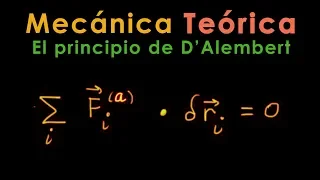
However, it is zero if the surface is smooth and the displacement is a virtual displacement. So, ideal constraints are those for which the work done, the total work, the virtual work done by forces of constraint --- Those tiny fi are the constraint forces acting on the system. This here is always zero.
D'Alembert’s principle is an equation that results from this condition here, that the constraints are ideal. The Newtonian equations of motion of a particle system are pi dot which is the same thing as mi ri two dots. Mass times the acceleration of i-th particle is equal to the resultant force on it, which is convenient to decompose on applied force, or active, plus the constraint force.
These forces are the forces responsible for maintaining the constraints that act on the system. So here, from Newton's Second Law, it follows immediately that pi dot minus the applied force on the particle number i is equal to the i-th constraint force. If we multiply scalarity by the virtual displacement of the position ri and add up, and use the condition that the constraints are ideal, then it follows this equation, which is known as the d'Alembert’s principle.
You should be asking, but what are the benefits in using the d'Alembert’s principle to try to describe the motion of a particle system? How this is advantageous over, for example, in respect to these equations that are the equations of motion of the Newtonian system. Let's first look at the Newtonian formulation, which is based on these equations here.
To write down the equations of motion of a particle system subject to constraints, as Newton's Second Law says that mass times the acceleration of each particle is equal to the resultant force on it, the resultant force includes forces of constraint. First, the Newtonian formulation requires a consideration of the constraint forces. The inclusion of constraint forces in the equations of motion.
If the system consists of N particles, there is an equation like this one for each particle. Each vector ri requires three components, then we need 3N coordinates to describe the position of each particle of this system. But if the system is subject to constraints, many of these coordinates are redundant, because in fact the system requires a smaller number of coordinates to describe its configuration at all times, than 3N coordinates, which are the position coordinates of each one of the particles.
Then there are two drawbacks of the Newtonian formulation. First, it requires the explicit inclusion of constraint forces in the equations of motion. Second disadvantage.
It requires to work with more coordinates than necessary to describe the motion of the system. What we're looking for is a formulation of the equations of motion that does not suffer from those two drawbacks. First, that does not include, or does not need to take into account the constraint forces.
Moreover, that it only requires the use of minimum number of independent coordinates needed to specify the motion of the system.