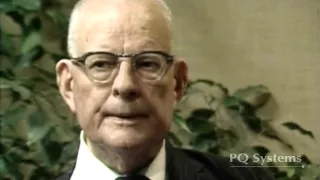
okay all right let's go to the slides the dimming way William Edwards Deming born in 1900 Sioux City Iowa he's a Midwestern ER he got his bachelor's degree in electrical engineering one of the things that you will find as you become more interested in do research in the area of quality is all of the major significant contributors in the quality field are engineers now why is that why don't people from marketing or finance or they follow this approach but why haven't they Big Ben get big contributors any idea I got my own theory they don't
have the technical background to appreciate the important issues what's different about engineering you're forced to think an engineer you think critically and you a certain level mathematical maturity the sciences are required in engineering don't don't you see that and I've said for many many years a baccalaureate degree and mechanical engineering is basically the liberal arts education of the 21st century when you look at the needs of society what is society need society needs technically trained workers and so what my point is that I think that it's important to recognize that these great contributors and we'll
only talk about a few of them we talk about some of the major ones got a BS in electrical engineering from University of Wyoming in Laramie a master's degree from the University of Colorado in Boulder 1925 then went to Yale that's interesting because Yale is a very special school at the time he went there was no engineering program at Yale it was it was called mathematical physics that's as close as they got today they do have an engineering program but they don't have discipline specific engineering programs I just have engineering ok died 20th December 1993
I I was aware that dr. D was not well I as the Midwest coordinator for his last major PBS broadcast and working with dr. Deming was a real thrill but also a challenge because his mind he had the ability to be thinking it seemed to me he'd be thinking about ten things all at the same time and a lot of energy tremendously deep thinker and maybe we'll talk a little bit about his writings he was reading the day he died a book in my book series on design productivity written by dr. Taguchi now you know
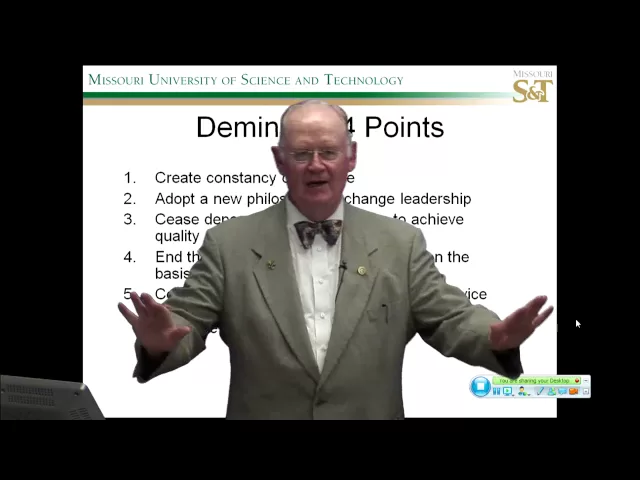
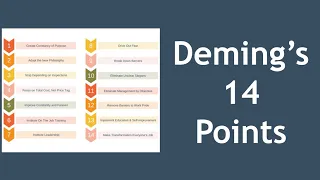
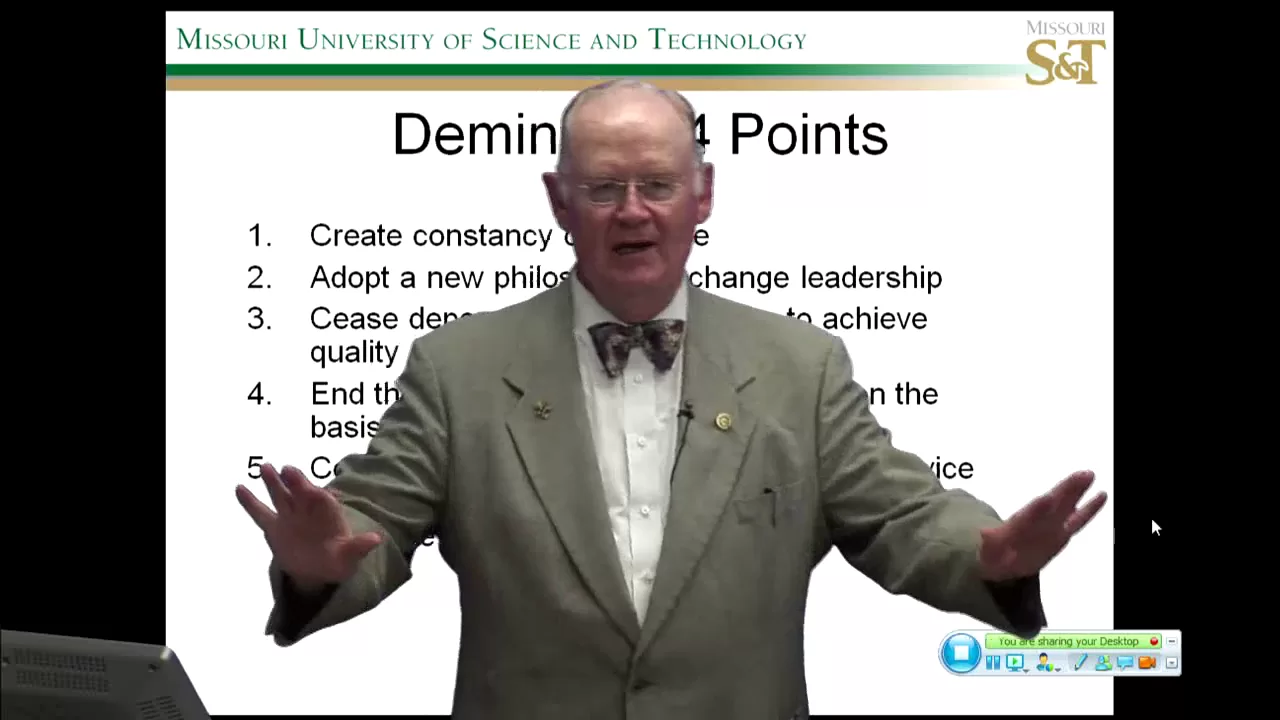
of course that he's well known for this and who did he say that this was came from who did Deming say that Speedy's who shuh heart yeah okay dennings 14 points let's just review these you've heard of the fourteen points right what are the 14 points let's just summarize what are they they're Demmings definition and commandments to management so God gave us the Ten Commandments to keep us out of trouble Deming gave us the fourteen points to keep us out of trouble okay create constancy of purpose if I remember my many many times months and
General Motors at the corporate headquarters and at the different locations the one I've spent the most time in is the truck plant in Pontiac and they have a video communication system so if the CEO or some executive needs to communicate to employees they'll email will go out and you go out in the hallways and they have all these big monitors in the hallways and they just talk to you so just so happened this one time I was spending 15 months at GM on a project that had originally been designed for me to do at the
University but it contains some propriety I was going to have to use some proprietary data that the unit that GM really did not want to get out leave the company and so they said look you've done this before how about taking leave just come work for us for 15 months and they make it very worthwhile and so I rented an apartment up in Pontiac and near Pontiac and this was my first day just happened to be that day with Rick Wagner's first day as CEOs so he was making a there was one of those things
like 10 o'clock rotten hallway listen to that very effective and the key point that he wanted to make was that I don't plan any immediate major changes in the management the company that is the he'd been serving as the director of North American operations for the prior it's like four or five years he was aware of the what the strategic mission and direction of the company was and he saw no need for immediate change but that that would be under review that they would be looking very carefully at the company and although he didn't use
the word downsizing if you read between the lines it was obvious that the company was going to look carefully at every component to see if consolidation and downsizing was going to be appropriate constancy of purpose if every quarter you make an announcement as CEO well this is the direction we're going and then the next quarter you say well that was good last quarter but we're going this way now and then the next quarter you say we're gonna go this way the opposite direction well before long the employees the the troops it's just not going to
listen to you you're just going to lose the troops besides the fact you're gonna lose a lot of energy and money due to the fact that you have inconsistent and oftentimes conflict objectives so so so an organization needs constancy of purpose if you take a company like General Motors which say in the year 2000 had an annual budget greater than all but 24th of the world it's um it's a few think of it as a huge ocean liner you don't just turn that sucker on a dime it takes a while to - to make changes
number-2 Deming said adopt a new philosophy of change leadership Deming was a master at helping us to understand and by the way Deming start started telling corporate America when he worked for the Census US Census he started telling corporate America in the 40s what we had to do to be successful this was a time after the Second World War when productivity was king just ship it put it in the box and just make it put it in a box and ship it don't worry if it doesn't work we'll tell them how to fix it once
it gets there and the reason for that is pretty simple to understand there was no manufacturing capability anyplace else in the world in 1945 the only the only place on earth where you could really make high technology products when I'm talking about is typewriters printers things like that automobiles was North America the rest of the world had pretty much been bombed to the ground now I'm not saying this is good or bad I mean it's just a fact if you if you looked at Germany there weren't any plants left in fact much of Europe the
Germans did the flattening during the war and then towards the end the Allies did the flattening and of course the only city in Japan that was spared was Kyoto the city of temples and there are advantages disadvantages that one of the advantages after the war General MacArthur's people if you read some of the writings of General MacArthur during the time of occupation you you'll see that there was no time and no concern about retrofitting factories you didn't have to retrofit or upgrade equipment there wasn't any you're building new factory so you could you could have
a new way change was the constant and a few people began to understand that now Deming did not achieve much favor in the United States till 1980 so almost 40 years he was pretty well ignored by corporate America he he began to be in favor when when the CEO of Ford invited him to come and give a talk in January of 1980 and then people began to listen seas depended on inspections to achieve quality now I have good news and bad news which do you want first inspection adds costs that's the bad news people may
think well if we just inspect every stage we'll end up with a good product but very quickly you find out that that the costs associated with excessive inspection seldom compensates are seldom is is a good investment that is and in addition to that many companies particularly in the 30s 40s and 50s felt just by inspecting you're going to get better performance and so they have mounds of inspection data but they didn't do anything with it okay Oh in the practice point number four in the practice of auditing business on the basis of price consider toll
costs lifecycle costs start yes the good news the okay the bad news was inspection is expensive the good news is if you do it right you can create a system where inspection is not choir that's the good news okay in the practice of warning business on the basis of price consider lifecycle cost five constantly improve your production and service system to improve quality and productivity and therefore drive down total cost now this was rather revolutionary the fifth point of Demings fourteen points rather revolutionary the idea that you could have productivity and quality together because we
had the mindset that you can have as much quality as you could afford and so therefore quality cost and anytime you focused on quality it meant that your productivity was going to go down six institute on-the-job training rotate one of the biggest um well let me back up when you go if you go to work for a large company when you get your degree and leave the university you will probably go into a rotational training program and different companies have different approaches but the idea is to expose you to the culture for you to see
the different group parts of the organization even though you might be it might already be decided that you're going to work in one segment it'll be useful for you to know about the other areas this is a very Japanese concept even even today you will find that rotating during specialization and generalization are balanced appropriately and many very effective companies okay focus on leadership at all levels from the shop floor