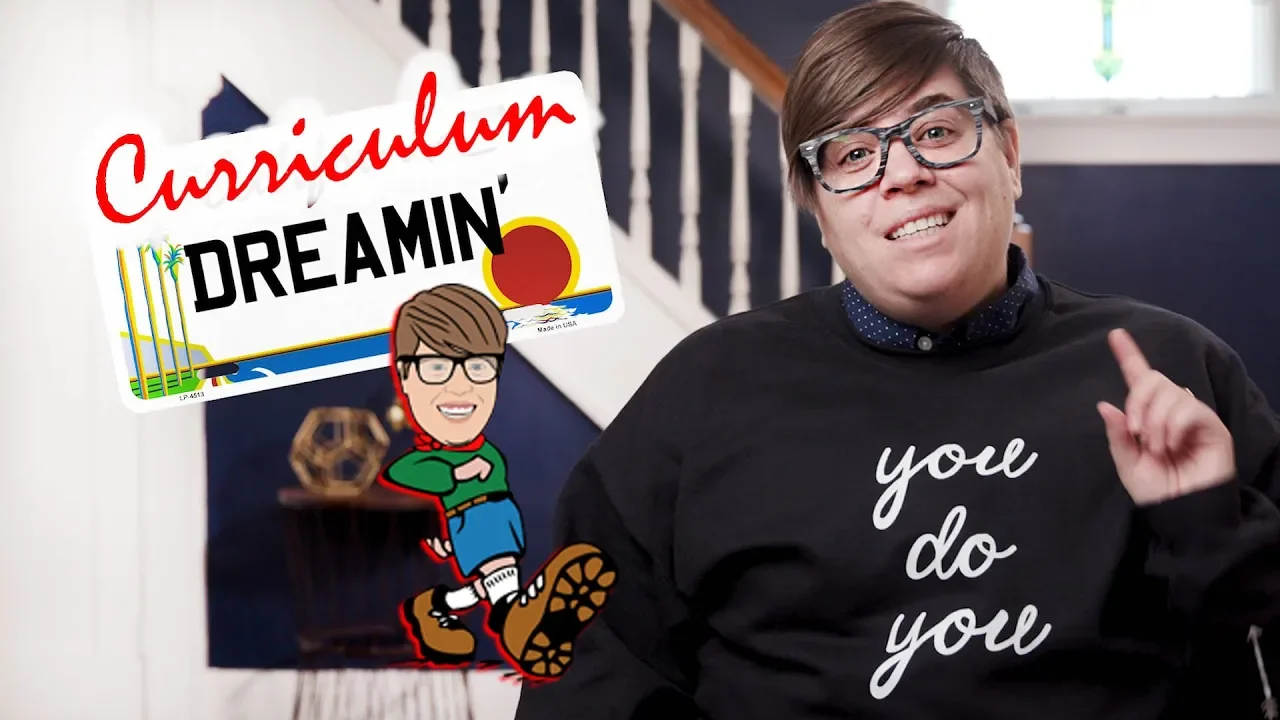
- Welcome to, Five Moore Minutes, useful videos in five minutes or less, that support the teaching and learning of all students. I'm your host, Shelley Moore. Today's episode is called, California Dramin'.
(record scratching) Nope, just kidding. Curriculum Dramin'. (upbeat music) Okay, curriculum, you know the stuff, it's all the Goals & Learning Outcomes that society tells us we need to teach to the children.
What I didn't realize, was that it is really important to not just know the goals in the curriculum, I also needed to know how those goals in the curriculum were organized. Now if you aren't totally immersed in education, you may not be super familiar with curriculum models and organization. But let's compare this to something that we might be more familiar with.
I want you to think about the self help book sections, that support us to become our best selves. In many of these books, there are great strategies. There's one that's referred to that's considered a Habit of a Highly Effective Person.
That strategy is called, Keeping the End in Mind, or in education it's called, Backwards Design. Okay, so here's the idea. You will have a better chance of meeting a goal, if you, A, know what the goal is, and B, if you make a plan to meet it before you start.
So for example, if I had a goal to go to California one day, because everyone has a goal to go to California one day, the chances of me getting there, will be way higher if I know where I'm going, when I'm going, how I'm getting there, where am I gonna stay? How am I getting home? You quickly start to see how important the plan is, if you wanna meet a goal, but you also realize that there's multiple answers to these questions.
In life and in education, there can be multiple pathways to the same goal, which is great, and it makes it responsive to the person who's trying to meet the goal. This is a much more effective strategy than say if I, for example, just decided to leave my house in Vancouver, and just start walking north, hopefully finding my way to California. Backwards Design is a strategy you use everyday, and it ranges from travel goals, to weight loss goals.
It's also used in many curricular organization models. But here's the thing, this is not a linear process. And Backwards Design, it's trying to aim to be responsive to the person meeting the goal, but curriculum is often interpreted as the opposite, very linear and not responsive.
It's totally standardized. How I used to think about curriculum was like this, curriculum is in a giant big red binder, and in September I start on page one. And when I'm done with page one, I moved to page two, and then I get to June 20th, and I have 147 pages left.
Well what if I told you, there's another way to read curriculum, that better aligns with Backwards Design big ideas? I want you to imagine that the curriculum is still a book, but the book is not a binder, it's a flip book. Do you remember these books?
I love these books. The flip book, it's still the same for everyone, but how it's read depends on who is reading it. There are many ways to read the same flip book.
So to make sense of this for curriculum, the first thing we need to do is understand what the pages of the flip book are. These pages represent the different types of goals in the curriculum. In British Columbia, we have three kinds of goals.
We have Content goals, these are the goals about knowledge. We have Curricular Competency goals, and these are the goals that builds skills and processes. And we have Core Competency goals, and these are cross curricular goals, that support the development of the people that we need to become, so that we can be contributing members of the world.
All of these goals are organized around a big idea, and these are the things we need to understand. Although the book is the same for everyone, the flip book pages we choose can reflect the kids we are teaching, and can be responsive to both their strengths, and their stretches. As educators, Backwards Design, helps us to keep the end in mind, by deciding what the goals are for a unit, and how we can teach them in responsive ways, that allows students to reach these goals in multiple ways.
I think this calls for some professional development in California. Okay, teachers, parents, students, if you're watching this video, I want you to go find your local curriculum, and I want you to look at how it's organized. If you're not in British Columbia, these goals might be called different things, but you will probably find that there's a lot of similarities.
And then I want you to think about, how we can start to translate these goals to students and families, so that they can see what they're learning, because they're the ones who are meeting the goals. They also need to know why we're going to California. Okay teachers, here's your job, and do this together.
Number one, I want you to go choose some goals that reflect your students' needs. Number two, I want you to make a plan with multiple pathways, so that all the kids can meet those goals. And number three, I want you to share those goals with students and families so that they know what the plan is.
So that was our episode, Curriculum Dramin'. Head on over to the website, to see some examples of plans, and stay tuned for the video, Strategy About Backwards Design, coming soon. Don't forget to subscribe to the email, and the YouTube channel, and the podcast, so that you don't miss any content.
I'll see you soon, friends.