The discovery of alpha and beta radiation by Ernest Rutherford in 1898 was a revolutionary moment in physics history. Not only was it shown to be possible that we can finally start to understand the nature of radioactivity, but also that there is more than just one form of radioactivity. In the coming decades, scientists everywhere continued to study radioactivity, its properties, and its effects.
After Einstein proposed his famous mass energy equivalence equation in 1905, it was quickly applied to alpha, beta, and gamma radiation. And an interesting discovery manifested shortly thereafter. When a radioactive element decays into another, the sum of the masses of the decay products is less than the mass of the original radioactive nucleus.
So where exactly did that lost mass go? Well, according to Einstein's equation, it is converted into kinetic energy which is carried by the decay products. Therefore, energy is conserved and all is right in the universe except for one small detail.
Everything seemed right in alpha and gamma radiation. the expected kinetic energies of the decay products. Helium nuclei for alpha decay and gamma rays for gamma decay both matched the observed kinetic energy that was predicted for beta decay.
However, which at the time was known to only emit electrons, the measured kinetic energies were rather peculiar. In all measurements of beta decay reactions, the emitted electrons carried less energy than expected. Not only that, but if only electrons were being emitted in beta decay, scientists would expect all the emitted electrons from a radioactive element to have the same amount of kinetic energy.
The observed behavior, though, was a continuous spectrum of kinetic energy, starting at zero electron volts and varying in intensity as it gradually increases to the expected kinetic energy of the emitted electrons. For beta decay of carbon 14, the example used in this picture, the ending point is at 15. 6 6 mega electron volts.
So electrons were not carrying the kinetic energy they were expected to be carrying during beta decay. Where exactly was this energy going? Is conservation of energy being violated?
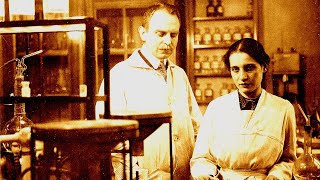
These questions would loom over the heads of many physicists for decades until an Austrian Swiss theoretical physicist would propose an idea that would start a two decade journey ending at the discovery of an entirely new elementary particle. In 1930, Wulf Gang Pali was in his third year as the professor of theoretical physics at ETHZ Zurich in Switzerland. He was eight years into his professional career at this point and had already achieved a fair bit of success.
2 months after receiving his doctorate at the University of Munich, he completed a 237page review of Einstein's theory of special relativity, which Einstein praised and published himself. After a year of assistantship under Max Bourne at the University of Godan and another year at the University of Copenhagen, he had a 5-year stint as a lecturer at the University of Hamburg. Here he completed his most famous work, the Pali exclusion principle, which states that no two electrons in an atom can share the same quantum state.
He also formulated the idea of non-relativistic spin here at Hamburg. Pi had achieved high status by the time he was in Zurich. But in 1930, his life took a tragic turn.
Three major things in his life happened by the end of this impactful year. The first was a divorce from his wife less than a year after the two had been married. The second, the death of his mother, and the third was in his professional life.
Amidst nothing short of a personal crisis, Wolfgang Pali wrote a short letter to a conference in Tubingan proposing a radically new idea. this idea, a new elementary particle that would account for the unexpected observed kinetic energy levels in beta [music] decay. Pali's elementary particle, which he dubbed the neutron, had no electrical charge, had a spin of 1/2, and has a similar mass to that of the electron extremely smaller than a proton.
Pale proposed that the continuous energy spectra of the observed beta decays makes sense if both electrons and these proposed neutrons were emitted during this reaction. Of course, this raised more questions than it answered. What is the neutron's nature?
What forces act upon it? Will it ever be experimentally detectable? And most importantly, is this just a way to make the math work?
An entirely new area of study had been opened, and answers would only come with more experiments, more theories, and more data. In 1934, Italian physicist Enrico Fairmy published a detailed overview of beta decay and its properties. In this publication, Fairmy built on Pali's letter formulating an equation that describes the reaction that takes place during beta decay.
This was the first theory of beta radiation that included both a process in the nucleus and Pali's proposed particle. According to Fairmy, during this process, a neutron is converted into a proton, emitting both a beta particle, in this case an electron, and also Pali's particle, which he called an anti-utrino, the antiparticle counterpart of the nutrino. See, 2 years prior to FM's theory, the nuclear neutron we know of today was discovered by James Chadwick.
And since it bore the same name as Pali's proposed particle, Fairmy chose to rename Pali's particle to the nutrino as it was Italian for little neutral one. Fair's mathematical explanations in this paper were both intense and detailed, and as time went on proved to be quite flexible as more and more particles were discovered. The mathematical backing of the nutrino's existence fueled the fire even more and the search for the ever elusive nutrino continued.
Since nutrinos are so tiny and not susceptible to the electromagnetic force, they are extremely difficult to detect. So difficult, in fact, that pi himself was worried that he had formulated a theory that would go forever untestable. The varied boundaries of science were being pushed at this point for an untestable theory is considered by many to be no more than philosophy.
Luckily, a major revolution came in the 1930s that gave scientists hope that they could finally search for the nutrino. This revolution was nuclear fision. But why exactly was this a big step towards nutrino detection?
That's because the products of nuclear fision are often times isotopes of elements that have too many neutrons to be stable. The nuclei of these isotopes find it energetically favorable to convert these excess neutrons into protons and reach a configuration that is more stable. The result of this is massive amounts of beta radiation, meaning theoretically massive amounts of nutrinos and anti-utrinos.
If there was a chance of detecting them, vision would be the method by which it would happen. Unfortunately, the advent of the Second World War meant putting the quest for nutrino detection to the side and focusing on creating a nuclear weapon. Still, during the war, many were hypothesizing experiments that could be set up to possibly detect them.
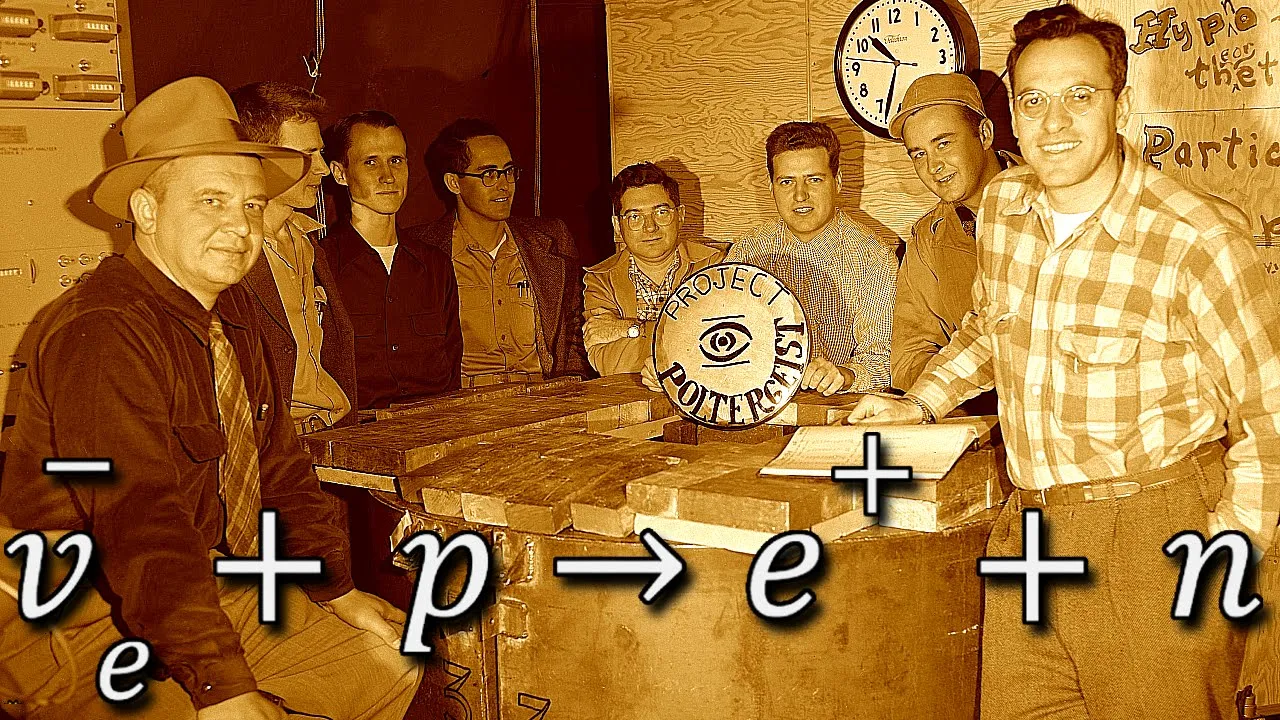
Most notably among these theorizers was American physicist Frederick Reinus. Reinus was a pivotal member of the team at Los Alamos, although most of his time there was after the war was over. He was recruited by Richard Feman to the theoretical division of the Manhattan project in 1944.
In 1951, Reinus decided to finally turn his attention towards nutrino detection, starting a 5-year process that would end with a discovery of the seemingly undetectable particle. The first idea Reinus brainstormed for detecting nutrinos was rather extreme and dangerous. To quote Reinus directly, "All I could dredge up out of the subconscious was the possible utility of a bomb for the direct detection of nutrinos.
" For such a test, he teamed up with another American physicist, Clyde Cowan, and the two began work on a nutrino detector. This task would require monumental amounts of effort, for not only would the detector have to be massive by their standards, upwards of 1 cubic meter, but it also would have to be capable of withstanding a nuclear blast. and simultaneously capable of detecting nutrinos before the nuclear fireball dissipated which was only after a few seconds.
The plan was to drop a 20 kiloton nuclear bomb comparable to the one dropped in Hiroshima, Japan into a hole 40 m from the detonation site. This bomb was nicknamed Elmon Monstro and permission for such a test was granted by the Los Alamos laboratory director Norris Bradbury. However, as they inched closer to the experiment and realized the task ahead and under [music] the added advice of the Los Alamos Physics Division leader JMBB Kellogg, they decided to abandon Elmonstro in favor of a nuclear reactor.
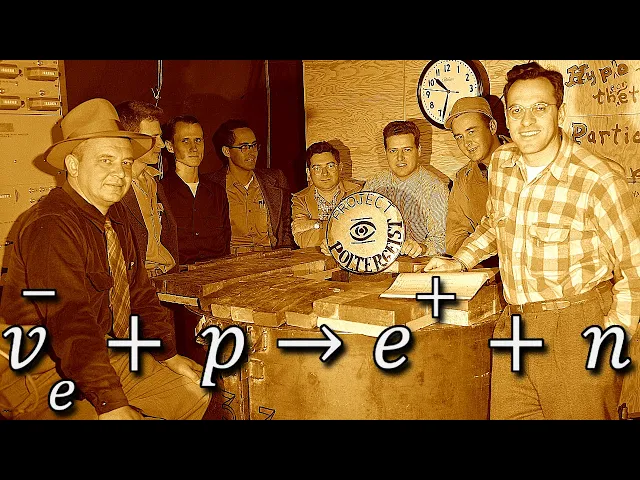
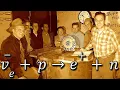
Their new plan was to use inverse beta decay to prove the existence of nutrinos. The theoretical equation went as follows. An anti-utrino created from beta decay in the reactor collides with a proton.
The products of this collision are a neutron and a posetron. The reaction first creates a burst of light as the posetron quickly annihilates with an electron creating two gamma rays. The neutron bounces around for a short period of time, only a few micro seconds, and is then captured by a nucleus.
This nucleus then produces a gammaray flash of its own as it releases excess energy. If Reinus and Cowan detected this chain of light bursts, they would know that a posetron and neutron had been created. meaning that they would know that an anti-utrino had collided with a proton beforehand and sparked such a reaction.
The probability of such a reaction happening was extremely low, but the reaction is distinct and easy to detect because of the successive gammaray flashes. For their detector, they incorporated new technology at the time, organic liquid centilators. These detectors made it easier to distinguish between types of detected radiation and were set up at the Hanford laboratory in Washington.
The first test they implemented was done so in 1953 and did produce possible traces of antiutrinos. However, the experiment was completely flooded with background radiation, making it difficult for even the organic liquid cinilators to distinguish what was what. They tested why there was so much flooding radiation back at Los Alamos and ultimately came to the conclusion that the source was cosmic rays.
If they wanted a more clear result, they would have to conduct their experiment underground. Rehness and Cowan relocated to South Carolina in 1955, wherein resided the Savannah River reactor. They set up shop in an open space 11 m away from the reactor core and 12 m underground.
They also redesigned their detector, adding cadmium, which is a great neutron absorber to increase its sensitivity. Now shielded from cosmic rays and also having both a more sensitive detector and a more powerful reactor as a source, Rhinus and Cowan were able to detect approximately three of these successive gammaray flashes per hour plus or minus 0. 2 successive flashes.
Reinus and Cowan published the results in 1956 in a paper entitled detection of the free nutrino a confirmation. The nutrino or rather the anti-utrino wasn't detected directly but rather was inferred through the products of a reaction predicted through pure theory. Rhinus and cowan experimentally validated the theory first postulated by pi in 1930 and expanded upon in great theoretical detail by fairmy in 1934.
Since the first detection of the nutrino, it has been classified into different flavors electron mu and tao each with their respective antiutrinos. It took 40 years for a Nobel Prize to be awarded for this discovery and due to its long wait time only Reinus was awarded the prize. Cowan unfortunately died of a heart attack in 1974 and Nobel prizes are not awarded postumously.
Frederick Reinus shared the Nobel Prize in physics in 1995 for pioneering experimental contributions to leptton physics jointly with one half to Martin L. Pearl for the discovery of the towepon and with one half to Frederick Reinus for the detection of the nutrino. The discovery of the nutrino as a massive feat in physics history.
Not only did it validate the existence of the weak nuclear force, but it also led to a better understanding of nuclear fusion at the centers of stars and supernovi. Nutrinos carry away about 99% of the energy released by a supernova and also play a crucial role in the creation of heavy elements. On top of that, there is a theoretical form of radiation known as the cosmic nutrino background, which supposedly consists of nutrinos created approximately 1 second after the [music] Big Bang occurred.
Since the cosmic microwave background reveals the radiation of the universe when it was 379,000 years old, being able to detect these so-called relic nutrinos would unveil a new understanding of the beginning of our universe never before reached. Thanks to the theoretical work of Pi and Fairmy and the relentless pursuit by Reinus and Cowan, a new world of opportunity was opened. One that involves the study of the lightest massive particle in our universe.
If you enjoyed this video, please consider liking and subscribing. Click here if you want to see more scientific progress made during this time period. Thank you for watching and I will see you in the next video.