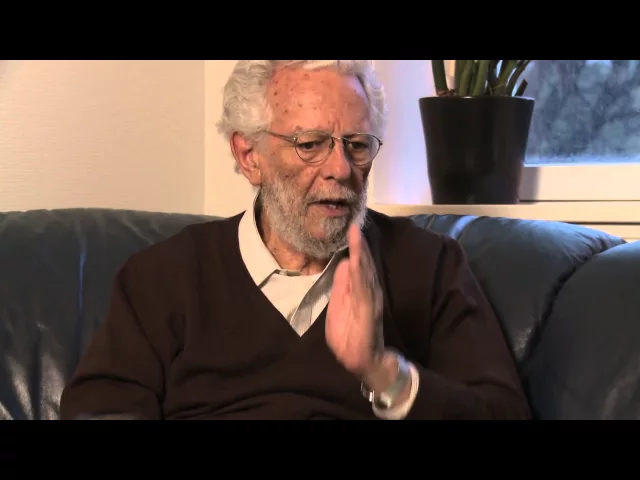
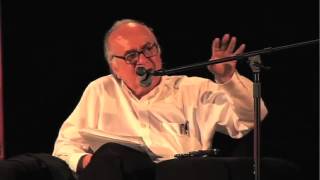
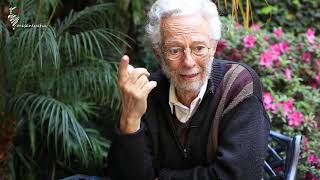
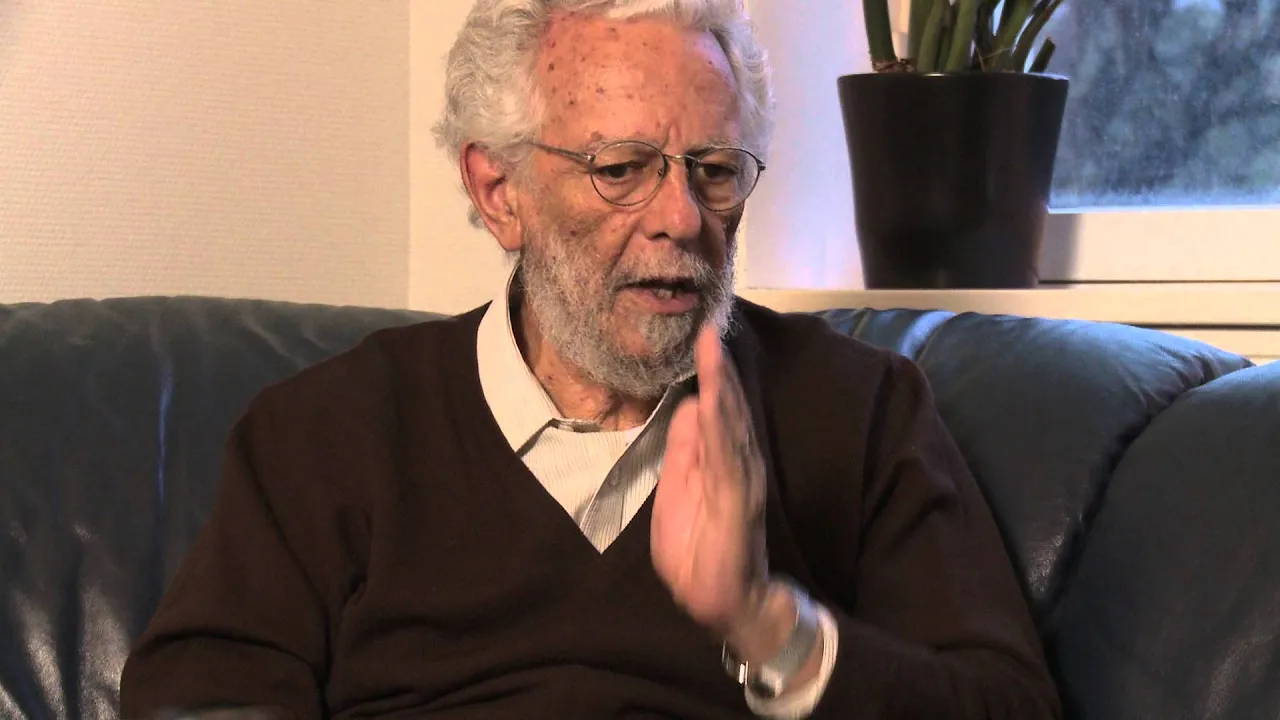
Interview with Enrique Dussel The decolonizing turn One of the most important intellectuals in Latin America, the philosopher and historian Enrique Dussel visited Norway April 18-21, 2012, invited by NorLarNet and CROP. Making the most of this visit a group of enthusiasts of the Latin American thinking interviewed him with the aim of elaborating a presentation of the theory of the decolonizing turn. Following, you will see the result of several hours of conversation summed up in five points of central elements of this theory.
The Decolonizing Turn How do you define the starting point for this decolonizing thinking? The decolonizing turn is an epistemological turn and its background are the literary “boom”, which is decolonizing, the dependency theory which permits us to start understanding, in an economical manner, the structure of globalization as early as the sixties, because ultimately the dependency theory is the “quintessence” of the process of globalization, and also what in the religious- political plane is called the liberation theology which moved the popular imaginary to another level and in this context arose a group in Argentina, which later generalized, that we have called the liberation philosophy. and in this context arose a group in Argentina, There was a literary one, the socio-economical one and later there were other epistemological contibutions, There was a literary one, the socio-economical one becoming more complex and profound, transformed the traditional Marxist theory into something new.
One of the expressions of this is Aníbal Quijano – the great Peruvian sociologist and economist-, who from a more traditional Marxism, but already the dependency theory, moves on to proposing all the colonial essence of power. For the power is organized in a colonial structure, and then we have also conflict of gender, but first of all of race, and he himself sais the way of categorizing in Latin America was not the social class but race, so this is an overturn of Marxism to another level. So Aníbal Quijano on his side and maybe me as a philosopher are the columns of a new generation that opens to an interdisciplinary task that we have called the decolonizing turn, which is a continuation of some movements that have arisen, some only in the United States and others in Latin America.
Postmodernity as a topic was European. It arose with Lyotard but in my “Liberation Philosophy” of 1975 on the first page… Your first text in exile… My first text in exile, I say: “this is a postmodern philosophy” in 1976, but with postmodern I meant a philosophy beyond modernity; but the postmodern Europeans, from Lyotard, Vattimo, and later all the ones to come, are still the last phase of modernity because they are Eurocentric. So I could not continue referring to Postmodernity, a concept which I used before Lyotard.
Because they used the name and burned it, I say “transmodernity”, which means going beyond modernity. A New Philosophical Method In this epistemological turn one topic is the method, because some have referred to the method of this new epistemology as changing the way we see things and see things from the side of the oppressed as an epistemological starting point. How do you do this, how does this possibility arise?
What is interesting in the Latin American thinking, different from the merely literary thinking, say Edward Said, who proposes the great idea of Orientalism in 1978. The liberation philosophy arises around 1968, 1969, and has to be considered chronologically, much before the Orientalism of Said, and before Guha in India who also rethinks from Foucault the way of doing history and does the "Subaltern Studies" of Spivak and this whole group of North Americans from India. In a certain way the liberation philosophy anticipates all of this.
So totality is Hegel, it is Heidegger: Being-in-the-World. And in the world the “Other”, the oppressed, does not exist, he is nothing, “δενείναι” in Greek, the non-existent, the barbaric, so immediately we said to ourselves: “the Latin American is non-existant”, and it is a barbaric philosophy, about the non-existing, and at that time Sartre wrote the two volumes of “ Critique of Dialectical Reason”, and so we understood how the dialectic was a process from one totality to another, but the most creative moment of the most creative moment of the journey was the exteriority of the first totality which permits me to pass on to the second one, and that is the topic of Lévinas. So the liberation philosophy worked on the topic of the alterity of the Other, which was the woman in machismo, already in the seventies -I have a volume on women’s liberation in in the pedagogic theory of Paulo Freire; but it was the poor, the “ekonomik”, and so Lévinas offers the possibility of understanding economic domination, but not only the capital-work at the level of the factory, but on developed and underdeveloped countries, the dependency theory and Latin America as a victim of a global process, in 1969 and 1970.
That’s to say, we were the first philosophy that took into consideration the horizon of globalization, which would be talked about 30 or 25 years later, and before the postmodern thinking of Lyotard, and even before the Orientalism of Edward Said and all of that. It is interesting. Latin America initiated a process still unknown.
That will integrate in all the rest, and so even methodologically we is not denial of denial. The slave is denied, and to deny slavery is moving on to a system where there are no slaves, but the slave is no more slave when he has a utopia in which he no longer is a slave, and that utopia is positivity. He has to imagine himself free in order to not be slave any more.
And so the origin of the process is not a mere denial of denial. It is a previous affirmation which permits me to deny the denial, and in our group it is called “analectic”, that’s why we talk about an “Anadialectic”. A new method because it gave importance to the exteriority which Lévinas had created from a Heideggerian, Hegelian, and still Eurocentric horizon, but now the Other appears, and situates us from the Other.
So we changed the point of view, but we still did not know how Eurocentric we were and we had not even thought about the topic, this would be a slow maturation process, Critique of Modernity and Eurocentrism How can we relate this to another central element in the liberation philosophy which is the critique of modernity? Toulmin, the great North American epistemologist, asks in a book called “Cosmópolis”; well modernity, when does it start? With the discovery of printing in Gutenberg?
Does he not know that the Chinese had discovered printing six centuries before? So the poor Toulmin is an ignorant and the greatest epistemologist during some centuries. And Habermas sais: the origin of modernity is the renaissance and later the Reformation and the enlightment; and everyone sais almost indifferently when it originates, but the origin of modernity will determine what exactly modernity is, which is a “I think” but as I always said, since the liberation philosophy, before the “I think” is the “I conquest”, which turned into ontology.
And the “I conquest” is made in Latin America, it is Cortés, the Conqueror! , the ego conqueror of the Other, who dominates him from a cultural and an economic point of view and puts him to work in the encomiendo, in the mita, in the hacienda and in the colonial world which instals the modernity. So the modernity as a cultural and global phenomenon, from an ideological point of view is the start of Eurocentrism, because the Europeans were not Eurocentric, they had a total inferiority complex with respect to the Arab world.
They knew the Arabs were more cultivated and more scientific. -A trauma! -¡Of course!
Culture came from the south, For that that El Quijote sais “I received a text from an Arab”, because he would not receive it from a German who had no significance in the 15th or 16th century. The cultivated and the rich were the Arabs. So I start realizing that the origin of modernity was in 1492 and no other European author has said that, not even Wallerstein and Mignolo, and my friends have now assumed it, but they forget that it wa an ontological year, because it is the moment in which Europe opens up towards the world and surronds the Arab world which had it surrounded.
The expulsion of the Arabs from Granada. ¡Of course! But at the same time, in the oceans they start surrounding the Arab world and with the American wealth the Arab world devaluates.
So there is a historical and vision which allows me to philosophize. It is a methodology unknown to the philosophical academy, No European philosopher is able to do that because they are unidisciplinary, the Marxists even more because they knew economy but were also confused because they all believed that the colonial era was a feudal economic system and said “the feudalism in Latin America”. Now, it was an Argentinian marxist author who, in 1949, while studying the topic said ¡No!
, the colonial era had a merchantile capitalism and that is like the thread of Ariadne. I would say that since 1949, epistemologically, the entanglement begins to untangle. If the colonial system was not feudal it was capitalist, and if it was capitalist, then what type?
And then modernity and capitalism are simultaneos, and also colonialism and eurocentrism, and they will all grow together. And the modern philosophy is built on eurocentrism and colonialism. So what Edward Said does in litterature and shows that the is a ghost that was created.
-It is a European creation… ¡Totally! So I read all over again the European philosophers in a Eurocentric fashion and have to destroy their theories one by one. So when I talk with whomever straight away I notice that they are Eurocentric and I critique them and they are left naked, because they do not know any of this subject matter and they do no even understand the critique to begin with and when they understand it they realize that they do not any longer have the control of the philosophical discourse, that it has been taken away from them.
A New Vision of History And now we have come to another point that we could say completes this map of the decolonizing turn and the liberation philosophy which is a new vision of history that has been called a non-Eurocentric vision of history and there we also have the tension with the European narrative history and the tension principally with Hegel and how he constructs what you would say is a myth or an ideological invention, the way we have been told history. So where is the point of collision between these two ways of understanding history? Hegel is not Kant, so he is the first, much beyond Kant and even Montesquieu and Voltaire in De l’esprit des lois, etc.
, who shows a new world history, which they contruct. And all his lections, the lections on ethics, on universal history, on philosophy, on law, they are all done in a historical frame. Religion for example starts in China and the Orient, grows in the Persian, Greek, Roman world, in the Germanic spirit which is the middle ages and the triumph of Germany in religion.
The aestetics, like the spirit and also philosophy, triumphs as “Absolute Spirit”, that’s to say it has a historical scheme, and that is an absolute novelty. Nobody had created the treaties in a historical manner. Thinking history… ¡Of course!
But that history is Eurocentric and Germany is the centre and he sais: “ the heart of Europe is Germany, Denmark and England. And the south of Europe disappears, Greece, Rome, Italy, Spain and Portugal were, but are not, and that determines Latin Americans until today, we disappear from history. I have always said, since Martin Bernal –who does a great study-, that in the 16th and 17th century the great classical culture was Egypt.
The Egyptian obelisks were in Rome, in Paris, all over it was Egypt. And suddenly at the beginning of the 19th century the romantic Germans say It’s Greece! and Winckelmann makes a whole new reconstruction of Greek art.
And so the University of Berlin has a proposal, that if you don’t say that philosophy originated in Greece you be a professor, and they impose “Helenocentrism”. A dogm. And this was done by the romantics, however the romantics criticise rationalism, but deep down they are eurocentric.
This is what I suggest in the first volume of “Politics of Liberation”. I now have to reconstruct the whole world history in order to start beeing Latin American and think from my own horizon. That is, the new history; The non- eurocentric history is the obligate starting point for critiquing.
History is like the last epistemological horizon of all sciences, even more than mathematics, because also in the history of mathematics, the other day when I discussed with a Norwegian philosopher he said to me “well but the European science and technology are fundamental”, and I say to him “but you do know that the numbers we use in mathematics are called Arabic numbers”, because they were invented by the Arabs in Bagdad and not in Paris. And the theorem of Pythagoras was not invented by Pythagoras, but is written in Syrian bricks 2000 years before Pythagoras. So then, we have a constructed history where “we did everything” , but furthermore it is not science that determines technology and this one the economy, but all the way around.
It is the opening of the oceans which demands navigation technology and the development of astronomy and then also mathematics, all to say, the economy determines the technology and this one the science. It is all the way around. And the modern European colonialist expansion allows the technological revolution hereafter.
In the 17th century and the industrial revolution in the 18th century, but China is also doing it. There is a recent book by Hobson, -professor in Sheffield, England-, where he demonstrates that all the machines used in the industrial revolution in the English agriculture are Chinese, even the steam machine, and we are discovering new things. So not even the industrial revolution was purely European, but England had a conjuncture which allowed development while China entered into crisis for reasons that are being investigated and China comes back today, but not as a miracle, more like after a “siesta” I would say which lasted two centuries.
-Not as an exceptionality. Until the 1800s all the products on the world market were Chinese. Europe could not sell China anything and had to start the opium war in to sell Hindu opium to the Chinese because the Chinese were more advanced in everything.
And here we have another point in this column of the decolonizing turn, the new non-Eurocentric history, which is the incursion of this “Other" excluded in history, because it is not only about denying the existence of the Other, or “cover up” as has been suggested here, but also denying the contribution of the “Other” in the universal history. Universal which is the pretension of European particularity. the That’s to say, what is called universal is the European pretension of universality, but in reality it is the very creative management of European particularity which is imposed on others as universality and in as much as I accept it I am also subjugated, dominated by it.
Of course technical advance is usable by everybody, but the way in which it is used and the way in which it develops are culturally different. Evidently since the 17th century and mostly after the revolution, Europe experiences a tremendous technological development, from the hypotheses and the discoveries it keeps taking from other cultures, without acknowledging, and which now permits Europe to produce what it is now producing. The Chinese capitalism at this time is neoconfusian, it is not Calvinistic like Max Weber thought and it is developing certain resources which are not of occidental capitalism.
So there will be unexpected development from culturally distinct horizons, and not a universality as overwhelming. Rather, it will be a process of of the differentiated cultural history from these great cultures -the Islamic, the Chinese, the Indostanic, etc. -, which returning to their history and in dialog with modernity, taking from it what they themselves decide and not what is imposed on them, will develop what we together with Walter Mignolo call a“pluriversal" future, that’s to say, there will be many centuries without cultural differentiation.
So this will no longer be postmodern but beyond modernity and the ecological problem will determine the definite crisis of capitalism in a way maybe unexpected to Marx and we are living it. We are living a financier capital which is beginning to crush the politics of even the central countries, so we are living a very interesting crisis but we need new categories to understand it. A New Politics You have said many times that for you Latin America today is the most important political laboratory that we have on the planet, but what is new in this political laboratory and what could be the perspective?
Like Ernst Bloch says “what is the hope”? Having created that historical, methodological, ontological and ethical horizon, it was necessary to construct a politics, and politics were constructed by knowing very well the great contemporary Badiu in France, Agamben in Italy, Carl Schmitt in Germany, Rawls in the United States, that’s to say, we took the best of the philosophical political thinking. But at the same time great events were taking place in Latin America which for me were the six revolutions which I commented today at the reunion: the Cuban revolution, Unidad Popular’s revolution with Allende in Chili, the Sandinist revolution which stirs the traditional Marxist theory, the Zapatistas, but most importantly the Bolivarian revolution in Venezuela, and there starts a whole new conception of politics because they come to power in a truly novel manner.
Firstly: reforming the constitution, that had never happened. No revolution, not the Russian, nor the Chinese. None had changed the constitution.
. “Those are matters of the bourgeois” No way! Legality and democracy are not bourgeois.
They are popular. They consist of a conception of politics. A Cuban in Caracas said to me: “These Venezuelans are naive, they are risking loosing everything in one election”.
But the Cubans will never lose an election because they have never had one. And I say to him: “Well if you don’t risk losing an election you’re not doing politics, and in order to not lose an election you have to be doing serious politics and you have to be. .
. ” Creating hegemony from below… Of course! And when you don’t fulfill you lose popularity and if do not correct your errors then they will take the power away from you.
It’s interesting. That’s why it’s politics, it has to be redefined. The theoretic expression of the Zapatism “those who rule, rule obeying” and of Evo Morales “I exert an obedient power” show that there is a new concept of “power”.
This is before Hobbes. So in my political philosophy I reconstruct the modern political thinking, I don’t concede anything to modernity. That’s to say I take Hobbs and I show that it is a modern model of “covering up” and dominance, from Locke, and from Hume, and the ones to until Habermas, because Habermas himself is a formalist who has lost the economics and that’s why he leaves Marx, and that is why Habermas cannot criticize capitalism and can accept the existing Europe and cannot in any way criticize the NATO invasion in Libya because he is confused.
I, on the other hand, start a reconstruction of political philosophy from before Hobbes and I say: What is power? And there I start redefining power, that even the left wing, including Lenin “The State and the Revolution” and Marx, according to the interpretation of Mészáros, had a negative interpretation. Power as dominance.
And if power is dominance why would I enter into politics, why would I get dirty and if the social movements say: ”you shouldn’t go into politics you become corrupt”, then who goes into politics? The corrupt ones? So we lose.
No! I need positive politics and to demonstrate when it is you get Of course, when Hugo Chávez read my second volume he loved it and he started showing it to the people because I gave him instruments to govern. So I said that our responsibility as philosophers after the revolution of 1917, was not to say “dissolve the state, all power to the Soviets”, and they started to discuss and discuss and since they didn’t resolve anything: 1921 the NPE, new political economy, and they moved from “all power to the Soviets”, -Anarquism-, to the non-democratic Russian bureaucracy because democracy was a bourgeois problem, and it was a dictatorship, and that is not acceptable, that is against the dignity of the worker who never governed in any country because a central committee bureaucracy governed, that was the real socialism.
How do you overcome this? You have to recreate everything, and that is my politics. It redefines power positively and shows when it becomes fetiched, and almost always power becomes fetiched in the bureaucratization, but then the bureaucratization is the problem and not power, so I confront Negri, I confront Holloway, and many leftist thinkers who are cuasi Anarquists that are no good to neither Evo Morales, nor Correa, nor Lula nor anyone because they criticize the State, ah well, they criticized the State, now you are president: ¡Govern!
Ah no, I dissolve the State. It's mad! But for example the FMLN in El Salvador surprized me with their slogan: “Fight against the system inside the system”, but to change the system, that is novel.
Yes, but it could be formulated in a different way: “fight against the system to make a new one”, because if you go inside and what you want to do is reform than you are a reformist, but if you take the power and you start all over again and there is a new constitution then you don’t get in it, but rather have different assumptions. That is the dual problem of Ernesto Laclau, who says that you have to take liberalism and modify it, and I did not say anything! I do not accept liberalism to begin with.
To say, we are individuals one fighting against the other to later make a contract. No! We have never been individuals, we have always been a community, besides the contract is always in the background because the whole human community has always had institutions.
Always! Even the primates have the institution of the dominant macho, so there has never been a group of people without a contract. So I do not accept liberalism at all.
And democracy does not belong to you. It was invented by the egyptians and the greek and we will redo it very seriously. Democracy comes from participative democracy but does not deny representative democracy, We will articulate it in a new manner and that has never been said.
So it is not a confontation between these two types of democracy, but a complementation. To me you don’t need to put an adjective on democracy, democracy is one, it is when the people can participate symmetrically in all desicions. Now, that is power per se, the ratification of life as feasible.
That is why, in my first definition of the “20 tesis”; What is power? There you have everything. And I have seen how Heidegger defines it and how Nietzsche defines it: “Will to power”.
And from ontology I will move on to the philosophical, and to Lenin and to Agamben, all of them, and I will say they do not know what political power is. I think it’s something else and I define it, but I define it positively: It is a people’s will of life, will of life means wanting to live, but to live is to want to eat, to want to to have water, to want to have an own culture, and even have own gods, if you believe in gods you have the right to have your own gods. All to say; a will to live.
But secondly: agree consentually in all decisions. But in direction of what Diego is asking, could we say that the new thing we are living is a little like what Foucault said also, the alchemic sum of diversities constructing a new conception of power? Yes, but that was before Foucault and much more than Foucault, because Foucault also understands power in a very interesting and complex way but I will go to something prior: the only subject, the only head of power is the political community, the only one, all institutions are delegated practice; the State, the president, the parliament.
The people is the only subject. So first the power per se, let´s say with Heidegger, ansich, which is undetermined and inexistent like the work itself in Marx. What I take is: Marx said that it is necessary to critique in all categories of the bourgeois political system.
That is a text from 1861 that the marxists do not know. What he did was a critique of all the categories of the bourgeois political system in “Capital” which is his theoric mark. So I say it is necessary critique in all categories of the bourgeois political philosophy from Hobbes to Habermas.
So, would we be more with Gramsci on the idea of hegemony? Gramsci is the only one still standing! Gramsci spoke on all the topics and I cite him continously.
Gramsci is the only one who thought the marxist pilitics. The others thought on economy, but not politics, and politics is one field economy an other, and it is necessary to distinguish them first, but then cross them. So there is a political detemination of economy and economic determination on politics and that will be another volume.
I am now publishing “Twenty Theses on Politics”, and later I will do “Twenty Theses on Latin American history” in which I will cross this mutual determination. Methodologically , all of this, is confused because it was thought that the economic level was the essence of everything. But no!
The politics of marxism was looked down on and on Marx himself also sais Mészáros –not me–, Marx had a negative vision of politics and that is why he thought there was dissolution of the State and end of politics when he starts and after the revolution, and so; what comes after politics? The administration and and the real socialism. And that problem was not Stalin - -like I had thought- , I said No!
It was Lenin, and it was Marx himself and there I now have a strong article in which I say “Marx had a negative vision of politics and we have t to do the politics that Marx did not do with the methods that he used to make economics", and that is what I do. I do the politics that Marx did not, but universally, not eurocentrically, and that is completely original because we are wondering what is Evo Morales saying and what is Hugo Chavez saying and what is happening in our revolution, I could not have written my politics in the year 2000, because it’s these revolutions that are giving me the material to do so. : In this new politics, what would be the determining subject?
The people! And that concept, which is the most ambiguos possible is without doubt the one I have pursued for forty years, and there are theses by my collegues that said: “that is populism and is against marxisme”, and I said to them: now look the theory of class works, but the people’s category is different. Because it is irreductible.
It is more complex but it is definable and for example Ernesto Laclau, in his book ”On Populist Reason” from four years ago. Has already advanzed greatly, but I also on my side and Boaventura too. That’s to say, there is a strong subjest, which is not the political community, but like Gramsci said: The people is the oppressed social block.
The historical block. No, the historical block is the power. Now, I said “block” and not “class”, because as Fidel Castro say the people, when in fight, the 400.
000 unemployed. They are not class, because they are only potencial class beyond 300. 000 workers.
The farmers. But after the petit bourgeois get together, the housekeepers and with them many groups in society form a block. And break out of the term of class.
On one side yes, and on the other side every one has contradictory elements, but when this succeeds in uniting, it is hegemony. Hegemony is a project, the only project that politics can formulate, because a unanimous project is impossible, but what is closest to unanimity is hegemony. Especially in the opressed.
And when there is a historical conjuncture where all the social movements and the inhabitants succeed in having a hegemonic project, a people appears as a block that transforms history, but later dissolves, and new contradictions appear, and that is why contradictions are the source of the people, Mao. And some that were part of the block were transformed in the dominators of the new system and that, in the first emancipation, the criollos hegemonized a project for the slaves, the natives, the por spanish, all. Liberty!
But there we come back to the same problem; Where is the seat of power? In the institutions or the burocracy? No, the seat is the political community and in particular, historically, the people which is not the whole political community but the ones who make themselves participants in the historical changeand there are antipeople.
They are the ones who change history, so the historical change history, so the historical transformation is in a collective participant that I call “the people”, but that later dissolves and enter into new contradictions. Yes, it dissolves, but like Bloch said, it leaves behind a way to continue constructing the horizon of hope. Of course, and at the same time, the last horizon is mythic and for Bloch is right, and it is not progress in a quantitative manner and there this all comes in.
But it is the people and then; is it populistic? No, i have an article “Six Theses on People and Populism”, what is the difference? One thing is the people and another thing is populism.
Populism is calling all including the dominators, “people”, the historical block of power and when I unite all this, it is peronism, which is populist. When it is not liked by the dominating axis it is populism. Of course!
That is why it is the conclution, but with philosophical and sociological precition. So it is the social movements, which all have different interests: the feminists, the women, the other ethnic groups, but little by little through dialogue and translation, Boaventura de Sousa, begins to say: Ah! I am a feminist” and do you see the ethnical problems?
But the coloured women are the worstly treaten, so the feminists say: Ah! The problem with racism interests me. And the other one says: Ah!
And they are the worstly paid. So the proletarian women have the worst condition. And the other one says: Well I spoke about the proletarians but it is true that the women have the worst part.
And little by little, through translation and dialogue we begin to have a homogenic project… And there the subject has grown! Of course! So they are no longer classes, nor social groups, nor excluded from the classes like etnias, but rather the social block of the opressed and there: Gramsci!
So Gramsci says: when the ruling class is supported in consensus it has hegemony. So a group within for example populism; Vargista, Priista, Peronista, achieved a bourgeois hegemonic project; national, proletarian, rural, and it had a true majority it had a majority consensus because the project was hegemonic. Now Gramsci says; when consensus is lost, dissent appears and dissent is when the groups say: my interests are not beeing fulfilled.
The hegemonic project is broken. The ruling class becomes the dominating class. So it does no longer govern with consensus, where peace lies, but rather with opression, and so the problem arises.
And here begins the historical tranformation that constitutes a new hegemonic system. I am adressing all of this in the third volume. It is complex, but I absorb the whole European contemporary political philosophy, Badiou, Gamble: you here, but not there, because you don´t fit in.
We hope this work will serve as an introduction to this new historical thinking.