we're going to be looking at a lot of claims in this course claims that our authors are going to make claims that your fellow students are going to make heck claims that you may find yourself making and they're going to be claims that look like these for example doctors should tell patients what they need to know to make informed decisions or maybe telling patients that they have a fatal illness will likely make them feel hopeless and depressed or here's one active euthanasia is illegal or another one active euthanasia should stay illegal or how about this
one abortions in most circumstances are wrong or there's this one abortions kill babies that could have Futures like ours but here's the thing are any of those claims actually true and are any of them false and furthermore how on Earth can we tell that's what we're going to talk about today as I said earlier we're going to be looking at a lot of ethical issues in healthcare in this course but before we dive into them I want to take some time today to talk about some strategies that we can all use to try to figure
out when a claim is true and when a claim is false so let's go ahead and get that started and let's start off with different kinds of claims now there are many ways to categorize claims but for our class in particular I want us to categorize claims into two different kinds the first kind we're going to call non-moral claims and the second kind we're going to call moral claims so in a nutshell non-moral claims are claims about what was or what is or what will be moral claims are different they claims about what's right and
wrong what's good and bad what's okay or not okay their claims about what's better or what's worse and their claims about what we should or should not do so how can you tell if a claim is moral or non-moral well for this class I want to keep it simple and I just want to say let's go ahead and look out for some keywords so here's a list of words that I want you to be on the lookout for right and wrong good and bad okay and not okay better and worse and should and shouldn't if
you see any of these words probably a moral claim so here I want to pause and do some practice so here I have listed a bunch of claims and these are actually the claims that you saw moments ago at the beginning of this lecture and what I want to do right now is to categorize these claims so for each of these claims I want you to know whether you think it's a moral claim or a non-moral claim so go ahead and do that for each one of these and when you're ready we're going to move
on and cover the answers so pause write it down or think about it and then when you're ready unpause and we'll go all right let's go over these answers together so let's start with the first claim doctors should tell patients what they need to know to make inform decisions this is a moral claim and how can you tell well it has the key word should in it doctors should tell patients because this is claim telling us what we should do it's a moral claim next claim telling patients that they have a fatal illness will likely
make them feel hopeless and depressed this is a non-moral claim how can you tell well we didn't see any of the key words in there so this claim isn't telling us what's good or bad it's not telling us what's right or wrong it's not telling us what's okay or not okay or better or worse or what we should and shouldn't do we didn't see any of those key words in here so that's a non-moral claim what about the next one active euthanasia is illegal again this is a non-moral claim we didn't say we did not
see any of those key words next claim active euthanasia should stay illegal this is a moral claim key word should next one abortions in most circumstances are wrong here we can see it's a moral claim why because has the keyword wrong it's a claim about what is right and wrong so it's a moral claim and finally abortions kill babies that could have Futures like ours this is a non-moral moral claim we don't see any of our key words in it so hopefully we have an idea of how to divide these claims up into moral claims
and non-moral claims so why does this matter why are we taking this time putting claims into the moral category or the non-moral category why are we spending our time doing this well we want to see if these claims are true or false which ones we have reasons to believe are true and reasons to believe are false and it turns out that moral claims and non-moral claims are very different kinds of claims so we need to assess them differently and this brings us to our flowchart for today so we just talked about how there are two
different kinds of claims that we're going to look at in this course non-moral and moral so what we're going to do now is we're going to jump over to the non-moral side of this chart we're going to talk about non-moral claims the different kinds of non-moral claims and how to assess each one of those kinds so when it comes to non-moral claims we're going to discuss two kinds of non-moral claims in this course we're going to look at conceptual claims and we're going to look at empirical claims so let's go ahead and get that started
so what are conceptual claims conceptual claims are claims that you can assess through some mental process so basically if it's a claim that you can check just by thinking about it or using pen and paper then it's a conceptual claim so let's look at two examples our first example is the claim that parentheses 2 + 4 * 3 equals 16 the next claim is this if anjoli is taller than valden and valden is taller than Jack then unolly is taller than Jack so why are these two claims conceptual climes well they're conceptual because we can
see whether they're true or false just by thinking about them mathematically or logically or using pen and paper to work them out mathematically or logically so let's look at that first claim parentheses 2 + 4 * 3 = 16 now this is conceptual because this is something that we can check just ma by using math either in our heads or using pen and paper so let's go ahead and do that right now we'll write it out so as we know using pmos we start with the parentheses 2 + 4 is 6 we bring down the
time three all that's left to do is 6 * 3 we get 18 now notice this claim said that that equals 16 we got the answer is 18 and we know our answer is correct so we know that this claim is false and how do we know it's false by thinking about it or using pen and paper by using math now let's look at our second claim if anjoli is taller than valden and valden is taller than Jack then anjoli is taller than Jack now how can we tell whether this is true or false well
we actually just use some logic here so you can actually do the logic in your head or you can find a way to write it out so this is kind of how we could do it visually so go ahead and imagine a line in your mind and we're going to put taller people on the left side and we're going to put shorter people on the right side so step one let's just put on Jolly somewhere it doesn't matter where you put her on the line just put on Jolly down step two we're going to put
valden somewhere now it says if un Jolly is taller than valden so here we want an Jolly to be taller than valden which means that her Circle needs to be to the left of valden and ven's circle needs to be to the right of in Jolly now step three if valden is taller than Jack so if ven's taller than Jack then valden needs to be on the left side of Jack and Jack needs to be on the right side ofden well let's now look here it goes and joli circle then valden Circle then Jack Circle
if it's true that un Jolly is taller than valden and valden is taller than Jack then Anjali is taller than Jack well that makes sense it says look if Anjali is taller than valden she's to the left of valden and if falden is taller than Jack falen's to the left of Jack then and jol is taller than Jack that's true true cuz look and jolly must be to the left of Jack which means that she must be taller so again whether you could do this in your head or write it out this way or write
it out a different way the point is this we can find out that this claim is true and how do we find out it's true we just use logic either in our heads or using pen and paper now let's talk about empirical claims what are these claims well empirical claims are claims that you assess through observation or scientific investigation basically if it's a claim that you must check by looking at the world you can't just figure it out by thinking about it or using pen and paper then it's an empirical claim so let's look at
two examples crime in Detroit has doubled since 1980 and Trump won the popular vote when he was elected president in 2016 now here you can't know if these claims are true or false just by thinking about them nor can you know if they're true or false just by jotting things down on paper in order to know if these are true or false you have to find some data you have to observe something you have to conduct some sort of scientific investigation or you need to collect data from people who did that for you so when
it comes to crime in Detroit has doubled since 1980 in order to see if that's true you need to find some data you need to find some data about crime in 1980 and you need to find some data about crime today and then you need to see if one of those numbers is double the other if you want to know if Trump won the popular vote when he was elected as president in 2016 you can't just like know that off the top of your head or write things down on pen uh using pen and paper
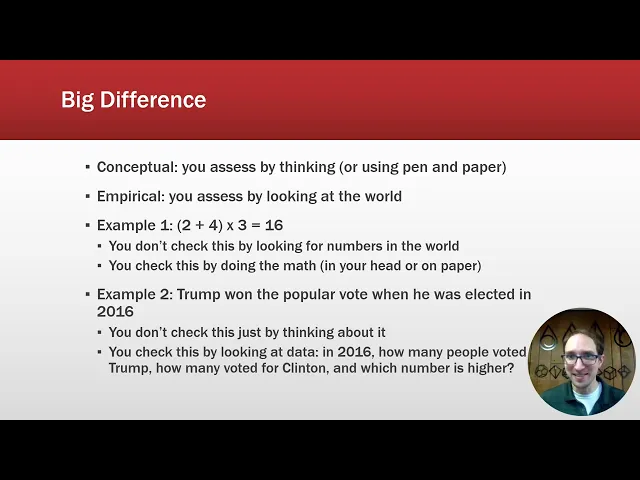
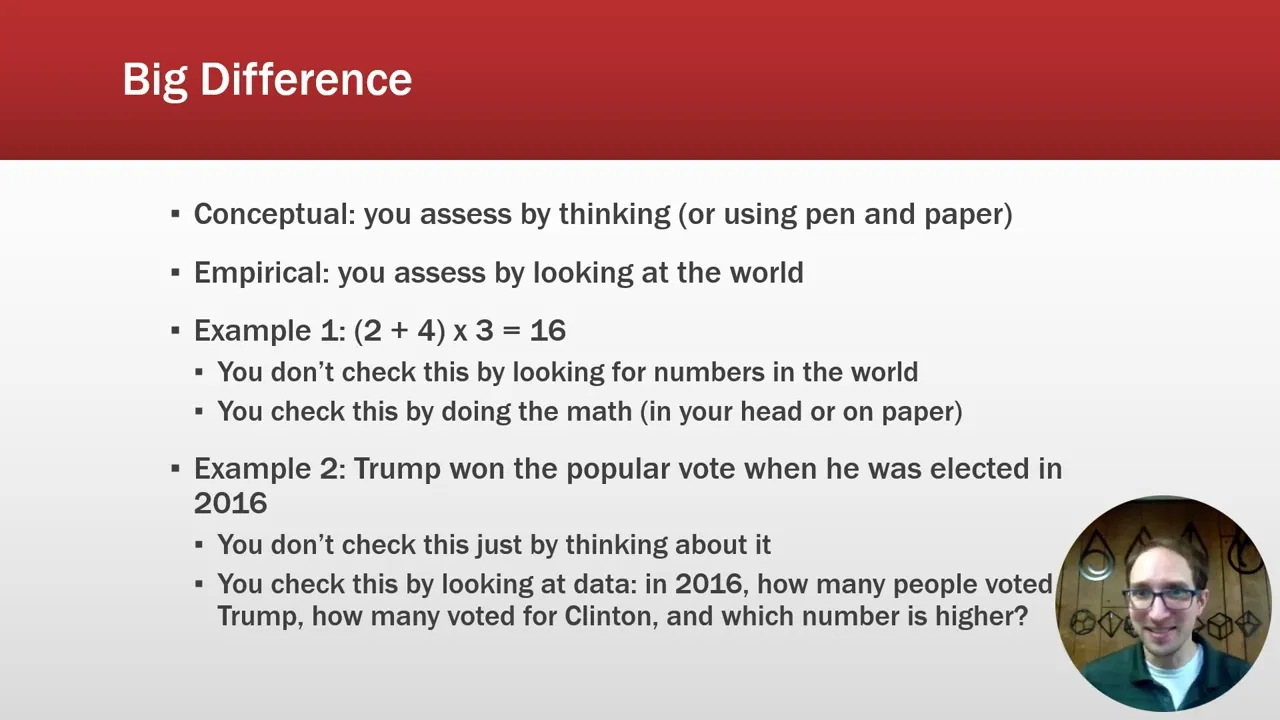
to know that you need to get some data you need to look back at um who voted in 2016 how many votes there were how they were cast you need to figure out how many people voted for Trump that year and how many people voted for Clinton that year and then you need to see which of those numbers is bigger so here let's spell out the big difference between conceptual claims and empirical claims conceptual claims are claims that you assess by thinking about them or using pen and paper empirical claims are claims that you assess
by looking at the world so let's look at our first example parentheses 2 + 4 * 3 = 16 you don't check this by looking for numbers in the world you check this by doing math either in your head or on paper that's why it's conceptual our second example Trump won the popular vote when he was elected in 2016 you don't check this just by thinking about it or writing things down on pen and paper you check this by looking for data you either observe or you conduct a scientific investigation or you get data from
people who did that's how you check this you have to go back to 2016 data and you need to see how many people voted for for Trump and how many voted for Clinton and then determine which of those numbers is higher that's why it's empirical so let's go ahead now and practice so I've listed four statements below four claims and for each of them I want you to start off by telling me if you think it's conceptual or empirical then after that I want you to say if you think it's true or false and finally
for each one I want you to explain why you think it's true and false what did you do to determine or figure out that it's true or false so go ahead do that for each of these claims and then we'll review them together as a class so go ahead pause do that now and unpause when you're ready to go over it all right let's go over the answers together and let's start off with our first claim most women who have abortions are over 30 years old and here I meant within the United States just to
be clear so for starters we know that this is an empirical claim why because you can't just use math on its own to get the answer you can't just use logic on its own to get the answer at some point we can't know if this is true or false unless we look at something in the world we need to observe something we need to conduct some scientific investigation or we need to get some data from people who did that themselves that's why we know it's empirical so is it true or false well it seems to
be false and how do we know that well I just did a Google search turns out that there's this organization called The gutacker Institute which specifically researches and gathers data for claims and questions like this so the gutacker Institute gathered a bunch of data and it found out that most women in the United States who have abortions are actually in their 20s now let's look at the second claim if all humans have a right to life and a fetus is a human then a fetus has a right to life now it turns out that this
is a conceptual claim why because it turns out it's actually just a logic claim that's it we just need to use logic to figure out if this is true or false and if we if we use logic we'll actually find out that it's true how is it true well it follows a certain format it says if all A's are B and if C is an a then C has B it turns out that whatever you plug in for a b and c there you're going to end up with a logically true statement now you can
also think about like this let's say I make the claim if all pigs can fly and if I'm a pig then I can fly is that true well yes it is because notice I never said all pigs can fly I said if all pigs can fly and I never said I'm a pig I said if I'm a pig but surely if all pigs can fly and surely if I'm one of those pigs then it must be the case that I can also fly that's just a logical truth we don't need to go out in the
world to find our answer we don't need to observe anything we don't need to run any scientific investigation we don't need to collect any data we can just use logic in our heads or on paper to find out that that's true let's talk about the next claim it's illegal to have an abortion in all 50 states in the United States now this is an empirical claim why because again you have to go into the world to figure that out you need to conduct a scientific investigation observe something or get data from people who did so
we know this is empirical furthermore we can find out that it's actually false why well we can use some Google again and we can look at the gutacker excuse me we can look at the gutmaker Institute again and they report after collecting some data that different states actually have different laws here all right final claim parentheses 6 - 3 + 3 equal 3 now this is conceptual why we don't need to look at anything in the world we just need to do some math here we can do it in our heads if that's too difficult
we can do it on pen and paper but we just need to do math we don't need to go anywhere else so we can find out it's false simply by doing the math again pemos 6 - 3 is 3 3 + 3 is 6 6 is not three so by doing the math we can find out this is false so why does this matter why am I making such a big deal about separating conceptual claims from empirical claims well this matters because there's a difference between trying to think your way to an answer and actually
researching your way to an answer and to illustrate let's start off with this claim the death penalty reduces more murders than life in prison in other words what this claim is saying is that the death penalty as a punishment for murder is going to keep more people from murdering than the penalty life in prison is this a conceptual claim or an empirical claim and why if it's conceptual why is it conceptual if it's empirical why is it empirical and how do you check to see if this claim is true or false go ahead and actually
answer those questions do you think it's conceptual or empirical why do you think that and how would you check to see if this claim is true or false pause and when you have your answers we'll go ahead and discuss as a class well it turns out that this is an empirical claim it is not a conceptual claim in other words we can't get our answer just by thinking about it at some point we can only get our answer by going out into the world and making some observation or conducting some scientific investigation or getting data
from people who did so why is that important well there's a difference between thinking and researching here now you may think that this claim is true you may think look the scarier a punishment is the less likely you're going to commit a crime and the death penalty is surely a scarier punishment than life in prison so surely the death penalty must reduce more murders than life in prison as a punishment you may think all of that and that gives you good reason to think that this claim is true sure but at the end of the
day your thinking alone is not going to give you the answer in fact you need to research here and when you research you're going to find out that this claim is false it turns out that when you do the research you're going to find that when it comes to reducing murders the death penalty and life in prison basically have the same effect on reducing the number of murders now let's talk about the claim the death penalty is less expensive than life in prison so the claim is that it's less expensive to kill someone as a
punishment than it is to give them life in prison as a punishment now is this a conceptual claim or empirical claim why do you think that and how would you check if this claim is true or false again go ahead and answer those questions and when you're ready we'll discuss it as a class so pause when you got your answers unpause and we'll go for it so again it turns out this claim is empirical it is not conceptual in other words you're not going to get the answer just by thinking about it you need to
do some research to get the answer now you may think this claim is true after all you may think look it costs money to keep someone in prison for just a day so it must surely cost a lot of money to keep someone in prison for the rest of their life but the death penalty just kills someone so that must be a lot cheaper you may think all that and that makes sense and that would give you reason to believe this is true but at the end of the day you're thinking here is only going
to get you so far in order to know if this is true or false you can't just think about it you have to do the research and if you do the research you're going to find out that this claim is actually false so it turns out at least in our country today that the death penalty is actually more expensive than life in prison in fact sometimes it's over three times more expensive than life in prison now why is that well it turns out that there are a ton of costs that go along with the death
penalty so if you have a trial where the death penalty would be the punishment you have pre-trial costs and you have trial costs and they're very expensive also in our country we typically don't find someone guilty and then kill them immediately typically there's this period of time that they have and when they're con when they're found guilty during this time a lot of them appeal their case and those peels cost a lot of money also there are the costs of incarceration on death row basically there are a lot of costs that come with the death
penalty in our country and those are very expensive so what's the point I'm trying to make here the point is this when it comes to empirical claims you can always make educated guesses it is totally fair game to make educated guesses but at the end of the day you can't know if an empirical claim is true or false just bying about it to find out if an empirical claim is true or false you have to do the research so remember when a claim is empirical because what when it's empirical your purely thinking about it is
only going to get you so far all right that covers the left side of our chart that covers the non-moral part of our chart so now let's go ahead and jump over to moral claims the right side of our chart so here's the thing about moral claims moral claims are making very special Kinds of Kinds of claims they are not saying what was they are not saying what is they are not saying what will be what they are saying is that something is right or wrong that something is good or bad that something is okay
or not okay they're saying is something is better or saying something is worse than something else they're saying what we should do or what we we should not do and because they are making these special claims we need to assess them differently look at the end of the day math by itself won't tell us what's right and wrong or what's good or bad at the end of the day logic by itself is not going to tell us what is or is not okay or what's better than worse or worse than something else at the end
of the day data by itself won't tell us what we should and shouldn't do in order to figure that out in order to figure out what's right or wrong or good or bad or okay or not okay or better or worse or what we shouldn't shouldn't do in order to figure that out we need to start by taking some math some logic and or some data but then rather than stopping there we need to take that and then connect it to some moral considerations so let's illustrate what I mean in more detail and let's start
by talking about what are these moral considerations that we're supposed to connect this stuff to well I won't pretend to write them all down but here are some moral considerations that we typically think are important so the first consideration is protecting people's rights here we want to consider what rights do people have and are those rights being protected or are they actually being violated another moral consideration is maximizing well-being whether that means that we're Maxim ma imizing people's happiness or we're maximizing People's Health or we're maximizing people's opportunities or anything like that and here what
we're considering is are people being made better off are people being made worse off also how many people are being made better off and how many are being made worse off also how much are people being made better off a lot better off or a little better off how much are they being they being made worse off a little worse off or a lot worse off another consideration is promoting justice so here what we're considering is are people being treated equally and if they're not is it for a good reason another moral consideration is being
fair so here we're considering things like who is benefiting and in what ways who is being burdened and in what ways and is this a fair distribution of benefits and burdens or are some people benefiting too much here and some people being burdened too much here and we need to change that so now with some idea of what some moral considerations are let's jump back to an example we're familiar with who gets the liver patient one or patient two so patient one 30-year-old white male he's married a father of three young children his career is
software engineer the cause of his liver problems are is his alcoholism aside from his liver problems he has no other health concerns and he has health insurance that would cover the cost of the liver transplant if he received it then we have patient two she's a 65-year old black female she's single she has no children or dependence as her career she's the head of a nonprofit that provides free nutritious meals to hundreds of poor children and families the cause of her liver problems are that she was a victim of a car accident she does have
other health concerns which include asthma and diabetes and she cannot afford to pay for the transplant if she ends up getting it so those are her two patients and the question is who gets the liver so which one of these patients should get the liver now you may think patient one should get the liver and why might you think that well you may think that patient one should get the liver because you think that that would protect patient one's rights so you may say this you may say look he has a right to access any
healthare he can afford and look he can afford this transplant his health insurance is good enough to cover for that and it turns out that patient 2 cannot afford this transplant so you may say look he has a right to this liver in this case so when we give him the liver we're protecting his rights and when we don't give him the liver we're actually violating his rights now another thing you might say is you might think patient one should get the liver because you think that that would maximize well-being in other words you might
say look patient one is married with three children patient two is single with no children or dependent as such you might say that if the goal here is to maximize well-being then we need to give patient one the liver because that's what's going to maximize overall health or opportunities or happiness or anything like that look if we give patient one the liver then he's still going to have a married household with these three children with co-parents and it's all going to be great if patient one doesn't get the liver and he dies now we have
a single parent in a very difficult situation trying to care for three children on their own so you may think because we're trying to maximize well-being here we should give patient one the liver now on the flip side you may actually think that patient to should get the liver and why might you think that well you might think that she should get the liver because you think that would promote Justice as you could argue you could sayl Patient 2 is not responsible for needing a liver here she was a victim of a car accident she
was obeying all the rules of the road and she was a victim of someone who wasn't but you might also argue that look patient one is responsible for needing a liver he needs a liver because he's an alcoholic and he was an alcoholic despite being told to cut back on that from his doctor so you may reason that PR voting Justice here requires us to give the liver to the person that is blameless not the person that is responsible and so you may argue that on the grounds of promoting Justice we need to give the
liver to Patient too you may also think that patient to should get the liver because you may think that that may be more fair at the end of the day and why might you think that well you could say that look Patient 2 already is suffering from many disadvantages in society based on her sex and G based on her race based on maybe other things as well and you may argue that patient one is not suffering those disadvantages because he is a younger white male so as such you may think that because Patient 2 is
suffering more of these societal disadvantages that it would actually be more fair to prioritize her ahead of patient one here and give her the liver instead now obviously there's a lot we could say there for starters you might not think any of that also there's a lot that we could do to challenge any one of those claims and arguments that we just looked at so here I don't want to focus on those particular details of those particular claims and arguments instead I just want to point out what's going on in each of these cases we
start by taking some data some data from the patients whether it's their health insurance status or their relationships or their number of children or their reason for needing a transplant or their P or their age their sex their gender the race and things like that we start by taking some data about the patients and then we take that data and we connect it to some moral considerations so for example we may connect that data about someone's health insurance status to the consideration of protecting people's rights we may take that data about people's relationships and the
number of children that they have and connect it to the consideration of maximizing wellbe uh well-being we may take this data about why a patient needs a transplant and connect it to the consideration of promoting Justice we may take some data about a patient's age or sex and gender or race or something else and connect it to the consideration of being fair so what are the big takeaways here the big takeaways are these moral claims are making very special kinds of claims they're saying that something is right or wrong they're saying that something is good
or bad they're saying that something is okay or not okay they're saying that something is better or worse than something else they're saying that there's something that we should or shouldn't do so when it comes to assessing these moral claims whether we think they're actually true or false and whether we're going to make them and believe them ourselves we need to do more than just use math and logic and data because it turns out that math by itself logic by itself and data by itself is not going to be enough we need to take math
we need to take logic and we need to take data and then we need to connect it to some moral considerations and we reviewed just a handful of moral considerations like protecting people's rights maximizing wellbeing promoting Justice or being fair now importantly this process of taking math logican data and connecting it to a moral consideration is not always as easy as we may wish it was in fact sometimes it can get complicated very quickly so for starters it's not always obvious what a moral consideration would say so for example let's say we're trying to figure
out who to give the liver to and what we want to do is we want to Maxim imiz wellbeing that's what we're going for well does maximizing wellbeing require us to give patient one liver or patient to the liver well you may think that maximizing happiness requires us to give patient one the liver after all he's married with three children and surely that'd be a detriment to his partner and his children if he didn't get the liver but on the other hand maybe maximizing well-being requires us to give patient to the Li cuz sure she
doesn't have any children or dependence of her own but she is ahe of a nonprofit that is giving nutritious meals to many children and families in her community and we don't know what would happen if she didn't get the liver and died what would happen to that nonprofit then and how those children and families can still get those healthy meals it's not obvious what would maximize happiness here there's a case to be made for both patients also sometimes moral considerations May class with other moral considerations so maybe we can only maximize well-being by violating someone's
rights in this case maybe we can only maximize well-being in this case by doing something unjust or unfair and if that's the case now we have a clash we have maximizing well-being telling us to do give the liver to one person and we have Justice telling us to give deliver to another person we have maximizing well-being telling us to give delivered to one person and we have fairness or rights telling us to give it to another person and in those cases it's not obvious which moral consideration should get priority are we going to favor maximizing
well-being or are we going to favor rights Justice and fairness it's not always obvious also just to be clear these are probably only some of the moral considerations out there not all of them I just gave you a handful I certainly don't mean to suggest that those are the only things that you should consider so there even more considerations out there that we should be thinking of needless to say it can get complicated pretty quick but for now let's just keep it simple when it comes to making a moral claim what you want to do
is you want to take some math some logic and or some data and you want to connect it to some moral considerations like protecting people's rights like maximizing well-being like promoting Justice like being fair now in this class we're also we're not just going to be making moral claims we're also going to be questioning moral claims seeing if we think that moral claims from our fellow students are authors if we think those are true or false so how do we question if a moral claim is true or false well there are a few questions we
should ask ourselves when looking at these claims we can start with is the Math logic or data they're using actually accurate because if their math is off if their logic is wrong or if their data isn't in accurate that's certainly a bad start but also even if that stuff is accurate we need to question are they accurately connecting it to the moral considerations they're trying to so for example in that case of who gets the liver if someone's trying to say that patient one should get the liver because that maximizes happiness we should question based
on the data do we think that giving them the liver would actually maximize happiness or do we think it would actually maximize happiness to give it to p toally we need a question there other math or Ora oral out there to consider so if you think that we should give patient one the liver because that would maximize happiness one thing we should ask is sure maybe but what about other considerations what about protecting people's rights what about promoting Justice what about being fair don't those count for something too and maybe those are enough considerations for
us to give the liver to Patient too so these are all things that we need to consider when we're questioning a moral claim given to us by either a fellow student or by an author that we're going to see in this course all right let's start wrapping this up and to do that let's go back to our flowchart now as we talked about today there are different kinds of claims and there are different ways to categorize these claims but for our class we're going to categorize all claims into one of two kinds they're either going
to be moral claims or they're going to be nonmoral claims so on the non-moral side we're going to look at two kinds of non-moral claims either conceptual or empirical conceptual claims are claims that we check just through some mental process whether it's math or logic whether we do it in our head or using pen and paper we do it just by thinking about it empirical claims are claims that we check by at some point making some observation or conducting some scientific investigation or getting some data from people who did on the flip side we have
moral claims and moral claims are making very special kinds of claims so we need a special way to check them and we do that by taking math and logic or and or data and connecting it to moral considerations like the kinds that we reviewed in this lecture so I don't know about you but I think it's about time that we got started so up until this point we've talked about two important things first we talked about discussions for our class and what I would like them to look like and phrases for us to avoid using
in these discussions we've also just reviewed strategies for assessing claims in this class the kinds of claims that we're going to see and the kinds of claims that we're going to make now importantly when it comes to these discussions and when it comes to these strategies there's more that we could say here we definitely could say more here but I think we shouldn't look this is an ethical issues and Healthcare course so I think the primary focus should be the ethical issues part but furthermore I at least think the best way to understand something isn't
just to learn it but then it's to practice it again and again and by using these ethical issues in healthcare we're going to have the opportunity to practice what we've discussed again and again so let's say that this is good enough to get us us started so now let's go ahead and dive into our ethical issues in healthcare for this course and next time I see you we're going to dive into our first one so I will see you then