– Hello. – Hello my super students. How are you?
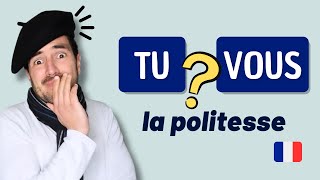
– Today we will look at how to use "le tutoiement", that is to say when you address someone with "TU", and how you use "le vouvoiement", that is to say when you address someone with "VOUS". – And before starting, don't forget, as always, to subscribe to this channel. Very many of you still watch our videos regularly without having subscribed.
So it's too bad. Also, don't forget that we have two fantastic free courses. We will leave you all of this in the description of the video.
And now we begin. – We will begin with a little reminder. So in French, when you address one person only, there are two possibilities, Pierre?
– Yes. So, either you can use the pronoun "TU", and this is called "le tutoiement". – For example: "Hey, Michel, tu peux aller acheter du pain ?
" (Hey Michel, can you go buy some bread? ) – "Bien sûr" (Of course). And the other possibility is to use the pronoun "VOUS".
This is what is called "le vouvoiement". – Yes. For example: "Monsieur, voici votre chapeau" (Sir, here is your hat).
– "Oh oh, trop aimable" (Oh, oh, too nice). So watch out, in the case of "vouvoiement" for one person only, we use the personal pronoun "VOUS" which corresponds with the second person plural, so regarding the grammar, it corresponds with the plural, however in this case here, we are addressing one person only. Clearly, you can use also "VOUS" to address many people who you "vouvoie" or you "tutoie".
– But, Pierre, explain to us when we should use " le tutoiement" and when we should use "le vouvoiement". – That is the question. – Okay, we will begin with "le tutoiement".
So "le tutoiement" is used rather in context, in a rather relaxed situation. – Exactly, it's what we call a more familiar language. So obviously with family and also when you address children.
– With friends too. – Clearly with friends. – With the young.
– Yes, so the young, we will talk more about this a little bit later, but normally, up to 20 years old, between themselves they "tutoient" each other. However, if they go inside… I don't know, a bank, for example, the banker will "vouvoie" him. But we will talk more about this a little bit later.
– Let's look at a little example. – "Caroline, tu pourrais me dire ce que tu penses de cette jolie plante verte ? " (Caroline, could you tell me what you think about this pretty green plant?
) – "Fais voir, ouais, pas mal. " (Let me see, yeah, not bad). – "Tu l’aimes bien ?
" (Do you like it a lot? ) – "Oui" (Yes). – "Je vais l’offrir à ma mère" (I'm going to give it to my mother).
– Let's now look at "le vouvoiement". So "le vouvoiement" is used in an a lot more formal situation. – More serious.
– So clearly in France, it concerns all contacts, communication with a shopkeeper for example. Well, in fact all strangers, if you ask someone the way in the street, you will also "vouvoie" this person. Next, if you address an elderly person, in general, you will "vouvoie" him out of respect.
Normally too, in a company, especially if you address your superior, in general, you must "vouvoie" him. And lastly, for example in a school, the students normally "vouvoient" their professors. And the professor, so that depends, we will talk more about this, can also "vouvoie" the students.
– And let's look at two little examples: "Bonjour, Monsieur Pirouette, comment allez-vous ? " (Hello, Mr Pirouette, how are you? ) – "Mais très bien Madame Laporte" (Very well, Mr.
Laporte). – "Bonjour, Monsieur, je voudrais une baguette s’il vous plaît" (Hello, Sir, I would like a baguette, please). – "Tout à fait, ce sera tout ?
" (Absolutely, will that be all? ) "Vous ne voulez pas goûter nos délicieux petits pains aux noix ? " (Do you not want to taste our delicious nut rolls?
) – "Ah, non merci, pas aujourd’hui" (Ah, no thank you, not today). – "Très bien" (Very well). Before moving on, we would like to ask you a question: you, our super students, how is it in your country?
Does "le tutoiement" and "le vouvoiement" exist? – Or in your countries do you "vouvoie" more or do you "vouvoie" much less, or "tutoie" everyone? – It's nice.
– Write us in the comments. We love seeing the different cultures, it's fascinating. – Let's move on now to a little bit more interesting things, that is to say particular cases, little tips.
– So then, first case, I wanted to talk about the Internet. – Yes, on the Internet, you can't see the other person, we don't know if they are older, younger. – Exactly.
So it's for this that, in fact, on the Internet… well, for two reasons: first because the Internet is more modern, it's mostly the young who use it, the new undertakings and all that. So in fact, "le tutoiement" it's not imposed completely, but you "tutoie" more. Next, in forums for example, you can't see the person, you don't know their age.
So in fact, by default, we chose to "tutoie", there, in forums, etc. And it's for this that I too, generally I "tutoie" you, my dear students, and when I reply to emails, etc. , I preferred simplifying my life, I preferred to "tutoyer".
– Well then, it must be said that before, we "vouvoyait" much more, and it's in the process of changing in France. So then, even in the work domain, before, in general, we "vouvoyait". And now, in the more modern companies, the startups, they are much younger.
The people have the tendency to "tutoyer" more. – To create a Google culture, young and dynamic. – And in the schools, for example, do the children "vouvoient" their professor, or do they "tutoient" or… ?
Because in « Le petit Nicolas », it seems to me that the professor "vouvoie" the students, and the students too clearly. – Yeah, because « Le petit Nicolas », so these are books which I recommend, it's very classic. It was rather long ago now.
And it's a very classic school. So in fact, before at school, really… already the students "vouvoient" the professor, but this still today, normally. And the professor, normally, in a classic way also "vouvoie" the students, even when they are little.
It's to mark a cetain distance, an authority too. But this is in the process of changing. Today, notably in high school, in middle school, and well, there are professors who "tutoient" their students.
You can even sometimes see some students "tutoient" their professors, but this, it's really more rare. – After, I also saw in films or elsewhere amongst the family, they "vouvoient". – Yeah, but that, in « La vie est un long fleuve tranquille », which by the way is a film which I recommend, which is nice, it's true that… but that there, it's really… it concerns extremely bourgeois families, a little rigid or repressed.
And it's possible to see "vouvoiement" amongst the members of a family, between the parents or with the children who have to "vouvoyer" the parents, notably, yeah, yeah. But then these are really special cases. – We will see some examples.
"Bonjour, Monsieur le Directeur, comment allez-vous ? " (Hello Mr Director, how are you? ) – "Mais Florence, mais c’est terminé le vouvoiement" (But Florence, "vouvoiement" is over).
"Tu sais, on est une entreprise cool, le chef, le patron, c’est fini tout ça" (You know, we are a cool company, the boss, the owner all of that is over). "Le vouvoiement, c'est un autre temps. On est une équipe" (Vouvoiement, it's from another time.
We are a team). "Ce qui compte c’est le chiffre d’affaires" (What counts are the numbers). – "OK, alors tu peux m’apporter un café s’il te plaît ?
Et bien chaud, avec deux sucres" (Okay, can you bring me a coffee, please. And nice and hot with two sugars). "Oui, il ne faut peut-être pas exagérer quand même.
On est moderne, mais… ouais, d’accord" (Yes, still, don't exaggerate. We are modern, but. .
. yeah, okay). "Nicolas s’il vous plaît, vous pourriez m’apporter votre carnet de notes que je le signe ?
" (Nicolas, could you please bring me your notebook so I can sign it? ) "Oui papa, je vous l’apporte de suite" (Yes, father. I will bring it to you right away).
– And so we have come to the key question, in these rather limited cases, particular cases, how to know if we should "vouvoyer" or tutoyer ? – Yes. I think the simplest is quite simply if, for example, you arrive at at a new company, in the beginning, you listen, and you do the same.
– You watch the ambiance, if it seems formal, relaxed. – But if it really poses a problem for you, simply, ask: should we "vouvoyer", "tutoyer" each other, in this company? And there then, you ask.
However, in a video from Cyprien who is very funny, which is called « Les Boss », I think, he says: « je ne sais jamais ce que je dois faire » (I never know what to do) because he's an intern. So in fact, he never knows what to do, and he never uses either "tu" or "vous", he uses them as suggestions, pirouettes (ways to avoid or wriggle out of something). – "Bonjour Cyprien.
Ça va ? " (Hello Cyprian. How are things?
) – "Oui, ça va, et… et… et j’imagine que ça va ? " (Yes, things are good, and. .
. and. .
I imagine things are good? ) – And also, you can change, you can start by a "vouvoyant" and after change to "tutoyer". – Yes, in this case here, we say: "bah on se tutoie, non ?
C’est peut-être plus sympa" (well, we "tutoie" each other, no? It's maybe nicer). – "Ah ouais" (Ah, yeah).
– Let's look at a final example. – "Bonjour Chantal, vous allez bien ? " (Hello Chantal, are you well?
) "Oui on peut se tutoyer, non, je crois ? " (Yes, we can "tutoie"each other, no, I think? ) "Mais oui, bien sûr, tu vas bien ?
" (But yes, of course, are you well? ) "Oui et toi Vincent ? " (Yes, and you, Vincent?
) "Oui, ça fait vraiment bizarre de se tutoyer, vous ne trouvez pas ? Euh, tu ne trouves pas ? " (Yes, it's really strange to "tutoyer" each other, each other, don't you think?
Euh, don't you think? ) "Oui" (Yes). And you, do you "tutoies" or "vouvoies" your colleagues at work?
Tell us in the comments. – In any case, whatever the case, you can "tutoyer", you can "vouvoyer", but what you must do is to absolutely use our two free courses, they will appear on the screen now. And then, if you liked this video, don't forget, a little thumb's up, it always please us.
So, we will see each other in the next video, if you wish it well. – Good bye. – Good bye!