There's 200 people or 150 people that start the class. There's 100 helmets of people that quit. Grown men whose dream it was to be a SEAL that get there that did all this physical training and all this preparation and sign that dotted line and committed to six years and they show up there and they get to that training and they ring that bell.
No one knows who's gonna make it through that program. The only way to know what's in the core of a human being is to rip that thing apart and see what's in there. And until you rip it apart and see what's in there you don't know.
What does it take to not ring the bell? Don't quit people always ask me what should I concentrate on? What's- what's your advice for me going to BUD/S?
Don't quit Don't quit Like, train hard, don't quit. Well, if you want to be a good leader you have to understand human nature. And the places where human nature reveals itself most clearly are times of extreme suffering and inhumanity I had a bunch of hard-headed very determined thick skulled guys that you know, I had to get them to do what I wanted them to do had to get them to want to do.
Trust is built on relationships, relationships are built on trust. If you don't trust me we don't really have a relationship. My first platoon we were doing a training operation, we get into this tactical situation everyone in my platoon is focused on one area.
Everyone's looking down their weapons waiting for a threat to expose itself which means you got 16 guys looking down their weapons and I’m waiting for someone to make a call. I was a new guy I’m waiting for someone above me in the chain of command to say Hey! move here or hey!
move forward or make some kind of a decision. And as I’m waiting no one's doing it. So, I’m a new guy I’m scared to say anything and I know I shouldn't say anything so I'm just waiting and no one's giving an order, no one's giving any direction.
So, I wait longer and this goes on for probably 30 seconds or a minute which is a really long time when you're trying to take down a target and finally I said to myself, "all right, I'm gonna see what's going on" so I actually point my weapon at the ceiling and I take a step back and I just look around and and I see that every single person in my platoon including my platoon commander, including the assistant platoon commander, including the platoon leading petty officer everyone is just focused on their weapons and no one's making a decision and I can see this and because I’m looking around and I’m detached from the scenario just by, just by eight inches I stepped back stepped back to look around I can see what decision needs to be made. And so, I summoned up as much courage as I could as a new guy because new guys don't make decisions. And I said HOLD LEFT, CLEAR RIGHT which is a basic command that we had rehearsed and you would practice and I expected someone to say you know, shut up, shut up Jocko but instead they repeated the command.
They all said, HOLD LEFT, CLEAR RIGHT which means we were going to execute it and sure enough, the guys in the left held and the guys in the right cleared and we got done and instead of someone saying hey! you need to keep your mouth shut one of the more senior guys said, hey! good job up there.
Way to make a call. So I looked at it, I said wait a second how could I have. .
. as a new guy have made a decision in that situation that was better than what the more senior more experienced guys were making. And I realized it was because I took a step back and detached from it.
So at that moment I said to myself, okay, from now on, when I get into these tactical scenarios I’m gonna take a step back and I’m gonna try and look around and I’m gonna try and detach myself from the chaos and the mayhem. And I started doing it all the time in every tactical situation in the land warfare, in the mountains, in the urban environments I was doing it all the time. And I was able to like see what was happening.
It was like a superpower to be able to see what was happening and make decisions. And so, then I actually started doing it when I was having conversations. And if you and I were in disagreement and you started getting emotional instead of me getting emotional back at you I would just take a step back and be like, oh okay, he's really, he's really concerned about this why is he so concerned?
What does he see that I don't see? And I started to actually- just detaching all the time and that became a very powerful tool in leadership that I used to this day. My second platoon, our platoon commander the guy actually in charge of the whole platoon.
he's not very experienced, he didn't listen, he didn't take advice, he didn't take guidance. Everything was like his way or the highway. And we had a mutiny inside of our platoon we went to our commanding officer and said hey, sir, we don't want to work for our platoon commander he- he doesn't listen, he's arrogant.
And eventually what ended up happening was this guy got fired as our platoon commander. And that left an impact on me because as I’m watching this going I’m thinking myself why don't we like this guy? Why doesn't anyone want to listen to this guy?
Why don't we want to follow this guy? And the reason because he was arrogant and he didn't listen and he didn't give us any ownership of everything, everything was about him. And that would, that would have made an impression on me, that would have left a mark but the mark got left even more clearly because when that guy got fired the guy that came in and took over for him was- was like I hate to use the word legendary but he was a pretty legendary Seal had a ton of experience, he'd come up through the ranks and he had been stationed at every different kind of Seal team and he took over as our platoon commander.
And I kind of thought to myself well he's going to take over because we're a bunch of mutineers and they need to put someone really strong that's going to like whip us back into shape. So I was anticipating that we were gonna have this super hardcore guy. And- and this guy shows up and he's got a nice smile on his face and he's super humble and I remember one of the first things he said to us was like I look forward to working with you guys.
And I was that word right there, I’m gonna work with you guys not- not I’m in charge, I’m glad I’m taking over, I’m glad to be your commander He was nothing like that, he said, hey, I’m looking forward working with you guys. So all of a sudden it was totally different and he started putting us in charge of things instead of him coming up with a plan he would say- hey you guys, come up with a plan and let me know how you want to do it. And all of a sudden we had all this ownership and that made me reflect on the way the first guy had acted compared to the way this guy had acted.
And I realized how important it was to be a humble leader and to listen to other people and to give ownership to other people. In the third platoon, it was a good solid platoon and we had a good platoon commander and we were out in the desert doing some training and some targets popped up and we start engaging the targets like we're supposed to and everyone gets in the prone position and is returning fire. And I did what I had been doing this whole time which was detached I kind of took a step back, took- shot a couple rounds then kind of pulled back and looked to see what was going on.
And I saw the call that needed to be made. And I gave the platoon commander a couple seconds to make a call and he didn't make it so you know, I call, I made the call. Peel left and everyone said, okay, peel left and we peeled left and we left the scenario and we got our distance and then we stopped the training exercise and we did a little debrief.
And during the debrief the platoon commander you know, he said to me why did you make that call? And I said well, I could see what we needed to do, you know, and you hadn't made a call so, you know, I made the call. And he goes well I actually didn't want to peel left I wanted to assault the target And- and right there in that split second, I kind of thought to myself well like part of my ego flared up and I was kind of thinking I could have said something along the lines of.
. . Well, you need to make a call faster if you're not going to step up and lead, then I’m going to do it, I could have said that but I realized at that moment in time wait a second, I didn't need to make a call the problem could have developed more but for some reason I thought that I needed to be the guy.
And I said, no, you know what, you don't need to be the guy your leader, you need to support your leader and it's not about you and what you have to do is subordinate your ego and be supportive of the person that's in charge and you move forward together as a team. Because that's what it's about. It's not about me it's about the team.
There's a word that people bring up a lot and I think they're pretty interchangeable and it's relationships and trust Trust is built on relationships relationships are built on trust. If you don't trust me we don't really have a relationship. But if you want to be a good leader you have to understand human nature.
And the places where human nature reveals itself most clearly are times of extreme sorrow, pain, suffering, and inhumanity. And if we don't recognize what causes that, where that comes from and that it's actually possible then it's bound to happen again.
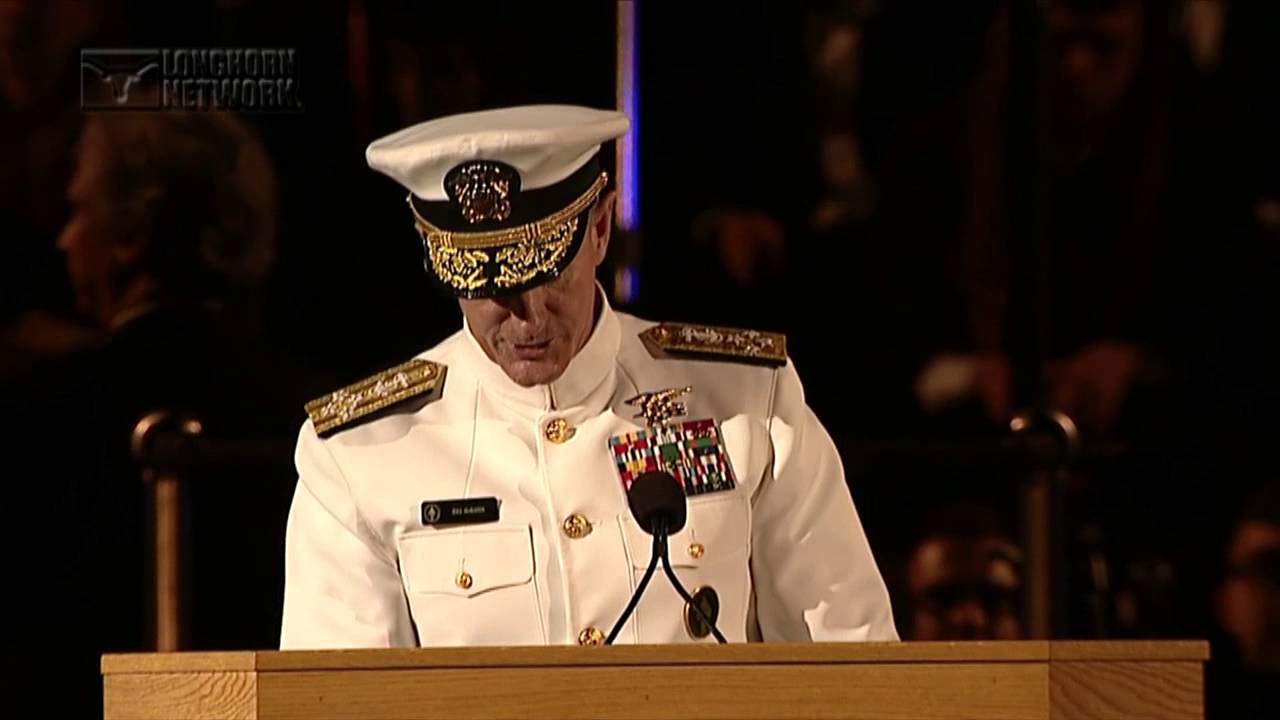
![THIS WILL CHANGE YOU! Navy Seal Admiral William H. McRaven [MOTIVATIONAL SPEECH]](https://img.youtube.com/vi/mMEq0r97T_k/maxresdefault.jpg)