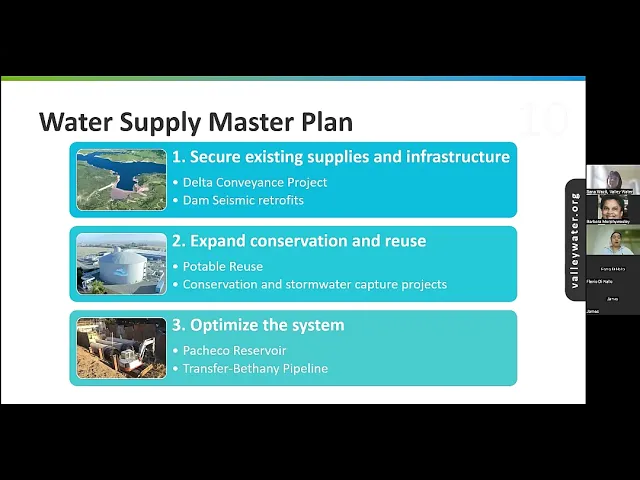
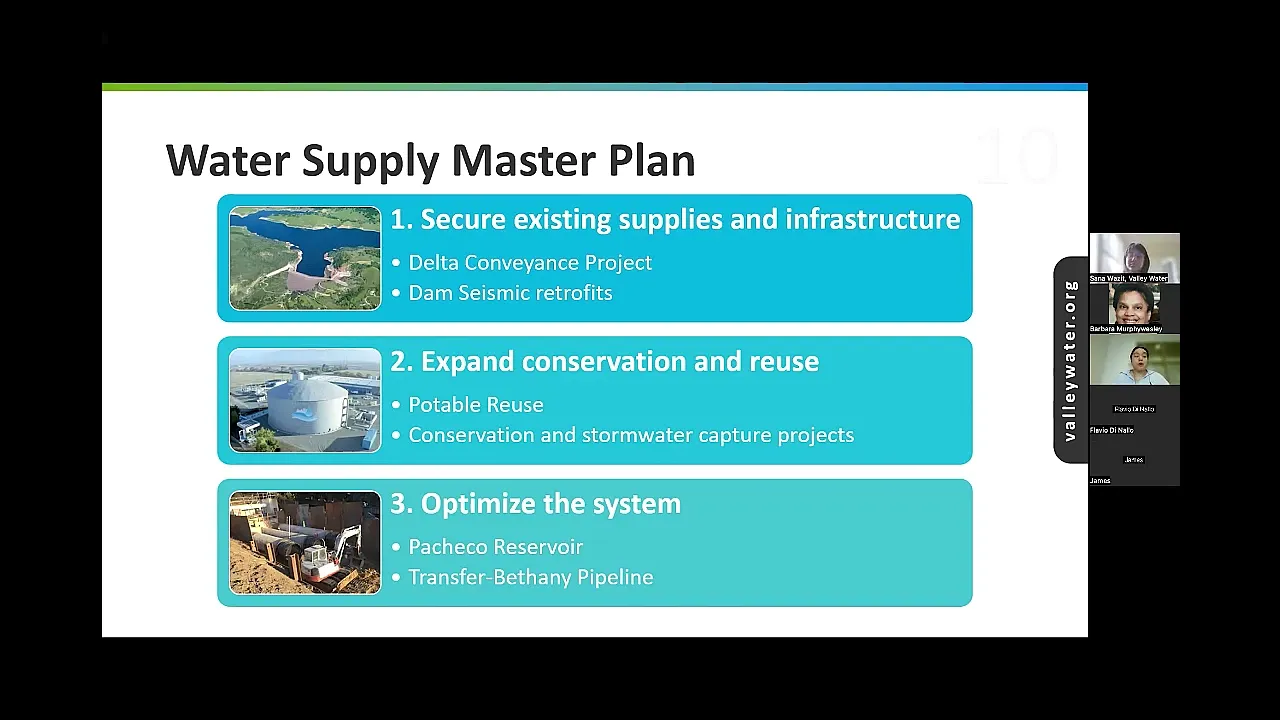
today we have representatives of H Valley Water to help us cover our topic of water conservation Valley Water is an organization that provides safe clean water flood protection and stewardship of our streams in our area I will let the uh Representatives just tell you more about what they do and who they are so we'll go ahead and turn the meeting over to them so welcome thanks Barbara let me just share my screen I'm use the Microsoft teams okay is my presentation presenting yes okay great all right so hi everyone uh my name is desire s I'm an assistant Water Resources specialist in Valley Waters water supply planning and conservation unit I'll be providing a little bit of a background into Valley Water as an organization some information on what water supply planning looks like and some examples of stewardship activities that Valley Water carries out and then son will follow my presentation with a little bit more information on our conservation program specifically um but to start uh Valley water's mission is to provide Silicon Valley with safe clean water for a healthy life environment and economy So to that end Valley Water has three primary goals to provide clean reliable water for residents flood protection for homes schools and businesses and stewardship of our streams for healthy Creek ecosystems Valley Water is a public agency with an elected board so our board of directors is comprised of seven members each elected from equally divided districts as equally divided by population district one looks huge here but that's just because not as many people live there um but our board helps to develop recommend and adopt policies and also provide comments on activities in the implementation of the district's Mission so if you if you live in the county and are registered to vote I highly encourage you to find out what district you're in and who represents you just so when these positions up for uh re-election again you can participate and know a little bit more um Valley Water serves all of Santa clar County which is quite a large area uh there's almost two million people living in the county within 15 cities Valley Water is also a water wholesaler so we sell water to 13 retailers throughout the county who then distribute the water to the residents and businesses so if you get a water bill it is most likely not coming from Valley Water so don't ask us for a bill reduction but Valley Water also manages the groundwater so water can be pumped from the groundwater oper beneath the county through Wells by private well owners farmers and also our water retailers for a little bit of history of the agency in the mid 1800s the gold West was happening California saw a big increase in its population and as people settled here the agricultural water demands also increase so in this graph um blue is the natural groundwater levels that orange dash line at the top is the actual uh land level and then green the green dotted line is the population and so Valley Water was formed in 1929 in response to overdrawn groundwater basins and the subsequent land subside you can see in the early 1900s the water level is dropping down and also the land surface elevation is slowly dropping down as well um land subsidence meaning the sinking of the surface of the lands and that was mostly due to the water demands of Agriculture so to combat this in the 1930s the agency built six surface water reservoirs to capture uh storm water and then recharge the groundwater and this did help to bring the groundwater elevation back up however the population continued to grow and strained groundwater resources and so subsidence continued between 1915 and 1969 Downtown San Jose where you know the university is uh San Jose had permanently sunk by nearly 13 feet and so in the 1950s four additional surface water reservoirs were constructed which helped a little bit but not nearly enough so in the 1960s Valley Water began importing water from state-owned reservoirs outside the county through the state Water Project which helped to stabilize the groundwater all the while population was still increasing and when groundwater levels dropped again Valley Water secured additional imported water through the Federal Central Valley Project and there's been periods of drought since then where we've seen the ground water levels dropped a little bit um but for the most part Valley Water is sustainably managing our count these groundwater so now today where does our water come from most of it is still imported from out of County around 50% comes from the north typically Sacramento Delta uh 30% is from our groundwater and local surface water so what we're able to capture and store in our watersheds when we get rain like we've seen this past winter and about 5% is recycled water this is a small but really important and definitely growing source of water in the county that helps to conserve drinking water and it's also drought proof so very important and then water conservation is also listed here which is really important for maintaining our water supplies but I will let s to talk about that more later and making sure all this water gets to where it's needed and to the right people it requires extensive infrastructure this map do do it justice there's like way more we have 10 surface water reservoirs to store local and imported water Although our largest Reservoir Anderson is currently drained to allow for a seismic vrit of the dam you may have seen updates uh on this project in the news and we also manage 122 groundwater recharge bonds these are smaller bodies of water where we can pump you know imported water to her locally captured water and have it sink back into our groundwater aqu Huffer for when um our retailers or well owners uh pump water and then there's 142 mil pipeline three pumping stations three drinking water treatment plants and also one water purification Center and along with all of that sort of built infrastructure Valley Water also owns and manages around 275 miles of streams in the county now for water supply planning specifically it's really important to understand the historic water use in the county you can see in this graph that the water use in blue does fluctuate from year to year um but will typically drop off rather dramatically during drought period drought periods as our residents conserve more water um and with the last two droughts water use would rebound uh back up but not to pre-drought levels which indicates that our drought time conservation measures like water effici fixture Replacements and other behavioral changes have lasting effects which is really great and then on the other side trying to understand where water use is going is also really important for water supply planning we need to understand what our future water use might look like um to determine when we'll need to invest in additional Supply options using demand projections we can compare against what we think our supply is going to be um and get an idea of if and when shortage may occur and plann for those additional supplies accordingly expanding a reservoir for example takes a long time to be completed so if our projections show that we need more Supply in 10 years we need to be planning for that Reservoir expansion today and so we have models that will project out our water demand in green on this graph uh it is the water projection from or the yeah the water demands from our water Supply plan 2040 this plan was developed in 2016 right after that big drought and assumed a rebound to pre- Drught water use um however since 2016 we've seen that the drought rebound has not been nearly as high as projected so we've been looking at projections that consider varying amounts of rebound after the drought to reassess demand projections uh from our water supply Master 2040 and speaking of that uh the Water Supply master plan is the plan that outlines Valley Water strategy for providing a reliable and sustainable water supply in a hopefully cost-effective manner uh the master plan acts as our roadmap uh for investment decisions through 2040 so Valley Water has a level level of service goal that we're always striving to achieve um and the master plan lays out the water supply strategy to meet meet that goal and puts together a portfolio of water supply projects we may need in the future to keep meeting that level of service school and for the water supply master plan 2040 there were three main elements to the water supply strategy to ensure sustainability one is to secure existing supplies and infrastructure so for example completing size of retrofits of our existing dams to ensure we can fill our reservoirs to full capacity and we aren't at risk of failure the second element is to expand conservation and reuse which is really critical this strategy is resilient to Extended droughts which is some of the hardest shortages to plan for and um it is also making efficient use of the supplies we already have and then our last strategy is to optimize the system or essentially increasing our ability to use our existing supplies and infrastructure in wet and normal years we typically have more than enough water supply to meet our demands uh however additional facilities and infrastructure could help us to store those extra supplies for dry years which is something the Poco reservoir uh project could help accomplish so I've listed some projects here but there are many more projects in the water supply portfolio that all kind of fit into one of these elements um but we are also uh actually currently in the middle of updating our water supply master plan so we're pushing out our planning Horizon from 2040 to 2050 we're also reassessing our supply and demand projections and working on evaluating projects so that we can develop new portfolios of projects to present to the board for investment um and there's more information online and I can definitely put a link to that web page in the chat if you'd like to learn more we kind of regularly have board meetings where we present this information if you are interested so lastly I also wanted to take some time to discuss some of Aly water's stewardship activities um and projects from the water supply portfolio uh can also fit into our safe clean water and natural flood Protection Program um this is the program that helps to carry out Valley waters flood protection and stewardship missions this program was first passed by voters in 2000 as the Clean safe creeks and natural flood protection plan and then again in 2012 but then as the safe clean water and natural flood Protection Program and it was permanently extended in 2020 and this program provides approximately $47 million annually for our local projects and there are six priorities listed here that each have their own sub projects so priority a deals with a reliable water supply priority B focuses on reducing contaminants in our waterways priority C is concerned with protecting our water supply and dams from natural disasters so like the SI retrofit of Anderson Dam if earthquakes are a concern in California uh priority D focuses on habitat restoration and open space access priority e covers flood protection and then priority F covers projects that help support public health and Public Safety along our waterways and infrastructure and so as I mentioned each priority has projects so I'll be providing a a few examples of some of those and then for the first one we have project B2 which is our inter agency Urban runoff program this project supports Valley Waters relationship with other organizations Valley wat of water wholesaler in the area but we don't have land use Authority that typically uh lies with the city so it's good to always coordinate uh with those organizations to help reduce the pollu mutants in the County's waterways part of this project includes placing trash capture devices or trash booms uh in our streams to prevent trash from moving down Downstream they're effectively like a big net in uh across the creek and uh once a trash boom is placed staff is going to monitor and then remove trash is needed uh as you can see here in this image and the these can capture quite a lot of trash in the last two years years Valley Water operated four trash booms in the county and collected approximately 3. 2 tons of trash next we have project D4 which is the fish habitat and passage Improvement project um which helps to restore and maintain healthy fish populations by improving fish habitat in our treats so for example in June of 2022 we began construction of the ubis Creek fish habitat Improvement project which includes large Woody debris and gravel augmentation along Evis Creek and Gilroy this project was recently completed last year in August 2023 and so by adding string features such as as large woods these the log jams that you can see here in these pictures um we can create Habitat to provide protection uh for migratory fish uh during prolonged drought or extreme rain fall events so the fish don't get washed out and then gravel also provides a more suitable fish habitat for spawning specifically than just having the regular sediment in the creek uh regarding flood protection we have uh E1 the Coyote Creek protection project so if you've been paying attention to local news like very recently you may have heard about this one um if you were here in 2017 it was a really rainy year and we saw a a lot of flooding uh particularly along kyot Creek which runs all the way from down in Morgan Hill up through San Jose and out to the bay and there are a lot of homes and businesses Etc along the creek in San Jose goes right through downtown uh and the 2017 flooding caused a lot of property damage so this project was developed uh to help present to help prevent that in case of flood again it's a really long stretch to protect so this project has to be done in phases so as you can see in the picture on the bottom right large sheets of Steel are driven into the ground along the banks of the creek which add about I've seen like 5 to 15 in certain areas feet of uh steel is left exposed that forms a barrier against the creek when it rises when we have a lot of rain and so that that construction is currently happening uh and roughly nine miles will be built along this SE uh along this section here in the map uh which goes from monu Expressway all the way down to Tully Road and where they recently began construction is reach seven which is running right through downtown which I think is why there's been a little bit more press about it and there are also other ways to reduce flooding in our waterways uh and this includes making sure that we maintain the flow capacity of the streams so over time sediment can build up raising the the creek bed and also vegetation will grow long and also within the channel uh which can reduce the the capacity of the streams and then lead to flooding and project one is the project that helps to control this so we have Crews that go out by hand using machines um occasionally herbicides uh to and they remove vegetation that are growing alonger waterways uh and in the last fiscal year Valley Water completed I think 13 projects and removed almost 15,000 cubic yards of uh sediment along 1. 6 miles of Creek to help maintain the design capacity and reduce the potential for future flooding so this was a very small subset of the projects that are included in the saf clean water program but there's plenty of more information on our website uh and I can definitely also put a link to the chat about those um but that's really all I had for you today just sort of a kind of overview of Valley Water uh but I'll pass it off to Sun now to talk more about our water conservation program specifically thank you thanks Des um okay I'll share my [Music] screen all right hi everyone my name is saana um I'm a water conservation specialist in the same unit as dese I actually went to San Jose State University I graduated in 2020 um from the Environmental Studies program and I've been at Valley Water since I started out as an intern um just started my full-time position last year um so thank you so much for having me here today um so conservation it's a very key important in responding to drought um conditions and the conservation programs that we offer helps achieve uh water savings gos um so why is water conservation important so some of you may pay uh water utility bills some of you may not but the way that we try to frame it for consumers is that conservation ultimately saves you money um a statistic that we like to use is that upgrading from a traditional toilet um to to a toilet that uses less gallons per flush model can save up to 13,000 gallons of water um and that's approximately $130 in water costs per year so you see that directly when it comes to your water bills but there's lots of other um reasons too so it helps increase long-term water supply reliability and helps us reduce our Reliance on imported water from the Delta from Hy like um desire mentioned and like she showed in her slide um we do count conservation as a um form of Supply right so every gallon of water we save it's water that we're not importing it's water that we are already utilizing um another um importance of conservation is that it reduces Urban runoffs so a lot of the runoff that we see um in our storm drains it's from fertilizers nutrients from runoff pollution and um those giant infrastructures that as showed uh treatment of water distribution of water it's one of the top energy users in California so conserving water ultimately leads to less greenhouse gas emissions this is the US drought monitor we are obviously no longer in a drought that we were in a couple years ago um but the thing about California is that we have wet wet years we have dry years right we can't rely on a consistent amount of rain um we're it's raining a lot this year but it might not rain next year and it's important um we use a quote we say every day it's not raining it's drying um they're going to be recurring droughts especially with climate change and everything we're going to see longer droughts we're going to see more intense droughts so it's important that we Implement um long-term changes in practice it's not just reactionary strategies when droughts occur um and that's a balance that we have to find right um what do we ask consumers to do when there's an intense droughts do we save those strategies for droughts do we make it an everyday kind of thing um we don't want to have a reactionary strategy in place all the time but we do have to balance that with when we do have wet years versus Dryears um the last drought that we had or the last drought before this one started in 2012 ended in 2016 and then this last year um it started in 2020 and then ended just last year so we're con consistently seeing droughts um come and go and it's important that we have long-term strategies in place um this is a water tracker uh that we have we monthly update on Valley Water I can share this link in the chat But it includes factors that um affect our water supplies so weather with rainfall we're getting um what the local reservoirs are looking like what's our groundwater um imported water how much water are we treading recycling conserving um and it is a great resource if you want to see what our groundwater levels are snow pack levels Reservoir levels um this is something that we share with our board with um you know the county frequently it really helps us to keep track of our water so this like I said we've consistently have droughts and we have something called a reactionary strategy so once a drought is in place what do we do about that um in June of 2021 our board of directors actually declared a drought emergency and this is one of the strongest um actions that we can take it implemented a 15% mandatory uh water use reduction compared to um 2019 for the whole County um so Valley Water we work with our retailers like Des re said we have retailers um to help that these help make these savings happen but ultimately it's up to our retailers to pass the to meet those goals um in 2022 of April we had a tway per week watering ordinance so um residential sites commercial sites they can only water um two days per week and there was certain restrictions on that so um uh it had to happen before 9:00 a.
m. after 700 p. m.