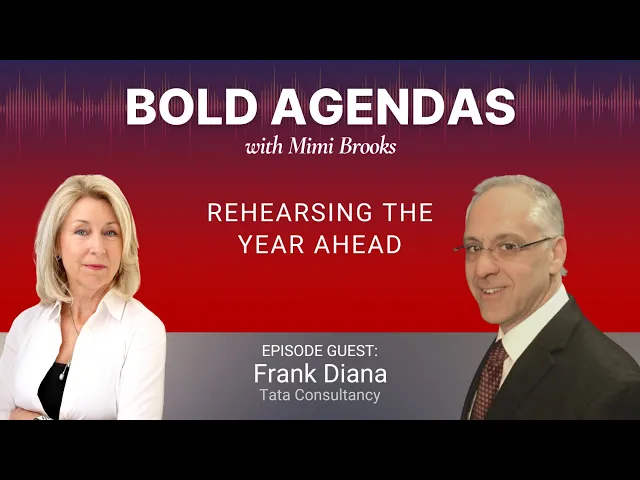
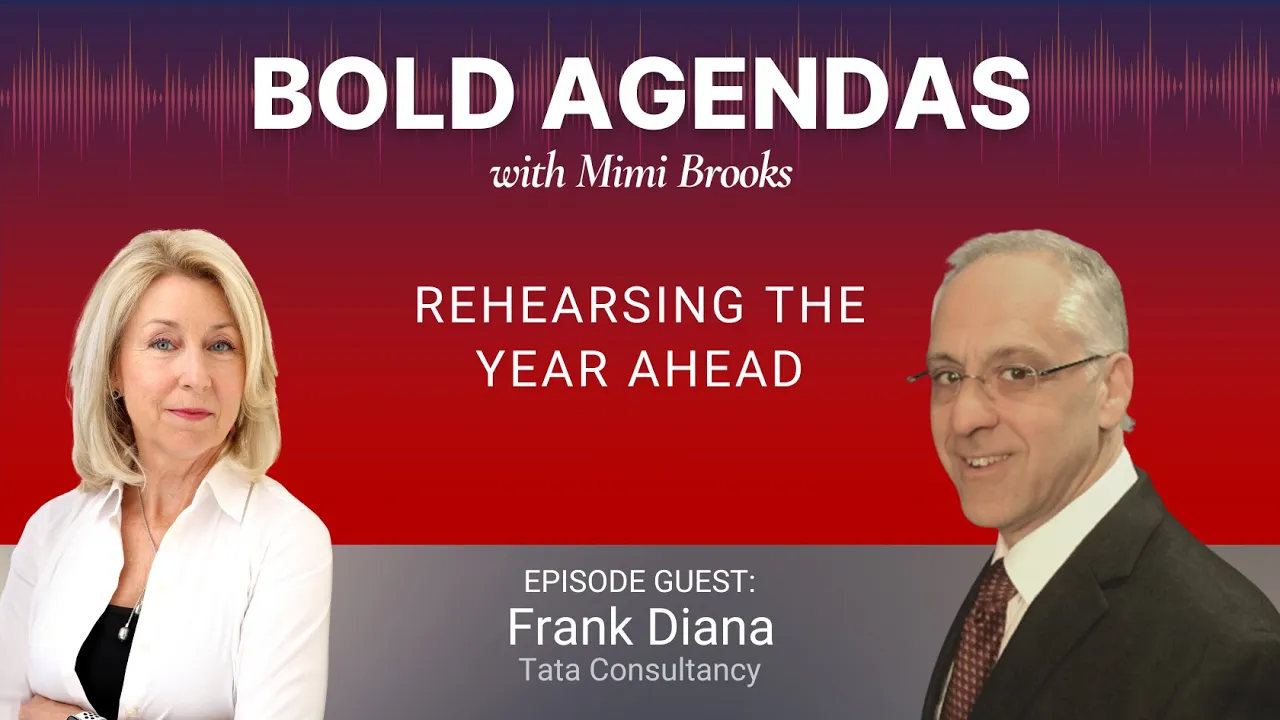
[Music] welcome to bold agendas a series of thought leadership podcasts dedicated to the discussion of transformation Management in each podcast we dive into topics of strategic interest to Business Leaders who are driving their organizations through transformative change today we're tackling one of the most critical challenges in business preparing for the future in an Increasingly complex and interconnected World As Leaders face rapid technological innovation shifting Global Dynamics and emerging societal Trends the ability to anticipate and adapt has never been more important to explore this transformative idea I'm thrilled to welcome Frank Diana a futurist and managing
partner at Tata consulting Services Frank is a recognized thought leader and advisor on the future of business and he's passionate about Helping organizations navigate the forces shaping tomorrow known for his concept of rehearsing the future Frank challenges leaders to go beyond simple predictions by imagining possible scenarios and preparing for the opportunities and disruptions they may bring I'm Mimi Brooks the CEO of logical design Solutions a business strategy and transformation consultancy and I'm a leadership coach today we'll unpack Frank's key insights for 2025 and we'll Discuss how leaders can build adaptability and resilience and explore actionable
strategies for thriving in an uncertain world so this is bold agendas with futurist Frank Diana on rehearsing the year ahead let's get started Frank welcome thank you so much for for being here I'm thrilled to have you oh thanks for having me uh good to reconnect it really is so Frank I think that you were one of the F first futurists that I ever met and spoke with and uh had a chance To uh had a chance to do some industry talks and uh and marketing work with so it's a delight to have you here
and uh as I was saying to you um we were speaking beforehand I think that uh not all futurists um necessarily do the same work although I imagine that you have some you know common themes to how you work in methodology but let me give you the floor for a few minutes so that you can tell folks you know what you do Frank uh who you do it for and uh what Maybe a day in the life looks like of a uh of a futurist sure well thanks for the opportunity to do that I am
as mentioned the futurist I am the principal futurist at Tata consultancy Services uh which means I spend all of my time as you might imagine thinking about the future um what many people don't realize is I spend as much time thinking about the past I'm sure we'll get into some of that as history is really instructive in terms of where Things may go um so it's a fascinating time to be one given what's going on in the world um and most of my day is spent if not constantly trying to understand our world it's really
kind of communicating that understanding to audiences around the world whether it's forums or SE Suite um customers or board directors it's it's uh really what I do every day it's fascinating it's and uh you have a team of folks that work with you too at Tata Right Frank so you've got as you said you're the principal Futures but it's a it's a team of people that do this this research and uh thought leadership for for Tata yeah yeah so small team uh some futurists mostly storytellers people that are really good at communicating complex messages and
in easy to digest ways so visualization is a really big piece of what we do um and then of course people that can have a breath of vision being able to see multiple things At once because that's really what our world really it calls for today yeah that makes sense that makes sense so Frank um when I asked you come on to the show there's a million things that we could have talked to you about but um as you know we're shooting this at the very end of 2024 and I um actually you come on
to kick off a series that I'm doing on you know how we think about um what's likely ahead of Business Leaders in 2025 so the year ahead you know um given some Of the lessons learned and uh change that we experienced in the last year how might we think about some of the big issues and opportunities that could sit ahead of us in 2025 and perhaps as you and I were saying even beyond that as we think about the second half of this decade the beginning of the end year in terms of the 2020s and
what could be unfolding you know over the next four or five years or so so you know thanks for kicking off this you know h a look ahead Into the future as part of the discussion I think you're a perfect person to do this with me well again happy to be able to do that I think these things are important because leaders everywhere really need to be thinking about these things yeah you know um part of my inspiration for this Frank was an article that you wrote that ran just a few weeks ago that was
um advocating for uh rehearsing the future the year ahead in 2025 rehearsing you Know versus predicting the future and there was a lot of um good ideas in that article maybe a bit of a framework of how to think about you know rehearsing potential scenarios you know for next year so can we start with just the concept Frank of you know why you describe this rehearsing idea as the better you know way to Envision the future as opposed to you know thinking about predicting the future yeah that's a great place to start um and it
starts With the notion that we as Jans have really never been that good at prediction um I'm sure there'll be people out there that will dispute that point but it's fact if you look historically we're not really that good at it especially in times of high degrees of uncertainty um and and some argue that we've always been in uncertain times but there are peers in history that have represented much more uncertainty than than traditional times And this is one of them so to think that we could with some degree of certainty predict the future I
just think is impossible which leaves us with this notion of rehearsing um it's a play on scenario planning and scenario analysis that companies like shallot have been doing for years but it's a it's a function of understanding the the elements of rehearsal the things that we need to focus on to do justice to rehearsing um and I think One of the key challenges for every leader out there today is just the number of domains involved in this rehearsal the number of domains that find themselves in a state of flux which is why I believe this
period is different than our last 70 years quite honestly because there are so geopolitics the economies of the world society science technology environment philosophy those are the seven key domains that I focus on that really are All the state of flux and we can get into some of the details but how do you rehearse when there are so many forces at play across all those domains and it's not easy but that's why I think it's imperative so Frank this is a a way in a macro sense this is a way to think about um how
we um anticipate risk manage risk think about it before it's upon us you know as an approach it's probably an approach that builds adaptability and Resilience into leadership decision making you know as we think less about you know a hardly Set uh strategy and plan for the next 5 to 10 years right so as a matter of strategic execution you know we need an approach that by its very nature is adaptable and flexible that's the concept here that we're talking about right yeah well and and your your use of the term strategic plan is very
appropriate given that I think the definition of one has changed Considerably um in light of the fact that 3 to five years it's anybody's guess what happens in that time frame so any anybody my belief anybody that thinks a three to fiveyear plan will hold is is really kidding themselves because they just don't anymore and so how do you then create a living strategy plan strategic plan that that evolves with you evolves with the times evolves with the changes that we expect in the world and a lot of this is not easy and It pushes
against traditional ways of doing things right which I find to be the biggest challenge for any leader out there is getting past the status quo getting past what we've done in the past approaches and allowing themselves to think about this world a little bit differently that was one of my questions Frank is um how do we make sure that what we're not doing is scenario planning you know against um kind of the current state and considering an Incremental change strategy if you will versus a transformative change so when we think about the framework itself if
we are modeling different scenarios where does the strategy and vision fit into the framework if you will like how do we account for that Frank beyond the scenario planning events themselves yeah well it starts with a mindset shift um which as humans is always the hardest thing for us to do so if one of the one of the questions I constantly get from Leaders is you know how do we stay focused on the here and now but at the same time allow ourselves to move us forward into a possible set of Futures defined as some
some rehearsal that that you do right um but what just lacking a compelling reason for boards or sea sues to accept that the world is likely to look differently now lacking that compound reason we we just tend towards that status quo just keep doing what we've been doing doing and that's the Question that people always ask me how do we create that compellent reason to focus on these different different futures um and that's why I I said storytelling is a big point of what my team does because if you can tell effective stories that compel
a leader to think about this world differently and to give them reasons why in likely in two to three years you know your business changes considerably and if we're anchored in here and now we're not Building towards the the possibilities that emerge so it starts with mindset shift allowing your belief systems to change to some degree and then allowing your strategies to be living strategies informed by rehearsal and because they're living not set in a specific strategy understanding that it's likely to change and I'm GNA have to Pivot along the way right but if you're
not consciously thinking about those scenarios there's no opportunity to PIV Pivot right you can't have a living document um and again it's the hardest hardest thing for leaders to do what about um Frank um combining this idea of uh scenario planning with other methodologies that are particularly good for you know future solving versus problem solving so for example you know the right to left motion of backcasting so you know where is it that we want to be as opposed to where are we today and how do we want to fix it you know where Do
we want to be and then right to left what would have to be true in order for us to get there you know so if I combine something like you know systemic design or backcasting with scenario planning then that says if that's the stake in the ground and as you said it's a it's a movable stake right based on Lessons Learned and events that unfold Etc you know and then I think about scenario planning in that context H how do you feel about what I'm saying Frank like How would you think about that so if
I were to look at this front to back left to right however we want to think about this the foresight piece of the story which is what you just articulated right starts with foresight um so that you've got a vision in terms of what the possibilities look like from those possibilities you the scenarios emerge um and I I'll walk through the rest of the cycle but let's stop there for a second and use an example as you might Imagine one of the key challenges that the world faces is demographically um an aging Society less children
less work um which has many people thinking about what does retirement look like in the future so I've had a number of financial institutions ask us what does the world of postretirement look like in the future so before you can scenario plan you've got to have at least a vision of what that could look like in the future What does retirement mean can you retire um if you do retire it's a are the social programs enough to sustain you over time are you living in a world where you're constantly relearning and retraining yourself so you
can can stay active in a world of work and mechanisms that emerge will allow us to do that but you have to have that first foresight kind of exercise to look at possibilities then in the context of your world your business what are the Scenarios that emerge from that vision of what retirement could look like um and then it flows to the process of ideation and thinking through what what we do to move us forward into that world incrementally and I only use the work incrementally because you want to do things that create some value
in here now but position you for that potential view of the of the world that is emerges and then it's the execution the agile the you know the piloting of PC's that We have to that work the whole process through right so foresight through ideation through execution with scenario planning being a part of that process so re I want to go into the um the elements the themes that you've identified for 25 but before I do that just a quick question um in the the perspective that you were describing um is there really no kind
of logical distinguishing done between short-term planning and long-term Planning in other words as both a futurist and using the process that you describe do we see those two ideas you know together you know more than we see them apart such that time itself what shortterm versus what long-term you know is less of a big distinguishing factor in planning well I hope we get to that place because again back to what I said earlier these time Horizons that we've been very used to are collapsing so if we're thinking that we're innovating Around something that is here
and now that's fine and most companies do that but if we're thinking well this is five years out so I'm not going to concern myself with this right now and it's an overriding way people think it's too far out for me to worry about so if you pull time Horizons forward if you get people to appreciate that what this scenario represents could be happening next year or the year after that compelling reason for Action starts to emerge in the Absence of it we are human so we just think it's it's too far out for me
somebody else will worry about it so that collapsing of time frames as you just described is is critical um and Innovation you know all my time I spend with leaders as they try to ideate and innovate you find that and we have a a pro a process that does this what Horizon is this idea going to support and the bulk of the ideas are in Horizon one which is here and now right I just Did an exercise it was fascinating with a leadership team where they had to think about their future in five years and
what might be different and it was dominated by just AI making something they do easier right there was no perspective on what that world might look like that looks very different than your current business your curent business business model yeah right and so you can see and then of course an exercise where we then overlay on top of That but what did these things happen and then perspectives start to change right but if you leave people to their own devices and this is not a criticism it's we who we are as humans we haveen an
experienced base we've done we've done for a long time in most cases in most organizations and it's just very hard to look up and start thinking a little differently about your world unless forced right unless you get an exercise and then those exercises sort Of end when the day is over and it doesn't kind of end up being part of your strategy part of the planning process you kind of lose the momentum that you started which is unfortunate as you look at these workshops you know I wonder Frank um just pontificating that for a moment
I wonder if um this isn't at least one of the real applied values in the ecosystem structure you know right because it kind of forces us to think about the system together Holistically versus the system in its parts because I think that we do when you put parts and short-term planning together or near-term planning you know you really get these incremental improvements in pieces of the system and this lack of recognition that the system really does evolve and move together as a whole and if you don't if you're not really factoring that right you're going
to miss these important relationship ideas your thoughts well I mean as you Know I've been a proponent of ecosystems for several years now and the notion that the possibility space is so large that no one company no one industry is going to solve the grand challenges of society it's going to take an ecosystem a community of stakeholders that come together to help solve these problems which means the way value is created and captured changes but talk about bumping up against traditional ways of thinking right if you have a competitive mindset If you just think about
Partners in a certain through a certain lens then stakeholders which are part of the process of creating and capturing value in win-win kind of relationships is very different than how we're traditionally used to thinking about that so it has not evolved this ecosystem model as quickly as I thought it would because of these underlying obstacles if you will but to your point when used correctly it's a learning platform now your learn Your diversity of thought the ability to get the learnings from such a diverse audience expands and as our learning expands our capacity to think
about the future our capacity to to create a future expands with it um but again it comes up against humans and how they're accustomed to thinking about it so just one example um I had a conversation way back when around an energy ecosystem that involved the the car the home obviously energy so an expanding Ecosystem that kind of fed each other in the context of energy and the the player that was looking to create this ecosystem and the platform that supports the ecosystem was thinking about owning it value chain kind of thinking versus bringing the
players insur be part of that ecosystem bringing the players in that that will create this ecosystem right and with me was the CEO of an insurance company and offline he said to Me why on Earth whenever they want to create such a complex business model like Insurance Capital intensive as opposed to just bringing in the right stakeholder and this was several years ago at the time I said play the long game the model can't survive So eventually there's no choice but to embrace this phenomena of ecosystem but again it's taking longer than I thought yeah
you know what's uh what's funny about it too Frank is that um you Know you need a structure and then I'm going to get into the framework itself but you need a structure like an ecosystem to explain the network effect of exponential value creation right I mean the value creation that's exponential doesn't come by taking the same model and just trying to juice it a little fast you know that's not exponential that's incremental so you need something that brings in this network effect right in Order to have the new value creation that we're talking about
and it it will happen yeah I'm not into prediction as I told you but this one I'm fairly certain about because the again the wave the possibilities Bas is so large consider synthetic biology and Quantum Computing and Ai and humanoid robots and I can go on and on and on right as those things continue their path the opportunities they represent are massive the problems we can solve I I show a lot of videos of A bionor that now the brain is is moving right you can see where we can take these things but again one
player can't do it so it naturally evolves to these places I just can't predict on what timeline yeah that makes sense so Frank let's talk about the framework itself you know these kind of uh seven themes that you think how could be relevant ideas as we think about rehearsing the future going into next year and some of these opportunity and risk scenarios That could be material to us depending on how the world plays out yep so when I did a lot of research on history and as I mentioned I just find it to be one
of the best signals I can find in terms of times that look like these in the past and what happened and then learning from that and hopefully avoiding the same mistakes we made back so for example in a lot of my work two periods in history look very similar to ours one is the 1800s the early 1800s when remember the Lite movement and automation being a big piece of what was happening back then um people don't remember or or know that there were 40 Years of human misery that that followed that automation 1800 to 1840
because Society didn't move fast enough to deal with the downside of the technology movement that was one period the second which is problematic is the 1920s we we look exactly like the 1920s so when I show an audience the characteristics of that error and ask Them to find something that doesn't exist again today nobody can do that because we look exactly like the 1920s so if you consider those things then there are lessons there to be learned and unfortunately humans don't do this very well but so starting this conversation around what did history tell me
these periods had something in common and I use the term convergence to represent that they had so many domains in a state of flux and the forces were Converging in ways that you couldn't predict but in hindsight you can see how the world was formed at least our current world so for example I mentioned the domains of geopolitics Society economy Etc every one of them has a series of forces at play that when you look at them in the macro level it's just overwhelming it's impossible for anybody to see how those things might converge in
ways that shape these possibilities so if talked four years Ago about a possible World War III I'm sure most people would think we were crazy right geopolitical tensions the reserved currency status of the US dollar I can go on and on and on and so we capture these forces in a model and using the model exercises with leaders that actually pull some of these forces together show how they might combine and in so doing represent a possibility right so if these things combine aging Society the geopolitical tensions of of The dollarization movement you just pick
a bunch of these things and tell the story and this has been very effective because it's again hard to grasp all this stuff right so the approach the frame is one of convergence identifying forces that span these domains and then doing Justice to the stories that you can tell in terms of how they might come together to shape the we have found it very effective but it's not easy um so let me pause there for your thoughts and I can expand upon that well that makes sense to me Frank so I feel like um what
you're kind of bundling together are some of these elements that you talk about like you know shifting systems and Global Dynamics I feel like that's one of convergence as a driving force I think that's another societal transformation what's happening there and how that affects us so all those you know make good sense to me that we would be thinking about you know um the energy Space the economic space the geopolitical space the the issues with Society certainly environment all you know kind of acting on each other under different sets of circumstances right Frank and creating
headwinds Tailwinds to whatever the business you know view of the future might be or what they're hoping to shape right so whatever that is how how about uh Frank these two concepts that are a little bit different than that um that are the issue around Dealing with these dual edges that I just want you to take a moment and talk about and then I'm going to have you go from there to this expand Ed possibility set so dual edges first like how do you see that as a uh as a theme so again historical precedence
here whenever we've been in periods where I use the word Innovation but I've increasingly been using the word invention and I do it for a reason periods where we're actually creating new innovation Leverages invention right and so in history we've been through S several periods where invention was the dominant form as opposed to Innovation and I think we're in one of those periods so if you think about history whenever we're in periods like this there's always two paths one is the constructive benefit Society path one diminishes it and so you have to understand both sides
of that story you have the Optimus that over think the constructive side and Downplay the destructive side you have the pessimists that are all focused on the destructive side don't want to move too fast on the constructive side and both of those are flawed so the challenge for society is how do we manage this dual path in ways that allows us to realize the benefit mitigates the risk of the unintended consequences not easy to do and in the past I'll go back to history again the the time in our most recent history Where we did
this very well post World War II when it was clear to society that this can't happen again in these kind of world wars that we just experience can't happen again and the institutions of our day were formed back then and they've been very effective their flaw but they've been very effective because we never been back to the world that existed in the 1940s since so we know we have the capacity as humans to manage this dual path n the nuclear cold war Issu is another good example of how we didn't uh we didn't allow that
to take the mutually destructive path so that dual path requires a societal Focus it's Global in nature because every issue that we can talk about is global whether it's climate change or I's path Etc so Global focus on these dual path is required and if I'm an OP a pessimist in any way it's the lack of willingness to do this globally right fragmentation in policy fragmentation in regulation Fragmentation in the institutions we build will not solve these problems so Frank can we say there for just one sec um because I think that these dual edges
um uh can weigh heavily on business leaders Minds in terms of you know how to think about best NE next steps and I'm going to call them you know best next step set or balancing good for the business with good for people uh good profit whatever analogy you know you might want to use there and U and there's a lot that could um come into view even in 25 right as we think about AI maturing quickly and concerns that you know people have other futurists have in terms of of whether we start staring down AGI
and we you know go or we don't go is that uh is that a real threat or is it overblown at this point Etc so these dual edges you know seem to um seem to be issues ethical issues and business growth issues that will weigh pretty heavily on you know Business Leaders minds I think in the next few years and they'll probably need to lead here you know the the stakeholder going to have to lead around some of these issues how do you see that playing out Frank like what do you hear from Business Leaders
here how are they thinking through this how are you advising them well I mean all that underscores this need for rehearsal right because we can't possibly understand the Dual edges unless we Understand where these these things may take us um and so this is a struggle because historically the focus in both places the today the here and now the cor the result this the shareholder view of the world is is a dominant view whether we like it or not right and so it we relied upon to focus there and obviously that's not going to change
the last several years have had somewhat of a purpose kind of orientation to sum of The dialogue the ESG discussion which we can spend hours on um were glimmers of Hope in terms of focusing in both places right yes profits important yes returning to our shareholders is important but so is realizing some of the gains that this world now represents so it's a struggle at every level this guard rail conversation around AI um how do we do it in a way that allows us to gain the value from AI but also mitigate the risk and
those are ongoing Discussions I don't know that I've come across a great you know solution to this problem just yet because I think it's still work in progress as far as people trying to to make some sense out of all this the the use case Focus that I see today around AI um doesn't help because we get into a lot wildar engent here but the use case Focus historically when you have a new technology like this is efficiency oriented know profit productivity oriented as it should be um And then you don't see enough Roi at
the onset so in some places you squash it so that the Dual side of this coin the positive side do a move because you don't see a traditional metric Roi being realized right so I don't know that I have a good answer to the ethics part of this because ah who's ethics what's the definition of a good future right what what what is that definition even yeah yeah did you find that Frank I know that you just came Back from um meeting with you know 200 clients in Sydney did you find that was a a
a a a top of Mind discussion with those folks Frank or would you say there were other things that came out you know much louder than that if you will well it was definitely dominated as most discussions are these days by AI um in that that conversation um but I have to say in places like Australia where energy is a very big piece of their portfolio if you will a lot of energy Conversation very U very focused on sustainability and climate change um and it varies across the world based on where you are you know
the degree at which people focus on sustainability and climate change and energy but that was a big big topic of conversation in Sydney as well but the notion of how to advance AI which was discussed in ways that mitigate risk like like this notion that if you train these models on data data that represents human values is probably The safest path forward to deal with the ethics and morals conversation that we're having here but the challenge is again who's human values there's no global standard for that right there are cultural differences there are all kinds
of differences that we have to appreciate and respect um so there is really no easy answer here it was Jeffrey Hinton I was telling you offline at one of our Summits that basically said exactly that he believes that if we Don't find a way to infuse human values into this AI path that we're going to run into some problems um so open questions open issues no good answers yet yeah' be interesting to to watch this discussion as we go into next year I imagine that we'll start you know hitting some of these um issues um
in real practical ways so soank let me move us to kind of a practical view of the framework then you know in terms of um how we work with leadership teams you Know in developing these forward-looking strategies where we anticipate risk while we're trying to build you know resilience and optionality if you will into the business model so how does it work Frank how does it literally work you know when you're talking to business teams or leadership teams you know and they're trying to figure out how to get from here to there so we have
I have a visual that I use that's very effective to do this um It's a figurate uh intentionally because you want to convey a message of it's a constant process it's never it's not linear it's never end it's never over um and along the figure eight on the left side is the foresight piece of the story as as we talked about earlier uh where you're looking at possible Futures you're trying to assess through these signals where the world may be going um and then it evolves into the scenario planning piece of the process and the
Themes that emerge from that scenario planning are fed into your your strategies your Visions um which is really the left side in the middle is an innovation portfolio and so what's it's spawned by the the the left side process and that Innovation pfolio living breathing document which basically captures how you believe you're going to manifest what came out at the left side of the discussion again pivoting changing as things change you might come Up with three different things you might want to pursue you wait one uh because you think it's more practical or probable and
you start down that path but then something changes and you say the second one might be more reasonable so you shift so that portfolio then feeds the execution side of the story which is the agile you know rapid way to get to Value um and it's it's a clo it's a circuit that just is constant right and so you're always feeding back and Forth across that figure eight and it's worked really well in terms of getting people to conceptualize how to do this there's times where people just want to ideate and they don't want to
do the foresight Pace just come in and help us you know work through the ideation piece of this there's times when they want just to rapidly move to Pilots my team doesn't get involved in those things I I manage the entire process right so uh foresight is clearly what we do well so That that's the approach um it's effective in terms of getting people to buy into trying to do some of those things but never easy how do you deal with um walking into situations Frank where we really are pursuing optimization versus new value creation
how do you reset that yeah it's always hard again realterm near-term kinds of value creation is always what people are are grasping for and you know I've been there you're There we know the drill um so that's not surprising um the the storytelling piece of this is the only thing I have found to be compelling enough to shift a mindset and that is your near-term value creation um is going to be offset by destruction um and that's not that's not some scare tactic is true the destruction is coming in terms of elements of your business
that are no longer viable or tenable or sustainable given what's coming so that near-term Focus undermines you eventually and that eventually that timeline is is is collapsing so how then do you do both secure value in the near term in ways that build you toward the future that you envision sometimes it's they're separate and distinct but you know a lot of times you can connect those dots and we actually visualize some of this a horizon one initiative that is creating or or supporting a Horizon 2 initiative that drives Horizon 3 right so if you Connect
those things visually you help leaders see that what you're doing today is positioning you for tomorrow and these other things are strictly Here and Now kinds of things that you're you're driving and of course some of those things have to be done whether it's customer experience oriented or you know efficiency profit or employee experience all those things are important um but you you have to help people connect those dots and and short of that it's Hard for mindsets to shift what do you think is critical Frank in going from the planning process to I'll call
it sustainable execution how do we get into um execution what becomes critical there that might be new systems processes models that I didn't have to use before that are now in the critical path of running these strategies as real programs yeah you know let me answer that by starting with an analogy that's working Really well you know AI will ultimately be viewed as a general purpose technology much like the steam engine much like the printing press and electricity and electricity being the the closest one to our historical time here uh that story resonates with people
when you show them how it evolved from replacing the steam engine all else remained the same to uh Motors being embedded in machines and now they could be U organized in the better workflow Separated from the central shaft to ultimately completely changing the system the factory system completely change that took 40 years and part of the reasons it took 40 years is that one you needed structures like wires and generation plants and physical things that have to be built before you can fully realize the benefit of electricity but two more important factors which play really
well into what we're experiencing now one it's like a new Generation of leaders to realize electricity for what it was capable of not viewing it in the context of what we already do and already know and then two it required a complete rethink of process because the process as it was really didn't fit very well with what electricity was capable of doing so two very big things that in a Lessons Learned capacity we should be learning from digital structures are not as necessary as the physical stri or not as Much of that we need data
we need another number of things iot a number of things that are physical but it's not as complex as the physical world was but the process Innovation leaders that start thinking about the capability of these emerging Technologies um rather than stuck in how we do things that's critical and I still see a lot of that mentality out there so to your point process um could be an enabler but right now it's an Inhibitor what about other um Frank um organizational systems and structures or Norms that um can either be Inhibitors or anti-patterns to the business
models that we're trying to run or others that perhaps you see as promising accelerators well most of them today are more inhibitor than an accelerator because we're still kind of stuck in a hierarchy command to control kind of bus organizational um operating model if you will um and again really hard for people To decentralize to allow decision- making to happen at the point of Engagement um I like to think about and and much like ecosystem has been thinking about this for years a sense and respond Paradigm which in a sense says in a world that
moves this fast in a world that's this uncertain so much change you have to sense signals in real time as close to real time as possible and then you have to actuate you have to respond in the right ways and so if we Think about the future simulation digital twins approaches that allow us to sense and understand that when these signals emerge here's how we're going to respond um that's so critical to operating in a world that looks like ours and that's so anti- commander control hierarchy right and there's there's a business I'm not sure
if you're familiar with them in China called hire h a i e r no I'm not familiar so they have embraced this Model they have 4,000 plus entities that are their own pnls that they're they pursuing an ecosystem opportunity on their own get funding from the core Mothership if necessary go out and get VC funding if if they think it's necessary and then they use capacity from from higher where necessary the contract they contract for IT contract for it um and so they've already proven that this sort of model is the future um but it
is kind of opposite of what most Leaders out there are accustomed to so our current models are in our way there are signs of new models look it up if you're interested because it's a fascinating case yeah I will um Frank what do you see with um with our Frontline workers with workers in terms of in terms of Readiness and if there are you know um headwinds there or barriers to change there that seem to be repeating from your Experience so in a lot of the historical work that I've done several quotes have just popped
up and I use them in my presentations where history tells us that humans are very stubborn species and resistant to change as not not news mind you unless forced and the other side of that that quote is but extremely versatile at change when we're forced that World War II post World War II story is a good example of that so humans being who we are we don't unlearn Very well um and which is critical in our times we have to unlearn because we have to forget what we know which doesn't apply to where we're going
right um and so at the human level at the employee level there's a lot of that resistance to change that that still exists today and if you think about a lot of businesses especially the ones I talk to you know the average age is in the mid-40s in these businesses right so you've got people that have been in Place for a very long time had leaders say come and speak to us because you know the employee base is stuck and we just need New Perspectives for folks to start thinking about and so I I do
believe that employees and human nature is what it is and there's going to be a challenge to getting folks to really think about some of this differently other side of that coin is diversity in thought whether it's cultural diversity whether it's younger Generations coming Into a business with different ways of doing things um and then their challenge is if they think differently they come up against that status quo and then they get frustrated because they're they basically are questioning why are we doing it this way um and then they get pushed back because we always
done it this way right so I think there's two sides there's two forces that play in terms of the employee base there's emerging thoughts conflicting with Entrenched positions and how that plays out I think is going to be very instructive you know Frank I also see sometimes I'm wondering if you do as well that um we haven't always done a good job in explaining to our workers particularly those that can be physically far away from corporate or the epicenter you know of the kind of power base of the business so our Frontline workers people in
the field Etc um challenging work environments in Terms of engaging them um where the idea of the new value creation that we need from workers isn't clear to them relative to how they fit into our business models going forward how can I be really successful there and find this win-win of my interest my purpose to the interest and purpose of the organization um have you seen that Frank yeah definitely especially with younger Generations um in terms of their focus on purpose their focus on really just Way different way of thinking about what they want out
of work um in the future I mean that's a challenging set of discussions that are happening today in terms especially j z um but that being said uh how we communicate and how we storytellin word I I I just think it's it's critically important getting people to buy into a vision um a purpose and being more explicit about our purpose right I I just think those things are critically important in our world today Um and it doesn't help that the environment we find ourselves in is so polarized that you actually get push back against what
was positive progress towards more of a purpose orientation if you will Etc so you got conflicting I don't know conflicting messaging happening that doesn't help us here yeah yeah you know um it's it it's kind of funny to me Frankie you know I spend a lot of my my time here in terms of organizational systems and structures You know as we think about our po Industrial Age business models you know and the transformation that we need to go through with those there's probably you know nothing more Industrial Age than our organizational systems and structures our
hierarchies our definition of leaders you know the difficulty in um in assembling and leading fluid cross functional teams Etc you know it just seems to me that one of the things we're going to have to take On over the next few years is the redesign of our organizational systems and structures so they work for us a lot better than you know being the anti pattern you know to uh to progress your thoughts spot I well again I think there's examples of businesses that are doing this very well um and only a few though but I
think they're ahead of their time and um it represents a model for the future I firmly believe that but structures and new approaches go only go So far it's the human mind that is going to be the obstacle if we can't get people to think differently um and of course history tells us this as well right it always takes something some Catalyst to Force humans to change their behaviors and without getting into a lot of depth here unfortunately history tells us that it's usually some form of catastrophe that drives that change in philosophy um and
I do believe that philosophical change is on the horizon There's so many forces at work that will force us into that um the question of when um and how effectively we can manage that philosophical change but it's its structure yes but I think a lot of this is rooted in the human mind yeah and in human systems right new new relationships foring forging new relationships new ways of interacting yeah and I know Frank before I move on just in case you wanted to say something about this um this concept of developing Learning as a capability
learning unlearning relearning I I think that's a I think that's a epicenter kind of um message of yours as well perhaps yeah so this notion of learning relearning un learning famous Alvin um to what was his name one of the famous futurists his quote I really like that quote that that the uh people that get ahead in the 21st century are those that can do all those things not just learn relearn but also unlearn um the unlearned piece because Of what we've been saying about the human mind is very challenging for us I show a
really impactful video of somebody that um has tried to get people to ride a bicycle on stage 10 feet for $200 and to this day nobody's able to do it and the reason is the engineers just change the bike if you turn left it goes right and if you turn right it goes left nobody can do it because the rigidity that sets in once we've learned something it just sets in right so it's A good example of of that so how does one unlearn or or at least have the mental model in place that says
I should try to unlearn is critical but in the context of business um you know failing fast allowing ourselves to fail those are really good buzzwords um but they're important and culturally few businesses are good at that um but if you don't allow yourself to fail learn from the failures and then actually take those learnings and Infuse them into the Business I I had a meeting a couple weeks ago in Virginia and and the conversation was about we think we we do learning okay we just don't use it right so it's okay to learn but
if you don't allow yourself to take those learnings and impact aspects of your business then it's it's all for n so anyway return on learning I think is a metric that should get much more attention and eventually maybe be more important than Roi especially in a world that looks like This so Frank um as I go to wrap this up I'm going to bring us back to where we started in terms of the new year ahead and um just want to give you some time to pontificate a bit of um you know what uh what's
top of mind to you as you think about you know Crossing into our new year you know maybe the things that you're optimistic about things you're worried about or you know what you're hopeful and kind of seeing next year um how are you how are you thinking about It well from a hopeful perspective I really do see that this possibility spacee and and by definition possibility means opportunity and challenge right it's both so the possibility space is as broad as I think think the world's ever seen it maybe a provocative statement but I really do
see that because of so many things that are converging on the Sciences technology and across the globe so what makes me very positive is the capacity for humans to solve some of the Challenges that have been with us since we've been on this planet um is as high as it's ever been um but so is the potential for downside um whether it's automated Warfare the Cyber risks that we all hear about and so many other things that can happen by biological warfare all those things exist in the context of this possibility space so how much
we move forward in 2025 um and I do think we're going to move forward fairly rapidly uh in ways That enable both sides of that dual those dual edges um is is the focal point right because that nothing else really matters if some of these things play out um and on the pessimist side um it goes back to that Global will to address what are a lot of global challenges without that Global will um it's going to be hard to put the guard rails around a number of these things um and so those are the
things that that I you know I focus on um on both sides of This discussion right positive negative and and how the world evolves in a year or two I really do think that by 20126 if we were to have this conversation again would to look a lot different so Frank how will you keep your finger on the pulse you know going into this year what did you you know what are your strategies for for keeping up well because of the overwhelming number of signals that fly at us these days especially if you're spending all
Your time focusing on them it is a really challenging thing to do um because you have to and you know one of the things that I would impress upon leaders everywhere is if you get good or are good at one thing s thinking is that one thing the the ability to see the system as opposed to just the peace Parts is so critically important today and in order to see the system all these signals matter and so you know how do you keep Pace with all the geopolitical Things that are happening today how do you
keep Pace at economics and how economics might change in light of all the things we've talked about right Society is such a big piece of the story because we're at a place where Society is changing significantly all of these things science technology environment philosophy they're all a source of signals that I have to and my team has to stay really AB breast of and you do that through all kinds of of channels Right we I I read like a Non-Stop it's just one of the things you have to do so non-stop reading um nonstop checking
the news all the things that are out there today and then even you know in our in our business we get exposure with a lot of customers and what they're thinking about right so it's invaluable to have a number of Industries in dialogue with you that are thinking about something in a certain way right those are signals in themselves so all of that it contributes To sort of a constant movement of our thinking and how do you infuse that into how we talk about this to the market I like the uh I like your idea
on um prioritizing thinking in systems and systemic design Frank I think that's a in some ways it's almost uh a way to deal with the complexity right because if you do think about it systemically you know you see all the inner relationships that you know could be there and are there today in in my Opinion it's a it's a way of dealing with complexity than to you know see them as individual pieces aren't connected to the whole like how else how you reason about it then so uh I think it's also a funny way of
dealing with complexity at the same time I agree I agree and if you go back to what I said about these Technologies ultimately change the system um so if you system level change is the is the last spot on that evolutionary path and AI is going to take us there so will Quantum all these things that we can talk about the science they're going to take us there so if you come in with the mindset that at some point and the consensus opinion is 15 years by 2040 the systems of our world have completely changed
and that's the economic systems the geopolitical systems what if the nation and state as the concept goes away that's a what if question that could actually happen right so if you if You don't start at that system level which requires system St thinking then you're constantly behind you're constantly behind yeah I think you're right I think you're right uh I I I really like it against the uh just to bring us back to the beginning I'd like it going against the scenario planning because I think it's the the what view that we can say what
if you know happen so it does create a stake in the ground even if you know that steak's going to Have to be you know fluid to move around as as the world moves on so and those what ifs are impactful because they help you envision what might be before you ever get into scenario planning right you think about what might be exactly what ifs is a great mechanism for that yeah I love it I love it well uh it's great to see you Mr Diana as always and uh I appreciate you spending some time
with us right before the holiday so gracious of you to uh let us drag you Into the studio with us a week before Christmas here well thanks for having appreciate it yeah I look forward to um I would like to do this about this time next year if that's okay and come back and uh talk to you about what did we learn I imagine as you say that it'll be a pretty different situation than what we're talking about here be a fascinating conversation yeah as always okay Frank um listen thank you again and uh have
a great holiday with your family And I hope to see you in 25 and likewise thanks [Music] [Music]