In early August of the year 2000, reports began to surface about a disabled submarine stranded beneath the Barents Sea. Multiple rescue attempts were quickly organized afterward, but when divers finally managed to enter the vessel, they uncovered a profoundly disturbing scene. As always, viewer discretion is advised.
[intro music] August 12th, 2000, was set to be a milestone day in Russian military history. Since the fall of the Soviet Union in 1991, the country's navy hadn't conducted a major military exercise, but that was about to change with an ambitious display that would garner the attention of the geopolitical world. A military exercise is essentially a combat simulation using real-world scenarios and dummy targets to assess things like operational readiness, test strategies, and prepare military personnel for the pressures and nuances of battle.
And with the rise of the newly elected Russian president, this event was expected to be a statement that Russia had supposedly reclaimed its place as having one of the world's elite navies. In addition to the 30 warships taking part in the exercise, the centerpiece of it all was a submarine with an almost mythical reputation. At 505 feet, or 154 meters long, and 60 feet, or 18 meters wide, the Kursk, as it was called, was one of the largest nuclear-powered attack submarines ever built, boasting cutting-edge technology and superior firepower.
And with a water displacement of nearly 2,400 tons when submerged, the Kursk was also one of the largest submarines in the world, second only to the Typhoon-class ballistic missile submarines that were also built by Russia. The Kursk, though, belonged to the Oscar II-class of submarines, which were designed during the Cold War in response to the growing power of Western naval forces. And submarines of this class weren't just built to be formidable instruments of war; they were also displays of engineering and technological superiority.
The Kursk's double-hull construction was a hallmark of Soviet era submarine design and intended to enhance the survivability of both the ship itself and the crew inside. The outer hull was built with steel plates about 8mm thick, and this was then reinforced with 80mm of rubber coating to minimize detection by enemy ships using sonar. The inner hull was then 50mm thick and protected the submarine's critical systems and crew.
These two hulls were also separated by a gap that could act as a buffer against underwater explosions, theoretically allowing the submarine to withstand torpedo hits that would devastate lesser vessels. Then beyond that, inside, the Kursk was also divided into 9 watertight compartments, each sealed with heavy hatches, designed to contain flooding or damage to specific sections and increase the likelihood of survival for the rest of the ship. It also had a maximum diving depth of nearly 2,000 feet, or 600 meters, and its 7-bladed propeller system made it quieter than earlier Soviet designs, allowing it to evade enemy detection more effectively.
And while it was clearly an advanced submarine from a defensive standpoint, the Kursk was just as intimidating on offense. It was armed with cruise missiles, which could carry either conventional or nuclear warheads, and had a range of 550 kilometers. In addition to cruise missiles, it also carried an array of torpedoes, including the Type 65-76A, which is a weapon infamous for its size, power, and volatile hydrogen peroxide fuel, which requires careful handling.
These missiles were an important consideration in the sub's engineering, because again, the submarine was designed to take on and neutralize Western aircraft carriers. Just one of these torpedoes could completely decimate one of these all-important enemy ships. More than any of these attributes, however, the Kursk was a symbol of national pride.
It was commissioned in 1995, and it represented the pinnacle of Russian naval engineering during an era where the country's military infrastructure was struggling to recover from the collapse of the Soviet Union. And because of its second-to-none durability, military officials and media often made the claim that it was unsinkable. The sub's design then reinforced this image, and its legendary status was further cemented by its crew, which was widely regarded as the best in the Russian Northern Fleet.
These many points of pride and supposed invincibility, however, overshadowed some known risks that turned the military exercise of August 2000, into an unimaginable tragedy. On August 10th, the Kursk was carrying 111 crew, 5 naval officers, and 2 civilian engineers as a pole of its base at Vidyaevo in the Kola Peninsula. The sub was then bound for the Barents Sea where the exercise was set to take place.
Two days later, the military exercise got underway early in the morning, and at 8:51 AM, the Kursk requested and received permission to conduct a torpedo training launch. Its target was a battlecruiser that was one of the most capable ships in the Russian fleet. The crew would then begin firing practice torpedoes, also known as dummy torpedoes, which didn't contain an explosive warhead.
After a delay for unknown reasons, the submarine was ready to fire two of these practice torpedoes at 11:29 AM. About 30 seconds later, seismic monitors across Northern Europe registered a minor disturbance, equivalent to a magnitude 1. 5 earthquake on the Richter scale.
This, however, was not an earthquake. Instead, it was undoubtedly an explosion of some kind. Then, at 11:32, a second, far larger explosion ripped through the submarine, equivalent to 2-3 tons of TNT.
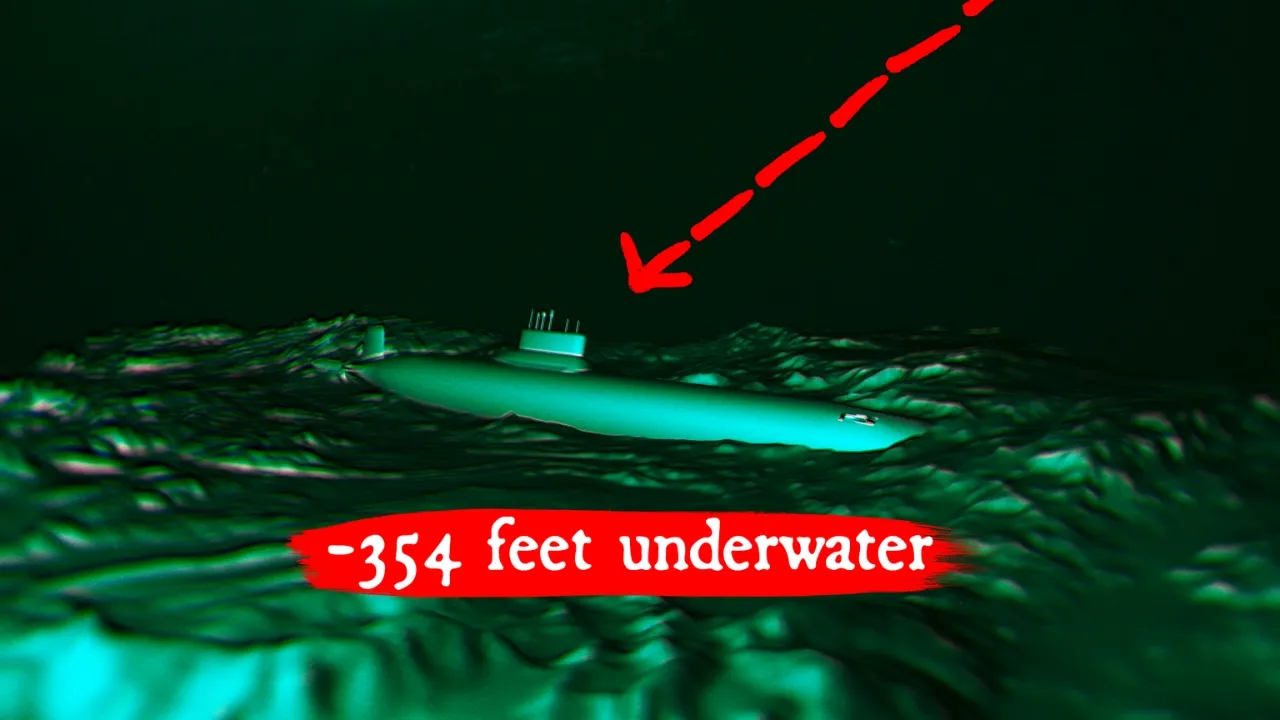
This blast obliterated the forward compartments and tore open the Kursk's hull. Seismic monitors as far away as Alaska detected the event, which was 250 times more powerful than the first explosion. The Kursk then plummeted to the seabed, coming to a rest at a depth of 354 feet, or 108 meters, just east of the Rybachy Peninsula.
Russian ships involved in the exercise were also rocked by the second explosion. In fact, another submarine named the Karelia felt the shudder as the shockwave tore through the ocean, but the captain was under the impression that it was just part of the exercise. Likewise, the crew aboard the battlecruiser also felt the distinct rumbling, and its control room registered a hydroacoustic signal that was consistent with an underwater explosion.
Attempts to establish contact with the Kursk then failed, but word of all this wasn't enough to convince the fleet commander, Admiral Vyacheslav Popov. He dismissed the failure to communicate with the Kursk as a technical issue. So next, the approval the Kursk had received to fire the practice torpedoes, had a deadline of 1:30 that afternoon.
When that time came and went without any word from the submarine, Admiral Popov apparently remained unconcerned, believing that the Kursk was still operational. By late afternoon, though, concerns began to grow among the fleet's command staff. A helicopter was then dispatched to search for the Kursk on the surface, but when no trace of it was found, additional aircraft were sent into the Barents Sea to aid the search.
Despite their efforts, however, the search yielded no results. At 6 PM when the Kursk failed to respond to increasingly urgent communication attempts, Northern Fleet officials began to acknowledge the seriousness of the situation. Admiral Popov then ordered a broader search and rescue, and sent out boats and aircraft to scour the sea.
Still, though, he remained largely stoic about the situation, but this again would change as the more expansive search also turned up nothing. Finally, he declared an emergency around 10:30 that night and halted the exercise entirely. By then, more than 11 hours after the initial explosion, the full scale of the disaster began to come into view, but only for the Russian Navy.
This is because, there was no announcement from the officials that night as to what happened to the Kursk. In fact, Admiral Popov spoke to reporters and told them that the exercise was a success all around, despite knowing that the Kursk was lost and communication with it had not been established. Meanwhile, back at the home base, family members of the submarine's crewmen began to hear rumors that something had gone terribly wrong during the exercise.
Word spread fast around the small base, but details of what happened and the condition of the ship or its occupants, were lacking. So, with no information coming in, worried families put their faith in the Kursk's reputation as being unsinkable. Early in the morning of August 13th, a Russian rescue ship known as the Rudnitsky made it to the outskirts of the exercise area, with a deep-submergence rescue vehicle, or DSRV, on board.
If you've watched any of the previous videos on submarine disasters, you know that rescue is a complicated and dangerous task. These vehicles look like small submarines and have a special hatch at the bottom. This hatch is carefully aligned with the hatch of a disabled submarine to create a watertight seal, and once it's established, both hatches can be opened to allow survivors to move into the rescue vehicle.
In order to do this, however, the Russian Navy would first have to locate the Kursk. Around 4:50 AM, a Russian naval vessel identified what appeared to be two unusual shapes in the seabed. This sparked hope that the disabled submarine had just been discovered.
By 9 o'clock that morning, the Rudnitsky arrived at the suspected site of the incident, and as it dropped its anchor, a strange sound echoed through the water. At first, this was mistaken for SOS signals coming from inside the submarine, but it was soon realized that the noise was actually the anchor chain scraping against the ship itself. While preparations for the DSRV, known as the AS-34, got underway, the Rudnitsky's control group monitored the area for any radio signals that might be coming from the Kursk, but nothing ever came.
It wouldn't be until after 4 PM that the AS-34 finally hit the water and descended beneath the waters of the Barents Sea. After it reached the seafloor, it didn't take long for the vehicle to collide with an object. And when the crew inside looked out the porthole, there was the disabled submarine's propeller and stern stabilizer.
They had found the Kursk. The collision, however, had damaged the AS-34, and it had to make an emergency ascent, meaning it couldn't begin attaching itself to the Kursk. Hours then went by before another DSRV, the AS-32, could be deployed; but once it was, it struggled to find the Kursk due to receiving an incorrect heading by the command ship.
So, after scouring the seafloor, it was also forced to resurface without ever having established visual contact. Meanwhile, a salvaged tugboat equipped with deep-sea cameras, arrived at the scene to provide more clarity on the Kursk's situation. What they found, however, was sobering.
The camera images revealed catastrophic damage, stretching from the submarine's bow to its sail. Enlisting at a 25-degree angle with its bow dipped slightly deeper by about 5 to 7 degrees, the Kursk was partially buried in the seabed. Curiously, though, its periscope was still raised, which is a telltale sign that the disaster had occurred while the submarine was at a relatively shallow depth, likely no more than 66 feet, or 20 meters.
Aboard the Rudnitsky, repairs were made to the AS-34, and although it took 13 to 14 hours to recharge the batteries fully, the DSRV was then sent back into the water and located the submarine within an hour of being launched. Right away, it began making attempts to seal the DSRV hatch onto the escape trunk over the 9th compartment, but repeated efforts failed. The DSRV just couldn't create the vacuum seal required for a proper connection.
To make matters worse, its batteries were rapidly depleting, forcing the crew to surface and abandon further attempts. Then, as if this wasn't enough, the weather turned against the rescue efforts as winds picked up and waves grew dangerously strong. The Russian Navy, which was already struggling with several logistical failures, was then forced to temporarily suspend the rescue mission.
As this was happening, Russian officials were also forced to confront the public, which had grown increasingly concerned as more and more rumors swirled about the true outcome of the military exercise. On August 14th, the Russian media were told that the submarine had suffered minor technical difficulties two days earlier. They also assured the public that the Kursk could have been located and that everyone aboard was still alive, and that they were pumping air and power to the submarine from the surface— but none of this was true, and the military knew that.
The announcement then prompted several countries to come forward and offer assistance in the rescue effort, including Norway, the United Kingdom, and the United States; but Russia initially refused any foreign aid. Days then went by with more attempts to attach the DSRV, ending in failure, and Russia quickly realized it couldn't save face. In all, they made 14 attempts to establish the correct seal on the 9th compartment hatch, and all of them had failed.
It was only then that the President agreed to accept foreign help and asked Norway to bring a team of rescue divers to the scene. Very quickly, though, the collaboration showed signs of trouble as the Norwegian Vice-Admiral in charge of the mission, nearly called off the operation, citing disinformation and outright lies told to him by officials. In the Vice-Admiral's view, these untruths would put Norwegian divers at unnecessary risk, but the issues were eventually sorted out, and a rescue attempt began.
Within just one day of being deployed at the scene, Norwegian divers successfully opened the 9th compartment hatch on the Kursk, only to discover complete devastation and tragedy waiting for them inside. All 118 people on board the Kursk at the time of the disaster were dead. In subsequent dives to the submarine, Russian and Norwegian divers located and retrieved bodies from inside the Kursk— one of which was that of Lieutenant Dmitry Kolesnikov.
The 27-year-old was the officer in charge of the turbine room, and upon examining his body, the salvage team made a tragic discovery. Inside one of his pockets was a note that Dmitry had penned after the explosion. In it, he wrote that 23 men survived the two explosions and managed to lock themselves into the aft compartments where they waited in complete darkness to be rescued.
This explained the messy nature of his handwriting in the note. An official inquiry into the disaster concluded that these survivors likely died from carbon monoxide poisoning within 8 hours of the explosion, meaning that there was nothing the Russians could have organized in that timeframe to save their comrades. This, however, was looked upon with suspicion.
Instead, Russian naval officials are thought to have quietly held the belief that the men in the aft compartments likely actually went through three days of a slow, agonizing end. In contrast, the official report all but clears the Russians of any wrongdoing in the search and rescue effort, which has fueled accusations over the years that there was a cover-up about the poor handling of the incident. What actually happened aboard the Kursk will likely never be known for 100 percent certainty.
Dmitry's last letter didn't indicate any cause of the explosions that sent the submarine to the bottom of the Barents Sea, but the most likely explanation is thought to lie with the test torpedoes. Oscar II-class submarines each had four standard 533mm tubes, but they were also constructed with two oversized 650mm tubes to accommodate the type 65-76A torpedoes, which were much larger. According to the official inquiry, one of the torpedoes had a faulty weld or suffered some kind of damage as crewmen prepared to fire it.
And again, these torpedoes require extremely careful handling because the volatility of the hydrogen peroxide fuel that powers them. It's unclear what the fuel might have come into contact with, but it's theorized that the first, less intense explosion caused a fire that then ignited the rest of the fuel in their torpedo, setting off a much larger second explosion. In the years that followed the Kursk's sinking, the inquiry's official findings into what exactly happened, have been subject to doubts, despite arguably being the most truthful part of the report.
State media meanwhile have put forward the theory that the Kursk collided with a submarine belonging to the US Navy. The Admiral has even gone on record to say the disaster was the result of a collision with a NATO submarine, but he's never offered any evidence to support this claim. And while the US acknowledged that it did have submarines in the region at the time, it denied any involvement in the Kursk disaster.
So, to this day, the true nature of what happened to the Kursk remains somewhat controversial, other than the fact that it was a terrifying tragedy for those inside the submarine. If you made it this far, thanks so much for watching. If you want to listen to the audio-only version of these videos, you can listen wherever listen to podcasts.
Also, if you have a story suggestion, feel free to submit it to the form found in the description. Anyways, thanks again, and hopefully, I'll see you in the next one.