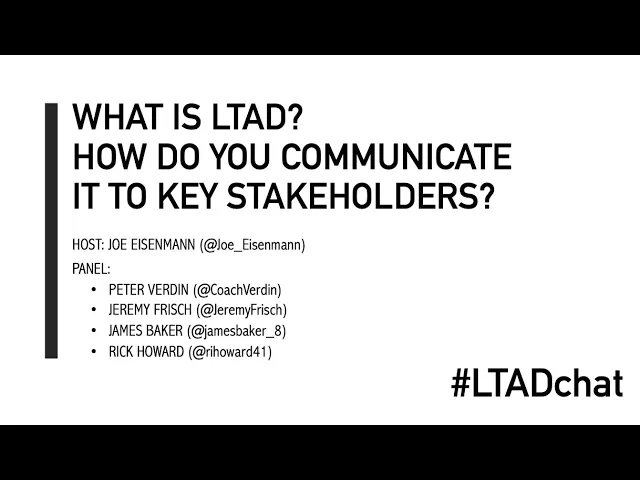
basically have two questions first is what is long-term athlete or what is long-term athletic development that's the first question so I'll have the panelist answer that one and then after that we'll go on to if you are in this situation such as the person who inquired was about I have to go to a school board meeting or a coaches meeting or my athletic director wants me to present to all the coaches what things like do I take to that presentation how do I go about my presentation and trying to get my school club organization community
to see the value of long term athletic development and to buy into it so again starting with the first question I don't care which panelist starts but in your eyes in your view what is long term athlete development gosh I'll jump in since nobody else is starting it's Rick Howard I everybody it's great to see this morning happy the year on board as Joe mentioned I do have a little bit of background with national strength and conditioning Association in terms of actually putting together a long term athletic development physician statement which has ten pillars associated
with it we came up with a definition within that position statement which read that it refers to the chronic development of athleticism over time to enhance health and performance reduce injury risk and enhance the confidence and competence of all youth so I think since we started this conversation several years ago we've kind of adjusted this a lot of these models were originally started to stop a lot of that peak by Friday mentality that we really needed a much better long-term approach and we knew a lot of the things that did not work but we weren't
really sure what did works we needed to try something so we looked at a couple different models and we figured out that the athleticism piece or something that is really huge but it's also our biggest enemy so when we look at long term athletic development we have this one big camp where everybody is really looking for the sports performance but we have this other big camp where we're saying well how are we working on the health and longevity of all of the population so we've kind of shifted our definition a little bit looking at it
more as a cradle-to-grave approach and I'm so excited at this unfortunate period of time I'm seeing more material about how families are actually interacting together doing things together moving together you know it's more than just dropping your kids off somewhere and even following the sports model on that degree so from my perspective personally I'm really excited right now that we're starting to look at the and I know a lot of people who get enrolled the eyes when I started talking about the Wellness wheel but I really think that that is really important when we're moving
forward with where we're going here it's not just the physical the physical is really important of course but so is the spiritual the financial a mental our academic our social and psychological as well as the technical and tactical perspectives of this and the strength and conditioning so it's all of these elements together in what's happened over the past few years as its evolved into this great model and it really is just that it it's a model it's a framework where we're trying to lead toward physical literacy which is another open-ended question for another day but
we'll get there - oh did also want to mention though when we mentioned that it's the product development of athleticism within our long term athletic development model we went back and forth for - the length of the paper I think what word could we come up with but we stuck with LT ad because at least at that point it was a word it was a phrase was starting to get recognized so we thought well if we go with a recognized language maybe we can influence people that way that will get into the second part of
the question but I wanted to mention the definition we came up with for athleticism because in the US I think we look only at peak athleticism is being athleticism if you're not a superstar you're really not athletic so we're only looking at you're either that elite level or you're just somebody else but athleticism is the ability to repeatedly perform a range of movement skills with style precision and confidence in a variety of environments which requires competent levels of strength power speed agility balance coordination and energy so in the US we kind of have this issue
going on right now we're only looking at health related fitness variables of cardiovascular endurance muscle strength muscle endurance flexibility and body composition and then the the sports skills that the things that kids like to do we kind of ignore that and said well that's not really important and that's kind of changed our framework and how we actually look at physical activity and during this time where I think we should really be looking at the amount of structured versus semi structured versus non structured play and activities a lot of what I'm seeing going out to families
is trying to get them to maintain a very structured environment and I think this is a perfect environment to blend all three of those together within the family and giving kids that time to actually grow and mold it as they need I know I talked a long time so I'll turn it over somebody else to add a little bit here you I'll jump in peter here i look at this there may be a little bit of a different lens because I currently teach physical education for kindergarten through fourth grade in the way that I define
long term athletic development is really is that it's an underlying philosophy or approach or model to just meet kids where they're at meet people where they're at and provide them what they need to continue pursuing whether that's competitive sport physical activity whatever activities that they want to so it's really just about good coaching and meeting them where they're at both physically cognitively socially emotionally and providing them what they need I'm more excited about the second question because I think where the rubber meets the road is is what that looks like in implementation you give him
here James I'll jump in okay I agree with the you know the definitions that Rick and Peter of just sort of mentioned I think it does depend on the environment that you're in I think Peters in a in a unique situation I find myself in a in a National Center of Excellence in aspire but also having worked in a UK secondary school but also having worked in the private sector within the UK as well so where we've been trying to recruit kids into programs to help them improve their their sports performance through three very different
environments but in all of them I think you know to me building on the definition of the Brit mentioned it and stealing from Calvin Charles is it's about a progressive curriculum and it's up to the coach that to design that to suit the environment that they find themselves in and the kids that they have in front of a progressive curriculum that transports them from a developing athlete or person into someone who is physically much more advanced and it's about how we select and sequence and progress different sports activities physical development structures programs to to help
them move along that pathway and as Peter said it's about meeting them where they're at but happen to scaffold and transport them through that process to the point where they're at their you know achieving their their potential I guess whatever that may be whether that's you know an active lifestyle an elite performer or you know a high-level College performer or university if we're in the UK I think it's about helping everyone achieve their potential with that progressive system James I think curriculum how do you define curriculum I would I define curriculum I'd say is the
overarching framework that guides the pathway of what we do you know there's within that then there's there's different modules which target different aspects or cover different areas of physical development and then have aspects of that curriculum that are not physical in nature to have the psychological and lifestyle factors built into that as well so yeah I'd say for me the curriculum is the the framework and the guide the objectives the outcomes that we're working towards and then there be the individual modules of work if you like make up that curriculum I mean what would your
definition be Peter do do you have something different no it's just interesting so you know I host a podcast or a couple friends called the other literacies in this season is all about curriculum and I think often people get confused with the difference between instructional materials like a lesson plan that's you know progressed and everything and they call that a curriculum but a curriculum like you're kind of mentioning is this bigger umbrella it's your mission your vision your values it's your pedagogical approach it's how you're scaffolding stuff and differentiating stuff so I like what you're
saying because I think a lot of times people mix that up with instructional materials they pull up you know a textbook off a shelf and they call that a curriculum which is I think of it as a and I think it has to be when you're dealing with adolescents because the different stages that all of them can be at at different times I think having a flexible objective based system within that curriculum that you know people can achieve those objectives and move through at their own sort of rate of development reflecting their you know their
maturation status their training age and those kind of things I think there's a good paper if people haven't seen it by Ian Jeffrey's the quadrennial plan for the high school athletes maybe Joe can dig that out now as he's checking some papers in the chat window but that sets out a really nice for face system that has those objectives that they you can work toward this then really a case of building out the the content to achieve those objectives based on your own I guess skill set and an environment that you find around you but
that's a nice really nice paper that really helped me in the early day sort of build off that into the environment that I was in within the within the UK school but yes we useful is also thing now let's let let's move on let's let Jeremy fresh jump in here as the last panelist and then I think we can open it up there's a few questions coming in and we can we can open up a little bit to some Q&A and I see the the other people who are on the call I think we can
provide some other great insight into this this question as well so so yeah let's let Jeremy respond here did you guys hear me now a little bit louder Jeremy hold on to me now sounds good so anyways everyone if you guys are saying you know for me long term athletic development is pretty much you know trying to figure out because I have know in my work I have athletes coming from all different age ranges from you know five years old you know children all the way up through high school and college and so for me
long term athletic development is trying to meet them where they're at and give them the appropriate tools that they need to sort of become a better athlete and do better in their sport depending on waist if they are at you know so I think I think there's certain things you do with with pre-adolescents compared to adolescence compared you know high school and college kids and then intertwine and that is that kids have their own specific sports to play they have their own you know body structure things like that emotional needs psychologically so I think all
those things a compliment to play and for me long-term athletic development comes down to each like what does that what does each individual individual athlete need or each individual person I think that's the trick and that's the thing I've been kind of figure out and study and learn about for the past few years and I think I'll probably continue to try to learn those things do you know what I mean it's a never-ending process but but uh you know I just always try to figure out what at which age know what do we do with
this athlete at this age what's the best thing for that athlete and that's sort of what I do every single day you know in my facility agree so so let's open it up to people who are on on the call here if if you think there's anything that's missing from what the panelists provided I think they covered a lot of ground but if you if you see this differently feel free to jump in here unmute yourself and have the floor anybody there's Ryan Mike Jennings Leo Totten want to jump in provide the extra insight or
if there's any you know any any questions that you want to get out you know to deepen the conversation in terms of information that the panelists provided feel free you know to jump on or put it in the chat box here I'm gonna try to keep this at about probably about five or seven more minutes and then move on to the second question just a newa time can can you guys hear me yeah awesome I've got I was just typing up a response to one of the questions in the chat box the one thing that
kind of stands out to me when all the panelists talk is kind of the idea of meeting people where they're at I think that's something that is oftentimes missed and in any approach that you're taking so kudos to all the panelists we're talking about that I think that's very important and I also want to kind of piggyback off of what Jeremy was I don't know if anybody noticed but everybody regardless of age group that Jeremy works with he just refers to as athletes and I think that's really important especially with regard to long term athletic
or long term athlete development because especially in the physical education world yet we get people all the time saying well it's not an athlete he doesn't play any sports or not an athlete well that's I think that's a bad take right I think everybody's an athlete and I think we're just trying to work through different movement problems and I think Rick and the nsa's definition of athlete is spot on and I think that type of thing needs to be sold to families and students and young people and adults alike so I just I think that's
pretty important stuff thanks for sharing Mike anybody else want to jump in add anything or ask specific questions related to any of the panelists or all of them we got to you're good yeah hi guys I just asked Jeremy there just he was saying he and you kind of you need to work with individual athletes and what that individual athlete needs what I was just wondering is how would you practically approach that if you were in a group environment and like most guys are working with groups of groups of their youth athletes Howard yet have
it a specific athlete well you know what I think for the most part very you know young athletes are sort of they all need the same they all need to develop the same skills you only mean so when I'm working with younger younger athletes you know in the pre app I think he's across the floor so be the same things you know they need to work on the same skills fundamental movement skills foundational skills coordination balance like all those things I think when you get older when the athlete starts to grow when you start to
hit growth spurts things like that I think that's when you sort of need to really sort of individualize so that's when I start to individualize primarily it comes down to a strength training part because that's probably the most dangerous part no so you want to make sure your athletes can do the exercises too early and since everyone's growing different rates and everyone's body is different you know they'll need different exercises and different approaches to how to do things you don't mean so that's really right where I start dating to do lives training most that example
sprint I think most of you know athletes as they get older they need to start you know some type of plyometric program jumping program things like that um you know those things can for me are pretty broad across go acting all my kids do that stuff I said it gets individualized when they get older and they stand I start to introduce them to they don't think like Olympic lifts like we got some kids that can come in and learn Olympic lifts and a other kids it's going to take a long time sometimes I might have
just scrapped that idea we may focus on just kettlebell work or bodyweight work so I think that's when you know when you're dealing with a potential you want to teach an athlete how to do something the right way and you've got to figure out what it is that they can what what tools are you gonna use to make them successful I guess I hope that answers your question I wouldn't mind jumping in here because I also work with create large groups I have 32 kids coming in usually so 32 five-year-olds come in to me with
at once so it's an interesting challenge to tackle and I think what to wit the way I individualize and it's not individualizing it it's really just providing the students some choice is having a range of options so trying to think of like a really simple example let's just take basketball dribbling which isn't the best skill example but it's easy to share this is I might have regular basketballs out I might have volleyballs out which are a little bit more pumped up they're easier to dribble they don't have to hit them as hard in order for
them to bounce and then I might have a range of other options of balls so equipment scaling using the constraints let approach but providing the students the choice to choose how they go about that because I think that also allows them to decide how much success or failure they want to have within that skill so that's how I do it from kindergarten all the way up to fourth grade and usually I'll label them is like easy media or easiest a little bit more difficult most difficult when it comes to it I'm a different skill getting
back up that a little bit of a good graduate no no crack on brick I'll jump after I was just thinking back to a Peter say because when I taught physical education basketball rules it was actually the social strata of the student body how well they played that determined that many friends they had so is huge so one of the things that I agree with everything you said and what jeremy has said too I would also add asked the kids it's you know one of the important things that sometimes we forget to do kids know
what they like kids know what they need sometimes so helping them guide us through the process and then we guide them through the process I think it's huge - so I do a lot of the same thing with constraints led and having different stations or areas that they can gravitate to and that helps me as a coach to actually figure out what they do well and what they don't do so well what they might need a little bit more work with so then I can rearrange what they do based on that but giving kids a
voice in what they do really helps to keep them coming back reg I'm sorry sure no worries the good points I think it's you know when I think about the question around how do we deal with these differences in the group but like you Rick I jump back to my PE teacher training and the hammerings I took on my observations when people were assessing my lessons and things about how I'd set up the lesson and I think it's about having when you've got large group groups within groups and whether that's if that's the technical tactical
session or you're teaching the sport through basketball football rugby whatever it may be then you know that might be their there their skill level dictate which group they fall into and then you adjust the tasks for each group to make sure that the challenge point for that group is in the right place if it's too hard especially when you're dealing with kids that you know if with if we're looking at a physical education class and you're gonna have kids in that group which are engaged in sport and left sport but at the other end of
the spectrum you're gonna have kids that don't love sport and aren't engaged in the activity in their there because they have to be there so I think when you're dealing with the kids at the bottom end it's about setting your task at a level that allows them to have a lot of success so that could be as simple as you know giving it might be four versus one for people versus one defender in another group it's to be two and it's much harder game so it can be differentiation based on the skill the skill level
if we're talking about technical sports but if we're talking about strength and conditioning I think like we said there's there's a I've you in the younger years it does it there's a finite list of skills that we need to develop training skills in terms of the fundamental movement skills speed and agility there's only so many effective ways for changing direction but jumping leaping hopping tasks it's then about looking again for maybe those groups within groups and putting the athletes that you've got into different buckets and then training those guides together now the theme of the
the program for me when I work with a larger group of athletes if let's talk about strength training it's probably gonna be the program is going to be squat push lunge pull brace rotate maybe as a simple six exercise program if I've got maybe 30 to 45 minutes with a group but if we take some my groups that I work with it aspire when we get them at grade eight we can see differences in maturation about the six years in terms of their bone age so we've got kids that are very much pre-gig type velocity
and kids that are very far post to be cut velocity so that that program or the the general patterns that we use in just become the central piece everyone's squatting and they all squat at the same time so we can coach them we'll set them up to be peer coaching as well so they can look at they can learn about the movement learn to what that movement should look like to help them help them learn but what that squat is for one and what it is for the other could be two different things someone could
be doing a bodyweight squat or or a counterbalance squat whereas someone else is doing learning a French squat with a five kilo training bar someone else who is much more mature might be onto a back squat but they'll all be doing the same movement patterning and I tend to do that when I'm working with larger groups because I've only got one movement to observe and if I've got kids let's say simple simple math so we've got a group of 18 kids maybe we have nine pairs working but if I get them working in in the
past one coaching one working I've then reduced my ratio down to one 9 I can see how they're doing those things I can make sure that the quality is high enough and then as we move through the program the next exercise we go to if this if it's if it's a pushing movement maybe some of them are on an incline push up some of the wrong on a push up on the floor some of them have got their feet elevated others are doing dumbbell presses so when you've got those large ranges it's just about identifying
then who should work with who what are the appropriate exercises for them whether it's based on their training age their biological age both of those things and then just work in the program as best as you can depending on the number of athletes you've got and just getting people to to a point where they're challenged but it's not so hard that they want to then pull away from it or that you know that you're prescribing an inappropriate intensity of an exercise for for an individual in any part of the group at great so thanks to
all the panelists for those responses and for the questions that came in afterwards on question one again we recorded this so we can go back and I think the other thing I want to do is go back and filter through it and kind of take out some of the key concepts as well and and have those available to individuals but let's move on to question two which becomes a lot more practical because there are individuals who are in this situation there's probably a lot of us on this call who have been in the situation as
well where we we are the expert in long term athletic development and the community or the school and we've been asked to give a presentation to a school board to the coaching staff or to a community but again we have other individuals who you know they're just getting into this space and they need some guidance the first part of the guidance was you know what is long term athletic development which was just discussed but if you are going into that room this evening and you need to give a presentation what's in your slide deck how
do you go about the presentation how do you go about selling this idea this concept and getting buy-in from the stakeholders who are sitting in that room I'll jump in and go first here I'm excited about this question because I think operationalizing long-term athletic development is not easy and it's really where the rubber meets the road so I honestly and I I actually went through that this past year coming to a new school it's a second year school has no physical education program as of year one so I'm starting this program from scratch so through
the interview process I had to sell our principles on what it is that I wanted to do and honestly I don't think our principles could even tell you what long term athletic development is if you said hey define long term athletic development they'd be like what are you talking about but what they could define is what our vision of our movement program is what our mission for this year of our movement program is and then what are the values of that program and then what you would see as experts or in practitioners and long-term athletic
development is that those aligned to the long term athletic development model so just to give my example I can I'm gonna screen share here this was actually something that I sent home to parents was an update from the first trimester and it clearly states our vision and our mission and our vision and we can debate that definition of a physically literate probably for a while as well but to develop physically literate students and then my year one mission of developing this program is to foster a joy for movement that leads to a pursuit avec of
activity and that the key word there is joy and that everything this first year is through that lens of joy like is what I'm doing right now gonna bring more or less joy to these students as they pursue movement in my class and then underneath mission underneath vision and mission is my values and aligning those values to our vision and mission and my values are equity so making sure that every single student has an equitable opportunity to pursue this joy of movement that's also a school value of our school my second value is relationships and
student voice making sure that students have a say in everything that they're asked for their opinion and that relationships are sacred that's your number one probably the most important thing is building those relationships with students my second value is that play is a form of teaching and that play can be used to develop skill using through the constraints let approached your thinking of play as a continuum and from more structured to less structured and using that as a form of teaching so watching kids play I'm using that to inform the content of what we're doing
within movement manipulating that strategically having some elements of risky play that's something that I know if I were to ask our community what we value that would be one thing that comes up is risky play and then my fourth value in my last value is this idea of multi activity sampling if you follow me on Twitter you you'd see that our most recent activity sampling is skateboarding and I can't even I can't even explain how much of a success that has been hopefully third-grade will still get to do their swimming after all of this stuff
dies down but that's another activity that's getting sampled k1 is doing jiu-jitsu the whole school did some golf with first tee which is a great organization trying to think of some of the other activities we we've sampled but trimester ly we're doing some activity sampling but when I'm explaining it to a stakeholder I'm saying here is what I want to accomplish here is what I'm going to do this year to help accomplish that vision and then here are the values that I'm gonna align everything that I do and then as I'm sharing information I'm connecting
it to those values well it's a tough act to follow Peter I was great stuff actually I appreciate that um I look at it from a two pronged approach when asked this question the first one is just like we mentioned in the first conversation meeting people where they are why are we invited what is it they really want to get at because the second part of this collection is getting to why so I think when we look at a long term athletic development approach too often we really want to make that quick fix and completely
change the whole screen of you sports and youth physical activity Peter you're doing a great job cuz you're breaking it down into components that people can see and they know that it's actually working rather than saying alright we're gonna completely redesign how youth sports are organized and here's what we can do so sometimes that's not an easy fix so figuring out if we get invited why what are the problems that they actually would like to have solve so that we can show them the exact things that we can do using the ltap framework to help
them to reach some small goals to build it on so that eventually we get to where we want it to be but I think too often we forget that it really is a long-term approach so cutting off a little piece at a time even if it's having a little piece of practice to do a little bit of skills and to work on some of the things that James was talking about and some of the things that Jeremy does I think would be fantastic I jump in here is they don't ask definitely having like PETA as
a structure and a framework for people to see what they're buying into is a really important part I think you know I went through a process in the UK of years trying to convince PE teachers and schools to take on youth strength and conditioning as part of their PE programs and as to sit in an office working with a guy called ed I chose definitely someone we should try and get on one of these chats and probably I phoned about 60 schools trying to get them in trying to convince them that you know we we
could help them help their athletes but we were we were banging our heads against a brick wall for a long time and actually what I find that they've got the bind in the end was actually just going in and getting started and taking some action you know running free sessions for them particularly if you if you're an outsider but Peter starting his program he's been employed by the school there's people bought into that process but I think when you're outside of that organisation and particularly if you're not a PE teacher you can be looked at
as the outsider who maybe you know doesn't understand what it takes to do that within within a school setting and I found until I was inside and I do I move I was running external programs and I moved into the pea setting and did a PE teacher training course and that was actually where we set up the pathway within within the school in the UK and even even when we started people didn't really understand what we would win so there was there was an education process a lot of what Peter did but it was really
when they started to see the results of for the kids and how they were progressing that really got the buy-in and you know that's that didn't it certainly wasn't a perfect system and we began we started with five lessons across a fortnight and we just got some good work done and it was it was after that that the program started to grow and we gradually got given more time so I think taking action is a big part of it being prepared to educate and have a framework at a structure I'm sitting down with the senior
leadership team at school after the first year and I was asking them to give me more time with the grade seven eight and nine as we were only running an after-school program and I think they they were they basically sat in the room I shared the framework very much like you had their pizza and they were they were then convinced because there was a plan they basically said oh we thought you were just messing around in the gym with them for two hours on a Wednesday afternoon it's like no there's like a real structure and
a framework bit off the good work being Jeffries Calvin Giles those guys to guide it so having a plan being prepared to just take action that they're big things to to get started but I think also one of the things that became apparent with those conversations with the senior leadership team is you know dealing with different stake holders within a school and every school is slightly different and I've worked with many of them over the years and what you have to get down to is what what are we helping them to do and what is
the benefit to them as a school and each person with each stakeholder within that organization the athlete and the parents they have said they're in it for something the head of department or the head of PE you know maybe it's he wants successful sports teams the senior leadership team are interested in the progress of the pupils but also that the school's attractive for people to want to come to it so I think when we sit down in these meetings it's about understanding all of those stakeholders and what the what the pathway offers them now for
us what we saw and what really got the buy-in to the program was people started to really buy into the program and then the senior leadership team saw that people would come and more people will come into the school because of this program when they could have chosen better schools in the area from an academic perspective so I think it's as I say it's having a plan taking action but understanding the benefits and what's in it for each of those individuals within an organization or layers of people I think if you can get to that
then you've got good chance of getting buying with your program James I I know your curriculum quite well in the past question Peter asked you about that word curriculum and so like speed agility strength power I know that you have a very well laid out curriculum would you have a slide a handout that you would walk these stakeholders through and explain to them you know what that progression is while you're doing that progression so yeah so the framework was laid out into the foundation development and performance phase its foundation was two years development two years
performance two to three years depending on rates of progression so they would see that framework they'd see the objectives and we'd explain at the start of each year to parents what those what we were working towards that year what to expect things that were likely to happen so we know in grade seven girls were likely to go through PHV in grade eight and grade nine we'd see more boys go through we'd help them understand that process and what was happening for later developers early developers you know trying to help the early developers not get too
carried away the late developers just to hang in there and you know this is this is what's happening so big education process but yet lay night all of those things and what we were going to do particularly in the early day from people just had no idea what it was you know when we're talking about 2013 you know schools certainly state schools weren't developed from a strength and conditioning perspective and so we really had to lay it out for people to understand what they were buying into you know for us at our school they were
choosing to do that over an academic subject so they we really needed to show them that what they were buying into was valuable and what's going to help great alright let's move on to Jeremy Frisch so Jeremy if you're in Clinton Massachusetts and you have to go into the school or a local club what's what's your strategy so I can tell you about apartness so out of meeting with the superintendent the elementary school principal well the School Committee my approach was a little bit different from the long term F of element I I approached it
from a learning perspective um so I think that I know a lot of I'm good friends with a little work for this we're in such a small town and so I can tell you that a lot of administrators are under tremendous amount of pressure for their schools to do well you know when it comes to standardized testing and things like that so my approach was to explain to them that um you know we really need the kids new movement in order to do better in school withdrawn a goes oh those skills that they need they
develop troop movement or also the foundations of skills right but so you know I tried to explain to them that being able to read and look up at the board and listen and did for longer the time-bar as better this matter balance and strength and coordination if they want kids want to be successful in class they need to have this sort of physical framework in place prior to learning and most of the you know School Committee or the in the principal and superintendent never heard of such a thing they had no idea because they all
I think years ago most children were when they entered elementary school they had a decent foundation because they a lot of time outside playing but that's not the case anymore and you can actually take most of the kids that I've had in my facility that are you know labeled a DD or ADHD they usually present with poor balance they have poor you know poor movement skills they can't sit for long periods of time their poor posture things like that so it just kind of shows you that you know physically kids need they need more Skills
to be able to learn so for me that was my approach because I'm always looking at where do we start like what's the foundation and that's why I was a meeting with the elementary school teachers because that's kind of what we're percept was I wanted to explain to them that you know but children need physical skills in order to be able to learn and then from there as they get older obviously those skills can turn into sports skills more sports specific skills things like that and so we've had this meeting and for me that's what
really like I thought that they should know and they should learn that children need those physical skills in place and we've actually already started that this past year you know starting with the kindergarten we've implemented a program where you know those kids get extra movement every day with the idea that it will help them you know with their academics you guys gave me yeah yeah I agree yeah I got better there towards the end things Jeremy I stopped your video so that we could hear you a little bit better sorry about that yeah thank you
you can't repeat any of that Peters Peters the movement and engineer and the audio engineer here on have the elta chat so yeah good so good information there from the four panelists in terms of you know holding an information and/or implementation meeting with key stakeholders so you're in the last you know 8 10 minutes or whatever open it up for questions related to that second question can I can I come in on this one can it be hear me yeah I don't know with my videos on at the minute ONC and really interesting by the
way list or this so and Debye and previous had PE over school and and now working a lot with the IP lady international physical literacy Association and very much focused at in the UAE where there is a very much focus on early specialization and academies and elitism and it's and trying to pass the word on a physical literacy there's a few things that I really touched on which I thought was fantastic to hear one which was about the building of relationships and about the importance of that where there is the physical and conditioning and the
learning of physical skills which yes has an amazing impact on not only children's thinking and learning in their behavior and what really the it's not the what activity as to why and what and whether they value it so when I am speaking to teachers and delivering and taking the program forward I tend to again come from a slightly different approach and and and present some of the facts that stand in front which is the children are dropping out of sport in some cases 70% by the age of 12 because they don't enjoy it anymore because
they're burnt out from from being focused on in a particular area and within that also within peace lessons where he teaches and from many colleagues I work with youth and some are doing an amazing job and still do a fantastic job but there are an awful lot who want sadly and and when you see a lot of children are leaving school no longer liking or valuing physical activity and where I almost select is that the the requirement to ensure that they have there's a window of opportunity within there within a school day in order to
ensure that children are enjoying movement enduring physical activity through structured and unstructured and play and movement so therefore that instead of needing always to have a set direction and this is exactly what it looks like there is a more of a holistic view that they see yes the element but it's the physical element but they also value and the enjoyment that it doesn't necessarily always just have to look in a particular line of a sports and hope that sort of makes some sense yeah anybody else have further comment related to the you know implementation meeting
how you go about it successes failures lessons learned okay we're rolling up to the top of the hour and I want to be respectful of people's time people probably have another zoom conference to get on since this seems to be the thing people are doing these days but this is something I think that we're gonna continue we're trying to discuss if we want to do it weekly or bi-weekly definitely willing to hear your input as well at this point I think I've four or five other people we're gonna kind of get on and do some
individual things we are gonna do more panel discussions moving forward we have a range of topics again very similar to the Twitter chat as well this has been recorded it will be archived and shared with everybody you'll want to thank everybody for getting on this morning thank the four panelists from providing some really great insight onto this topic again kind of at a intro level as well like what is it and if we need to sell it to a group how do we do that again for several people on this call you've already been through
that process but I think what's more important is this is gonna help others as they move forward as well so thanks for everybody and stay tuned we'll do this again maybe next Saturday or the following Saturday and have a good weekend