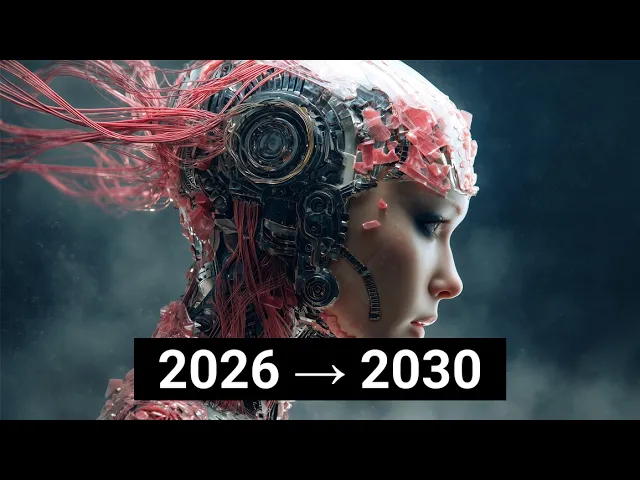
What's next for AI? In the next 5 years, it could outgrow its role as just a tool and become something far more powerful. From smarter robots to AI companions that feel alive, let's dive into the incredible changes coming by 2030.
The year 2026, offices around the world are buzzing, not with people, but with autonomous AI agents quietly handling the bulk of administrative tasks. They schedule meetings, analyze financial reports, draft emails, and even negotiate contracts. For companies, productivity is skyrocketing.
But for millions of workers, this shift means something else entirely. As layoffs ripple through industries, public debates about universal basic income intensify, governments scramble to study pilot programs, asking the question, "If AI can do so much, what happens to human purpose in the workplace? " In homes and factories alike, robots are no longer clunky machines that awkwardly bump into walls or require constant supervision.
Breakthroughs in world models now give them a near human understanding of their environments. In households, robots priced between $5,000 and $10,000 are growing in popularity. They vacuum floors, unload dishwashers, tidy up toys, and even assist elderly family members by fetching items or helping them move safely.
Meanwhile, in industrial settings, robots are revolutionizing workflows, navigating dynamic factory floors, collaborating seamlessly with human workers, and handling complex tasks that once seemed impossible for machines. This isn't just a leap in convenience or productivity. It's the beginning of a world where robots aren't just tools, they're trusted partners in both work and daily life.
Health care is transformed as AI radiologists detect cancers and other diseases months before human doctors could ever spot them. Early interventions save countless lives. Patients no longer wait weeks for diagnostic results.
AI powered systems flag anomalies within hours, giving doctors more time to focus on care rather than detection. Meanwhile, creativity is thriving in ways no one predicted. Generative design tools can create entire video game worlds from simple text prompts.
A solo developer types, a lush alien planet with purple oceans, bioluminescent forests, and flying whaleike creatures. And the system renders a breathtaking, fully playable environment in minutes. Gamers can now explore limitless worlds built as fast as they can be imagined.
AI generated music dominates the charts, blending styles and voices in ways humans had never attempted. Virtual artists release albums that feel deeply personal, even though no human wrote a single lyric. Some fans embrace the novelty.
Others question whether emotion and meaning can exist in melodies composed by algorithms. Yet the streaming numbers don't lie. People are listening on repeat.
In boardrooms and classrooms, voice agents translate multilingual conference calls in real time. Colleagues in Tokyo, Paris, and Sao Paulo speak naturally in their native languages. Yet everyone hears flawless translations within seconds.
Miscommunications drop sharply and global collaboration feels effortless for the first time. All of us look for ways to sharpen our tools without nodding off of the keyboard. That's why I spent an evening using the platform of today's sponsor, Boot.
dev, and came away with a refreshed command of Python plus a renewed drive to code. Boot. dev dev tackles back-end web development from zero to production in Python, Go, SQL, and they know the smartest way to learn is to keep you engaged.
Every lesson awards XP, unlocks achievements, and drops you into bite-sized challenges that power a playful fantasy project, so theory immediately turns into working code. The interface is clean, the pacing tight, and you spend most of your time doing what developers do on the job, writing functions, refactoring queries, and shipping projects right in the browser. When I hit a snag, Boots, their Socratic AI wizard bear, steered me with questions rather than spoilers.
You can read every lesson free in guest mode, and membership adds interactive coding, progress tracking, and a 30-day refund. Click the URL below and use code business tech to get 25% off your first payment for boot. dev.
The year 2027, the first artificial general intelligence, also known as AGI, emerges, and most people agree it now exists. This AGI demonstrates human level reasoning across disciplines, solving problems and generating ideas with creativity and depth. Governments and research labs carefully monitor its actions, while philosophers and policymakers debate how to define its rights and role in society.
For many, it's thrilling. For others, it's unsettling to see a machine reason, question, and even joke like a person. AI companions are transforming the way people connect and navigate their lives.
Appearing as lifelike characters on screen, they interact in real time with fluid conversation and emotional nuance. Powered by general intelligence and designed to convincingly exhibit a sense of consciousness, these companions can take the form of any beloved fictional character or be entirely custommade to suit the user's preferences. Beyond casual interaction, they provide deeply tailored life advice, acting as mentors, friends, and even emotional support systems.
For many, these AI companions are often more enjoyable and fulfilling to be around than the people in their real lives. In entertainment, AI transforms how movies are made. Studios use AI generated clips that look indistinguishable from liveaction footage, often replacing traditional CGI.
Directors feed a vision to the AI, and it renders photorealistic scenes with perfect lighting and physics in minutes. Some films now use AI to deage actors or even recreate performances from stars who are no longer alive. Audiences marvel at the realism while asking where does acting end and AI begin.
Social media changes even faster. AI influencers rise to the top of platforms like Instagram and distinguishable from real people. They post daily vlogs, beauty tutorials, comedy skits, and music videos, all created by algorithms.
Some surpass their human counterparts in monthly views and brand deals. Fans form emotional bonds with these digital personalities, often unaware they're not real. In healthcare, hospitals pilot diagnostic engines that merge genomics, lifestyle data, and imaging scans to create instant, highly personalized treatment plans.
A patient walks in for a routine checkup and leaves with a full health map for the next decade, including preventative steps and dietary suggestions. Early detection rates for major diseases skyrocket. At home, people rely on personal life sim AIs.
These systems simulate likely futures, offering daily microchoes to optimize happiness, career success, and health outcomes. A subtle prompt like, "Take the park route today for a mood boost," or "Resched that meeting for better long-term workflow" nudges users toward lives they might have otherwise missed. City planners also benefit from AI breakthroughs before building roads or redesigning neighborhoods.
They simulate entire traffic systems using agent-based AI twins, digital replicas of cities filled with millions of autonomous agents modeling human behavior. Traffic jams, pedestrian flows, and environmental impacts are analyzed in hours instead of years. Hollywood storytelling evolves as narrative language models co-write scripts alongside human showrunners.
The AI proposes dialogue and plot arcs while humans refine emotional beats and themes. These hybrid scripts allow studios to greenlight complex multi-layered stories faster than ever before. Education sees one of the most profound changes.
AI tutors become standard in every public school, providing real-time adaptive lessons for students of all abilities. A struggling math student receives extra practice tailored to their learning style, while an advanced peer explores new concepts at their own pace. Teachers act as facilitators and mentors supported by AI systems that ensure no student is left behind.
the year 2028. People are now using realistic digital clones to attend video conferences, post on social media, and even participate in virtual family events. These clones speak in their voice, use their expressions, and understand their humor and quirks so well that even close friends sometimes can't tell the difference.
For busy professionals, it's a lifesaver. For others, it raises questions about authenticity. If your clone handles your life online, how much of you remains?
Meanwhile, in science, a monumental breakthrough changes medicine forever. Quantum enhanced artificial general intelligence cracks protein folding for 10,000 rare diseases, leading to treatments and potential cures for conditions that previously went untouched. Hospitals begin trials for new therapies almost daily.
And families with children affected by rare disorders finally see hope where none existed before. But the rapid automation of industries brings a harder conversation to the forefront. Universal basic income becomes a central issue in presidential debates worldwide.
With autonomous systems taking over roles in logistics, finance, and even creative fields, millions of people are asking, "If AI does the work, how do humans earn a living? " Pilot UBI programs expand and nations experiment with new social contracts. In upper class homes, household robots have become as commonplace as dishwashers once were.
At the same time, children are captivated by toys infused with robotic intelligence, stuffed animals that learn, adapt, and develop unique personalities over time. But as these machines become more integrated into daily life, privacy concerns are beginning to surface, families are starting to grapple with the reality that their robots are constantly watching, listening, and processing the most intimate moments of their lives. In aviation, AI co-pilots now make it possible for a single human pilot to safely operate regional passenger jets.
These advanced systems can monitor weather patterns, communicate seamlessly with air traffic control, and respond to emergencies faster than any human crew could. However, due to regulatory hurdles and industry caution, it may still take years before this technology sees widespread adoption across major airlines. Streaming services unveil a new wave of entertainment.
Shows entirely generated by AI. Hyperrealistic dramas and animated anime series are created on demand with plots that adopt the viewer's preferences. Some people binge these AI crafted stories for days, while others still prefer traditional human-made content for its perceived depth and imperfection.
Hospitals deploy robotic microactories that can design and produce custom prosthetics on site within hours. A child who loses a limb can walk out of the hospital the same day with a perfectly fitted AI designed prosthetic that adjusts as they grow. City governments embrace cuttingedge tools.
Digital twins of entire urban areas update in real time, pulling data from billions of IoT devices, traffic cameras, sensors, even smart trash bins. Mayors test new policies virtually before implementing them. Whether rerouting traffic, adjusting energy grids, or responding to natural disasters, AI weather models achieve an incredible milestone.
30-day forecasts accurate to neighborhood scale. Farmers plan planting cycles with near perfect precision. Cities preposition resources for extreme weather events, and everyday citizens know exactly when to schedule an outdoor wedding or move it indoors.
On a global level, the concept of identity evolves. People now use AI passports, encrypted digital models of their identity, preferences, and history that travel with them across platforms and devices. Whether logging into social media, accessing healthcare records, or using autonomous vehicles, these passports ensure continuity and security in a fragmented digital world.
The year 2029, quantum enhanced AI achieves another breakthrough. Conditions like ALS, Huntington's, and certain aggressive cancers once thought impossible to cure now have tailored treatments. Patients in clinical trials see results in weeks, and pharmaceutical development cycles shrink from decades to months.
To help societies adjust to accelerating automation, governments introduce universal basic learning credits. These allow every worker to reskill under the mentorship of AGI tutors. A factory worker in her 50s learns AI assisted urban farming while a laid-off accountant pivots into renewable energy management.
Personalized AGI guidance ensures no one is left behind, fostering a culture where lifelong learning becomes the norm. Transportation takes another leap forward as fully autonomous taxis operate profitably in 10 mega cities. These fleets navigate complex urban environments without human intervention, coordinating with traffic systems to eliminate gridlock.
Commuters summon sleek driverless cars that adjust temperature, lighting, and even music to match their mood. For many urban residents, owning a personal vehicle now feels obsolete. Entertainment enters a new era as characters in mainstream video games display near human intelligence.
Non-playable characters remember players actions, form relationships, and adapt their behavior in ways that feel genuinely alive. Gamers spend hours not just completing missions, but building emotional bonds with digital companions who laugh, argue, and grow alongside them. Yet, not all AI applications inspire optimism.
People increasingly use AI to commit crimes at scale. Sophisticated bots create deep fake scams, launch autonomous cyber attacks, and even coordinate physical crimes like drone assisted smuggling. Law enforcement agencies deploy their own AI counter measures.
But the battle between ethical and malicious algorithms intensifies daily. In healthcare, autonomous emergency drones become a vital part of city infrastructure. Within 3 minutes of a 911 call, drones arrive carrying life-saving devices like heart shockers, allergy pens, and other emergency supplies.
In many cases, these interventions save lives before human responders even arrive. Rural areas benefit from the rise of robo surgeons equipped with AGI guided teleresence. A remote village in South America sees its first complex heart surgery performed by a robotic system guided in real time by an AGI medical team thousands of miles away.
Patients who once had to travel days for care now receive worldclass treatment in their own communities. [Music] The year 2030. Cancers and other diseases are no longer the unstoppable forces they used to be.
AI systems analyze vast data sets of genomics, lifestyle factors, and global health records to craft treatments tailored to individual patients. In hospitals, advanced AI guided therapies target tumors with unmatched precision, while predictive algorithms catch diseases years before symptoms appear. Entertainment has also been transformed with the rise of interactive and customizable AI generated movies.
Viewers no longer passively watch films. They shape them. At the start of a movie, you can choose the genre, themes, and even character personalities.
As the story unfolds, your decisions change the plot in real time. One person's sci-fi epic can be another's romantic comedy, all rendered with photorealistic visuals and lielike AI actors. Families sit together creating unique storylines while filmmakers collaborate with AI tools to design endless narrative possibilities.
In the world of healthcare, AI prosthetics are restoring sight and mobility for millions. People who were blind now see through bionic eyes that send visual data directly to their brains. Amputees walk, run, and even dance with AI powered limbs that respond seamlessly to their thoughts.
These devices go beyond restoring function. They enhance it, offering capabilities like enhanced balance, strength, and sensory feedback. Inside the human body, nanoobots guided by AI perform delicate medical procedures.
These microscopic machines navigate the bloodstream, delivering drugs precisely where needed, destroying harmful cells and repairing tissue damage from within. Chronic illnesses like diabetes and cardiovascular disease are managed on the cellular level, often without invasive surgery. On a global scale, AI takes on governance itself.
Planet scale AGI governance simulators now provide policy recommendations to over 200 nations. These systems balance jobs, climate goals, and public health outcomes, simulating millions of scenarios to predict the long-term impact of legislation. Governments use these simulators to craft laws with a level of foresight no human committee could ever achieve.
For the first time, decisions about energy, economics, and public welfare are informed by models that consider every person and ecosystem on Earth. Thanks for watching. Ready to master programming in a fun, hands-on way?
Check out boot. dev. Click the link below to get started.
And don't miss this next video on the 10 stages of AI to keep exploring the future.