In this section, we will discuss in detail about imunotherapy. So, what is imunotherapy? Immunotherapy is a type of cancer treatment.
It uses substances made by the body or in a laboratory to boost the immune system and help the body find and destroy cancer cells. Attempts at using imunotherapy have been based on the idea that the immune system could eradicate existing tumors. Many approaches at tumor imunotherapy have been attempted and most have failed.
But here we will mention only some of the imunotherapy approaches that have been of some success. Imunotherapy can be classified as passive when an existing immune response usually in monoconal antibbody is administered or it may be active when the patients own immune response is activated to respond to the tumor. Active immunity is considered better because it could provide a lifelong response tailored to the patients exact tumor antigen.
Passive immunity lasts shortly and is a generic treatment rather than an exact fit. There are two main approaches that immune system utilize to try to destroy the tumor cells. These are the use of antibodies against tumor cells and the development of tumor vaccines.
Let's look at these imunotherapies one by one. Starting with the use of antibodies against tumor. Antibodies can act against tumors in many ways.
Here monoconal antibodies play their role. So first let's understand what are monoconal antibodies. Monoconal antibodies are a type of protein that are made in the laboratory and can bind to certain targets in the body such as antigens on the surface of cancer cells.
There are many kinds of monoconal antibodies and each monoconal antibbody is made so that it binds to only one antigen. Monoconal antibodies are being used in the diagnosis and treatment of many diseases including some types of cancer. They can be used alone or to carry drugs, toxins or radioactive substances directly to cancer cells.
That's why monoconal antibodies have been used in cancer treatment for about 20 years now and most of these have been generated in mice that is of neurine origin. But the problem with map of neurine origin is that when they are injected in body antibodies against these neurine map start to produce inside human body thus decreasing its efficiency. So now monoconal antibodies of human origin called humanized antibodies are being used in cancer immunotherapy.
In humanized monoconal antibodies major portion is of human origin and so they have significantly longer half-life in patients blood and they activate the aector immune cells more efficiently. Two humanized monoconal antibodies have achieved remarkable results in the past few years. The CD20 antibbody rtoximab has activity against PC cells lymphus and the antibbody trstuzzumab directed against human epidermal growth factor receptor 2 or her two which is active in breast cancer.
These monoconal antibodies can work in a number of ways such as killing of tumor cells. Antibodies targeted against specific tumor antigen can bind to tumor cells and recruit other components of the immune system to kill the tumor cells or we can say it activates otherector immune responses. This could be compliment activation where these tumorbound antibodies activated complement component seek 1 that initiates complex complement pathway and ultimately cause the listis of tumor cells or involvement of antibbody dependent cell mediated cytotoxicity where the FC portion of tumorbound antibodies comes in contact with FC receptor on natural killer cells or macrofasages.
These cells ultimately cause ficoytosis or engulfment of that tumor cell and ultimately causes killing of tumor cells. Another way that monoconal antibodies can adopt is modulation of the immune system. We know that tumors appear to be very good at inducing trig that if you remember are the regulatory Tlymphosytes that suppress immune response.
So one approach of monoconal antibodies is to deplete Tres and they do so by targeting specifically CD25 that are the main receptors present on the surface of Tres and these receptors are mainly responsible for their functioning. So when there will be removal of CD25 Tres won't be able to work efficiently. Similarly another mechanism followed by MABs can be blockage of growth factor receptors.
The growth of some tumor cells is promoted or dependent on growth factors such as epidermal growth factor binding to receptors on the tumor cells called as growth factor receptors. Antibodies against these receptors can bind to these growth factor receptors and in this way block the binding of the growth factor to the tumor cell. No binding with growth factor.
So no more growth of tumor cells. Another mechanism that mats can follow is the inhibition of vascularization of tumor. As solid tumors grow, they need to generate new blood vessels to supply oxygen and nutrients to the tumor.
This is called as neovascularization or the process is called angioenesis. This angioenesis is controlled in part by various growth factors mainly vascular endothelial growth factor VGF. Now one map is specific for this V EGF.
It works against V EGF and blocks its action thereby inhibiting neovascularization or angioenesis. It is licensed for use in cancer of the colon, breast and lungs. These all mechanisms were considered under first approach of MAB as in all these mechanisms antibodies directly work against any one of tumor antigens and thus directly inhibit or kill the tumor cells.
But in a second approach monoconal antibodies form a conjugate with some other substances such as toxic agents. These toxic agents can be radioactive isotopes or toxins. These agents are too toxic to use directly and alone.
But the theory is that the antibbody conjugated to these toxins are prepared in lab. Then these antibodies specific to tumor antigens will bind to antigens on the tumor cell and be internalized leading to delivery of the toxic agent specifically to the tumor cells. Specific agents that have been considered for use include iodine 100 and 31, bacterial toxins such as death theoria toxin and plant toxins including ryson, a very powerful toxin obtained from the caster bean.
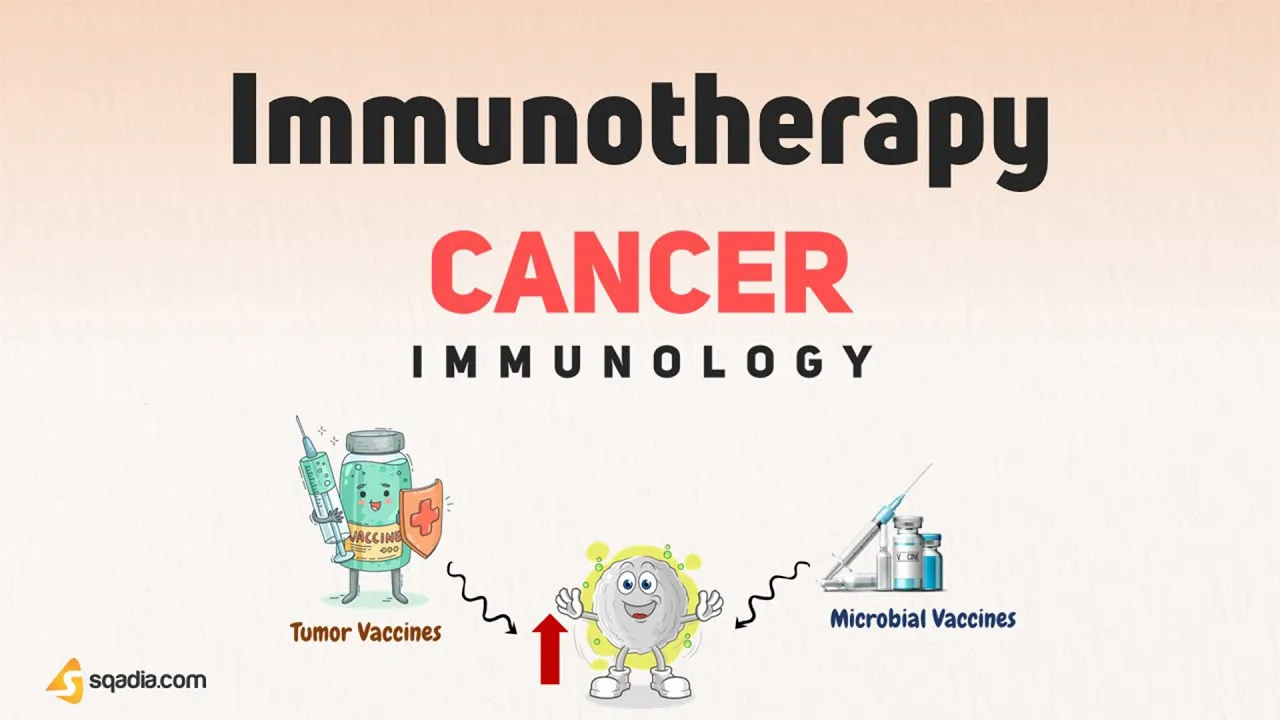
A number of these immunotoxins are now licensed for use. After monoconal antibbody therapies, another important known imunotherapy is provided by tumor vaccines. Tumor vaccines represent an approach to try to stimulate immune responses against tumors in the same way that microbial vaccines approach against pathogens.
So the type of vaccine being developed are similar in approach to vaccines against infectious disease but with some additional innovative methods being developed in tumor vaccines. These tumor vaccines can be peptides and DNA based vaccines. tumor cell vaccines and transfected tumor cell vaccines.
So what are the peptide and DNA based vaccines? These type of vaccines are usually the injection of antigens or peptides with adgivants or the use of dea encoding tumor antigen. In addition to using adgiants in peptide vaccines, other agents especially cytoines such as interucan 2, granulosy or macrofase colony stimulating factor GMCSF and interlucan 12 have been incorporated into tumor vaccines to try to boost the immune response.
Whereas DNA based tumor vaccines use the same approach as with infectious agents involving injection of DNA encoding tumor antigens or peptides intramuscularly or dermally by gene guns. But one of the problems with the antigen or peptide approach is that for many tumors no tumor specific antigens have been identified and even some of the known tumor antigens are not expressed by tumors in all individuals. So another approach has been introduced in which irradiated tumor cells or tumor cell lysets as vaccines are directly introduced in the body.
These tumor cells have the advantage that they have the potential to stimulate an immune response. Whole vaccines are based on the cells derived from the tumors of the patient themselves because each patient has its unique tumor antigens. So tumor cells derived from one individual can't be used for another patient.
But these tumor cells are not able to generate or stimulate a very good immune response. So scientists used an alternative approach where they transfect tumor cells. In transfected tumor vaccines, scientists transfect tumor cells with genes coding for products that would boost the immune response.
This approach has the advantage that it does not require knowledge of the particular tumor antigens, but instead involves manipulation of the tumor cells so that they directly or indirectly stimulate immune responses. A typical approach is to take out some tumor cells and transfect them with genes that will make the tumor immunogenic or stimulate an inflammatory response. For example, tumor cells have been transfected with co-stimulatory molecules CD80 or CD86 so that they can directly stimulate CD4T cells.
Experiments proved that the transfected tumor cells stimulate a response that will ultimately protect against both transfected and non-transfected tumors. So this was all about techniques that are being used in imunotherapy against cancer. And it is evident from these examples that many innovative approaches are being used to induce or increase anti-tumor immune responses.
Although they have been used in clinical trials, results have not been spectacular. But immunologists are still focused on developing a more targeted immune therapy that will prove a hallmark in the eradication of cancer. So this was a detailed video about cancer immunology.
This video must have improved your knowledge. So if you want to learn more about immunology, keep watching scottia. com.