[Music] i want to talk today about contextualism it's an approach to the theory of knowledge and specifically the problems of skepticism that has become popular since keith derose wrote a paper on it defending this as a view and as a response in fact a solution to the skeptical problem a few years ago but it's something that has ancient roots there are a number of ancient philosophers who i think described something like this response maybe it's most explicit in gangasha a medieval indian philosopher who develops an account that is rather like this i think it also
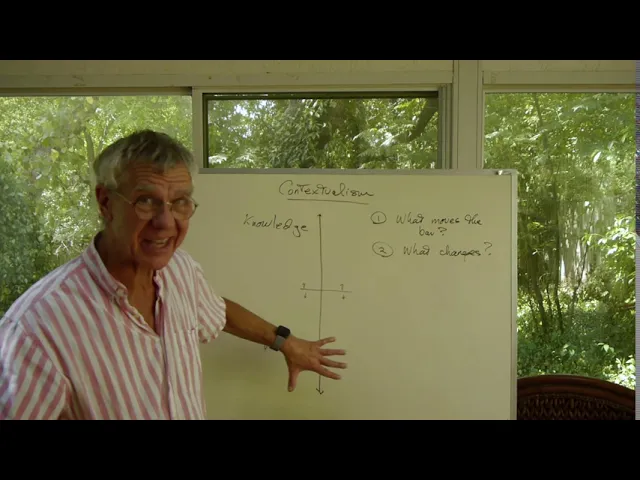
has echoes in wittgenstein and a variety of other people so let's take a look at the contextualist analysis knowledge is contextual in other words whether a belief counts as knowledge is not something we can give a general across the board account of it's something that depends on the context so what do i mean i mean something like this there's a scale and somewhere up here we are willing to count beliefs as knowledge down here we say well it's mere belief it's mere opinion it doesn't count as knowledge and so i will use the term opinion
to mean belief that doesn't count as knowledge now at some point in here we draw a line we say above the line that counts as knowledge below that line it's opinion it's not known and what does it take for a belief to be above the line and count as knowledge well we can have different accounts the internalist says it's a question of justification as well as true belief and the externalist says it's a true belief that arises from a reliable process for example or has a reliable source or is causally related to the fact that
it's about in the right way or is such that you wouldn't believe it if it weren't true or you believe in the basis of reasons that are connected appropriately to the truth of your belief or whatever there is an account that involves some relationship between that belief and something in the world other than simply the fact that it's true now however we think of things that way we think there's something that constitutes this bar but notice the internalist and the externalist in that case are both committed to drawing a line do you have a justification
did it arise from a reliable source is this the kind of thing that is the causal result is the effect of the fact that it's about those are things that would allow us to establish an absolute line the contextualist says it's not like that the context can move this bar up or down sometimes it's quite low sometimes it's quite high and context determines that so this line can shift it's something that is capable of going up it can also go down and that's crucial to understanding what knowledge is knowledge is a belief that's true but
also is just good enough in that context now what exactly good enough means well there's a lot more that could be said about that you could talk about various ways of understanding what it is to be good enough maybe in terms of the strength of a justification or the strength of the knowledge source there are many ways in which an internalist or an externalist might try to build context into their account but i want to notice that this is the kind of thing that many skeptics throughout the ages have seemed to presuppose in the background
nagarjuna for example says we don't speak without accepting for practical purposes the word today world in other words he's giving you skeptical arguments claiming there's no such thing as knowledge but he's not saying stop living your life he's saying yeah i don't mean to challenge for practical purposes the workaday world of course you're going to walk around assuming there are causal connections forming beliefs on the basis of what you're perceiving counting them as knowledge in those contexts that's okay i want to say they're not real knowledge hume says something like the same thing i'm giving
you arguments for doubting that there are real causal connections in the world but then i'm going to go out of the seminar room and i'm going to go back to playing billiards and there i'm going to assume that moving the cue tick in the right way will cause the balls to move in a certain way i forget about my skeptical worries and i go back to that in that context something like that is in sextus empiricus too adhering then to appearances we live in accordance with the normal rules of life undogmatically seeing we can't remain
wholly inactive ancient sources tell us of a skeptic who became so extreme into skepticism that he simply refused to believe the evidence of his senses refused to believe there were any causal connections in the world refused in other words to believe that any belief that he had counted as knowledge or was the basis for action this is someone who would routinely walk in front of chariots his students had to lead him around he decided that there was no point in speaking because there was no reason to believe that anyone else could actually understand his words
or respond that he was ever communicating and so he took to remaining silent well that didn't last very long people thought he had gone deaf they started shouting at him to try to make themselves heard finally he took to wiggling his finger to indicate i've heard you um and conveyed somehow to some of the students who were able to realize oh he's doubting even communication there's no point but of course it's a lie i mean the wiggling of the finger then communicated something and so really the attempt to you know fully live as if you
had no beliefs and no reason for any beliefs didn't really quite work out miles bernie has asked in a famous paper can the skeptic live his skepticism and most skeptics throughout the ages have said no not really as soon as i leave philosophical reflections i count things as well known enough to get by for practical purposes in effect you might say from a contextualist point of view they're saying look here's where the bar really ought to be but in the practical work of a world i lower it here i lower it to this point when
i'm playing pool or walking down the street or in other ways having to actually function in the world there are a number of questions we can ask about this basic picture one question to ask concerns the motion of this bar what moves it up what moves it down so we could say first question is what moves the bar what makes our criteria for knowledge or reasonable belief after all the ancient skeptics were not really primarily concerned with knowledge at all they were concerned with what makes a belief reasonable but we can make the same point
with respect to that we could say these might be reasonable beliefs these are well maybe unreasonable beliefs if you go far enough down maybe otherwise just just opinion um mere opinion they're not really on the basis of reason and so i think nothing crucial here hangs on the term knowledge it won't do to say okay forget knowledge but we have a different kind of account of reasonable belief the same thing should apply here too reasonableness might be a matter of degree in any case something is going to move the bar up move the bar down
in various contexts what is that what allows hume to say in the seminar room we have one set of rules when i play billiards i've got another set of rules or for the guardians to say yes when we're acting as buddhist philosophers we have one criterion but the bar moves way down in the work a day world how does that go what moves the bar and the second question is well what effect does it have when we move the bar we move it up what survives up here what's up there what survives as knowledge or
is reasonable belief we move it down well what do we gain so it's not just a question of what moves the bar it's a question of what changes is a result what if anything survives all the moving up and you might say what in general gets thrown out or gets admitted if we move the bar up or down now those are critical questions and contextualists can give you different kinds of answers to that maybe some think some things are going to count as knowledge or is reasonable relief in any possible context no matter how far
up you move the bar those things survive some may say look no matter how far down you move the bar some things are mere opinion or highly unreasonable beliefs that are never going to count as good enough and so there are there's considerable plausibility to both of those so you might think at some point here there's really a hard and fast limit and that would be a third question you might say connected to these two are there limits to how far the bar can move in either direction there might well be in fact there probably
are now i want to focus on the question what moves the bar up in particular because the skeptic from this point of view is playing a weird game with us we say i know that the shirt has pink stripes i know when i'm at the zoo say that i'm looking at a zebra seems plausible enough but now with respect to the zebra someone says are you sure that could be a cleverly painted mule i somebody said well um gosh zebras and mules do look a lot alike uh you know i mean there's different coloring a
mule tends to be brown and zebras are black and white stripes but if somebody painted that mule black and white i might well think it's a zebra so suddenly say well gee i don't know and so raising that kind of skeptical hypothesis is something that can make me start doubting or with respect to the shirt somebody might say are you sure your color perception is right um or might say much more rapidly are you sure that there isn't a cartesian demon out to deceive you about everything tricking you constantly maybe there is no external world
at all maybe there is no shirt maybe there is no daniel who is speaking into this camera right now uh well i gee do i know that i'm not the victim of a cartesian demon i don't know maybe not um so in short if we think about what moves the bar and in particular what moves it up we can think well what do those things have in common someone says hey that might be a cleverly painted mule i said oh i haven't thought about that or someone says there might be a demon out to deceive
you about everything maybe there's no external world at all saying oh i never thought about that so there are a number of things we can say one thing that seems to raise the bar up is well a skeptical hypothesis someone says but this might be a visual illusion or you might be a brain in a fact you might be trapped in the matrix there might be a cartesian demon or maybe it's simply a matter of you hallucinating maybe you're dreaming maybe this external world doesn't exist at all maybe your perceptual faculties are completely messed up
today well whatever it is a skeptical hypothesis arises and that's intimately connected to another thing that seems to happen when that arises which is doubt suddenly i begin to doubt i say oh uh i haven't thought about that possibility i didn't think about the fact that it could be a cleverly painted mule i didn't think about the fact that i could be a brain in a vat and so forth here's the way derose thinks about this he says in order to have knowledge or i think we can also say in order to have a reasonable
belief i have to be able to exclude relevant alternatives so i think here are ways the world could be and i think for me to know something i have to be able to exclude things that are relevant that are outside so let's say i claim i know that p that the shirt has stripes for example and then i've got to be able to exclude these other possible situations that are not p now presumably some of these in ordinary context i consider irrelevant i say a cartesian demon you know there i am in the store picking
out shirts and i say well i like this one and somebody says well yeah but if there is no shirt what do you mean it's right here no but what if you're what if the external world doesn't exist at all you're buying nothing now ordinarily when i'm in the store shopping for a shirt that is not a relevant consideration i don't think i you know i do think do i like the shirt is it worth this amount of money i don't stop and think but what if the shirt doesn't really exist because i'm just a
brain and a fat that i'm completely wasting my money that never occurs to me that's an irrelevant alternative but if somebody brings them up and says are you sure are you sure you even exist that you have a body that there are shirts well suddenly they're trying to get me to expand the range of relevant alternatives so one way of looking at this is to say i ordinarily think of these alternatives as relevant and i think i have to be able to exclude these no my eyes seem to be working fine i don't i'm not
color blind or anything it's all good but then somebody says uh-huh but what about this so in effect by bringing up a skeptical hypothesis or saying what if it's a cleverly painted mule what if the external world doesn't exist they're expanding that group of relevant alternatives here's one way to think about what happens when someone introduces this kind of skeptical hypothesis or other reason for doubt we think about these relevant alternatives and we think okay ordinarily i think i can rule out the relevant alternatives here that would contradict my belief i think oh no i
know what a zebra is for example i know that you know that has stripes it looks like that uh yeah that's a zebra okay but then somebody says what if it's a cleverly painted mule and that's a possibility i hadn't considered that's out here somewhere and there's my mule and now i think oh dear okay so i've got this belief here and i think hold on a second um i would believe it if if that were the case okay so shoot maybe i don't know it after all so what's happening when someone introduces a doubt
or introduces a skeptical hypothesis is that they're putting something into the class of relevant alternatives or to put it another way they're expanding the relevant alternatives in such a way that i start thinking oh wait a minute maybe that is a relevant alternative um gee i don't have a way of excluding that and so maybe i don't know maybe given what i've been thinking shoot i would still believe it even if that were true so maybe i better withdraw my belief or at least recognize that i'm not going to count it as knowledge i won't
count it as a fully reasonable belief are there other kinds of things that can raise the bar well sure one of them is disagreement i think that's a zebra and somebody says oh no no i've been studying african animals that's not a zebra that's a close relative of the zebra blah blah blah right here um oh i didn't know there was a close relative of the zebra and in that kind of case i'm gonna say yeah okay um yeah wow i no i'm pretty sure that is a zebra you know i think i saw the
sign over there it said zebra really because i've got you know so in short there can be disagreements as i'm speaking we're in the midst of coronavirus and in the context of that there are all sorts of disagreements even among medical experts let alone the general population how contagious is this how high is the death rate what's the best strategy for combating it how likely is it that this particular treatment is going to be successful all of those things are cases where people disagree and so i might have beliefs about this but suddenly the disagreement
of someone else with me makes me think hmm okay maybe that belief that i thought was justifiable isn't really well supported enough to count as knowledge and so disagreements especially disagreements that are hard to resolve it's one thing if we can say hey look at the sign it says zebra then maybe it's a disagreement that's easy to resolve but other disagreements tonight might not be like that they might be hard to resolve and when somebody who seems reasonable and has good evidence and decent arguments disagrees with us that raises the bar and makes us think
okay maybe i don't know after all are there other considerations well one of the most important is high stakes here's an example from the recent literature someone asks me whether the bank is open and i say yeah sure they they don't close until 4 30. and then the person says are you really sure if i don't get this payment in on time i'm going to be in default in my mortgage i'm going to lose my house then suddenly oh well i better check okay ordinarily i was yeah i know when the bank closes but in
this circumstance i think oh dear you know i better make sure and there are situations like that where the stakes matter a lot ordinarily we count certain things as known because look i mean it's good enough right it's good enough for the work a day world it's good enough for playing billiards and so forth but if suddenly someone says but your life depends on it they ask me what the capital of malaysia is and i say kuala lumpur yeah i'm pretty confident of that but someone says now they point a gun at my head and
they say i will shoot you if you are wrong about that are you sure it's kuala lumpur now suddenly i get scared right that raises the bar and i start worrying about it so that's the kind of context of extremely high stakes that makes me there might be contexts like that that lower the bar either because the stakes are very low or simply because there is no disagreement there is no doubt and maybe in some cases like this it's not just a question of all those things but really all that matters is getting the right
answer it doesn't matter how you got it it doesn't matter how reasonable it was or whether it really counted as knowledge good example i'm playing in a trivia contest i'm part of a team and one of the questions is what's the latin word for whatever well i stop and think about that nobody else at the table knows in fact several of them start proposing things that are not even in latin say no that's not latin that's spanish that's italian and do i know well it's not like i knew it like that but i think well
i know what whoever is it's quisquid so what's whatever well just says quist would be who quid would be what so i think it must be quid quid so i say it's quid quid and that turned out to be right did i know well i i was inferring it right based on what i knew i didn't remember it right off the bat if you said are you sure i would have said no however i got it right and so yay you know well did i know it depends what the bar is right in that situation
it's pretty low for one thing the stakes aren't critically high for another thing there was no disagreement the other people had bizarre suggestions um i had some reasons in support of it and so forth was i but i was far from certain but in that case we you come up with the right answer we tend to be inclined to think look knowledge may not just be true belief but it's pretty close to true belief if on the other hand a lot dependent on it all of a sudden then i might say look i don't know
but but here's something that might be and so a lot of things determine this bar going up and down by in effect putting things into or removing things from that set of relevant alternatives now what's the relevance of this to the skeptical problem here's one way of thinking of what the skeptic's doing the skeptic is raising that bar dramatically is saying by bringing in all sorts of wild relevant alternatives not just what if that's a cleverly painted mule but what if there's a cartesian demon what if you're a brain and a vat what if there
is no external world what if we're trapped in the matrix and all of those are sort of wild hypotheses now ordinarily you might say i don't think about those possibilities at all in shopping for shirts i don't think what if the whole external world is a fiction a figment of my imagination what if i'm a brain and a bat etc i don't think about any of that those seem irrelevant but if someone suddenly brings them up they are in effect raising that bar dramatically now you might think do i know well you know what when
i'm in the clothing store or when hume is playing billiards or when the guardian is in the workaday world sure i know but in a context where people introduce this kind of hypothesis or worry about the source of sources of knowledge and all of that suddenly that market's raised way up and so whether i know well i know relative to the standards of the work a day world maybe i don't know relative to the standards of the philosophy seminar now one possibility is to say well as hume seems to i don't really know i just
adopt it for practical purposes in the workaday world but there's another response to say i don't see why i should raise the bar up that high at all why should i i don't see why that makes me doubt anything here for example is the complaint of udaya a very important figure in the history of indian philosophy udayana is the person who combined the nyaya and vaishasika traditions into something known as miyabaisheka and was really the first figure in a movement then known as the new nia the new logic he says that is doubted concerning which
as doubted there occurs no contradiction with the dollar's action in other words udaya is saying look do you really doubt have you really expanded the set of relevant alternatives i look at what you do you say aha so maybe you are the victim of a cartesian demon and look what you do you pick up the marker and draw something if you really believed that it was a possibility that there was a cartesian demon you wouldn't bother picking up the marker you wouldn't draw on the board you wouldn't think you could communicate anything to anyone and
so he says your doubt quote unquote is belied by your own actions gun geisha one of the main figures in the new logic a 14th century indian philosopher puts it this way it is not possible it wants to resort regularly to fire in the light for smoke and the like and to doubt that fire causes it it would be meaningless behavior that's how we should understand what udayana is saying so gangnesh is saying look you you want to grill your steak you start a fire in the grill all the while you're telling me that this
world might not exist at all if you really doubt that the world exists what on earth are you doing starting fire you really doubt as hume does that there are causal connections in the world why would you think that starting that fire on the grill would produce smoke or cook your steak you yourself are showing you don't really doubt this causal connection and so don't give me this stuff in fact they say you're trying to raise the bar stop it your own actions show that you're not really raising the bar you're still speaking and expecting
me to understand you're still doing things like using tools moving around the room you act as if we all have bodies you're acting as if they're causal connections this skepticism is false it is a faux skepticism none of this is real he says we can reject the argument the contradiction understood as natural opposition governing precisely which x can't occur along with precisely which why can't block a vicious infinite regress it's the doubter's own behavior that proves the lie to the doubt that blocks it the doubter's own behavior blocks the doubt the skeptic acts as if
they're not true skeptics at all and so don't take this seriously they claim that in an important philosophical context we raise the bar and count only this as knowledge only this is reasonable belief if anything survives at all but they say give me a break their own behavior shows they don't really doubt it the bar isn't really being raised they're pretending to raise it wittgenstein says something similar he says i can doubt only if i have reason to doubt you have to give me a reason to doubt you say hey what if there's no external
world what if it's a cleverly painted mule what if there's a cartesian demon wittkin science says well what reason do i have to take that seriously as a possibility why do you think so now it would be one thing if you say look i was here at the zoo last night and i saw this crazy artist guy go into the enclosure here and take out his paints and start painting a mule and i think maybe he led it over and is playing a joke on us then it's like oh you have reason to think it
really might be a cleverly painted mule it's hard to imagine what might be a reason for thinking there really might be a cartesian demon or i might really be a brain and a vat on the other hand maybe there could be eli hirsch describes cases like that maybe i find out there are lots of people who are brains and bats maybe i go into this place in a remote corner of wyoming where there are huge farms of brains in vats and i start thinking wait a lot of people i've been corresponding with on the internet
for example a lot of my facebook friends trying to be brains in fact maybe i'm a brain in a vat then i've got a reason for my doubt but because a philosopher says what if we are brains advanced that's no reason for me to take it seriously so that idea of who diana's of conges of wittgenstein says look i'm going to believe that this should be raised and that i should doubt that i have knowledge only if you give me a powerful reason for it if you tell me hey somebody was in that enclosure painting
animals then the possibility it's a painted mule becomes real for me then i'll take it seriously but in the abstract i'm not going to take it seriously especially when your own behavior shows you don't take it seriously either