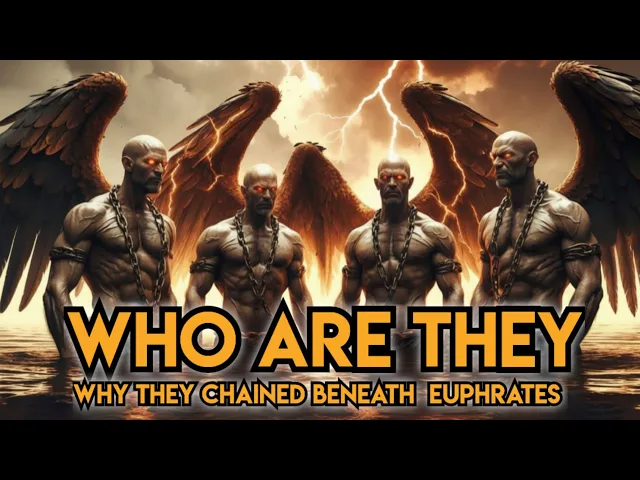
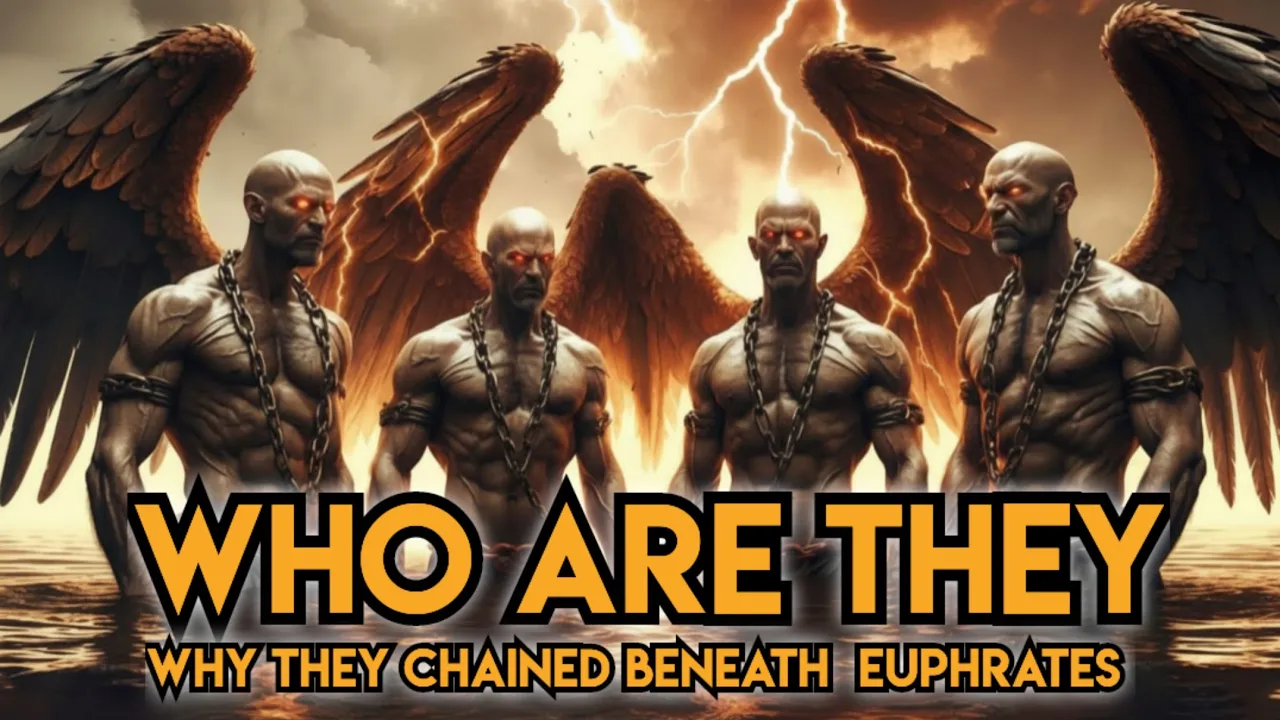
Right now, somewhere beneath the surface of our planet, under the soil of war torn lands and the slow ancient flow of a river that has shaped empires, something is waiting. Not a myth, not a symbol. Four powerful angels restrained by God himself. Held under lock and key until the very second their chains are ordered to fall. The Bible doesn't just say they exist. It tells us the exact place they're held. It tells us the Exact hour [music] they will be released and it tells us what happens next. The death of onethird of all humanity. If
that's true, then somewhere under the Euphrates, four ancient beings are already in position, silent, awake, counting down to an appointment on God's calendar. Before we dive in, make sure you like this video, subscribe to the Mythic Library, and turn on all notifications. because we're going to be unpacking some of the most intense Endtime passages in the Bible. The kind of content most channels won't even touch. And you don't want to miss what's coming next. Now, let's step into the mystery of the four angels bound at the great river Euphrates. [music] Deep beneath the surface of
the earth, beneath rock layers older than any kingdom, beneath sand that has tasted the blood of armies and the footsteps of prophets. Beneath the flow of one of History's most iconic rivers, the Bible tells us something is bound. Not a legend passed down through folklore, not a metaphor crafted by poets, but four real and powerful angels restrained by God himself waiting for an exact moment in time. Not a vague season, not a general era, but as scripture emphasizes, an appointed hour, day, month, and year, a precise timestamp burned into the divine timetable. Revelation 9:14 Records
the chilling command. Release the four angels who are bound at the great river Euphrates. In this single line, heaven speaks and the seal on a hidden prison is ordered to break. These are not messengers of peace. They are not bringers of hope. Their release will mark one of the most terrifying moments in human history. The death of onethird of mankind. Pause and let that sink in. Not a city, not a region, not a single nation, a third of the entire human Population. Who are they? Why are they bound? What did they do that warranted such
severe restraint and such catastrophic release? In this journey, we're going to explore one of the Bible's most hidden and haunting endtime mysteries. A prophecy that threads together Genesis, the ancient near east, the book of Enoch, apostolic warnings in the New Testament, and the final trumpet blasts of Revelation. We're going to walk through scripture step by step and Ask, are these angels connected to the rebellion of Genesis 6? Are they part of the imprisoned beings Jude and Peter describe? Why does the Bible name the Euphrates specifically out of all the rivers and regions on Earth? Prepare
for a journey through the depths of scripture, spiritual warfare, and the unfolding plan of divine judgment. The question is not just who these angels are, but what their story means for you right now. The book of Revelation is a Divine tapestry, not a random collection of visions, but a carefully woven masterpiece of symbols, numbers, heavenly scenes, and earthly upheavalss. Every word is loaded with prophetic weight. Every image carries layers of meaning. Among its many apocalyptic scenes, beasts rising from the sea, stars falling, scrolls being opened. One passage stands out as especially haunting, chilling, and mysterious.
Revelation 9 13:15. Then the sixth angel Sounded, and I heard a voice from the four horns of the golden altar, which is before God, saying to the sixth angel who had the trumpet, "Release the four angels who are bound at the great river Euphrates." So the four angels who had been prepared for the hour and day and month and year were released to kill a third of mankind. Let's slow down and pay attention to what's actually being said here. First, this moment is triggered when the sixth angel sounds His trumpet. Revelation organizes its judgments in
sequences, seals, trumpets, bowls. Each trumpet blast announces a new wave of judgment upon the earth. By the time we reach the sixth trumpet, the world is already in chaos. The supernatural has invaded the natural realm. Mankind has already witnessed horrors no generation before has seen. But then, Jon hears a voice. Not from the earth, not from the pit, from the four horns of the golden altar. Before God in the Old Testament, the golden altar was connected to incense, a symbol of the prayers of the saints. In Revelation, we consistently see the cries of God's people
rising like incense before his throne. That means what's about to happen isn't random. It's not just evil breaking loose on its own. It comes in response to heaven's timing, heaven's justice, and heaven's perspective. The voice from the altar speaks to the sixth angel and gives a Simple terrifying order. Release the four angels who are bound at the great river Euphrates. Here we discover several critical details. There are four specific angels, not a vague host, not an unnamed crowd, four identifiable beings known in heaven, assigned to a particular role. They are bound. The Greek idea here
is restraint held back, tied up, restricted. They are not currently roaming free. They are not participating in ordinary spiritual Activity. They are in custody. They are bound at a real location, the great river Euphrates. Not just bound in darkness, not just kept in the abyss. They are geographically associated with a river that has existed from the earliest pages of Genesis through the rise and fall of empires. They have been prepared for a specific time. Scripture doesn't simply say in the last days or sometime in the end. It stacks the language hour, day, month, year. That's
Extreme precision. It tells us that God has an exact moment marked out when the order to release them will be given. And then the purpose they were released to kill a third of mankind. This is not allegorical poetry. John doesn't present it as a fuzzy symbol that can mean anything we like. This is a direct prophetic announcement of a coming judgment executed by four specific beings under direct permission from God. We need to feel the weight of that. If The Bible is true and if revelation is truly prophetic, then somewhere on the timeline of human
history, there is a moment already scheduled when these four beings will no longer be restrained. This leads us to some disturbing but necessary questions. Why does God bind certain angels and not others? What kind of rebellion or danger would require such extreme long-term restraint? How long have these four been imprisoned? Are we talking centuries, millennia, Since before the flood? If we read the rest of scripture carefully, we begin to notice something important. Gods, holy angels are never described as bound. Holy angels are described as ministers of fire, messengers of God's word, warriors who fight for
God's people, worshippers who stand in his presence. They go where he sends them. They minister to the heirs of salvation. They execute his will with perfect obedience. There is no hint of them being chained, Imprisoned or geographically confined because of disobedience. But in Revelation 9, these angels are different. They are bound. Bound implies danger. Bound implies rebellion. Bound implies that without restraint, their actions would be devastating. out of sync with God's present purposes, yet still usable in his final judgment. In the Bible, bound angels only appear in very specific contexts and they are always associated
with three themes: Sin, judgment, divine restraint. So the question naturally arises, who are these four angels? Are they fallen angels of a particular rank? Are they ancient rebels involved in a unique sin? Are they regional principalities assigned to the Euphrates region, removed from their posts and imprisoned until the end? And then there's another question. Why are they imprisoned in the first place? Judgment in scripture is never random. God does not incarcerate spiritual Beings just because he can. There is always a reason, a history, a context. Somewhere in the story of the world, something happened. Some
transgression so severe, so corrupting that these angels had to be removed from circulation and locked away until the final stages of the end times. That's where the trail of clues leads us back not to Revelation, but to the very beginning of human corruption. To find out who these imprisoned angels at the Euphrates might be, we have to travel backward in the biblical timeline, past the prophets, past the kings, past Moses, past the Tower of Babel, all the way into the era before the flood, before judgment by water, before Noah's ark, before human civilization had fully
formed. There, tucked almost quietly into the sixth chapter of Genesis is a strange, controversial, and often misunderstood passage. Genesis 6 to 1 2 When men began to multiply on The face of the land, and daughters were born to them, the sons of God saw that the daughters of man were attractive, and they took as their wives any they chose. Verse 4 continues, "The Nephilim were on the earth in those days, and also afterward, when the sons of God came into the daughters of man, and they bore children to them. These were the mighty men who
were of old, the men of renown." For many readers, these verses are puzzling. Who are the sons of God? Why are their relationships with human women highlighted just before the flood narrative? And why does the text immediately move from this event into God's grief over human wickedness and his decision to wipe the earth clean? These are not throwaway details. They're a clue, a doorway into a deeper spiritual conflict that may be directly connected to the four angels in Revelation 9. Throughout ancient Jewish tradition and in much of early Christian Thought, the phrase sons of God
in this passage wasn't understood as human kings or ordinary men. It was understood as angelic beings, heavenly watchers, spiritual entities who had a legitimate place in God's heavenly court, but who abandoned their proper domain. They crossed a line that was never meant to be crossed. They did what was absolutely forbidden. They took human women as wives and produced hybrid offspring. The Nephilim, described as giants, mighty Men of old, men of renown, violent and corrupt. This wasn't just physical violence. It was spiritual contamination, a deliberate blending of heavenly and earthly bloodlines that twisted God's design for
humanity. From that moment, humanity's wickedness accelerates. Violence fills the earth. Corruption spreads like a disease. Genesis 6:57 tells us, "The Lord saw that the wickedness of man was great in the Earth. And the Lord said, I will blot out man whom I have created. For I am sorry that I have made them." In other words, the world becomes so spiritually and morally polluted that the only solution is a global reset. The flood. Here's the connection we need to hold on to as we move forward. There was an earlier generation of angels, heavenly beings who sinned
in a unique way and triggered a unique judgment. And according to the New Testament, they did Not simply disappear. They were bound, imprisoned, reserved for a future day. So the natural question as we move deeper into this mystery is this. Could the four angels bound at the Euphrates be part of this same class of beings? To answer that, we'll have to look at two of the most chilling verses in the New Testament passages that pull back the curtain on what happened to those rebellious angels of Genesis 6 and where they are right now. To understand
the Forebound angels of Revelation 9, we have to sit with a haunting reality the New Testament makes uncomfortably clear. Not all fallen angels are roaming free. Some are already locked away. Some are not merely influencing nations, tempting individuals, or whispering in the shadows. They are restrained, chained, and held in places of spiritual confinement until an appointed moment of judgment. That idea alone changes how we read Revelation 9. The four angels at The Euphrates are not an isolated mystery. They fit into a pattern, a disturbing, consistent pattern of rebellion followed by imprisonment. We saw in Genesis
6 that a group of heavenly beings called sons of God, crossed a forbidden boundary. They took human wives and produced hybrid offspring, the Nephilim, a spiritually and physically corrupted race. Their rebellion helped provoke the flood, the most severe judgment the world had seen. But Genesis doesn't tell us what happened to those angels afterward. The text goes on to describe the flood. Humanity is judged. The earth is cleansed. Noah and his family begin again. If we only had Genesis, we might assume those angels simply vanished from the story or were left unressed. But God did not
leave that question unanswered. Many centuries later, two New Testament writers, Jude and Peter, pull back the curtain on what happened to those Specific rebellious angels. Their words are brief, but they are loaded, and they form a crucial bridge between Genesis 6 and Revelation 9. Jude 1:6 says this, "And the angels who did not keep their own domain, but abandoned their proper dwelling, he has kept in eternal bonds under darkness for the judgment of the great day." Let's break that down slowly. First, Jude is not talking about all fallen angels. Satan and many demons are clearly
still active. They tempt, Deceive, influence, and attack. So who is Jude describing? He gives us three key phrases that narrow the focus. The angels who did not keep their own domain but abandoned their proper dwelling. He has kept in eternal bonds under darkness. Their sin is defined as leaving their god-given domain and abandoning their proper dwelling. This isn't just ordinary rebellion like pride or disobedience. It is a boundary violation. They had a realm assigned by God, a sphere of existence, a role, a mode of being appropriate to angelic nature. But they left it. They crossed
over into a realm they were not meant to occupy in that way. This language echoes exactly what we see in Genesis 6. Heavenly beings stepping into human relationships in a forbidden manner. Then Jude describes their punishment. He has kept them in eternal bonds under darkness. Think of that phrase eternal bonds. Not temporary, not flexible, not Easily broken. These are spiritual chains. And the phrase under darkness implies not just separation from God's light, but a place of confinement removed from influence in the visible world. And then Jude gives the time frame for the judgment of the
great day. That means these angels are not yet judged in full. They are awaiting something. Their sentencing is determined, but the execution of that sentence is tied to a great day, a Future moment in God's unfolding plan. Somewhere in the timeline of the end, that great day will arrive. And whatever these angels have been reserved for will come to pass. Now turn to 2 Peter 2:4, where Peter speaks of the same group. For if God did not spare angels when they sinned, but cast them into Tartarus and committed them to pits of darkness reserved for
judgment. Here Peter adds more detail. First he confirms again, God did not spare these angels. Their Sin was so severe that no delay, no leniency, no ongoing freedom was allowed. They were cast somewhere. He uses a very specific word, Tartarus. In Greek thought, Tartarus was not just any place in the underworld. It was the deepest pit, the lowest abyss, a prison for the most dangerous and rebellious beings. Peter borrows this word under the inspiration of the Holy Spirit to describe the spiritual prison where these angels were thrown. He then Describes them as being placed into
pits of darkness. Again, the language of confinement. And like Jude, he adds the phrase reserved for judgment. That means their fate is locked in. Their destination is decided. Their role in God's future plan is already fixed. They are not roaming. They are not negotiating. They are not free. They are bound. Like the four angels in Revelation 9. Now the pieces start to come together. Genesis 6 shows Us the crime. Jude and Peter reveal the sentence. Revelation 9 shows us the release of a specific group of bound angels for a specific judgment. The question practically asks
itself, are the four angels bound at the Euphrates part of this same imprisoned class or at least of the same order and nature? We can't dogmatically say they are the exact same individuals Jude and Peter refer to because scripture does not name them. But we can say this with Confidence. The Bible clearly acknowledges a category of angels who sinned in a unique way. These angels were not left free but were imprisoned in darkness. They are being kept for a future day of judgment. Revelation 9 describes four angels already bound being released during a phase of
endtime judgment to kill a third of mankind. The patterns line up with frightening precision. Think about the logic here. If God allows lesser evil to roam free, Satan tempting, demons influencing, principalities waring over nations, but chooses to imprison certain angels, then the ones in chains must be extremely dangerous. Their release must be tied to something enormous in God's prophetic plan. [clears throat] These are not low-level spiritual foot soldiers. They are high- risk, high impact entities. John tells us in Revelation 9 that when they are finally released, they are connected to an army whose actions Result
in the death of a third of humanity. The scale of destruction suggests that these four angels are not minor figures. They are ancient powers stored away like spiritual weapons in God's armory of judgment, drawn forth only when the time is right. Now, let's step back and take a more panoramic view. Jude in context. doesn't only speak about the angels. He connects their sin to other examples of judgment. In Jude 1:57, he lists Israel's unbelief In the wilderness, the angels who left their domain, Sodom and Gomorrah. He ties them together as illustrations of how God deals
with rebellion, sexual immorality, and spiritual corruption. Sodom and Gomorrah in particular are remembered for their sin and for the fire and sulfur that rained from heaven in judgment. When we turn back to Revelation 9, what do we see? Fire, smoke, sulfur, an army associated with plagues that sound eerily like a scaled Up global echo of Sodom's fiery end. The connection is not accidental. Jude uses Sodom as a pattern of what happens when sin ripens and judgment falls. Revelation shows us that pattern amplified to a planetary scale. We also need to notice how Jude and Peter
speak about the angel's sin in relation to strange flesh and abandoning their proper abode. The rebellion of Genesis 6 isn't just about power. It's about crossing God-given categories. Angels Entered into relationships and roles they were never assigned. In a sense, they tried to rewrite creation. When creation tries to rewrite creation, judgment follows. Now, let's bring this back to the Euphrates. One of the most intriguing questions in Revelation 9 is why these four angels are bound at a river, and not just any river, but the Euphrates. We'll go deeper into the symbolism of the Euphrates later,
but it's important to see now that location Matters. If Jude and Peter show us that certain angels were confined in Tartarus, a deep abyss, and Revelation 9 shows us four angels bound at the Euphrates, then it's reasonable to think that God's prisons for spiritual rebels can be dimensionally layered, connected both to earthly geography and to unseen realms. In other words, a spiritual prison may have a real world anchor point. Think of Jacob's ladder in Genesis 28, a physical place on earth, Bethl, where heaven and earth intersected in a vision. Think of the Mount of Transfiguration,
where Jesus's glory broke through. Think of the Valley of Hinnom, a physical location used as an image of hell. So when revelation says these four angels are bound at the Euphrates, it may indicate that their prison though spiritual is somehow beneath or within the dimensional space associated with that river and region they are located not in the sense of Being trapped in water and mud like buried artifacts, but in the sense of being tied to a spiritual fault line that intersects with that geographic zone. This is why Judes and Peter's language about darkness, Tartarus and
chains matters so much. It shows us this is not metaphorical psychology or poetic symbolism. These are real beings in real confinement. And if God has already done this before, imprisoned certain angels because their rebellion was too Dangerous to be allowed to continue, then Revelation 9 isn't introducing a new idea. It's revealing the moment when some of these restrained powers are finally brought out of that confinement as instruments of endtime judgment. Another important detail both Jude and Peter emphasize that these angels are reserved. To be reserved for judgment means God has scheduled their role. Their freedom
is not determined by their own strength or will. They cannot break Out early. They cannot rush the timetable. Their release will only happen when heaven commands it. Revelation 9's phrase about the hour, day, month, and year matches this perfectly. The four angels who had been prepared for the hour and day and month and year were released to kill a third of mankind. Prepared, reserved, held back for a precise moment. The same God who put them in chains is the God who holds the key and the stopwatch. This is Both terrifying and comforting. Terrifying because it
shows that when these beings step back onto the stage of history, it will be devastating. Comforting because it reminds us they are never in control. They are not plotting an escape. They are not slowly breaking the chains. They are not sneaking out to start a secret war. They are bound until God says otherwise. That means the world is not at the mercy of their whims. It is under the sovereignty Of God's plan. Still, the thought lingers. Why would God ever choose to release them if they are that dangerous? Why not leave them in chains forever?
Why not destroy them outright and erase the risk? The answer takes us into the heart of divine justice. God does not simply prevent evil. He judges it. The history of rebellion, both human and angelic, must be brought to a final accounting. Evil is not only restrained, it is exposed, confronted, and defeated Publicly. The release of these four angels is part of that final confrontation. Just as Pharaoh's hardness of heart led to plagues that revealed both his stubbornness and God's power. Just as Sodom's sin led to a judgment that stood as a testimony for generations. Just
as the cross exposed the hatred, blindness, and cruelty of the world even as it crushed the serpent's head. So the release of these angels and the devastation they bring Will serve a purpose in God's ultimate story to show the true cost of rebellion. To demonstrate God's absolute authority over every power to clear the stage for the return of Christ and the establishment of his kingdom. When we view Revelation 9 through the lens of Jude and Peter, the picture comes into sharper focus. We are not dealing with abstract monsters or vague forces. We are dealing with
real ancient beings who crossed a terrifying line long ago and Were locked away because of it. Now, Revelation shows us the moment when some of these long imprisoned powers will once again be allowed to act not as free agents, but as instruments within the boundaries of God's judgment. And as we move forward, we'll need to pay close attention to where they are bound. the Euphrates because that river has a story of its own from Eden to Abraham to Babylon to the final days and its role will help us understand why God chose That specific place
as the edge of a prison that is about to open. To understand why four of the most terrifying beings in prophetic history are said to be bound at the great river Euphrates, we have to follow that river like a trail of breadcrumbs through the Bible. Because the Euphrates isn't just background scenery. It's not a random landmark. It is a line that keeps appearing whenever the story reaches a spiritual crossroads. In Revelation 9, The command is precise. Release the four angels who are bound at the great river Euphrates. Not in the abyss, not in the pit,
not in the heavens, at the Euphrates. Why there? To see the weight of this, we need to go all the way back to the beginning to a garden, to a river system that flowed out of a place humanity has never been able to return to, Eden. In Genesis 2, before there was sin, before there was judgment, before there were fallen angels, there was a Garden planted by God himself. A perfect home, a place of harmony between heaven and earth. Genesis 2:10:14 says, "A river flowed out of Eden to water the garden, and there it divided
and became four rivers." The name of the fourth river is the Euphrates. The very first time we meet the Euphrates, it is part of a system flowing from Eden, the paradise of God. This alone should make us pause. A river that begins in paradise later becomes the border of Conflict, the symbol of judgment, and the location of bound angels. From the beginning, the Euphrates is connected to God's original design, the watering and sustaining of the garden of the Gaskin, the geography of a world untouched by sin. It starts as a river of life. But like
humanity itself, its story doesn't stay there. As history unfolds, the region around the Euphrates becomes the cradle of civilizations that will later oppose God's people. Places like Babylon And Assyria. The river that once flowed from Eden now runs through territories that will become symbols of rebellion, idolatry, and oppression. This transformation is important. The Euphrates begins as a river of blessing, then becomes a boundary and ultimately a stage for judgment. Let's trace that ark. After Eden, the next major figure whose story intersects with the Euphrates is Abraham. In Genesis 12, Abraham is called to leave his
homeland And follow God to a land he will show him. That land will become the promised inheritance, the land of Canaan. But the borders of that inheritance are larger than most people realize. In Genesis 15:18, we read, "On that day, the Lord made a covenant with Abram, saying, "To your offspring, I give this land from the river of Egypt to the great river, the river Euphrates." There it is again, the great river, the river Euphrates. In this moment, the Euphrates becomes more Than a geographic feature. It becomes a covenant border. It marks the outer edge
of the territory God promises to Abraham's descendants. Think about what that means symbolically. On one side of the Euphrates lies the land of promise, the sphere of covenant blessing, the territory connected to God's chosen people. On the other side lie the lands of powerful pagan empires, nations steeped in idolatry and false gods. The Euphrates then becomes a threshold Between two realms. The realm of covenant and the realm of pagan power. It is the line where the inheritance of God's people meets the ambitions of the world's kingdoms. As history goes on, some of the most dangerous
enemies Israel faces come from beyond that line. from regions watered by the Euphrates. Assyria, the brutal empire that conquered the northern kingdom of Israel and scattered its people, grew in the region of the upper Tigris and Euphrates. Babylon, the empire that destroyed the temple and carried Judah into captivity, rose from the plains of Mesopotamia, the land between the rivers. Every time the Euphrates is mentioned, it quietly reminds us this is the line between God's people and the empires that oppose them. Now listen to how the prophet Jeremiah uses the Euphrates when he speaks of judgment.
Jeremiah 46:10. But that day is the day of the Lord God Of hosts, a day of vengeance. For the Lord God of hosts has a sacrifice in the north country by the river Euphrates. A sacrifice by the river. A day of vengeance by the river. The Euphrates is no longer just Eden's gentle waterway. It is now a battlefield. A place where God's vengeance is executed against rebellious nations. This is a pattern we can't ignore. Eden, Euphrates, as part of God's life-giving design. Abraham's covenant. Euphrates as a boundary of Promise, prophets and empires. Euphrates as the
arena of conflict and judgment. By the time we reach the New Testament, the Euphrates is loaded with spiritual significance. It represents the edge of God's covenant territory, the gateway through which invading armies approach, the zone where God confronts proud empires. So when Revelation mentions angels bound at the Euphrates, all of this history is quietly in the background. The river is not random. It Is a spiritual fault line. Now let's jump forward to the last book of the Bible. Revelation mentions the Euphrates twice in chapter 9 and chapter 16. In Revelation 9, the Euphrates is the
location of bound angels whose release unleashes a catastrophic judgment. In Revelation 16, we see something different but related. Revelation 16 12. The sixth angel poured out his bowl on the great river Euphrates, and its water was dried up to prepare the way for the Kings from the east. Here, the Euphrates is not the prison of angels, but the obstacle that stands between eastern kings and the land of Israel. When its waters are dried up, a path opens for a massive invasion, setting the stage for the final great conflict, often associated with Armageddon. Again, the Euphrates
appears as a threshold. Once crossed, events escalate toward global conflict and climax. Taken together, Revelation 9 and 16 show us two sides of The same river in the end times. In chapter 9, beneath or associated with the Euphrates, four destructive angels are released. In chapter 16, on the surface of the Euphrates, the waters dry up, making way for human armies to march. It's as if the river is a multi-layered boundary. Beneath it, spiritual forces are bound and later released. Upon it, geopolitical forces are restrained and then allowed to advance. The Euphrates becomes a Convergence point
where spiritual and political realities collide. But why would angels be bound there? To answer that, we need to think about how the Bible often treats geography and spirituality as overlapping realms. In the ancient world, regions weren't just physical territories. They were believed to be overseen by spiritual powers. We see glimpses of this worldview in scripture. In Daniel 10, an angel sent to Daniel is delayed because of Opposition from a spiritual entity called the prince of the kingdom of Persia. Later, the angel mentions another entity, the prince of Greece. These princes are not human rulers. They
are spiritual powers associated with specific nations or regions. This tells us something crucial. There are spiritual beings assigned to territories. Nations are not just political units but spheres of invisible influence. Now consider the Euphrates Region. Historically it has been the cradle of Suma, Akad, Assyria, Babylon, Persia. These are not small kingdoms. These are the very empires that tower over biblical history, oppressing Israel, seducing nations with idolatry and embodying human pride in its most organized militarized form. If the Bible hints that nations have spiritual princes, then what sort of beings might be associated with the cradle
of empires, the birthplace of Babylon, the Heart of Mesopotamia? It would make sense that some of the most powerful and dangerous principalities in history would be tied to that region. Now, imagine that some of these beings or beings of similar rank committed a sin so grotesque, so corrupting that God didn't just limit their influence. He bound them. Imagine if their prison was anchored to the very region they once ruled, below the surface of the land that had seen their ancient work. the Euphrates. Suddenly, the phrase bound at the great river Euphrates becomes deeply symbolic and
deeply literal. Bound at the edge of covenant land, bound in the region of ancient rebellion. Bound beneath a river that has witnessed Eden, empire, idolatry, exile, and prophecy. There's another layer we need to consider. How ancient cultures in the Euphrates region thought about the underworld. In Mesopotamian belief, the underworld wasn't imagined as somewhere Floating in the sky. It was believed to be beneath the earth with gates, doors, and sometimes rivers marking boundaries between the living world and the realm of the dead. Now, we don't base our theology on pagan myths. But we should notice something.
God often speaks into human history using images people recognize while correcting and reorienting them. So when Revelation says there are four angels bound at the Euphrates, people familiar with the Ancient Neareastern worldview would have immediately pictured a boundary region to a place where the worlds overlap. A zone where access between realms can be opened or closed. In other words, revelation isn't borrowing from mythology to teach fantasy. It is reclaiming imagery to reveal a deeper spiritual reality. There is a real spiritual prison. There are real rebellious beings bound within it and one of its access points,
one of its Thresholds into our world is associated with the great river Euphrates. We see this same pattern elsewhere in scripture. Mount Si, a real mountain where God descends in fire, turning geography into a stage for divine revelation. The Jordan River, a real river used as a boundary between wandering and inheritance, old life and new, exile and entry. Gehenna, the valley of Hinnham, a real valley outside Jerusalem, used by Jesus as an image of Hell because of its history of idolatry and child sacrifice. So when revelation associates bound angels with the Euphrates, we are meant
to hear more than somewhere over there in the Middle East, we are meant to hear the threshold between God's covenant and the world's rebellion, the region that birthed Babylon, the archetype of human pride and false religion, the fault line between blessing and judgment. And right beneath that dividing line, four beings Once free, now imprisoned, are waiting, not resting, not sleeping, waiting. Another important detail. Revelation doesn't say the angels are bound in the river's water as if they are physically underwater. It says they are bound at the great river Euphrates. That preposition leaves room for a
layered interpretation. at as in near, under, or associated with the territory of the river. At as in anchored to the spiritual geography of that boundary. Think of it like this. You might say an underground missile silo is at a particular base. Even though most people never see it, its presence is hidden, but it is still tied to that location. In the same way, these angels are at the Euphrates hidden, restrained, but territorially anchored to a place where God has chosen to draw a line. That line throughout scripture keeps saying the same thing. Here is where
my people end and the empires of rebellion begin. So When that line becomes the place of release, it signals something huge. The forces that were once held back at the edge of Covenant land are now being allowed to cross over. The restraint is lifted. The barrier is breached. Spiritually speaking, the Euphrates becomes less of a border and more of a gate. There's one more angle we need to address in this chapter. Could the Euphrates also be acting as a divine seal over a deeper abyss? Throughout Revelation, there is repeated mention of the abyss, a bottomless
pit, a prison for demonic entities. In Revelation 9:13, just before the passage about the four angels, we read about a star falling from heaven to earth, given the key to the shaft of the abyss. When he opens it, smoke rises like from a giant furnace. And out of that smoke come locustlike beings that torment those without God's seal. So in the same Chapter we have the abyss opened releasing one class of beings the Euphrates as the place where four angels are released. The result in both cases is judgment and torment. This raises an intriguing possibility.
What if the prison beneath the Euphrates is connected to the abyss? We don't need to imagine a literal tunnel system beneath the ground. Instead, picture the spiritual realm as having multiple access points into our World. Some are pictured as pits or shafts. Some are connected to specific locations. All of them are under God's lock and key. In that sense, the Euphrates might not just be a symbolic boundary, but the surface marker of a deep spiritual prison, a sealed hatch, if you will, over a chamber where ancient rebels are being held. When the order comes, release
the four angels who are bound at the great river Euphrates. It could be describing the moment when God unlocks that specific hatch. Not the general abyss, not the global prison, but a particular cell holding four particular beings reserved for one horrifying history-shaping assignment. So where does all this leave us? By tracing the Euphrates from Genesis to Revelation, we see that it begins in paradise. It becomes a boundary of promise. It marks the front line between God's people and the empires that oppose them. It becomes the theater of judgment For nations in rebellion. And in the
end, it becomes a gate both for human armies and for bound angels. The four angels of Revelation 9 are not just locked up in a random place. They are being held at a point where geography, history, covenant, and cosmic warfare all intersect. That should make us read the passage with trembling. Because when that boundary finally breaks, when those chains finally fall, the world will feel the impact. Not only in one region, but In every nation. As a third of mankind falls under the wave of judgment that follows. In the next part of our journey, we're
going to focus more closely on who these angels might be. Are they highranking watchers like the ones described in the book of Enoch? Are they ancient principalities tied to empires like Babylon and Assyria? Or are they something else entirely? A unique class of beings reserved only for this moment. To identify who the four angels Bound at the Euphrates might be, we must move beyond geography and into the realm of angelic hierarchy, ancient rebellion, and spiritual authority. Revelation does not name these beings. It does not tell us their rank, their past, or the specific sin that
led to their imprisonment. But scripture gives us enough patterns, enough hints, and enough doctrinal anchors for us to build a picture. One that is both terrifying and theologically consistent. There are Two dominant interpretations among biblical scholars and ancient Jewish thinkers, both anchored in scripture and historical context. They may be highranking watchers similar to those described in Genesis 6 and elaborated on in books like one Enoch. They may be ancient principalities, cosmic rulers assigned to nations like the prince of Persia and the prince of Greece in Daniel 10. And there is a third possibility. They might
be something far Older, far more ancient, part of a classification of supernatural beings whose stories we only see fragments of in scripture. But all three possibilities share one thing. These beings are not ordinary demons. They were dangerous enough for God to confine, powerful enough for their release to trigger global catastrophe, and significant enough that Revelation gives them their own prophetic moment. Let's explore the first possibility. The Watchers. The fallen angels of Genesis 6 and the Book of Enoch. The watchers appear in Genesis 6 in a brief but explosive account. The sons of God saw that
the daughters of man were beautiful and they took them as wives. This action leads to the birth of the Nephilim, the giants, the mighty ones of old. While Genesis gives only the outline, the book of Enoch, a Jewish text known to the early church and even quoted in Jude, expands this story dramatically. According to one Enoch, 200 angels descended to Mount Herman. Their leader was called Seamjaza and another key figure was Aazelle. These angels entered into forbidden unions with human women. They taught humanity occult practices, weapon-making, sorcery, astrology, and other corrupting knowledge. Their hybrid offspring,
the Nephilim, ravaged the earth with violence. The book of Enoch describes their judgment. bind them for 70 generations underneath the rocks of The ground until the day of their judgment. This aligns perfectly with Jude and two Peter who say these angels are bound in chains in darkness awaiting judgment. If the watchers are real and Jude's quotation of Enoch shows the early church took the tradition seriously, then some of these beings could very well be the four angels bound at the Euphrates. Their profile fits the crime. They rebelled in a catastrophic way. They crossed a boundary
God set. They unleashed a wave of corruption that required the flood to stop. They were imprisoned instead of being allowed to wander. But if 200 watchers were bound according to Enoch, then why would Revelation speak of four specifically? Why four, not a multitude? In ancient Jewish thought, the watchers had chiefs leaders among the 200. Enoch names several. These leaders were not all imprisoned in the same place or for the same length of time. Some were said to Be held in deeper darkness than others because of the magnitude of their sin. It is possible though we
cannot be dogmatic that the four angels in Revelation 9 are four chiefs among these imprisoned watchers. Their release would not simply unleash personal power. It would unleash an army. And this is exactly what Revelation says. After they are released, John sees an army of 200 million mounted troops. Numerous scholars have noted the numerical echo 200 watchers in Enoch's account. 200 million troops in Revelation 9. The number may be symbolic or it may be a deliberate pattern, an amplification of ancient rebellion into endtime judgment. If these four angels are indeed watcher leaders, then their release would
represent the return of forces that have not walked the earth since the days before the flood. Beings so destructive that even the fallen world of Noah's time could not contain them. Revelation 9 would then become the final resurrection of pre flood spiritual warfare. But there is a second possibility we must consider, one rooted not in Genesis but in Daniel. the four angels as ancient territorial principalities. Daniel 10 gives us one of the clearest windows into the unseen spiritual structures behind earthly nations. An angel sent to Daniel is delayed for 21 days by a being called
the prince of the kingdom of Persia, not A human prince, a supernatural ruler, a principality. Later, the angel mentions another entity, the prince of Greece. And then of course we know of Michael called one of the chief princes who fights on behalf of Israel. This passage reveals a hierarchy of spiritual beings assigned to nations or empires. They are not demons in the sense of aimless wanderers. They are rulers, commanders, regional powers orchestrating influence, warfare and ideology behind the scenes. Now consider the region around the Euphrates. Babylon, Assyria, Persia, Media, Suma, Akada. These were civilizations that
shaped human history. They built the world's first cities, invented writing, established law codes, and developed mythologies filled with gods and spiritual beings. Their kings often believed themselves to be divine or semi- divine. These empires also became the arch enemies of Israel. Assyria destroyed the northern kingdom. Babylon destroyed the temple. Persia ruled over the exiles. Based on Daniel's pattern, it's hard to imagine these empires rising without significant spiritual powers behind them. If Persia and Greece had princes, how much more would Babylon, the archetype of rebellion throughout scripture, have its own prince, or multiple? Now, imagine this.
What if certain principalities in the Euphrates region grew so corrupt, so destructive, so intertwined with ancient Rebellion that God had to bind them? Daniel shows us that principalities can resist the will of God's angels. They have real power. They shape world events. They control regions. But Revelation shows us something else. Some angels were not just opposed. They were imprisoned. Imagine four of the most ancient principalities tied to the oldest empires of the Euphrates, perhaps Babylon, Assyria, Persia, and even the forgotten kingdoms like Akad. Imagine They had been restrained, removed from influence, and sealed away until
the appointed hour, day, month, and year. When released, they do not return to their ancient territories. They unleash judgment on a global scale. This interpretation fits the geopolitical symbolism of the Euphrates, a boundary of civilizations, the birthplace of empire, the seat of ancient divine rebellion time. These four angels may be the fallen princes of the world's Earliest kingdom's powers that once shaped humanity's course and will shape it one final time. But there is still one more angle to consider. A unique class of angels reserved only for endtime judgment. Revelation uses precise language. The four angels
who had been prepared for the hour and day and month and year. The word prepared suggests intentionality. These angels were not just punished. They were reserved, set aside for a specific task. This means their role in endtime judgment is not incidental. It is part of the blueprint. If that is true, then these beings may be more ancient and more primal than even the watchers. Consider the hierarchy of the supernatural realm. Thrones, dominions, principalities, powerso, cherubim, saraphim, archangels, sons of God. Scripture hints at classes of beings older than humanity, older than the stars, older than the
Foundations of the earth. Some of these beings fell not in a single rebellion but across long ages of spiritual history. We only see fragments. The serpent in Eden, the divine council in Job, the sons of God in Genesis, the princes in Daniel the princes, the bound angels in Jude, the dragon and his angels in Revelation. What if these four are not merely watchers or territorial spirits, but primordial in forces of judgment? Originally created for warfare In the divine realm, but corrupted in some ancient rebellion, beings so destructive that God locked them away because the world
was not ready to face them until the final judgments. This would explain their extreme danger, their confinement, their precision, timing, their connection to apocalyptic events, their ability to command a 2000 million strong army. These four angels might be to the spiritual world what nuclear warheads are to the physical World. Locked away, sealed, untouchable, reserved for the final stage of a conflict. The moment they are released is not meant to warn humanity. It is meant to witness humanity's final descent into rebellion and to initiate God's response. But what do all these theories have in common? Despite
the differences, all interpretations agree. These four angels are not holy. They are not messengers. They are not servants of light. They are bound. Meaning they are Dangerous, rebellious or catastrophic. Their release marks a turning point in world history. Their action results in the death of onethird of humanity. The fact that God himself bound them shows their sin was not ordinary. Their release shows their purpose is not incidental. Their timing shows divine orchestration. Whoever they are, watchers, principalities, or primordial powers, they are instruments of God's wrath, not agents of his mercy. Just Like God used pagan
nations to discipline Israel, just like God used Assyria as the rod of my anger, just like God used Babylon as an agent of judgment. So he will use these four angels not because they love him, not because they are obedient sons, but because his sovereignty extends even over rebels. The four angels of Revelation 9 are the ultimate example of this truth. God can use even his enemies to fulfill his purposes. They are Dangerous. They are ancient. They are restrained only by God's authority. And the moment he releases them, the world will change forever. In the
next chapter, we will examine not just who these angels might be, but what happens when they are released, the nature of the army they command, the horrifying plagues they unleash, and why the number 200 million is far more than a statistic. When the four angels bound at the Euphrates are finally released, Revelation does not describe a small regional event, a symbolic warning, or a quiet spiritual shift. It describes a moment where restraint is removed and a specific kind of destruction held back for ages suddenly allowed to flood into human history. Up until this point in
Revelation 9, the judgments have already been intense. The earlier trumpets bring ecological disaster. Heavenly disturbances and terrifying torment from the abyss. The world has already been Shaken, economies disrupted, nations destabilized. But the sixth trumpet introduces something different. It isn't just about suffering. It is about mass death on a scale no generation has ever seen. Revelation 9:1 15-16 says, "And the four angels who had been prepared for the hour and day and month and year were released to kill a third of mankind. The number of the mounted troops was twice 10,000* 10,000." I heard their number.
A Third of mankind. 200 million troops. We need to slow down and let those words land. When scripture says a third of mankind, it doesn't soften the blow with symbolic language. It doesn't say many people or a great multitude. It gives a fraction, a proportion of the entire human race. If we applied that to today's global population, we would be talking about billions of lives, entire continents shaken, cities emptied, nations left in shock. This isn't one More war. This isn't a regional conflict like we see in history books. This is a global culling taking place
under the authority of four beings who have been waiting for this assignment since the moment God chained them. And then there is the army. The number of the mounted troops was twice 10,000* 10,000. I heard their number. Twice 10,000 * 10,000 is 200 million. 200 million. In John's day, that number was almost unthinkable. Ancient armies might have numbered in The tens of thousands. On extremely rare occasions, maybe a few hundred thousand, but 200 million. In J's world, that number was not just big. It was absurd, beyond any human ability to mobilize or even imagine. And
yet, Jon doesn't say, "I saw what looked like a great army." He doesn't say, "It seemed like millions." He says, "I heard their number." That means God wanted him to know exactly how overwhelming this force would be. The number is not an Exaggeration for dramatic effect. It is a deliberate part of the prophecy. A number stamped into the record so every generation reading Revelation would understand. What is coming is beyond human precedent. Now, some people have tried to interpret this army as purely human, an enormous conventional military force from a particular nation or coalition. But
the description John gives simply does not fit a normal human army. He continues, "And this is how I Saw the horses in my vision and those who rode them. They wore breastplates the color of fire and of sapphire and of sulfur. And the heads of the horses were like lion's heads, and fire and smoke and sulfur came out of their mouths. By these three plagues, a third of mankind was killed by the fire and smoke and sulfur coming out of their mouths. For the power of the horses is in their mouths and in their tails.
For their tails are like serpents with heads, and By means of them they wound. This is not how you describe ordinary cavalry. Look at the details. The horses heads are like lion's heads. Not ordinary horse heads, but something predatory, fierce, unnatural. Out of their mouths come fire, smoke, and sulfur. Weapons that are not fired or thrown, but exhaled. Their tails are like serpents with heads, capable of wounding and harming on their own. These are not war machines. These are not metaphors for Helicopters, tanks, or artillery. John has words for weapons when he wants to describe
them. But here he is describing living, terrifying, hybrid creatures, part mount, part monster, part instrument of divine judgment. This is a supernatural army unleashed under the authority of the four angels. Notice also that the text calls the destruction they bring, three plagues. By these three plagues, a third of mankind was killed by the fire and smoke and sulfur. Fire, smoke, sulfur. Those three elements echo earlier biblical judgments. When God destroyed Sodom and Gomorrah, fire and sulfur rained from heaven. Smoke rose from the land like the smoke of a furnace. The language here pulls that imagery
into the end times and magnifies it no longer limited to two cities in a valley, but poured out across the whole earth through this fearsome army. So what are we seeing? We are seeing a judgment army. Not a Political empire expanding its borders, not a human alliance trying to gain power, but a host of beings unleashed as an act of divine wrath whose very existence breaks the limits of the natural world. And at the center of this storm, stand the four angels. Revelation says they had been prepared for the hour and day and month and
year. That phrase is not just about timing, it's about purpose. These angels have been prepared. Their role was assigned long Ago, bound. Their freedom was taken away, not as an accident, but as part of a larger plan, reserved. They were kept for a specific moment, not allowed to act until God commands it. In other words, the existence of this army and the moment it is unleashed are not random events. They are part of the architecture of the end times built into the structure of God's prophetic timetable. There's a sobering truth here. We often talk about
God thwarting Evil, restraining evil, holding back evil. And that is absolutely true. But in Revelation 9, we see that sometimes in the final stages of judgment, God does something else. He loosens the restraint. He takes beings that were once locked away and allows them to act not in defiance of his will, but under its direction. Not as free agents, but as instruments. Think of it this way. When Jesus stood before Pilate, he said, "You would have no authority over me at All unless it had been given you from above." If that is true of human
rulers, how much more true is it of spiritual powers? The four angels and the army they unleash have no authority beyond what God permits. They are terrifying. They are destructive. They are ancient. But they are not sovereign. God is not looking over the balcony of heaven in shock when 200 million riders appear. He is the one who allowed them to march. He is the one who set the exact hour, day, Month, and year of their release. And yet that raises a question many people struggle with. Why would God allow this? Why permit such massive destruction?
Why let a third of humanity die under the assault of this supernatural force? To answer that, we have to look at the pattern of judgment leading up to this point. In the earlier trumpets and seals, we see partial judgments. A third of the trees burned. A third of the seas affected. A third of the rivers turned Bitter. A third of the sun, moon, and stars darkened. Again and again, God strikes infractions, never total annihilation. He is shaking the world, but not yet ending it. These partial judgments function like alarms. Sirens, warnings from heaven that something
is desperately wrong and must be confronted. Then in the fifth trumpet, the abyss is opened and a different kind of judgment appears. Torment, not death. Demonic locusts are allowed to sting and Torment people for 5 months but not to kill them. It's as if God is saying to the world. You feel the pain. You see the signs. You experience the fear. I am giving you time to repent. But then comes the sixth trumpet. After all the ecological shaking, after the torment, from the abyss, after one wave of warning after another, humanity is still hardened. And
so the tone shifts from torment to termination. Instead of they were tormented for 5 months, we now Read, "A third of mankind was killed." Judgment at this point is no longer just about waking the world up. It is about holding it accountable. And yet even here we see mercy in the math. Twothirds remain. God does not wipe the slate completely clean. He does not end all life. He allows the world to see the consequences of rebellion in real time while still leaving a majority of humanity alive. What is even more shocking, maybe the most tragic
part of The entire chapter, is what John tells us next, which we'll explore more deeply later. The rest of mankind, who were not killed by these plagues, still did not repent of the works of their hands. That single sentence reveals the spiritual reality beneath all the horror. The plagues are terrifying. The army is unimaginable. The destruction is immense. But the human heart remains stubborn. Instead of turning to God, people cling to their idols. Instead of Humbling themselves, they double down on their sorcery, immorality, violence, and theft. This shows us why the judgment had to escalate.
It's not that God enjoys destruction. Scripture is clear. He takes no pleasure in the death of the wicked. But when warning after warning is ignored, when lesser judgments are brushed aside, when pain does not lead to repentance, then justice moves forward. The release of the four angels and their army is not God losing Control. It is God finishing what he started, bringing history to a point where evil is no longer merely tolerated, but confronted and crushed. From another angle, we can say this. The cross revealed how far God would go to save humanity. Revelation shows
how far God will go to judge a world that refuses that salvation. At the cross, judgment fell on one man instead of the many. In Revelation 9, judgment falls on many who rejected the one. The angels Bound at the Euphrates then become a dark mirror. They reflect back to humanity the seriousness of sin, the reality of spiritual warfare, and the fact that God's patience, though immense, is not infinite. For ages, these beings have been chained, their power held back, their influence shut down. Humanity has lived, sinned, built, destroyed, repented, rebelled, all while never even knowing
that somewhere beyond sight four ancient powers were waiting For their hour. And then in that appointed moment, God gives the command, "Release the four angels who are bound at the great river Euphrates. Chains fall, prison gates open, the boundary between restrained judgment and unleashed wrath is crossed. What follows is not random chaos, but precise judgment. A third of mankind removed by three plagues flowing from the mouths of supernatural war beasts under the leadership of four beings who have been Waiting. Not because they chose to, but because God decreed it. The message embedded in this is
sobering. Evil is real. Spiritual forces are real. Judgment is real. And God is not merely watching history. He is directing it. The four angels and their army remind us that the spiritual realm is not a distant myth, but a dimension that will one day break into human experience in undeniable ways. What is now only read, debated, or dismissed will then be seen, Felt, survived by some, and regretted by many. And under all of it, one truth remains. The only safe place in the midst of that kind of judgment is not military power, not money, not
technology, not hiding places. It is being reconciled to the God who controls the hour, the day, the month, and the year. Because the same God who commands, "Release the four angels is also the God who promises. Everyone who calls on the name of the Lord shall be saved." Before We move deeper into the judgments unleashed by these four angels, we need to pay attention to one detail in Revelation 9 that is easy to overlook. Yet, it reveals the heart of humanity in the last days more clearly than almost any other passage in scripture. After describing
the catastrophic destruction that kills onethird of mankind, after revealing an army of 200 million supernatural beings, after showing fire, smoke, and sulfur pouring out like a Global echo of Sodom, John records something almost unbelievable. Revelation 9 20:21. The rest of mankind who were not killed by these plagues still did not repent of the works of their hands. Nor did they repent of their murders or their sorceries or their sexual immorality or their thefts. This is one of the most sobering truths in all of prophecy. Judgment does not guarantee repentance. Even when the supernatural tears through
the natural World, even when death claims billions, even when the world sees unmistakable acts of divine judgment, humanity refuses to change. Let's step slowly through what this tells us. Not just about the future, but about the human condition itself. Humanity does not break, it hardens. Throughout scripture, there is a pattern. When God sends warnings, the humble repent, but the proud respond with even deeper rebellion. We see this in Pharaoh Hardening his heart after each plague. Israel turning to idols even after miracles. The nations rejecting God's prophets again and again. And Revelation shows the final and
ultimate expression of this pattern. The judgments become global. The supernatural becomes visible. The wrath becomes unavoidable. Yet, humanity does not turn. They dig in. They cling to their idols. They choose their rebellion over their own survival. This tells us Something chilling about the last days. The problem is no longer ignorance. It is defiance. Humanity's rebellion becomes fully matured. Not confused, not accidental, but deliberate. This explains why the end time judgments escalate so intensely. Not because God delights in destruction, but because humanity reaches a point where mercy is refused. What sins does revelation highlight? John lists
four categories of sin that define the unrepentant world at The end of the age. One, idolatry. Two, sorcery pharmacia. Occult power, druginduced rituals, spiritual corruption, three, sexual immorality, four, violence and theft. These four categories mirror the sins that led to God's greatest past judgments. The idolatry and occult practices of Babylon, the sexual immorality of Sodom, the violence before the flood, the rebellion of the Watchers. In other words, the sins of the ancient world Return but magnified. The same spiritual forces that corrupted humanity before the flood and led entire empires into darkness and drove idol worship,
human sacrifice and demonic rights now rise to the global stage again. This is why the four angels release is timed. They are unleashed when humanity is fully aligned with the very sins that led to their imprisonment in the first place. It is as if the world becomes a mirror of the ancient rebellion and God releases the Ancient rebels to judge the world that has embraced their ways. The meaning of did not repent. This phrase appears multiple times in revelation. Every time it is associated with escalating judgment, judgment comes. Humanity refuses to repent. Judgment increases. This
pattern continues until the seals break, the trumpets sound, the bowls are poured, and Christ himself returns. In other words, the world is not destroyed suddenly. It refuses mercy repeatedly. This tells us something crucial. God does not judge harshly. He judges patiently. He judges after warning. He judges only when mercy has been rejected past the point of return. The four angels are not released at the beginning of rebellion. They are released at the climax of it. When the world openly embraces the sins of Babylon. When the nations turn to sorcery and spiritual darkness. When immorality becomes
celebrated. When violence becomes Normalized. Then God releases the beings who were imprisoned for inspiring similar corruption long ago. Why humanity refuses to repent. It seems unthinkable. Billions dying, supernatural plagues, fire and sulfur across the earth. Yet the survivors still reject God. Why? Scripture provides multiple answers. Spiritual deception. Revelation 13 says, "The Antichrist and false prophet deceive the whole world with signs and wonders. Lies Become the air humanity breathes. Hardness of heart just like Pharaoh. Repeated rejection of truth makes the heart resistant to repentance. The same sun that melts wax hardens clay. Demonic influence. As judgment
progresses, demonic forces influence entire nations. Revelation. 16 14. They are demonic spirits performing signs. Humanity begins to mirror the nature of the beings they follow. Love of sin. John 3 19. People Loved darkness rather than light. In the end times, sin is not merely practiced. It is cherished. People do not repent because they do not want to repent. They prefer the world as it is even as it is destroyed around them. The tragedy of divine judgment. If you read Revelation closely, you notice something surprising. Judgment is not meant to destroy. It is meant to break
pride. The seals, trumpets, and bowls follow a pattern. God sends partial judgments. 1/4th, 1/3. So, humanity will turn to him, but humanity refuses. So, judgment escalates. Not because God desires destruction, but because judgment is the last form of mercy offered to a hardened world. Even when the supernatural becomes undeniable, even when the abyss opens, even when ancient angels are released, humanity still says no. Revelation shows us the final divorce between humanity and repentance. Not because God withdrew mercy, but because Humanity rejected it until nothing remained but consequences. What does this reveal about the four angels?
It tells us their release is not random. It is not premature. It is not disproportionate. Their release happens at a moment when the world is fully aligned with rebellion. Humanity has embraced the sins that imprisoned those angels. Repentance is no longer part of the world's desire. Judgment has become the only way to bring the story to its End. In other words, the four angels are released when the world becomes like the world that created them. This is why their release marks a turning point. After they act, no repentance follows. The human heart is fully exposed.
The stage is set for the rise of the Antichrist and the final global confrontation. Revelation 9 is not just a chapter of destruction. It is a chapter of revelation. It shows what humanity becomes when God fully Withdraws his restraint. It shows what angels become when rebellion reaches its peak. It shows the moment when mercy gives way to sovereignty. In the next chapter, we are going to explore something even deeper. Why does God bind angels? Why not simply destroy them? What does their imprisonment and later release reveal about divine justice, spiritual law, and the cosmic order?
To truly grasp why four incredibly dangerous angels were bound rather than Destroyed, and why God will one day release them, we have to explore the deeper structure of divine justice and spiritual order, the laws that govern angels, demons, nations, and even judgment itself. Because if God is all powerful, why not simply eliminate these beings? Why imprison them beneath the Euphrates? Why hold them for thousands of years only to unleash them at the end of the age? The answers are not simple, but they unveil some of the most Profound truths in biblical theology. Truths about justice,
sovereignty, cosmic law, and the fulfillment of prophecy. Let's break open the layers. God does not destroy angels lightly because their existence serves an eternal purpose. Angels are not like humans. They are not mortal. They do not die of age. They are created beings with eternal durability. When they rebel, God does not annihilate them instantly. Why? Because angelic existence reveals Something about God's nature, his justice, his sovereignty, his patience, his holiness, his ability to bring good out of evil, destroying fallen angels immediately would erase the demonstration of these attributes. Instead, God does something deeper. He restrains
rebellion until the exact moment he chooses to confront it. Angels, even fallen ones, reveal God's glory by existing, whether as instruments of mercy or instruments of Wrath. Imprisonment means their sin was unique. A violation unlike any other. Most fallen angels, demons, are not imprisoned. They roam. They influence. They deceive. So why imprison some of them? Because their rebellion was unlike the others. Jude 1:6 and 2 Peter 2:4 emphasize a very specific sin. They left their proper domain. They abandoned their proper dwelling. They sinned and were cast into pits of darkness. This wasn't pride like Satan's.
It wasn't Deception like ordinary demons. It was a cosmic boundary violation, a crossing of realms, laws, and natures. Genesis 6 describes precisely this kind of sin. These angels didn't just rebel morally. They rebelled biologically, spiritually, and creative. Note, they attempted to rewrite creation. That kind of rebellion requires not just restraint, but containment. God bound them because their influence would destroy humanity. Their corruption was generational. Their Power was beyond demonic temptation. Their presence would hijack God's plan for salvation. Their rebellion could not be allowed to continue. Binding was not punishment alone. It was protection for humanity
and for God's redemptive timeline. Binding demonstrates God's authority over cosmic powers. When angels rebel, God does not bargain. He does not negotiate. He does not plead. He binds. Binding is a demonstration of absolute sovereignty. You cannot move Unless I authorize it. Your power is subject to my command. Your release will happen on my schedule, not yours. Even the strongest rebels remain under his authority. Revelation 9 is not just the story of angels being released. It is the story of God exercising ultimate control over the timing, scope, and effect of their activity. These angels do not
escape. They are released. They are not outwitting God. They are serving God's timeline even as instruments of Judgment. Their release serves prophetic justice. Evil is judged by evil. This is one of the most uncomfortable truths in scripture. Sometimes God judges evil with evil. We see this throughout the Bible. God used Assyria to judge Israel. Isaiah 10:56 God used Babylon to judge Judah. God used the Calaldanss as an instrument of discipline. Habachok 1:6 God used foreign armies to judge nations in the Old Testament. In Revelation, he uses Supernatural rebels. The four angels do not attack because
they hate humanity. They attack because God unleashes them as the rod of his wrath. They are not good but they are useful. Their existence allows God to demonstrate the consequences of rebellion side. The severity of sin, the reality of spiritual warfare, the certainty of judgment. They become living judgment. Just as ancient empires were summoned against Israel for discipline, these Ancient angels are summoned against the world. The timing reveals God's precision judgment is never random. Revelation 9:15 says, "Prepared for the hour and day and month and year." This is divine scheduling. This is God saying, "I
have not forgotten. I have not delayed by accident. I have chosen the perfect moment." Timing matters because judgment is part of prophecy. Prophecy requires precision. Precision reveals sovereignty. Sovereignty reveals Divinity. Their release is a clock tower moment, a bell ringing through spiritual and natural realms. It declares the age of mercy is closing. The age of wrath is opening. Everything happens exactly when God has determined destruction is not enough. The world must witness justice. God could have destroyed these angels long ago, but destruction happens quietly. Imprisonment and later release reveals something publicly. Revelation is not just
history. It is testimony. When God releases these angels, heaven witnesses his justice. The spiritual realm witnesses his authority. The world witnesses the cost of rebellion. The nations witness prophecy fulfilled abound. The devil witnesses his forces under God's command. The redeemed witness God's consistency. Justice in scripture is not merely punitive. It is often demonstrative. It shows truth. It exposes evil. It magnifies God. Releasing these angels is part of that Demonstration. Their imprisonment protects the redemptive timeline until the church age is complete. If these angels were free, humanity could not survive their influence. Nations would crumble prematurely.
redemption through Christ could not unfold historically. Israel's prophetic destiny would be derailed. The gospel could not spread across the earth. God bound them to preserve the lineage from Adam to Noah. The covenant from Abraham to David, the Prophecy from Isaiah to John for the birth, death and resurrection of Christ, the calling of the church, the global mission of the gospel. These beings were so dangerous that their presence in the world before the flood almost wiped out the human race. God removed them so that his plan to save humanity could unfold. Only when the age of
grace nears its end. [clears throat] Only when the gospel has gone forth. Only when the church age is complete. Only when the world embraces darkness fully. Then will these beings be released again. Their release marks the transition between grace, wrath, mercy, judgment, the church age, the day of the Lord. Their release shows the full maturity of human rebellion. These angels are not released when humanity is innocent. They are released when humanity becomes like the world before the flood. Jesus said, "As it was in the days of Noah, so will it be at the Coming of
the son of man." Matthew 24-37. What was the world like in Noah's day? Violent, corrupt, demonically influenced, morally perverse, spiritually dark. The four angels were imprisoned because of that era. They will be released when that era returns. This is poetic justice, perfect symmetry. Humanity reopens the door to ancient sins. And God releases ancient beings who once thrived in that Darkness. The world becomes the judge of itself. Their existence reveals the cosmic courtroom. God judges all powers, human and angelic. We often think of judgment only in terms of humans. But scripture shows God judges. Nations, angels,
demons, principalities, powers are even the heavens and the earth. The four angels are part of a cosmic trial where every being who rebelled is confronted and dealt with. Their release is not mercy. Their release is an Invitation to judgment. Just as criminals are brought from holding cells to the courtroom, these angels are brought from imprisonment to their appointed role and then to their final sentencing later in Revelation 20. Their release is a legal step, a procedural moment in divine justice. They must act before they are judged. Their release brings the story to its climax. Evil
must reach full strength before Christ returns. In nearly every biblical Narrative, evil is allowed to rise to its maximum height before God intervenes. Egypt hardened its heart repeatedly before the Red Sea. Canaan's iniquity was not yet complete before Israel entered. Babylon grew in pride before being humbled. Israel rejected Christ before salvation was offered to the Gentiles. The Antichrist rises before Jesus descends. Likewise, the world must reach full rebellion. The spiritual realm must reach full Manifestation. The ancient powers must reach full release. Only then does Christ return. The four angels are one of the final escalations.
Their release is like the last piece of a prophetic puzzle falling into place. Where this leaves us, by binding these angels, God contained ancient corruption. He preserved humanity's future. He protected the redemptive timeline. He demonstrated his sovereignty. He prepared a future moment of cosmic Justice. By releasing them, he reveals the fullness of human rebellion. He unleashes the final cycles of judgment. He displays his authority over evil. He moves history toward its climax in Christ's return. Their story is not random. Their imprisonment was not pointless. Their release is not accidental. It is the unfolding of a
plan written before the foundation of the world. In the next chapter, we will explore something even more powerful. How the Euphrates becomes the final spiritual battleground. The place where heaven's restraint ends. Human rebellion peaks and demonic forces spill into the world to prepare for Armageddon. To understand why the Euphrates becomes the final spiritual battleground of Revelation, we must look at the river not just as a geographic location but as a symbolic threshold, a prophetic border and a spiritual seal placed by God himself. Because the Euphrates is not Chosen at random. Scripture could have said, "Release
the four angels who are bound in the abyss or bound in darkness or bound in Tartarus." But instead, the word of God emphasizes a specific physical location, bound at the great river Euphrates. Revelation 9 14. This means that the Euphrates is both literal and spiritual, functioning as a divinely chosen marker in cosmic warfare. And in Revelation, it becomes the line where the supernatural and natural realms Converge for the final showdown. Let's explore why the Euphrates is the original boundary between God's garden and the world. The Euphrates first appears in scripture in Genesis 2 as one
of the rivers flowing from Eden. This means the Euphrates marks the edge of paradise, the boundary between God's perfect creation and the world outside it. What began as a river of blessing later becomes a river of separation. This sets the tone for everything that Follows. God's presence on one side, human rebellion on the other. And by the end of the age, that ancient dividing line becomes the place where God unleashes judgment by releasing beings who were bound at that border. It is a return to the beginning, the unraveling of Eden's boundary in the final days.
The Euphrates becomes the border of promise and prophecy. In Genesis 15:18, God tells Abraham, "To your descendants, I give this land from the river of Egypt To the great river, the Euphrates." The Euphrates is not just a natural border. It is a covenantal boundary. It marks the maximum extension of the promised land. the extreme limit of Israel's inheritance. Everything beyond the Euphrates to the east represented the land of exile, the nations of idolatry, the empires of rebellion, the spiritual domain of pagan gods, every empire that oppressed Israel, Assyria, Babylon, Persia came from beyond this river.
So When the four angels are bound here, it is symbolic. They are held at the boundary where God's covenant collides with the world's rebellion. They are restrained at the edge of promise until the day they are released to judge a world that has rejected that promise. The Euphrates region is the birthplace of human empire and spiritual rebellion. The Euphrates runs through the cradle of ancient civilization Mesopotamia. And it is here that humanity's earliest Rebellions unfolded. Nimrod the mighty hunter built his kingdom in the region of the Euphrates. Genesis 10. Babel, the tower of human pride,
was constructed here. Babylon, the symbol of all idolatry, rose from here. Assyria, a fierce and cruel empire, came from here. Suma, the earliest recorded civilization, worshiped a pantheon of gods and spirits from this region. This region is where the spiritual corruption of humanity began to crystallize into Systems, ideology, empire, ritual, false worship, and worldly power. The Euphrates is not just physical land. It is ground zero for human rebellion. So when Revelation places the bound angels here, it ties the end of the story to the beginning. The first human empires rose here. The final supernatural judgments
will rise here. History becomes symmetrical. Rebellion begins in Mesopotamia and judgment is unleashed from Mesopotamia. The Euphrates serves As a spiritual seal, a prison gate over the abyss. In the ancient Neareastern worldview and in biblical imagery, certain physical locations are connected to spiritual realms. Mountains equals portals of divine presence. valleys equals places of sacrifice or curse. Rivers equals boundaries between realms. The Euphrates often represented a gateway between worlds, a border, between nations, a marker between covenant and exile, a symbolic frontier Between God's authority and the dominion of pagan powers. Revelation reveals that the Euphrates is
also a seal, a spiritual lock over a prison that contains four ancient beings. Their prison is not mud and water. It is a dimensional confinement tethered to that location. This is similar to Satan being bound in the abyss. Revelation 29. The demons begging Jesus not to send them into the abyss. Luke 8, angels being kept in chains under darkness. Jude 1:6. But Revelation adds a new detail. This prison is not only spiritual, it is geographically anchored. The Euphrates is a surface marker of a deeper spiritual reality beneath. It is like a divine warning sign. Under
this line lie forces that will one day be unleashed. The Euphrates marks the point where human and demonic armies merge. Revelation mentions the Euphrates twice. Revelation 9, supernatural forces are released. Four Angels are released to command an army of 200 million riders. These are not human warriors. Their horses breathe fire, smoke, and sulfur. Their power is in their mouth and their tails. Their appearance is otherworldly. This is a demonic army unleashed through the gate of the Euphrates. Revelation 16. Human armies cross into the land of Israel. The waters of the Euphrates were dried up to
prepare the way for the kings of the east. Here the Euphrates again Becomes a gateway, but this time for human armies, not spiritual ones. These armies march toward the final battlefield, Armageddon. Combined, these two scenes reveal something profound. The Euphrates is the place where spiritual and natural wars intersect. It is the gateway through which supernatural judgment, human rebellion, demonic deception, and global war are funneled toward their final confrontation. The Euphrates is the line Where God's restraint ends. Throughout history, God has restrained evil, restraining Satan, restraining the Antichrist spirit, restraining demonic forces, restraining spiritual principalities. But
Revelation 9 describes the moment when certain restraints are removed. The fact that the four angels are bound means they cannot act without God's permission. They cannot escape their confinement. They serve a specific future purpose. Their binding represents divine restraint. Their release represents the removal of divine restraint. This is similar to 2 Thessalonians 2:7, which speaks of a coming moment when he who now restrains will do so until he is taken out of the way. Once restraint lifts, rebellion explodes. The Euphrates is the place where God says, "No more restraint. Judgment begins." The Euphrates represents the
final breach between heaven and earth. In the early Chapters of scripture, Eden and Earth were connected. In Revelation, heaven and earth reconnect again, but through judgment. Between these bookends sits the Euphrates. A river of beginnings, exiles, invasions, and endings. When the four angels are released, the abyss opens wider. Demonic forces manifest physically. The world enters a period of uncontrollable spiritual violence. Human armies begin moving toward Armageddon. Prophecy accelerates. The events of the End become irreversible. The Euphrates becomes the hinge point on which the final phase of world history turns. It is not just a river.
It is a prophetic countdown trigger. The Euphrates is the line between mercy and wrath. In Revelation structure, the seals reveal escalating warning. The trumpets reveal divine judgment. The bowls reveal divine wrath. And the Euphrates appears in both the trumpet and bowl sequences as a marker that humanity is crossing from Judgment into wrath. Once the Euphrates barrier breaks, humanity can no longer claim ignorance. The supernatural becomes undeniable. Nations align against God. The Antichrist rises to full power. God's wrath accelerates without restraint. And the Euphrates is the final border between mercy, wrath, grace, consequence, restraint, release, world
history, end times history. Once crossed, the story cannot turn back. The Euphrates connects the first age and the Last age. Where did the greatest rebellions of ancient times occur? Before the flood, in the cradle of Mesopotamia, near the Euphrates, under the influence of pagan gods and fallen watchers. Where does Revelation place the release of the next great supernatural rebellion? Under the Euphrates, in the same region, reconnecting the sins of the ancient world with the judgments of the last world. The beginning and the end Collapse into one another. What started in Genesis will finish in Revelation.
What began with rebellion ends with judgment. What began with corrupt angels ends with their release and destruction. God's story becomes a perfect circle. The Euphrates is the point where the circle closes. The Euphrates reveals the spiritual reality behind world events. To the world, the Euphrates is simply a Middle Eastern river. To prophecy, it is a spiritual border. To Revelation, it is A prison door. To the nations, it will become a path to war. To the angels, it is the edge of confinement. To God, it is a mark in the sand, the boundary where his patience
ends and his judgment begins. When the Euphrates dries up, when the angels are released, when the armies begin to march, when the world crosses that final line, all of heaven and earth will know the day of the Lord has begun. In the next chapter, we will confront one of the most terrifying and Important themes in Revelation 9. What does the release of these angels reveal about humanity's spiritual blindness? And why do billions still refuse to repent even after witnessing undeniable judgment? By the time we reach the moment of the four angels release, the world is
no longer simply wicked. In the casual way it has often been throughout history. It is spiritually hardened. It is entrenched. It has seen enough of God's hand to fear him, but not enough To love him. And that is one of the darkest conditions a human heart can ever reach. Revelation 9 doesn't just reveal what angels do. It reveals what people refuse to do. To many modern minds, it seems obvious. If I saw clear proof of God, if I watched fire fall from heaven, if I knew the Bible's judgments were real, I would repent. But the
Bible tells a different story, a far more unsettling one. Judgment does not automatically produce repentance. Miracles do not automatically produce faith. Terror does not automatically produce surrender. Instead, Revelation 9 shows us this. When a heart has spent long enough rejecting God, the very things that should soften it can actually harden it more. The same sun that melts wax hardens clay. And in the last days, the world has become clay. Picture the scene. The sixth trumpet has sounded. The abyss has already been opened previously. Tormenting spirits Have gone forth like locusts. And now four long imprisoned
angels are released from their confinement at the Euphrates. An army of 200 million riders follows. Fire, smoke, and sulfur pour out. A third of humanity dies. The world will not be able to explain this away with simple categories. This won't look like a normal war, a normal famine, a normal plague, or a normal disaster. It won't fit news anchors scripts or political spin. Humanity will stand in a world That clearly, visibly, undeniably has been invaded by a realm beyond their own. You'd think this would spark a global wave of repentance. You'd think altars would fill.
You'd think nations would cry out for mercy. But Revelation 9:20-21 tells us the opposite. The rest of mankind who were not killed by these plagues still did not repent of the works of their hands. Nor did they repent of their murders or their Sorceries or their sexual immorality or their thefts. They survive the judgment. They see the judgment, but they refuse the message of the judgment. They cling to their idols. They cling to their immorality. They cling to their violence and spiritual darkness. In other words, they survive the trauma, but they do not allow the
trauma to transform them. This is spiritual blindness at its peak. We might ask, how is that possible? How can people see such things and still refuse To repent? The answer is that Revelation 9 is not describing the sudden hardening of basically decent people. It is describing the final condition of a world that has resisted God for generations. Hardness doesn't usually happen overnight. It happens slowly. A thousand small rejections of conscience. A thousand moments of I'll repent later. A thousand shrugs at conviction. Over time, these become armor. Scripture warns about this again and again. In Hebrews,
we're told, "Today, if you hear his voice, do not harden your hearts." Why? Because every time we hear and don't respond, the heart becomes just a little less sensitive to God's voice. In Revelation 9, the world has reached the full expression of that process. They have heard, they have been warned, they have seen signs, prophets have spoken. Scripture has been preached for centuries. The gospel has been broadcast in every direction. Early judgments in The seals and trumpets were not total. They were partial, 1/4, 1/3. These were opportunities to wake up. But instead of repenting, the
world doubled down. They turned more to idols. They leaned more on occult power and spiritual counterfeits. They elevated their desires as ultimate. They killed more freely. They stole more boldly. So when the angels are finally released, humanity is not neutral. It is aligned. The world is not innocent. Suddenly Shocked into disbelief by divine action. The world is guilty and now confirmed in its guilt. There is another layer here. Deception. Revelation makes it clear that the last days are not only marked by judgment. They are saturated in lies. False prophets arise. The beast performs signs. Demonic
spirits go out to deceive kings and nations. The world will not interpret these events the way scripture does. People will look for explanations that allow them to keep their idols. They will accept any narrative, scientific, political, spiritual that lets them hold on to their sin and avoid bowing their knee to Christ. They may call it cosmic energy. They may call it alien invasion. They may call it dimensional rift. advanced weapons or planetary shift. Anything but judgment, anything but sin, anything but repentance. This is the tragic irony of the end times. The clearer God becomes, the
more determined his enemies are to Explain him away. The more obvious the spiritual realm becomes, the more eagerly people cling to deception that keeps them from facing the truth. There's another disturbing factor, love of sin. Revelation doesn't just say they did not repent of bad habits or mistakes. It names specific sins, the works of their hands, idols, false worship, self-made gods, murders, sorceries from the Greek pharmarmacaya tied to occult practices and Mindaltering rituals, sexual immorality, thefts. These are not accidental stumblings. These are lifestyles. These are systems. These are economies. At this point in history, sin
is not simply something people fall into. Sin is something people build into their cultures, their laws, their entertainment, their identities. It's not just what they do. It's who they think they are. If sin becomes your identity, then repentance feels like Death. To turn away is to lose yourself. So they cling tighter. No amount of judgment can pry someone's hands off their sin if they have decided that sin is their god. And Revelation tells us plainly, "By the time the four angels are released, the world has largely made that choice." We've seen this pattern before in
smaller form. Think of Pharaoh. He watched the Nile turn to blood. He saw frogs, flies, and darkness. He lost his livestock. He Watched judgment after judgment hit his nation. Each time he had the chance to let Israel go to bow to the God of heaven, but instead his heart hardened. At first, scripture says Pharaoh hardened his heart. Later, scripture says God hardened his heart. This doesn't mean God forced Pharaoh into evil. It means that after Pharaoh repeatedly resisted, God confirmed him in the path he had chosen. In the same way, Revelation 9 shows us the
world as A global pharaoh. Plague comes, judgment falls, warning after warning appears, and still the verdict remains. They did not repent. The world has become a collective Pharaoh and the day of the Lord has become the global Exodus where God confronts hardened power one final time. We also see this pattern in Sodom. Lot warns his sons-in-law. They laugh it off. Judgment comes. The city burns. But notice, there is no mass repentance recorded. No city-wide cry for mercy. Only mockery, blindness, and destruction. Sometimes sin has gone so deep that even fire cannot awaken a heart. That
is the condition. Revelation 9 describes not a world that never heard, but a world that would not hear. A world that had years of sermons, centuries of scripture, warnings in nature, signs in the heavens, witnesses from every culture and yet chose darkness. Another key dimension of this blindness is blame. When judgment falls, People almost never say this is my fault. They say this is the government's fault. This is the other nation's fault. This is the church's fault. This is random. This is just the universe. This is nature in chaos. Anything but this is my sin.
In the end times, humanity will likely respond the same way. Billions dying by supernatural plagues. They will blame climate, technology, politics, enemies, coincidence, fate. Spiritual blindness is not just about not seeing. It's about seeing and refusing to interpret what you see through God's truth. It's not just ignorance. It's resistance. Why does Revelation show us this? Not to make us despair, not to make us feel superior, but to warn us. do not wait for a trumpet to repent. If someone will not listen to God when he whispers, they are unlikely to listen when he shouts. If
someone will not respond to conviction in a quiet moment, they are unlikely to respond when the Sky is on fire. The time to soften your heart is now, not when judgment falls. Revelation 9 is a mirror held up to the future world and in a smaller way to us. Because the same patterns that will rule the last generation can rule a single person's life. Ignoring conviction, justifying sin, explaining away warnings, hardening slowly year by year until one day even a crisis cannot change us. The world in Revelation 9 is what happens when that process is
scaled To global size. But even this chapter, heavy as it is, is not devoid of mercy. The fact that one/3 die means 2/3 are still alive. That fraction itself is an act of mercy. God could have ended it all in one stroke. Instead, he leaves survivors not because they deserve it more, not because they are better, but because even in judgment, he leaves time and space for repentance. That they do not take it is not a failure of his mercy. It is a revelation of their Hearts. The same sun shines on all, but not all
respond the same way. This brings us to a critical truth. The purpose of revelation is not to make believers obsessed with timelines and charts, but to make them sober, sober about sin, sober about eternity, sober about how easily a heart can drift from God. When we read that men did not repent, we are not supposed to say, "What fools!" We are supposed to ask where am I doing the same? Where do I Cling to an idol? Where do I justify disobedience? Where do I delay repentance? Assuming I'll have another chance. Revelation 9 is future prophecy,
but it is also present warning. The angels bound at the Euphrates may not yet be released. The army of 200 million may not yet have ridden. The trumpet may not yet have sounded. But the spirit of the age described in that chapter is already forming. We already live in a world that excuses sin, normalizes Darkness, denies spiritual reality, loves idolatry in refined modern forms. The differences scale, the seeds are here. The harvest will come later. The question is, will we let the message of Revelation 9 touch us now while hearts can still be softened? While
grace is still offered freely, while the day is still called today, in the final chapter, we will bring the threads together. Who these angels are, why they were bound, why the Euphrates matters, What their release means prophetically, and most importantly, what it means for anyone watching this video right now before any trumpet has sounded. While mercy is still wide open, we have now reached the end of this exploration. A journey that began with a single verse. Release the four angels who are bound at the great river Euphrates. Revelation 9:14. From that command, we have traveled
across the entire sweep of scripture. From Eden's rivers to Babylon's towers, from Genesis to Revelation, from rebellion to judgment. And as the story closes, one truth becomes clear. This prophecy is not just about angels. It is about us. The great pattern of scripture. Every thread of this mystery follows the same pattern that runs through the whole Bible. Creation, order, beauty, harmony between heaven and earth. Rebellion. Angels and humans alike cross boundaries. God set. Restraint. God intervenes binding what would destroy his purpose. Redemption. He makes a way for mercy through covenant and the cross. Judgment. When
mercy is refused, justice completes the story. The four angels belong to this pattern. They are part of the cosmic bookkeeping of justice. Rebellion restrained until the appointed hour when all accounts are settled. Their imprisonment at the Euphrates is the pause between sin and its consequence. Their release is the moment that pause ends. The meaning behind their release. When the chains break, it means the season of mercy has ended. God's patience is not weakness. It is grace. But grace has a limit when continually despised. The restraint on evil is lifted. The line between the natural and
the supernatural blurs. The world finally sees what it has long invited. The justice of God is vindicated. Evil is not allowed to continue unchallenged Forever. Every act of rebellion will meet its appointed day. The release of the four angels is heaven's declaration that God has kept his word. He promised justice and justice arrives on schedule. The river as symbol of decision. The Euphrates began as a river of paradise and became a river of judgment. That transformation mirrors the human heart. Every life has its own Euphrates. the line between obedience and rebellion, between repentance and hardness,
between Grace received and grace resisted. Crossing that line is always a choice. The question Revelation leaves us with is not where are those angels right now, but where am I standing? Am I still on the side of Eden, trusting, worshiping, walking with God? Or have I crossed into Babylon, building my own tower, exalting my own will, ignoring his voice? Because once the Euphrates breaks in the spirit, there is no turning back. The sovereignty of God in the midst of Terror, it is easy to read Revelation 9 with fear to imagine chaos beyond control. But scripture
insists on this. God never loses command. He decides when they are bound. He decides where they are bound. He decides when they are released. He decides how far they go. Even in judgment, heaven's order remains perfect. Nothing happens by accident. Nothing escapes his authority. The same God who once spoke light into darkness now commands darkness itself to serve His purpose. That means believers need not panic when they see prophecy unfold. The same hand that releases wrath also seals his people with mercy. the purpose of the vision. Revelation was not written to satisfy curiosity. It was
written to produce conviction. John did not record the angel's release so that we could speculate about ancient geography or the population of armies, but so that we would understand this. If God's word about judgment is certain, Then his word about salvation is even more certain. The one who keeps the timetable of wrath will keep the promise of redemption. That is why revelation begins not with the Euphrates, but with the lamb standing among the lampstands, Jesus Christ, the center of every vision, the interpreter of every symbol, the conqueror of every evil power, the call of the
spirit throughout revelation. There is a refrain. He who has an ear, let him hear what the spirit Says to the churches. It is the spirit's voice that turns warning into invitation. Before judgment, the spirit calls. Before wrath, grace pleads. Before the Euphrates breaks, the gospel still flows like living water. And that water still speaks. Whoever is thirsty, let him come. Whoever desires, let him take the water of life freely. Revelation 22:1 17. That verse is the antidote to Revelation 9. For every chain under the Euphrates, there is a Fountain in heaven still open. Why this
matters now? We are not living in the trumpet judgments yet, but we are living in their shadow. We already see moral boundaries dissolving, violence spreading, nations preparing for war, technology erasing restraint, truth being traded for illusion. The soil for Revelation 9 is being tilled in the present age. That is why the message of the mythic library of uncovering the hidden patterns of Scripture matters now more than ever. Because prophecy is not given to frighten the faithful. It is given to focus them to remind us that time is finite. That every boundary God sets is real.
That every act of rebellion has consequence. That every offer of mercy has an expiration date. The invitation. So what do we do with this knowledge? We respond the way scripture always commands when the end is near. Repent. Turn away from sin while grace still Speaks. Watch. Live alert. Not asleep in comfort or compromise. Pray. Align your will with heavens. Proclaim. Warn others that mercy is real and so is judgment. And above all, believe. Believe that the same God who bound those angels also bound your sin on the cross. Believe that the same Jesus who will
judge the nations first bore their judgment himself. Believe that when the Euphrates breaks and the earth trembles, the redeemed will stand secure. The final Word. The story of the four angels ends where all prophecy ends. Not in fear, but in the sovereignty of Christ. The lamb reigns. The judge is righteous. The timeline is perfect. The gospel is still open. The Euphrates will one day roar with unleashed judgment. But right now, another river flows higher than it, the river of life, proceeding from the throne of God and of the Lamb. And that river invites every soul,
"Come." So come now while the water still flows Before the hour, day, month, and year of wrath arrives. Because once the angels rise from the Euphrates, mercy will no longer whisper. It will be the roar of the king himself returning to claim his world. And for those who belong to him, that roar will not be terror. It will be triumph.