Okay. Um let's have a brief review on integration before we get into the chapter on techniques of integration. So um for integral we use this so-called fundamental theorem of calculus part two.
um for a definite integral. So for definite integral where we have the bounds okay where capital f is the so-called anti-derivative and any of them and for um convenient we're taking the easiest where c is zero. Okay.
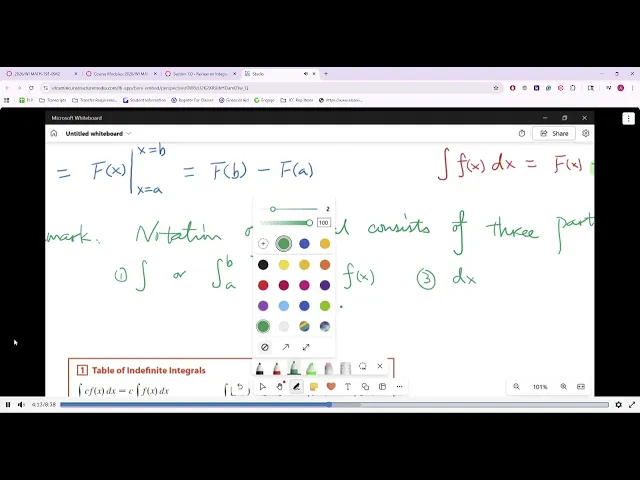
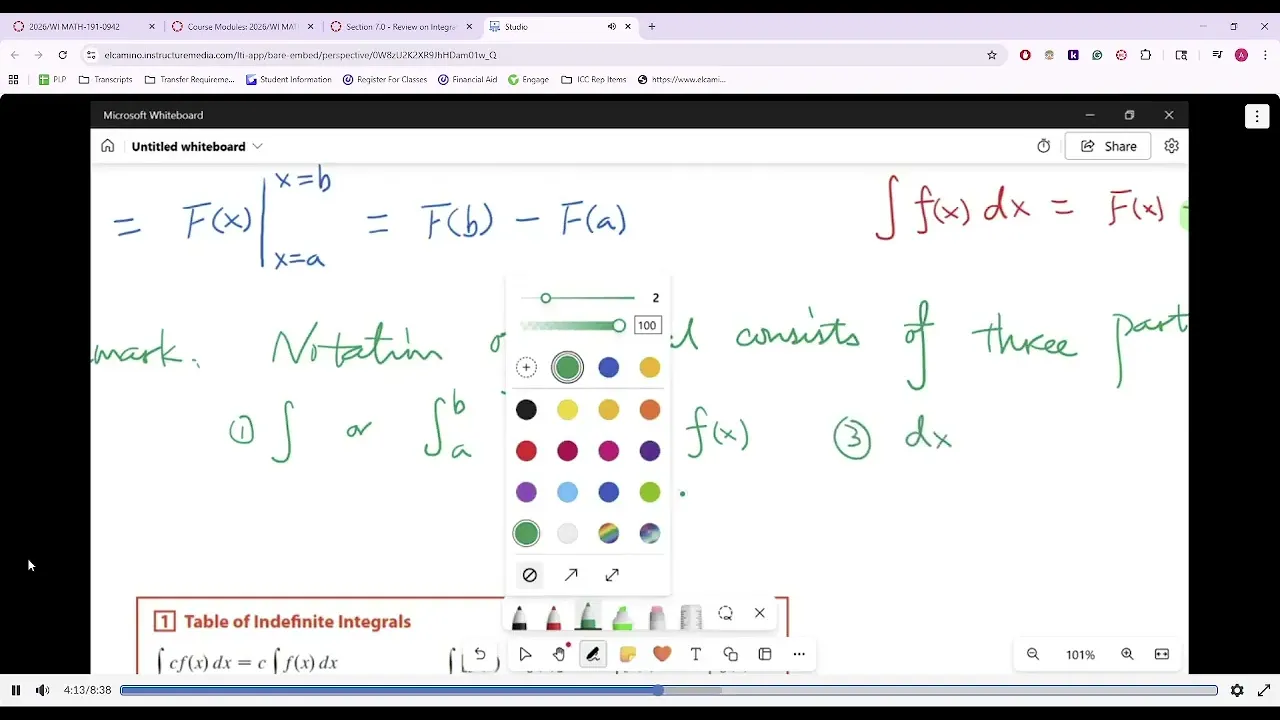
And the fundamental theorem of calculus part two says that the integral from a to b of little f ofx dx equals to f of b minus f of a. Okay. So the format I suggest this find the anti-derivative f ofx.
So supposedly it is f ofx plus c. But since it says, you know, for any anti-derivative, therefore take C to be zero. And then I'm going to draw a bar where I put X = to A, X= to B.
I mean, you can simply say Whoops. You can simply says that, you know, A and B. That's fine.
But I just want to remind me, you know, remind oursel that we're going to substitute x for the value of a and b. Okay. And then evaluate b.
Evaluate capital f at b and then minus the um evaluation of f at a. Okay. So that's the definite integral.
Now for indefinite integral. Okay. For indefinite integral we have this.
Okay. Indefinite integral. So we have integral f ofx dx.
Okay. And um I would say the way to really do it, you know, when we're writing it, we want to keep the C to indicate this is a family. Okay, this is a family of functions.
Okay, so that's um what we have here this f ofx could could contain a c already, but um to emphasize that c we have to have that. Okay. Now, a remark.
Okay. So, notation notation of integral consists of three parts. Do not miss any of them otherwise it is not a correct way of writing it.
Okay. Um this is the first one. So the integrate the integral sign okay or the integral operation two the integral and then three dx.
Okay. So the way that I understand that is this is what I refer to integration operation. This is what we call integral.
This is like uh with respect to okay this is with respect to okay that's what we have okay now when we really apply it you have to make sure that you have this table of indefinite integral you have this table memorized okay have this table memorized and once again um you have to put a C. You have to put a C there. Okay.
Now um for the next part I'd like to talk about some properties very useful properties for definite integral say um properties of definite interval. Okay. um some some of them will be um very useful especially when we're trying to um get the answer.
The first one this one. So integral definite integral of a constant equals to constant times the difference of the bounds. Okay.
Now all those like number two, number three, number four, we are using it. So we're using them without noticing to be honest. Okay.
But if you really want to, you know, trace back to the reason that that's the property. Okay. Now the next two will come in handy if we are trying to prove.
So this one is normally we prefer to go this way. Okay, we split the integral into two parts. Okay, we split the integral into two parts.
Geometrically it means that we split the area the region right the region under the curve into two parts. That's what we're doing. And this property is about like switching the um order of the bounds.
Okay, normally we prefer the lower bound smaller, the upper bound is bigger, but doesn't really matter to be honest. Doesn't really matter. Now, this is extremely important.
Okay, this property about the um even function and odd function it is extremely important and very useful especially when we are evaluating integral um with um polomials. Okay, because if if the function is odd function the integral from a to a will be zero directly and if the function f is even function then the integral from negative a to a of f ofx with respect to dx will be twice of the integral from 0 to a. And we're taking the advantage of zero like you know when we substitute zero into the anti-derivative the calculation can be simple simplified it dramatically.
Okay. So those are some basic properties. Okay.
Now for the um substitution rule um I'm going to talk about this in the next video as well as introducing a new technique because this substitution rule is the so-cal first technique of integration and no matter what when we are dealing with integral make sure that you memorize the table of integration.