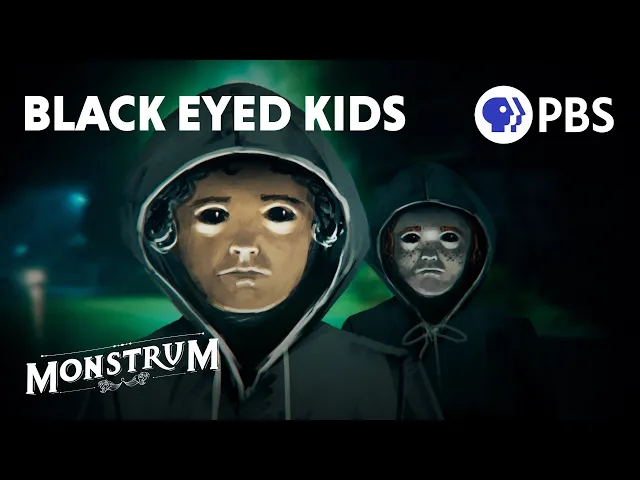
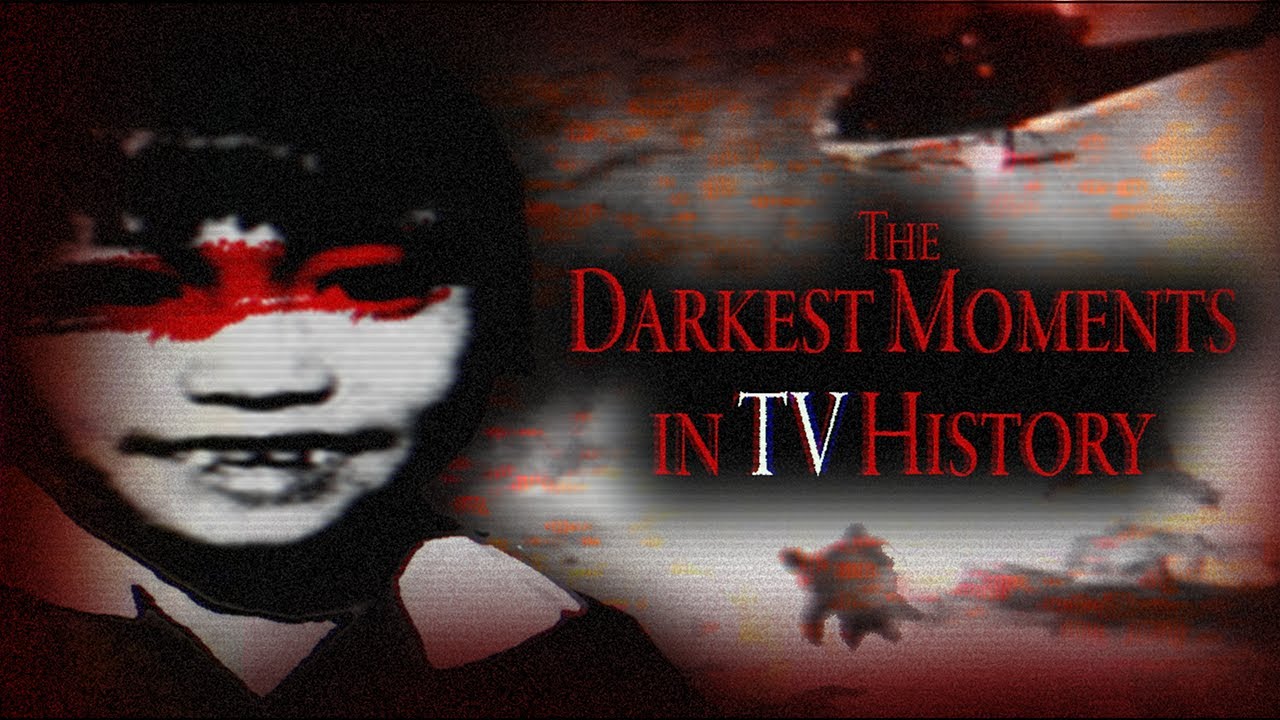
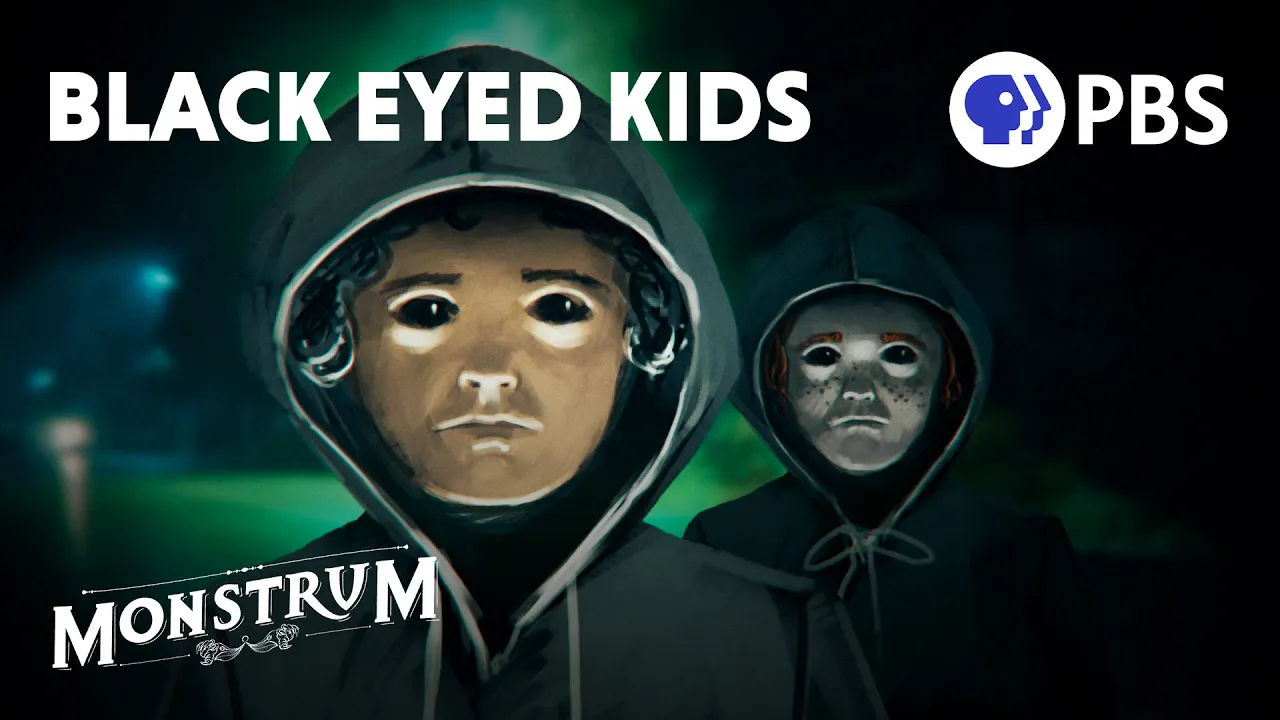
You’re relaxing at home when there’s a knock on the door. You peer through the peephole and see a small child with their hoodie obscuring their face. You open your door and ask if they need help but when they look up—you are staring into black, lifeless eyes.
It’s not hard to figure out why these creatures horrify us so much—it’s in their name. Black-Eyed Children or Black-Eyed Kids, also known as BEK, are modern monsters whose eerie and unnatural appearance and behavior inspire fear. The unusual eyes are unnerving, but it’s the age of these monsters that really amps up the terror.
What is it about “evil” children that freaks us out so much? [Monstrum intro. ] The first report of a Black-Eyed Kid appeared in 1998.
Texan reporter Brian Bethel wrote of an experience he had two years prior while he was sitting in his car near a movie theater. Bethel claimed that his car was approached by two boys around the ages of 9 and 12 wearing hooded sweatshirts. One appeared as an “olive-skinned, curly-headed young man” and the other a “redheaded, pale-skinned, freckled young man.
” Bethel opened the window a crack, and the two boys asked for a ride to their mother’s house to pick up some money so they could see the Mortal Kombat movie. To this day, Bethel recalls that when the second one of the boys spoke he felt an unnatural sense of dread. He pointed out the movie had already started, and they wouldn’t make it back in time, but the boys began to push harder saying things like “They were just two kids” and that “They didn’t have a gun or anything.
” Bethel describes their voices as “mechanical” and “rehearsed. ” The strange experience culminated in terror when he realized each boy had black eyes, “soulless orbs”—with no white showing at all. Understandably unnerved, he began to drive away, but one of the boys banged on his window and angrily cried “We can’t come in unless you tell us it’s OK.
Let us in! ” Bethel sped off, and upon checking his rearview mirror, he noted that the strange, black-eyed children had completely vanished. In 2013 Bethel wrote that his strange experience with these children was originally shared in a private communication with “a small group of friends on an email list” that then was leaked onto the Internet.
I couldn’t find any evidence of this original document, but Bethel’s story is undoubtedly the foundation of all BEK lore. And that’s how an urban legend is born. In eyewitness accounts and other stories, the child-like creatures are frequently wearing hooded clothing, although some versions claim they are dressed in antiquated outfits.
They have odd speech patterns, black eyes, and perhaps most importantly—they just don’t act in a way we think children should. Similar to some vampire legends, it appears that they must be invited into a private space. And to me this creepiness evokes fairy, demon, and changeling vibes.
Though encounters tend to end without lasting effects, some people who’ve had run-ins with these creatures report nightmares and agoraphobia. Through the numerous interviews Bethel conducted as his story circulated online, others across the world began to speak up about their own supposed experiences with other Black-Eyed Children. England in particular seems plagued by Black-Eyed Children and they often serve as fodder for tabloid magazines and newspapers.
Like in 2014, when songwriter and paranormal investigator Lee Brickley was interviewed by the Birmingham Mail about a sighting in Cannock Chase, England. The sensational story was quickly picked up by the British and international press. Brickley had been investigating rumored sightings of a black-eyed ghost in Cannock Chase, including one where a woman and her daughter were out for a walk when they heard screams and spotted a child wandering alone.
The mother ran to catch up but could not find the child. When she turned back around, a girl appearing to be 10-years-old stood there with her hands over her eyes. She asked: Are you okay?
Were you screaming? The girl just dropped her hands and revealed eyes the woman said were “completely black, no iris, no white. ” Startled, the woman grabbed her daughter and jumped back.
When she looked up, expecting to see the child - she’d vanished Interestingly, Brickley also claims that this same girl, whom he calls a “ghost,” had been seen 30 years earlier in 1982 in that same area by his own aunt, something he wrote about in his 2013 book UFOs, Werewolves, & The Pig-Man. Brickley claims that his aunt heard a child crying at night, and following the sobs, she came upon a girl about 6-years-old who looked up at her with completely black eyes, before racing off into the woods. Even a police search for the child turned up nothing.
The sightings of this singular female BEK in Cannock Chase may be connected to a real-life tragedy that influenced Brickley’s identification of the creature as a ghost. Cannock Chase made headlines in the 1960s as the site of one of the largest police investigations in British history—the search for the murderer of three local schoolgirls. Some say the Black-Eyed Child of that area is the ghost of one of the girls, and it would make sense that a young female resident who grew up with those stories would believe she had seen something even if it wasn’t there.
As the urban legend of the Black-Eyed Children evolved out of references to eyewitness accounts of the monsters in the British and American press, their presence across media of all kinds exploded. Numerous YouTube videos claim to show evidence that such creatures exist. The BEK also gained notoriety (and lore expansion) through crowd-funded “fanfiction” texts and productions like Sunshine Girl and the Hunt for Black Eyed Kids, The Black-Eyed Children, and Black Eyed Children: Let Me In.
The comic series B. E. K.
expands the monsters’s threat with the invention of a violent origin story where regular children turn into Black-Eyed Kids if they murder their family. BEK are such great modern folklore because they defy romanticized notions of childhood and the inherent goodness of children—ideas that have evolved over time. The perception of children as innocent and weak, requiring constant adult instruction both morally and physically, is a relatively modern invention.
Prior to the Romantic period, children were largely socially insignificant. They were background characters relegated to chores and familial duties, and little else. Prior to the Romantic period, children were rarely featured in Western literature, and when they did they were often insignificant background characters.
But with the progression of the Industrial Age in the late 18th century, as infant mortality declined, and literature and philosophy regarding child education grew alongside increased scrutiny around child labor—the cultural concept of the child changed. Childhood became a sacred cultural symbol, a time of perceived innocence and happiness when children were not valued for their usefulness or economic viability but rather for their hopeful possibility and vulnerability. This continued to progress and evolve well into the 20th century, when the seismic social shifts following World War II changed everything.
Suddenly, youth culture and scrutiny of popular media’s influence on children became hot topics, and 1950s pop culture was flooded with movies and literature showing “bad kids” and juvenile delinquents. Around this time, the theme of children being born evil became a prevalent one, as we were introduced to ever younger characters with genetically inherited threatening characteristics, like a desire to kill (The Veldt; The Bad Seed) and mind-control (Village of the Damned). Then through the 1970s and all the way into the 90s we see a spike in horror texts with children possessed by demons (The Exorcist) or some other kind of evil entity (Pet Sematary).
They’re even portrayed as the literal offspring of Satan (Rosemary’s Baby), or the Devil himself (The Omen). The examples from this time period seem pointed? The rise of the child villain can be framed in countless ways, including an emerging fear of youth culture stemming from a movement away from traditional, conservative ideas by younger generations.
Others argue it’s a manifestation of Freud’s “Oedipus Complex” where it is the Id, the instinctual, unconscious part of the mind of the child that wants to murder the parent. Or “Peter Pan Syndrome” which locates the child’s desire to kill in an attempt to reject their own future as an adult. And sure, as a generalized explanation for the increase in fictional accounts of terrifying children, these all make sense.
But none of that really explains the other key feature besides age that makes the Black-Eyed Children scary—those black eyes. “The eyes are the window to the soul” is a familiar saying. We communicate with our eyes, and they serve vital survival and social functions, so when they appear unnaturally obscured, we become uncomfortable—even scared.
Scientific research does show that we tend to track the eye movements of others as an evolutionary social mechanism. Perhaps the inability to follow the gaze of the BEK is what adds to their eeriness—and the danger they threaten. They could be looking anywhere—or nowhere.
Unfortunately, this concept was at one point taken to the extreme with a practice called physiognomy, which is predicated on the idea that one’s facial features and eyes could be “read” as a “natural language” that would reveal insight about a person’s character—or supposedly an indication of their ethnic origins. Needless to say, there was a lot of bigotry and racism in the practice. Although it’s roots date back to ancient Chinese, Japanese, and Mesopotamian traditions, the practice held prominent intellectual weight in Europe until the eighteenth century.
Unsurprisingly, the eyes were the most important feature to interpret. According to a late 15th century text (De homine, Galeotto Marzio 1490), eyes with no whites visible were manifestations of unreliability in a person. There is also a larger cultural history of dark eyes or black eyes being tied to inherent evilness or an inner darkness, including many racist depictions of non-white individuals in literature, including children.
Dark or black eyes are also featured in evocations of possession and demonic presence, and often symbolize a lack of control. To me, Black-Eyed Children are the— excuse the pun—the offspring of four main thread: One: our natural wariness of an obscured or unusual gaze; Two: intergenerational conflict; Three: the legacy of malevolent children in horror films; and Four: the ease of which the Internet reinforces urban legends. The power of the internet to expand the reach of these creatures cannot be overstated.
Historically, folklore and folk tradition have been passed on through generations by word of mouth and could even take years to spread from one country or continent to the other; but in modern times the world wide web functions as a global town square, the electronic equivalent of sharing stories by the fire. I know that personally, thanks to a combination of The Children of the Corn and the French film Them [2006], I am terrified of trick-or’-treaters. Which yes, makes me somewhat of a Halloween Grinch—but it also helps me understand why stories of BEK continue to circulate.
Obviously, we know that my fear of trick-or-treaters is largely irrational. And we know that there aren’t soulless children out there trying to kill us. Right?
I mean, the Black-Eyed Kids are always trying to breach the border from outside to. From a public space with witnesses, to a private, more solitary one. Their faces are obscured, their eyes unreadable.
This particular urban legend seems to tap into something deeper. We are genetically programmed to care for and protect the youngest of our species for survival. So when they are portrayed as sinister and dangerous, it is deeply unsettling.
The world of BEK suggests that if you care for children, they will kill you. And if you ignore them, they will haunt you.