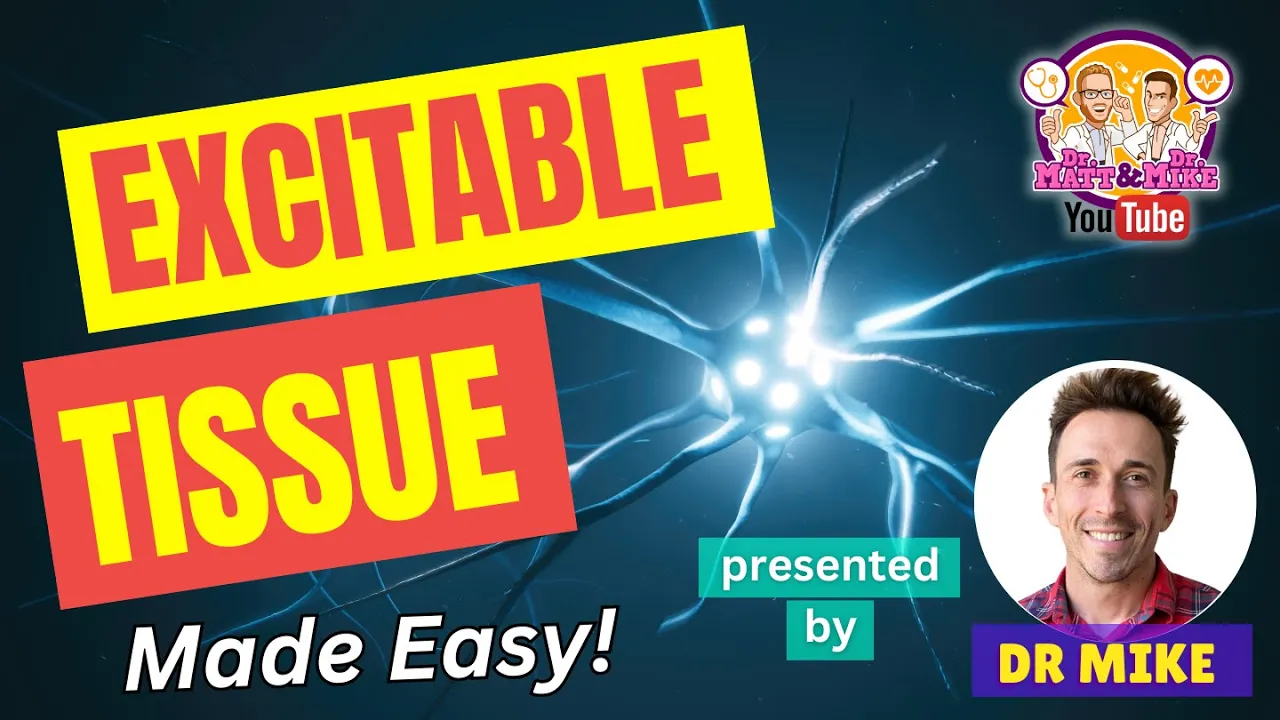
hi everybody Dr Mike here in this video we're taking a look at excitable [Music] tissues now we need to first begin with the fact that there are four major tissue types of the body so the body is made up of epithelial tissue connective tissue nervous tissue and muscle tissue and we need to think to ourselves of these four tissue types which are excitable well the question we have to ask before this is what does excitable tissue mean now excitable tissue are tissues of the body that can either do nothing or be stimulated or excited to
perform a function and generally speaking of those four tissue types two fit that category first of which is going to be nervous so nervous tissue has the capacity to communicate so either neurons don't send signals and nothing happens or they fire off signals and something happens and when they fire off off they fire off because they want to communicate they are fast they are direct so they are there for communication the other tissue type is the muscle tissue and muscle tissue we know can do nothing and be relaxed or it can be stimulated to contract
and if muscle tissue contracts it performs some form of work and that work is generally movement in some regard so if we think about all the different muscle types right we know that we've got sceletal muscle we know that we've got smooth muscle we know that we have cardiac muscle now all of these are muscles that the fibers inside will contract and when they contract let's take scal muscle for example this muscle tends to cross joints so when it contracts and shortens the joint moves the skeleton moves so skeletal muscle is therefore conscious movement of
the skeleton smooth muscle smooth smooth muscle lines hollow organs so it's inside of our blood vessels our genit urinary tract it's inside of our digestive system and when this muscle contracts it can either shorten the Hol tube that it's lining or it can narrow the Hol tube that it's lining and generally will help Propel whatever substance is inside and then cardiac muscle this is the muscle that lines our heart when it contracts it squeezes blood generates force and therefore pushes blood and generates blood pressure so with we' got these two major tissue types that can
do nothing or do something so the question then is what makes them excitable well we need F to first begin with just a general cell if I were to just draw up a cell and this cell is going to be representative of both nervous and muscle tissue so here I have a normal cell and what we need to understand about the cell is that there are various channels and pumps inside of a cell or at least lining the membrane of the cell all right so let's just take this first one what we've got here is
what we call a sodium pottassium pump what this pump does is it takes ATP that the body is generating and it uses that energy to pump outside three sodium 1 2 3 and it exchanges it for two potassium 1 2 now let's have a look at this what is this sodium potassium pump doing by throwing three sodium out it's throwing not only a chemical outside and creating a chemical gradient where most sodium is outside it's also creating a gradient where most potassium is inside so one the sodium potassium pump creates a chemical gradient where sodium
is outside potassium is inside the other thing it does is it creates an electrical gradient because as you can see the sodium has a positive charge associated with it and so does the potassium here we're throwing three positive things outside yet only two positive things inside so if we were to check the charge difference of this cell just across this membrane you would see well the outside is slightly more positive compared to the inside or you could say that the inside is slightly more negative compared to to the outside simply because you've thrown more positive
things outside but what else happens in these excitable tissues is we don't just have a sodium potassium atpa pump we've also got some channels some leaky channels and in the case of neurons and most muscle we've got what we call leaky potassium channels now what these leaky potassium channels have is their lid or their door is creaked open a little bit and because of the process of diffus Fusion where things like to go down their concentration gradient so go from an area where there's a lot of them to where there's not many of them to
try and balance themselves out this potassium will leak through the sodium potassium Channel and leak outside what do you think that means it means it's carrying its positive charge with it making the outside even more positive compared to the inside what we've just generated through these two major channels right or at least a pump and a channel is have generated a charge difference across the membrane of both our nervous and muscle cells if we were to measure that charge difference it's going to be different between neurons and muscle cells in actual fact it can be
different between different types of muscle cells and even different neurons that's why I'm not going to give you a particular value but what you do need to know is that the inside's negative compared to the positive and at rest we call this charge difference the resting membrane potential the resting membrane potential so this is excitable tissues at rest they have a resting membrane potential where the inside is negative compared to the outside let's just quickly draw this up on a graph right so if I were to have a graph like this where I've got time
on the x-axis and we've got molt so a charge on the Y AIS I'm not going to give you any particular values here because it's different compared to different tissues but let's just say right now our resting membrane potential is sitting down here and let's just say down here it's negative up here it's neutral and up here it's positive so right now what we've got with this difference is that this difference is termed polarized right so as you can see this charge difference has a term it's called polarized so let's now have a think it's
polarized and it's sitting here and nothing's happening we also need to remember that for most of these tissue types there are various thresholds so if I were to just draw a line like this as you can see there is a place along this charge gradient where if the charge of the cell from inside to outside changed and hit this threshold the threshold will trigger something and generally the threshold is going to trigger that excitable tissue to do its thing all right so right now it's at rest nothing's happening so as you can see the threshold
tends to be in the more positive than the resting membrane potential again doesn't matter whether it's a neuron or a muscle in this case so what can we see here what could we do to make this hit the threshold to trigger it to do its thing well let's have a think we know that outside we've got most of our sodium inside we've got most of our potassium and outside we've also got most of our calcium as well now another thing you should realize is that outside we've got another thing we've got most of our chloride
where should I draw the chloride let's draw the chloride here we've got most of our negative chloride now this is important these are the major ions you need to keep in mind if I were to open some sodium channels so I'm going to take this charge difference and just show it down here right negative inside positive outside so if I were to open a channel for example that was a sodium Channel what do you think's going to happen sodium is going to rush into the cell down its concentration gradient now if sodium rushes into a
channel down its gradient bringing its positive charge with it what do you think happens to this graph it starts to move up in the positive if enough positive sodium go inside that it hits the threshold this then triggers this excitable tissue to do its function right so for example this might be for a neuron to send a signal down its axon for a muscle it might trigger it to contract now have a think sodium isn't the only positive ion that sits outside we've got other positive ions outside like calcium so if I were to show
calcium and open a calcium channel we're going to have calcium enter as well carrying its positive charge with it the same thing happens if it's down here right it starts to drift up to the threshold so the point I'm trying to get here is that if you open up positively charged ion channels where most of those ions are outside and you get positive ion called cat influx that leads to the cell changing its charge now generally speaking that threshold is the key to open a whole bunch of other channels that make it even more positive
so for example if I were to let some sodium in for example and it let's just say I let some sodium in and it it was enough to hit that threshold that threshold might be the key to open that k Channel calcium's now open and all that calcium comes in and then you get it going up even more positive what we've just done was we've gone from a polarized state where it was positive outside negative inside to making it positive inside this change is called depolarization and the depolarization event is what coincides with the excitable
tissue doing its function so when an excitable tissue depolarizes that is going to be synonymous with it performing its function for neurons the depolarization sends a signal down the axon for muscle tissue that depolarization will correspond with the fibers or fibral inside like the Acton and my and my fibral coming together to form cross links and Contracting that's really important this is the primary way you can excite an excitable tissue but I want you to have a think about something in this case right so let's just say the sodium and the calcium channels they're closed
so there's no sodium and calcium getting inside of these channels close the lid close the lid nothing's happening they're stuck outside it's negative inside this cell compared to the outside that's positive and we're just sitting at our resting membrane potential all right what if I really don't want this thing to fire off what could I do well anything that brings it further away from the threshold so dropping it down here into the more negative will make it less likely to be excitable and how could we do that well we need to make the inside more
negative two major ways we can do that right we could throw more potassium out so maybe we just open more potassium channels if we open more potassium channels more potassium leaks out it drifts down into the more negative what else could we do we could open chloride channels and if we were to open chloride channels chloride is going to come in carrying its negative charge with it making the inside even more negative anything that widens the distance between the charge inside and the threshold well that's going to make it less likely to stimulate less likely
to be excitable and fire off a signal and this is how neurons can work to stop signals this is how some drugs can work to stop sending signals for example and this can happen with muscle tissue and nervous tissue now finally to finish with we need to think about another tissue type which sort of sits under the banner of epithelial tissue and this is what we call endocrine tissue now endocrine tissue this is tissue that can release chemicals that we call hormones into the bloodstream an argument could be made that endocrine tissue is also excitable
and it can work similar to this I'll give you one quick example as to how this is the case all right so if we've got let's just say this cell here is a pancreatic pancreatic beta cell do you know what that means pancreatic beta cell pancreatic beta cell the cells within the pancreas that make insulin we need insulin released into the bloodstream so that tissues like our liver uh so tissues like our muscle and our um fat cells can take glucose in so imagine that this is not a neuron this is not a muscle but
this is a pancreatic beta cell all of this this is what's happening right let's get rid of this calcium channel here but the sodium potassium that's working the potassium e flux to the Leaky Channel that's working and we've got a resting membrane potential in this beta cell just like this now here's the thing with this beta cell we've got insulin present right insulin's made and it's sitting Within These Little vesicles that we want to release we want to release this insulin out of the beta cell into the bloodstream how do we do it well let's
take a look first thing we need to understand is we have glucose we eat food our blood glucose levels go up glucose will bind to glucose receptors which will then allow for the glucose to enter the cell that glucose through various enzymatic reactions will undergo glycolysis and will ultimately turn into something called pyruvate which will then turn into to a cetal COA and that will enter the mitochondria and in the mitochondria it undergo the kreb cycle it under goes a whole bunch of stuff and what It ultimately will produce is ATP it takes a DP
and produces a TP all right that's the role of glucose in this case to produce ATP but I want you to think about this there is a potassium channel right present in this beta cell and this potassium channel has a lid now in actual fact if we were to draw it up like this it's inside like that right now if you've got no glucose entering you've got low ATP and you've got high ADP right because no glucose means you're not making ATP so the ADP ADP remains high and when ADP remains High what it does
is it the ad piece sits on this lid and keeps it open and that allows for pottassium [Music] to leave the cell making it more negative inside the cell which means it makes it less likely right for this cell to be excited when the cell gets excited it releases insulin but here it's not getting excited no glucose means no ATP which means High ADP sits open it is less exciting however when ATP is made because we have thrown glucose in to turn into pyruvate to turn into a cetal COA to into the kreb cycle to
undergo this process and we start producing large amounts of ATP and low ADP while the ADP disappears the lid closes ATP sits on that lid keeping it shut what do you think this means means it means the potassium remains inside right making it more positive and if it becomes positive enough that it hits the threshold this then opens calcium channels and calcium channel Lids will fly in and calcium will enter the beta cell we know that calcium in neurons right when calcium enters neurons right at the end of the neurons towards the synapses it stimul
Ates the release of vesicles that contain neurotransmitters similar thing happening in this case this will then travel to the membrane and it will release insulin into the bloodstream so you can make an argument that in this case endocrine tissue is excitable tissue all right I'm going to leave that there this is a quick 101 and introduction to excitable tissue hi everyone Dr Mike here if you enjoyed this video please hit like And subscribe we've got hundreds of others just like this if you want to contact us please do so on social media we are on
Instagram Twitter and Tik Tok at Dr Mike todorovich at d m i k t o d o r oov i c speak to you soon