Welcome back to our channel, my amazing friends. If you're watching this video right now, it means one thing. You're not just someone who scrolls through life.
You're someone who wants to learn, to grow, to understand the deeper truth of this world. And today, we are bringing you one of the most powerful, emotional, and timeless real life stories in human history. The true story of a man who changed the world without wealth, without power, without an army, without even writing a single book.
A man who lived in poverty, walked barefoot, slept on stone floors. And yet, even 2,500 years later, his words still shake the earth. He was hated by politicians, mocked by the powerful, feared by the system.
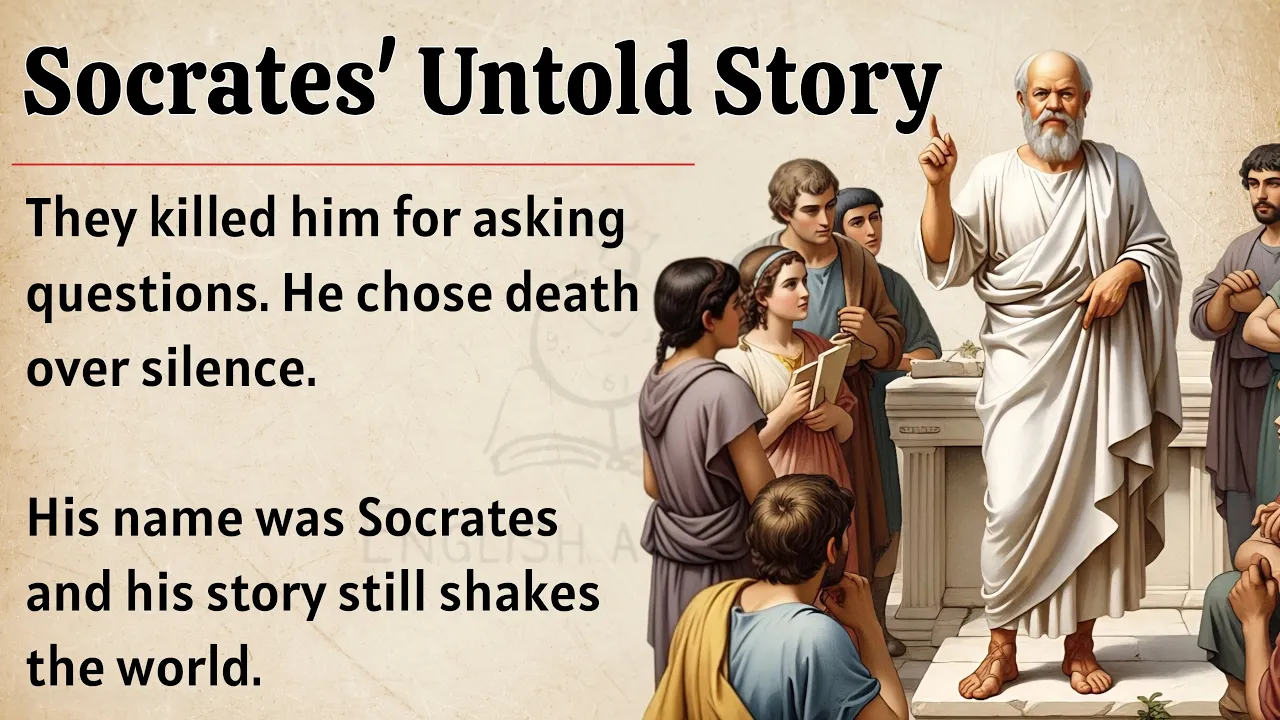
But he did not stop because all he ever wanted was the truth. His name was Socrates. And in this four-part series, I'm going to take you through every detail of his life, his wisdom, his death, and his legacy.
And yes, this video is not only a story. It's also great for your English. You'll learn how to listen, understand, and feel the language with powerful storytelling that will stay with you forever.
So don't just watch this video, feel it, live it, learn from it. Part one, the poor boy who taught the world to think. In the year 470 BC, in the city of Athens, Greece, something strange was happening.
Athens had become a place of power, wealth, beauty, and pride. Statues of God stood tall. Marble temples touched the sky.
Poets, painters, and warriors walked the streets. But under all the golden glory was something missing. The people of Athens were forgetting how to think.
They loved fame. They loved pleasure. They loved money.
But they had no time for the soul. And in the middle of this proud, shining city, a poor, ugly boy was born. His name was Socrates.
Socrates was born into a workingclass family. His father, Sophroniscus, was a stonemason, a builder of walls, pillars, and temples. His mother, Feneriti, was a midwife.
She helped women give birth. But even as a child, Socrates was different. He wasn't interested in statues.
He wasn't impressed by kings. He didn't care how people looked or what clothes they wore. He only cared about one thing.
what is right? What is good? What is real?
He would sit alone for hours thinking. While others chased coins and power, Socrates chased truth. Not a hero, not a celebrity, just a mirror.
Most great men in Athens wore beautiful robes, styled their hair, and gave long speeches to show off. Socrates, he wore the same simple clothes every day. He didn't wear shoes.
He ate very little, only what was needed. He didn't care about fame or money. He once said, "He who is not content with what he has will never be content with more.
" People would laugh at him in the streets. They called him ugly. They said his face looked like a seder.
Wide eyes, big lips, round nose. He was not a charming speaker. He didn't impress crowds with sweet words.
Instead, he asked questions. He would walk up to a rich man and ask, "Do you think you're wise? Then tell me, what is wisdom?
" And the rich man would stumble because Socrates exposed their ignorance not to humiliate them, but to help them. He once said, "I am a gadfly sent by the gods to sting this city and keep it awake. " He was not trying to destroy Athens.
He was trying to wake it up. Socrates never said, "This is the answer. " Instead, he would ask a question and then ask another until the other person realized that their beliefs were shaky, uncertain, weak.
This became known as the Socratic method and even today it's used in modern law, education, psychology and debate. Example, someone says, "Justice means helping your friends and harming your enemies. " Socrates would reply, "But can you be sure who your enemies are?
If you harm someone, do you not make them worse? Is it just to make others worse? " Suddenly the definition of justice falls apart and the person is forced to think deeper.
That's what Socrates wanted, not just answers but understanding. Socrates never wrote a book. He believed truth should not be written and stored.
It should be discovered moment by moment through conversation. He had no classroom. His school was the marketplace, the temples, the gymnasiums, the sidewalks.
He spoke with shoemakers, farmers, politicians, and teenagers. To him, everyone was worthy of deep thinking. And soon, young men began to follow him.
They weren't learning how to get rich. They were learning how to live a good life. Among his students were young men who would later become giants of philosophy.
One of them was Plato. Another was Zenapon. They watched how Socrates lived.
How he never got angry, never chased pleasure, never feared poverty. They listened to his questions, his calm voice, his courage. They didn't just follow a teacher.
They followed a man who lived what he taught. But not everyone was happy. While his students loved him, the powerful men of Athens hated him because Socrates was dangerous.
He wasn't violent. He didn't shout. He didn't insult.
But his questions were like fire. They exposed lies. They made the rich feel weak.
They made the leaders feel small. They made the people think and a city that is built on pride and image doesn't like to be questioned. By the time Socrates reached his 70s, Athens was not the glorious city it used to be.
It had once been the crown of the ancient world, a place of art, democracy, and unmatched beauty. But after the Pelpeneisian war, a long bitter fight between Athens and Sparta, the city was deeply wounded politically, economically, and emotionally. The people had lost their pride.
The democracy was unstable, and there was fear everywhere. Fear of new ideas, fear of rebellion, fear of change. And in times of fear, societies often look for a scapegoat, someone to blame, someone to silence.
And that someone was Socrates. Socrates was not a politician. He didn't run for office.
He didn't lead revolts. He didn't write manifestos. But his very presence, his voice, his questions, his calm defiance felt like a threat.
Because what Socrates questioned was not just individuals. He questioned the entire foundation of Athens, its values, its justice system, its leaders, its understanding of right and wrong. So one day he was charged with two crimes.
One, corrupting the youth of Athens. Two, not believing in the gods of the city. But what did these accusations really mean?
Let's break them down in a way anyone can understand. Many young people in Athens loved Socrates. They followed him.
They watched him question the powerful. They learned to think for themselves. And the leaders of Athens hated that.
Imagine being a politician who lies to the people. And suddenly all the teenagers start asking hard questions. That's what was happening.
Socrates didn't tell young men what to think. He taught them how to think. And for the elite class, that was dangerous.
So instead of admitting their own fear and pride, they said, "He's poisoning the minds of our children. " In truth, Socrates wasn't corrupting youth. He was awakening them.
The second accusation was even more emotional. The people of Athens believed in many gods. Zeus, Athena, Apollo, and more.
Temples filled the city. Sacrifices were made. And belief in the gods was tied to loyalty to Athens.
Socrates never insulted the gods. But he questioned blind faith. He believed in a higher spiritual force, maybe a single divine voice, a moral guide.
He often spoke of a demonian, an inner voice that guided his decisions. This confused people and anything that confused people, they feared. So they said, "He doesn't believe in our gods.
He's teaching others to do the same. " But this wasn't about religion. It was about control.
In 399 BC, Socrates was officially put on trial. It wasn't a small event. It was a massive public drama.
A total of 501 citizens were selected as jurors. No lawyers, no judges. Socrates would speak for himself.
In ancient Athens, public trials were common, but this one was different. This was the mind versus the mob, truth versus fear, philosophy versus politics. People gathered by the hundreds to watch.
His friends came, his students came. The whole city buzzed. And Socrates, now an old man, nearly 70, stood in front of them, wearing his usual simple clothes, no shoes, no wealth, just words.
When Socrates stood to defend himself, everyone expected him to beg for mercy, to cry, to apologize. But what he said shocked them. He didn't beg.
He didn't plead. He stood calm, proud, fearless. I am not here to beg you for my life, he said.
I am here to speak the truth. He looked directly at the jurors and said, if you think I will stop asking questions, challenging lies, and awakening people just to save my life, you are wrong. He explained that he had never corrupted youth.
He had never disrespected the gods. He only asked people to live with integrity, to seek virtue, to love wisdom. And then he said something that shook the whole courtroom.
The unexamined life is not worth living. That one sentence became one of the most powerful quotes in history. It meant if you live without thinking, questioning, reflecting, then you are not truly living.
You are only existing. He reminded Athens. I do this not for myself, but for this city, for the soul of this democracy.
I am your gadfly. I keep you awake. But the city wasn't ready to hear truth.
After the speech, the 501 jurors voted. And by a narrow margin, Socrates was found guilty. But that wasn't the end.
Now came the sentencing. In Athens, after being found guilty, the accused could suggest a punishment for themselves. Socrates could have said, "Exile me.
Find me. Let me live in silence. " But what did Socrates say?
He smiled and suggested this. I should be given free meals for life at the city's expense, just like an Olympic hero. Why?
Because he believed he had done good, not wrong. He finally agreed to a fine, but the jury had already decided. They sentenced him to death to drink a cup of poison hemlock.
The sentence shocked many. Even some jurors regretted their vote. But it was too late.
After the sentence, Socrates was taken to prison. But unlike other prisoners, he did not cry. He did not panic.
He continued to talk with his friends calmly about the soul virtue life and death. He told them, "Do not fear death. It is either a deep peaceful sleep or a journey to another world.
And in both cases, it is good. " He remained there for 30 days. Enough time for anyone else to escape.
Many of his friends begged him to flee. They had the money. They had the plan.
he could live in another city. But Socrates said, "No. If I run away, I destroy everything I've ever taught.
" To him, dying for truth was better than living with fear. And so the city of Athens had spoken. The wisest man in the land was to die.
Not because he was evil, but because he was honest. Not because he hurt people, but because he made them think. As Socrates sat in his prison cell preparing to drink the poison, he had no idea that his story would echo for thousands of years.
The men who killed him would be forgotten, but the man they tried to silence would become immortal. Part two. Socrates last day.
The poison, the prison, and the peace. The city of Athens continued as usual. Markets opened.
Citizens argued in the agora. Sculptors chipped away at marble. But in one small corner of the city, Socrates waited to die.
He sat calmly in a dim, cold prison cell, not angry, not afraid. The man who had shaken the minds of kings and teenagers alike was now surrounded by stone walls, iron bars, and silence. But even here, Socrates had not changed.
His mind was still free. He continued to do what he had always done, think, question, and teach. For most prisoners, the final days would be filled with fear.
But Socrates welcomed his students, friends, and even guards into his cell. And what did they find him doing? Teaching, asking questions, discussing the soul, the afterlife, and virtue.
Among his visitors were Plato, his most famous student, who would later write everything we know about these final days. Crito, a loyal and emotional friend who begged Socrates to escape. Apollodoris, a young follower known for his deep devotion, and many others who couldn't accept the idea that such a great man was being killed by the very city he loved.
They brought him food, wine, and offers of escape. But Socrates refused it all. To him, this was not a tragedy.
It was the final lesson. One day, Crito arrived before sunrise. He whispered with urgency.
Socrates, the guards have been paid. We can take you out of the city. There are friends waiting.
You can live in exile. Please come with me. Any other man would have jumped at this chance.
But not Socrates. He looked at his friend and replied calmly, "Credo, what is more important, living or living rightly? " Creda was confused.
Socrates continued, "If I escape, I prove that my teachings were just empty words that I don't believe in the laws, in justice, in virtue. I have taught all my life that we must obey what is right, even when it hurts. I cannot break the very laws I taught others to respect.
" He knew that if he ran, people would say, "See, even Socrates feared death. Even he didn't believe in his own truth. So he chose to stay not because he wanted to die but because truth must be lived not just spoken.
On the last day of his life, Socrates spent his time in deep conversation with his students. This dialogue is recorded in one of Plato's most famous works, Fedo. They spoke about something most people fear, death.
But Socrates said something no one expected. Death is not the end. It is a release of the soul from the prison of the body.
He explained, "The soul is immortal. The body is just a temporary shell. True philosophers should not fear death because their entire life is spent preparing for it.
" By detaching from physical pleasures and focusing on the soul, his students cried. But Socrates remained peaceful. He told them, "You fear death because you think it is the unknown.
But is it not more frightening to live a life of lies? " He even joked. Yes, joked.
On the day of his death, he said, "If I go to the other world and meet Homer and Hessod, that would be a blessing. I'll finally be able to question Achilles and Adysius. To Socrates, death was not an enemy.
It was a door to deeper knowledge. " As the sun began to set, the time had come. A guard brought in the poison hemlock.
a deadly plant that slowly shuts down the body from the legs upward. Socrates took the cup in his hands. His friends burst into tears, but Socrates looked at them and said gently, "What are you doing, my friends?
" I asked the women to leave so that this would be a quiet ending. Be brave. He raised the cup.
No trembling, no fear, no anger, just peace. He drank it slowly, every drop. Then he walked a few steps.
His legs began to feel heavy. He laid down. A silence fell over the room.
His last request. He turned to Credo and whispered, "We owe a rooster to Eskeipius. Don't forget to pay the debt.
" This was no random sentence. Eskeipius was the god of healing. Socrates was saying, "Death has cured me, not from illness, but from the limitations of the body.
Death is my healing. " And with that, his eyes closed, his breathing slowed, and the greatest philosopher of Athens was gone. As his soul left his body, the room was filled with grief.
Even the guards wept. His students were devastated. Some of them, like Apollodoris, cried out in agony.
Others sat in silence, unable to believe what had just happened. Crito gently touched his hand and whispered, "Is he gone? " No reply, only the quiet sound of mourning.
Outside the prison walls, Athens continued. But something had changed. The man they feared had died with more dignity and truth than anyone they had ever known.
In the days after Socrates death, a heavy silence hung over Athens. Some citizens began to feel guilt. Even some who had voted for his execution said, "We have made a terrible mistake.
" They saw that Socrates had not fought, had not hated, had not begged, and yet he had died more powerful than any general or king. The body of Socrates lay still on a simple prison bench. His hands were calm.
His face was peaceful. There was no sign of pain or fear, only dignity. The students, friends, and followers around him could barely move.
They had spent years listening to this man. Now there was only silence. Outside the prison, Athens carried on.
But something had changed. People began to whisper. Was it right to kill the wisest man in the city?
He harmed no one. He asked questions. He lived simply.
The same citizens who once feared him were now filled with guilt. Because deep down they realized something horrible. They didn't just kill a man.
They killed their conscience. And that guilt, that shame, that emptiness would become the fuel for a new beginning. Among those sitting in the shadows after Socrates death was a young man named Plato.
He had been Socrates student for years. He had watched him ask, teach, walk barefoot, and finally drink the poison with peace. And now Plato felt one thing, responsibility.
He knew what Socrates meant to the world. He knew that if no one told this story, people would forget. The powerful would rewrite history.
The city would erase its guilt. So Plato made a quiet promise. I will write everything, every word, every lesson, every conversation.
The world must know who he was. And from that promise came one of the greatest literary missions in history. Plato began writing a series of texts called dialogues.
These were not dry, boring books filled with definitions and arguments. They were conversations, stories, dramas of thought, philosophy told like a play, easy to follow yet deeply profound. In almost all of them, the main character was Socrates.
Plato brought him back to life on the page, walking in the marketplace, debating with leaders, questioning poets and priests, teaching youth, facing death with honor. Through Plato's words, Socrates became immortal. Even people who never met Socrates, never saw him speak, never lived in Athens, now had a chance to listen to him.
His voice continued, his questions echoed. His fire burned on in every word Plato wrote. Let's look at some of Plato's most famous dialogues where Socrates plays the lead.
Apology. This is not an apology like I'm sorry. It's a defense speech.
The speech Socrates gave during his trial. In this, we hear his calm voice, his belief in truth, his refusal to beg for life. The powerful line, the unexamined life is not worth living.
This dialogue shows the exact moment where philosophy stood face to face with death and refused to run. CTO. This dialogue shows Socrates in prison.
When Crito begs him to escape, we hear Socrates calmly explain why escaping would betray everything he stood for. He says, "It's never right to do wrong, even if others do wrong to you. " This simple but powerful idea is the foundation of modern ethics.
Fido, this is perhaps the most emotional dialogue. It takes place on the final day, the same day he drank the poison. In it, Socrates discusses the soul, life after death, why death is not to be feared, how the body is a temporary prison, why a good life prepares the soul to leave the body peacefully.
Plato's fo is not just philosophy, it's poetry for the mind. It's the story of a man who looked at death and smiled. Plato was not the only student of Socrates.
Another was Zenapon, a soldier, historian, and admirer of his teacher. While Plato focused on the deeper philosophical conversations, Zenapon focused on the day-to-day character of Socrates. He showed Socrates teaching moderation, living simply, being kind to strangers, giving advice to friends, and practicing what he preached.
Xenopon's writings remind us that Socrates was not just a mind. He was a human. A man who smiled, joked, helped others, and lived with great simplicity.
Even though Socrates was gone, the flame of his ideas began to spread across the ancient world. Let's pause and understand what he truly gave the world in simple words. One, the power of questions.
Before Socrates, people thought wisdom was about giving answers. But Socrates showed that real wisdom begins with asking questions. He said, "I am wise because I know that I know nothing.
" This is called intellectual humility, knowing the limits of your knowledge. It teaches us to stay curious, challenge assumptions, never blindly follow tradition, think for ourselves. Even today in universities, courts, interviews, we still use the Socratic method.
Two, virtue is more important than wealth. Socrates lived in a city full of rich merchants and powerful generals. But he said, "An unexamined life chasing pleasure, money, and fame is empty.
" He taught that the greatest goal in life is virtue. Living with honesty, courage, and justice, not having things, but being someone. This idea inspired Christianity, stoicism, Gandhi, Martin Luther King Jr.
and millions who chose truth over comfort. Three, the soul matters more than the body in a world obsessed with war, power, and beauty. Socrates said, "Focus on the health of your soul.
" He reminded humanity, "We are not just flesh. We are not just machines. We have consciousness, reason, moral choice.
This shaped how future generations viewed ethics, death, love, and inner peace. Socrates never opened a school. He never charged money.
He didn't sell teachings. But his student Plato did open a school. It was called the academy, the world's first real university.
And its foundation was built on Socrates ideas. From the academy came another great student, Aristotle. And from Aristotle came science, logic, medicine, politics and more.
So in a way from one poor shoeless man came a chain of thinkers that shaped the entire western world. Socrates died at age 70. He never traveled far.
He never held power. He never earned wealth. But his voice was so honest.
His mind was so fearless and his death was so pure that his name lived longer than kings and conquerors. He taught us that your life is not defined by how long you live but by how deeply you live it. Part three, the immortal voice of Socrates.
How one man's death changed the world. Socrates was gone, his body buried, his voice silenced by poison. But strangely, the world was beginning to hear him louder than ever.
Not through his own words, but through the voices of those who couldn't forget him. And that is where true legacy begins. Some people leave money.
Some people leave statues. Socrates left a way of thinking. And over the next 2,500 years, that way of thinking would become the foundation of Western civilization.
Then came Aristotle, Plato's student, a man of pure logic, science, and observation. He took Socrates method of questioning and applied it to biology, physics, ethics, and politics. He would later teach Alexander the Great who would go on to spread Greek culture and ideas across the world.
And then the world followed. This chain, Socrates, Plato, Aristotle, Alexander, the world became one of the most important chains in human history. Because through it, the spirit of Socrates traveled far beyond Greece.
Socrates never left Athens, but after his death, his name and teachings began spreading across entire continents. The Roman Empire. Many Roman thinkers like Cicero and Senica were deeply influenced by Socrates.
They admired how he lived a simple, fearless life. They studied his method of questioning. They tried to apply his teachings to law, politics, and virtue.
Early Christianity. Believe it or not, many early Christians looked at Socrates as a kind of spiritual hero. A man who died for what he believed.
A man who lived simply. A man who valued the soul over the body. Even St.
Augustine, one of the most important early Christian thinkers, studied Plato. And through Plato, he met Socrates. The Middle Ages.
For hundreds of years, Socrates was studied in monasteries, cathedrals, and universities. His ideas were translated into Latin and Arabic. Even great Muslim scholars like AoE and Avisenna engaged with Socratic thought.
Socrates became a bridge between civilizations, between Greece, Rome, the Islamic Golden Age, and Europe. In the 1400s, Europe entered a period of rediscovery. It was called the Renaissance, which means rebirth.
Artists, scientists, and philosophers began digging through old manuscripts. And who did they find again? [clears throat] Socrates.
They read Plato's dialogues with fresh eyes. They saw a man who asked questions, who challenged authority, who lived for truth. Socrates became the ideal man.
Someone who listened more than he spoke, questioned more than he preached, lived with courage instead of comfort. During this time, Michelangelo painted God reaching for man. But Socrates had already shown that man could reach for truth.
Leonardo da Vinci searched for perfection in nature. But Socrates had already searched for perfection in the soul. Galileo and Newton used observation and questioning, methods born from Socratic thinking.
The Renaissance was not just about art. It was about returning to wisdom. And Socrates stood at the center.
In the 1700s and 1800s, the world entered a new phase, the age of revolutions. People in France, America, and other countries began fighting for freedom, justice, democracy, truth. And guess who became one of their heroes?
Socrates, because he had already shown the world how to stand up to corrupt power, speak even when silenced, die with dignity rather than obey lies. In France, the revolutionaries admired Socrates moral courage. In America, leaders like Thomas Jefferson admired Greek philosophy and its love for reason and liberty.
Even in India, great thinkers like Raja Ram Moan Roy read Western philosophy and were moved by the Socratic spirit of truth seeeking. You might wonder, was Socrates only important in the west? No.
His ideas began appearing in conversations all over the world. Even though different cultures had their own spiritual and philosophical traditions like Confucianism, Buddhism and Hinduism, many modern thinkers in Asia and Africa began engaging with Socratic philosophy. They saw in Socrates a universal message.
Be honest with yourself. Live with purpose. Think deeply.
Question blindly accepted ideas. These are not western ideas. They are human ideas.
Do you know what most universities, classrooms, and even law schools around the world use today? The Socratic method. When a professor asks students, "What do you think about this idea?
Why do you believe that? Can you prove it? What if the opposite is true?
That's Socrates speaking through them. He turned teaching into a conversation, not a lecture. He made learning about thinking, not memorizing.
This is why doctors use questioning to diagnose. Scientists use hypotheses and testing. Lawyers use cross-examination.
Teachers use dialogue instead of commands. Socrates is in every question that makes us smarter. Let's pause here and understand something emotional and real.
Even today, in every country, there are people like Socrates, people who speak the truth, question the system, make people uncomfortable, try to help others think clearly. And many of them are punished just like he was. Journalists are arrested, activists are silenced, students are threatened, teachers are fired, whistleblowers are hunted.
Why? Because truth is still dangerous just like it was in Athens. And that's why Socrates story still matters today.
He reminds us even if they silence your voice, your ideas can live on if they are real, honest, and powerful. Socrates was never trying to be famous. He didn't want followers.
He didn't care about glory. He just wanted people to live better, think deeper, be more human. And if you've ever asked yourself a hard question, refused to lie, followed your conscience instead of the crowd, chosen to do what's right instead of what's easy, then a part of Socrates lives in you.
Socrates was executed to silence him. But that death became a louder voice than any speech because his life was not about shouting. It was about asking.
His death was not about fear. It was about peace. His legacy was not about power.
It was about truth. And as long as truth matters, as long as humans think, as long as one person dares to speak against the mob, Socrates is still alive. Socrates died long ago, but he is not gone.
Because every time someone questions the system, chooses honesty, lives simply, faces fear with peace, speaks even when it's dangerous, thinks for themselves. Socrates is alive. He was not a god, not a prophet, not a warrior.
He was a human being just like you. And that is the most powerful message of all. If one simple man in sandals with no money and no power could change the course of human thought forever, then what about you?
What truth is inside you? What fear must you face? What lie must you question?
What courage is waiting to be born? Let the story of Socrates remind you that you don't have to be perfect. You don't have to be rich.
You don't have to be powerful. You only have to be true. And the world will remember you.