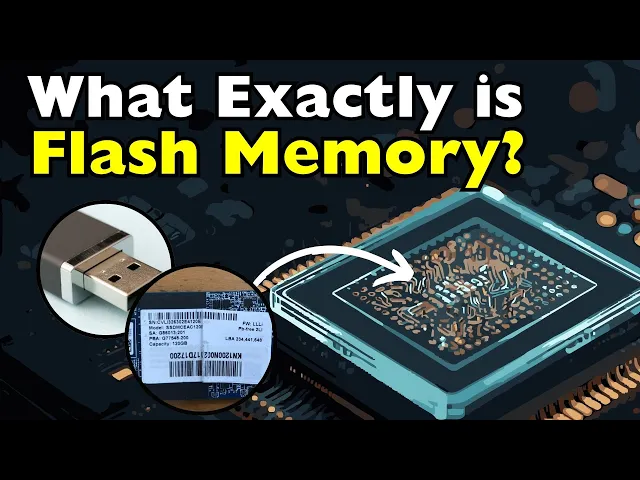
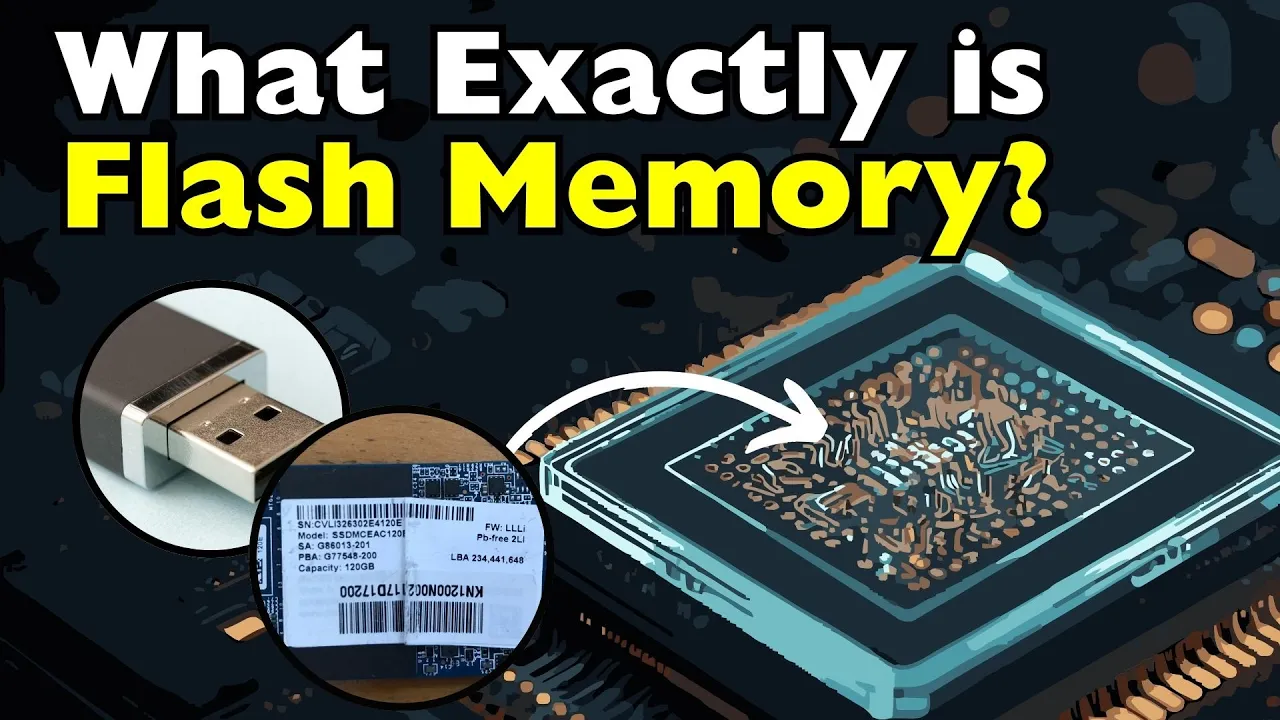
Imagine this. You're taking photos on your phone during a trip, switching songs on your playlist, or saving a school project on a USB drive. All of these everyday actions rely on one silent hero, [music] working tirelessly behind the scenes.
Flash memory. We use it so often that we barely even think about [music] it. But without it, modern digital life would basically fall apart.
So today we're breaking it down. What exactly is flash memory? How does it work?
Let's unravel the science and the simple brilliance behind the tiny memory chips that quietly run our digital lives right here on History of Simple Things. Before we jump deep into the tech, let's start with something simple. Think of flash memory as the brain of your gadgets, but with a twist.
It doesn't forget. Even when the power is off, even when the battery is dead, even when your device crashes at the worst possible time, flash memory still holds on to your data. And that ability to remember without power is exactly what made it revolutionary.
But where did it come from? And why do we trust it so much with our photos, documents, videos, apps, pretty much everything? Let's break this story down in a way that's easy to follow and hard to forget.
Flash memory is a type of nonvolatile storage. That means it stores data even when electricity stops flowing. Unlike RAM, which forgets everything once the power turns off, flash memory acts like a digital notebook that never loses its pages.
At its core, flash memory is made up of millions, sometimes billions of tiny electronic components called cells. Each cell is capable of holding an electric charge and that charge determines whether the cell represents a zero or a one. Put enough of those zeros and ones together and you get files, apps, videos, everything we store digitally.
Flash memory was invented in the 1980s at Toshiba by Dr Fujio Masuoka. His idea was bold. Create a storage technology that combines the best traits of different memory types.
Something fast like RAM, but stable like traditional storage. The first flash memory chips started small, not much more than a few megabytes. But once demand for portable electronics skyrocketed, flash memory became the industry's go-to solution.
Today, the same concept powers SSDs that store terabytes of data. Let's go a little deeper. But don't worry, we're keeping this simple and human friendly.
Inside a flash memory chip, each storage cell works like a tiny container that can trap electrons. When electrons are stored inside, the cell might represent a zero. when they're not, it might represent a one.
Devices read this information by running small electrical checks on those cells. So, whenever you save a photo, record audio, or write a document, your device isn't actually saving the image itself. It's saving a massive pattern of zeros and ones across millions of cells.
What makes flash memory impressive is that it can do this millions of times without breaking. though it does wear out eventually. Each write and erase cycle stresses the cells a bit.
That's why manufacturers design memory controllers that spread the usage across different cells, a technique called wear leveling to help the memory last longer. There are two major types of flash memory, NOR and NAND. Think of Nor Flash as that reliable friend who's slow but super precise.
It lets you read individual cells really quickly, which makes it perfect for running small programs straight from the memory chip. You'll often find NOR Flash in things like routers, microcontrollers, and older smartphones. But here's the catch.
Nor Flash is more expensive and not great at storing huge amounts of data. That's where Nandlash comes in. It's faster, cheaper, and can pack in a lot more data.
Photos, videos, apps, downloads, you name it. NAND is what powers SD cards, USB drives, SSDs, and the storage inside your phone. To put it simply, Nor is the librarian.
Organized, precise, but takes its time. Nandandy is the warehouse worker. Fast, efficient, and ready to handle massive loads.
Whether you realize it or not, you interact with flash memory all day long. It's impossible to survive modern digital life without it. Here are some common places you'll find it.
Smartphones. Your phone probably uses Nandy Flash to store everything from apps to photos to system files. Without flash memory, your phone would either be huge, slow, or lose all its data when turned off.
Not exactly ideal. Solid state drives, SSDs. SSDs replace spinning hard drives because they're shockresistant, faster, and more energy efficient.
USB flash drives. These became popular because they combine portability with durability. Drp your USB drive and your data is still fine.
Try that with an old spinning hard drive and well, you might cry. Smart gadgets, smart watches, drones, TVs, tablets, basically the entire modern gadget family depend on flash memory to store user data and run system software. As amazing as flash memory is, it's not perfect.
Limited write cycles. Flash memory can only be written and erased a certain number of times. With each cycle, cells degrade a bit, but because of wear leveling technology, most people never reach this limit under normal use.
Data degradation over very long periods. If a device sits unused for many years, some cells may lose their charge, not a big issue for everyday gadgets, but important for long-term archiving. Higher cost compared to hard drives.
Although prices have dropped drastically, flash memory is still more expensive per gigabyte than traditional hard drives. So, what exactly is flash memory? It's the silent foundation of the digital world.
A tiny collection of electronic cells that store everything important in your life. It remembers even when your device doesn't. It works fast, lasts long, and makes our gadgets powerful and portable.
Every picture, every file, every saved moment, you owe it all to flash memory. Thank you for watching. If you have suggestions for our next video, feel free to share them in the comments below.
We'll be sure to give you an acknowledgement for your contribution. If you enjoyed this video, please check out our other Bingeable channels. Thank you for joining us on this journey through the history of simple things.
Don't forget to like, subscribe, and stay tuned for more stories woven through the smallest details.