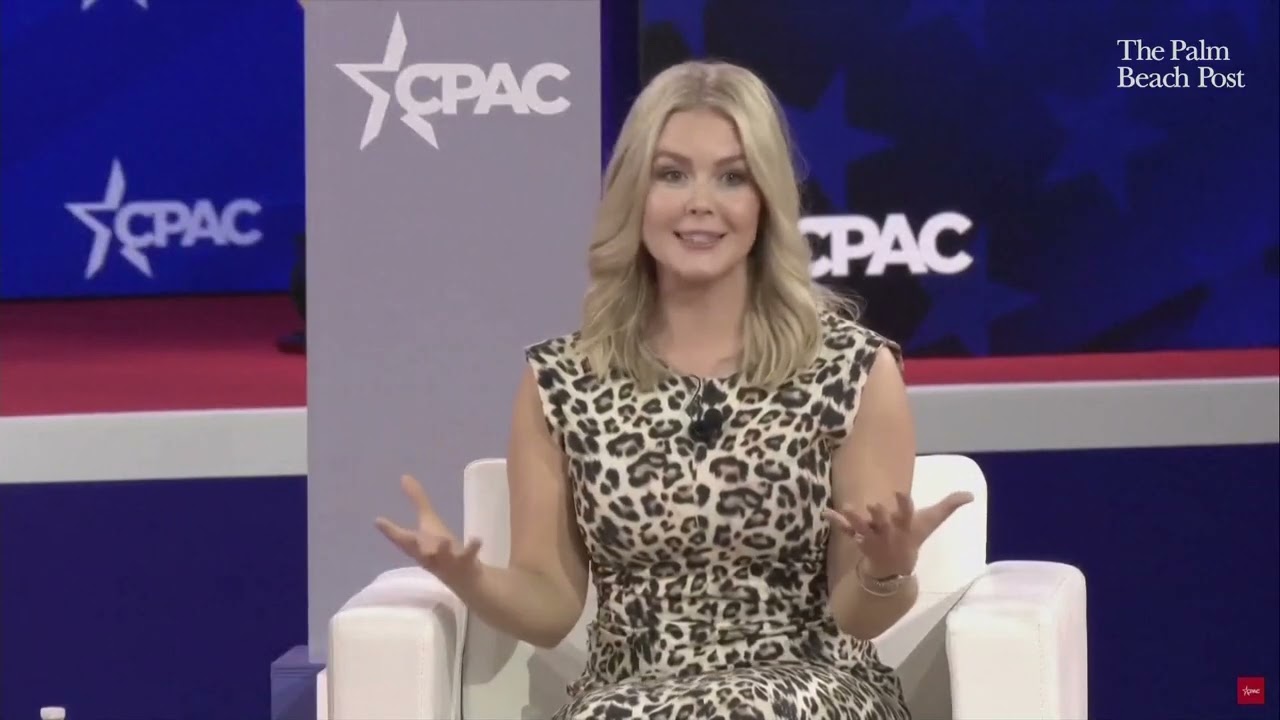
He came prepared to humiliate her on live television, but by the time Karoline Leavitt was done, the entire studio sat in stunned silence. Karoline Leavitt wasn't new to interviews; she had faced tough questions before, handled hostile debates, and stood her ground in conversations designed to shake her. But something about this one felt different.
She first heard about the interview a week ago—an invitation from a high-profile news program, not just any program but one known for its confrontational style, the kind where guests weren't just questioned but cornered. The host, a seasoned journalist with decades in the industry, had a reputation for belittling younger guests, especially those who didn't fit his world view. Caroline had done her research; the journalist, Richard Caldwell, was a veteran in the industry.
He had built his career on his sharp tongue and his ability to expose guests who, in his eyes, weren't qualified to sit across from him. His strategy was simple: provoke, discredit, and if necessary, humiliate. It wasn't about conversation; it was about control, and tonight Caroline was his target.
She could already hear the criticisms before even stepping into the studio: too young, too inexperienced, too ambitious for her own good. The labels didn't bother her. What did was the arrogance of men like Caldwell, who thought they could rattle her with a smirk and a raised eyebrow.
The moment she arrived at the studio, she felt it—the unspoken condescension. The producer, a man in his mid-50s, greeted her with a thin smile that didn't quite reach his eyes. The assistant, a younger woman, offered a hesitant nod but avoided eye contact.
It was the kind of atmosphere that made one thing clear: she wasn't expected to win this exchange. But Caroline wasn't here to play by their expectations. She sat in the makeup chair, barely listening as the stylist brushed powder over her face.
The murmur of voices from the adjacent set filtered through the walls. She could hear Caldwell's distinct voice wrapping up his current segment; his tone was measured, confident—the voice of a man who had spent years controlling the conversation. The stylist adjusted the collar of Caroline's blazer.
"You ready? " Caroline met her reflection in the mirror. She didn't need to answer.
Minutes later, she was led into the studio. The lights were blinding, the air-conditioned room unnaturally cold. The audience, composed mostly of journalists and industry insiders, was seated just beyond the cameras, silent and waiting.
Caldwell was already in his chair, legs crossed, a practiced smile on his face—the kind of smile that wasn't meant to welcome but to challenge. His fingers drummed against the desk as she took her seat. "Karoline Leavitt," he said, stretching out her name as if tasting it for the first time, "welcome to the show.
" She nodded. "Thanks for having me. " His eyes flickered, scanning her as if assessing how much resistance she'd put up.
He leaned forward slightly, his smirk barely concealed. "You've made quite a name for yourself in a short time. Some might say too fast for someone with so little experience.
" Caroline held his gaze; she had expected this—the veiled insult disguised as an observation, the attempt to plant doubt from the very first sentence. "I think experience comes from action, not just years," she said evenly. Caldwell let out a short laugh, shaking his head slightly as if amused.
"Ah, but isn't that what every young upstart says before realizing they're in over their head? " There it was, the first attempt to make her shrink, to make her second guess herself. Caroline didn't blink, but Caldwell wasn't finished.
He tilted his head, fingers tapping the desk in mock curiosity. "I have to ask, though. Do you really believe you've earned a seat at this table, or is this just another case of someone trying to skip the hard work and go straight for the spotlight?
" The air in the studio shifted. This wasn't going to be a conversation; it was going to be a battle. But Caroline had never been one to back down from a fight.
Caldwell leaned back in his chair, fingers steepled, eyes locked onto Caroline like a predator sizing up its prey. The studio felt colder now, the tension thick enough to cut through. Caroline knew this tactic: establish dominance early, make the guest feel like they're defending themselves from the start.
But she wasn't here to play defense. She adjusted her posture, meeting his gaze without hesitation. "I don't believe success has a set timeline," she said.
"If someone is competent, driven, and prepared, why should they have to wait their turn? " Caldwell smirked, shaking his head slightly. "That's the thing about younger generations—always in a rush.
You talk about preparation, but let's be honest; experience matters, and frankly, many would argue that you haven't paid your dues. " Caroline could hear the faint chuckle from someone off-camera—probably a producer. They were expecting her to stumble.
She didn't. "I think the idea of paying dues is often used to keep people in their place," she said. "What exactly are we talking about—a waiting period?
An arbitrary number of years before someone's opinion is valid? Because I don't think the world works that way anymore. " Caldwell's smirk twitched; he had expected a rehearsed response—something polished but predictable.
Instead, she had given him something he couldn't immediately dismiss. He shifted in his chair. "That sounds convenient," he said, his tone laced with condescension.
"But let's be real: people don't just wake up one morning and suddenly deserve a platform. It takes time, hard work, and frankly, wisdom that comes with age. " Caroline let a brief silence pass before responding— not long enough to be awkward, but just enough to let his words settle.
"Wisdom comes from experience," she said, "but experience isn't just about age; it's about what you do with the opportunities you have. " People spend decades in a field and never push beyond the surface. Others come in and, through sheer work ethic, insight, and innovation, make an impact almost immediately.
Caldwell chuckled under his breath, and I assume you put yourself in that second category. She tilted her head slightly. "I'll let my work speak for itself.
" For a split second, Caldwell's expression flickered—just a hint of irritation. She wasn't playing into his game, but he wasn't done yet. He leaned forward, voice lowering slightly.
"Alright then, let's talk about credibility. Some would say that in today's world, it's dangerously easy to build a following without actually knowing what you're talking about. Social media amplifies voices that, in past generations, might have been ignored for a reason.
" A murmur rippled through the studio; the audience wasn't just watching. Now, they were invested. Caroline's heartbeat stayed steady.
She could see where he was trying to steer this: undermine her credibility, paint her as a product of the digital age rather than someone who had earned her place. She didn't flinch. "I think it's funny how people in power always say that right up until the moment someone younger outperforms them," she said.
"Then suddenly, the conversation isn't about skills, facts, or results; it's about credibility. The goal posts move. " Caldwell's smirk didn't fade, but there was something forced about it now.
"So you're saying expertise doesn't matter? " he challenged. "Not at all," she said smoothly.
"I'm saying expertise isn't exclusive to people who've been doing the same thing the same way for decades. Sometimes, the ones asking new questions are the ones actually moving things forward. " Caldwell inhaled slowly, exhaling through his nose.
His next move was clear: he needed to regain control of the conversation, but Caroline had just shifted the balance of power, and she wasn't letting it go. Caldwell straightened in his chair, smoothing an invisible wrinkle from his sleeve. His usual tactics weren't working, and he knew it.
The playful smirk had faded, replaced by something more measured. He wasn't done trying to dismantle her, but now he had to be more careful. "So let's talk specifics," he said, folding his hands.
"You've positioned yourself as a strong voice in your field, but when we look at your background, there's a noticeable lack of—shall we say—traditional credentials. No decades of experience, no long list of past leadership positions. So why should anyone trust your perspective over those who do have that kind of history?
" Caroline could hear the unspoken words: you don't belong here, you haven't earned this. She kept her expression steady. "I think people trust results," she said simply.
"When someone is effective, when they produce meaningful work, people notice. That's true whether you've been in the game for two years or twenty. " Caldwell exhaled sharply through his nose, a half-laugh, half-scoff.
"Results? Let's be honest—public attention doesn't always mean quality. We've seen plenty of people gain influence for the wrong reasons.
" Caroline nodded as if she'd been expecting this. "Absolutely. But if someone stays relevant, if people consistently turn to them for insight, if their work holds up over time, that's when you know it's real.
A few lucky breaks won't sustain someone in the long run; real impact does. " The corners of Caldwell's mouth twitched again, and this time Caroline saw it for what it was: frustration. She wasn't taking the bait; she wasn't fumbling; she wasn't playing the defensive role he had expected.
But he wasn't giving up yet. "Okay," he said, shifting tactics. "But let's acknowledge the elephant in the room.
The world has changed. We live in an era where opinions are thrown around carelessly, where facts are," he made air quotes, "interpreted in whatever way best suits the person saying them. Do you think it's possible that your confidence comes from the fact that, up until now, no one has really challenged you?
" The audience was silent, waiting for her reaction. Caroline let a beat pass before responding. "I think people confuse confidence with arrogance," she said.
"I've been challenged plenty, but being questioned by people who assume they already know better—that's not a real challenge; that's just gatekeeping. " Caldwell blinked. The shift in his expression was subtle, but Caroline caught it.
She continued, "The real test isn't whether someone can challenge me; it's whether, when they do, I hold up under pressure. " Caldwell's fingers tapped against the desk, a quick, unconscious movement. He hadn't expected that answer.
"Alright," he said slowly, "so you believe that results and resilience speak louder than time served? " "I do," she said. He exhaled through his nose, nodding slightly.
"Then let's really put that resilience to the test. " The tone of the conversation had changed; he was about to play his next card, and it was clear he had been saving it for this moment. But Caroline wasn't just holding her ground anymore; she was controlling the conversation, and Caldwell knew it.
Caldwell adjusted his posture, planting both elbows on the desk. He wasn't smirking anymore. The easy, condescending amusement from earlier had been replaced with something colder—a calculated decision to strike harder.
"Alright," he said, his voice measured. "Since you are so confident in your own credibility, let's talk about why people question it. " Caroline didn't respond right away; she knew better than to rush into a trap without seeing the full shape of it.
Caldwell didn't wait; he pulled a sheet of paper from the stack in front of him—a prop meant to make this next part seem like an undeniable fact rather than an opinion. He scanned it for a second before looking back up at her. "You've been accused of pushing narratives that fit your personal agenda rather than sticking strictly to facts.
Some critics have even suggested that you avoid certain details in your arguments because they don't support your perspective. Would you say that's fair criticism? " Caroline didn't.
. . "Blink, he was trying to paint her as dishonest and manipulative.
It wasn't just about her credentials anymore; now he was attacking her integrity. She tilted her head slightly. "I'd say that's an easy accusation to throw around when someone doesn't like what I have to say.
" Caldwell raised an eyebrow, as if amused. "So you're saying your critics just don't like you? " "No," she said.
"I'm saying that when people don't have a strong argument against the substance of what I say, they attack the messenger instead. It's a classic deflection tactic. " Caldwell let out a slow breath through his nose.
"A deflection tactic," he repeated. "So when people claim you've ignored inconvenient facts, they're just making that up? " Caroline leaned forward slightly.
"Here's the thing," she said. "Every discussion has multiple angles. I focus on the parts that are most relevant to my point, just like you do, just like every journalist does.
That's not deception; that's framing. And if someone thinks I left out something important, they're free to bring it up, and I'll address it. " Caldwell's fingers curled slightly against the edge of the paper.
He had expected her to flinch, to scramble for a defense. Instead, she was meeting him head-on. He tried again.
"All right, but let's take this beyond just framing. You've built a platform on confidence, on the idea that you have answers. But what happens when you're wrong?
Have you ever admitted to making a mistake? " The way he said it made it clear he wanted her to hesitate. He wanted the audience to see her falter, even for a moment.
Caroline didn't. "Of course," she said easily. "I've been wrong before.
That's part of learning. But here's the difference: when I realize I'm wrong, I don't double down to save face. I correct it and move forward.
" Caldwell's jaw tightened just slightly before he forced another smirk. "And yet some people say you never acknowledge your mistakes. " Caroline smiled just a little.
"Some people say a lot of things," she said. "That doesn't make them true. " The audience chuckled, not at her, but at him.
The balance of the conversation had shifted again, and he could feel it. He tapped the paper against the desk, exhaling. He wasn't out of moves yet, but Caroline could see it now—the frustration beneath the surface.
"So let's get this straight," he said. "You're young, you're outspoken, you challenge conventional wisdom, and yet you think none of the criticism against you holds weight? " Caroline shook her head slightly.
"That's not what I said," she answered. "I think criticism is valuable, but not all criticism is honest. Some of it comes from people who just don't want to hear a perspective that challenges their own.
" Caldwell opened his mouth, but she kept going. "And let's be real," she added. "People in your position, they've spent years deciding who gets to be taken seriously and who doesn't.
So when someone comes along and doesn't wait for permission, doesn't play by the old rules, you call it lack of credibility. But what you're really upset about is losing control of the conversation. " A few people in the audience murmured.
Caldwell's jaw shifted just slightly; she had hit a nerve. But instead of backing down, Caldwell forced another tight smile. He had one last play left—a desperate one.
"Then let's talk about control," he said, "because right now you're sitting in a seat that a lot of people don't think you deserve. And I have to ask: what happens when they're right? " The studio fell silent.
It was a direct challenge, a final push to knock her off balance. But Caroline had never been more steady. Caldwell's words hung in the air.
The studio was silent: the audience, the crew, even the off-camera panelists who had been quietly murmuring before—everyone was waiting. Caroline met his gaze, steady and unshaken. "That's the real question, isn't it?
" she said, her voice even. "Not whether I'm competent, not whether my arguments hold up, but whether I deserve to be here. That's what this has been about from the start.
" Caldwell leaned forward slightly, latching onto the word. "Exactly, because there's a difference between being loud and being qualified, between being popular and actually earning respect. " Caroline exhaled through her nose, a short breath—not frustration, but something close to amusement.
She wasn't rattled; if anything, she looked stronger than she had at the start. "Respect isn't given, Richard," she said. "It's taken.
" The weight of those three words landed. Even Caldwell's smirk faltered for half a second before he recovered. Caroline continued, her voice unwavering.
"You talk about qualifications, but let's be honest: a lot of people in positions of power didn't earn their spot either. They were born into the right family, knew the right people, said the right things to the right audience, and you never questioned whether they deserve to be there. But when someone like me—who built their own platform, who doesn't wait for permission—comes along, suddenly it's about qualifications.
" The audience shifted; some nodded, a few murmured. Caldwell crossed his arms. "So you think you're above criticism?
" "No," Caroline said instantly. "I think criticism should be fair. And the reality is people like me will always be held to a different standard.
We're expected to be twice as sharp, twice as prepared, twice as perfect, just to get half the respect. And when we still manage to prove ourselves, the goal posts move. " Caldwell's jaw tensed.
Caroline didn't stop. "You call it arrogance," she said. "I call it not waiting to be given a seat at a table that was never built for me.
" Another murmur from the audience. This wasn't just an interview anymore; it was a reckoning. Caldwell exhaled, rolling his shoulders back.
"That's a strong answer," he admitted. "But confidence isn't proof. If you're wrong about something, are you willing to admit it?
" She gave a small nod. " Absolutely, but being questioned by people who've already made up their mind about me—that's not the same thing as being wrong. Caldwell didn't move.
For the first time in the entire interview, he had nothing to say. The silence stretched, and the audience could feel it: the shift, the unraveling of the narrative Caldwell had been trying to control. Caroline watched him, waiting.
Nothing. No smirk, no comeback, just silence. The cameras captured it all.
Finally, Caldwell let out a slow breath. He glanced at his notes, flipping a page, then set them down. The energy in the room had shifted, and he knew it.
Caroline did, too; she had won. The studio remained still, the weight of Caroline's words settling into every corner of the room, leaving an undeniable tension in its wake—the kind of moment that couldn't be manufactured, the kind that changes the course of a conversation entirely. Caldwell's fingers twitched slightly where they rested on the desk; he was searching for a way to regain control, for something sharp enough to cut through the silence.
But the problem was, there was nothing left to say. The crew exchanged glances; the producers, seated just beyond the cameras, looked at one another, waiting for Caldwell to break the moment. He didn't.
He couldn't. One of the panelists off-camera cleared their throat as if preparing to step in, but even they hesitated because to step in now would only confirm what everyone watching already knew: this wasn't just an interview anymore; this was a moment. Caroline didn't move.
She didn't feel the silence; she had no need to, because sometimes the most powerful thing you can do after making your point is to let people sit with it. The seconds ticked by—too long for TV, long enough for the audience at home to feel it. Caldwell's lips parted slightly, then pressed into a thin line.
His hand found the stack of papers he had relied on throughout the interview, but this time he didn't even look at them. He just lifted them, then let them fall against the desk. The message was clear: he was out of moves.
And Caroline? She was still right where she started—steady, unshaken. One of the producers, likely recognizing the moment for what it was, quickly gestured toward the control booth.
The camera angle shifted, cutting to a wider shot—one that framed the entire studio: the audience, the panelists, Caldwell sitting with his shoulders slightly tenser than before, and Caroline—unmoved, unapologetic, unstoppable. Finally, Caldwell let out a quiet chuckle—forced, empty. "Well," he said, voice carefully controlled, "that's certainly one way to look at it.
" Caroline just smiled. Caldwell straightened his papers, buying himself a second, then, grasping for the only lifeline he had left, he glanced toward the cameras. "We'll leave it at that," he said, shifting gears.
"Karoline Leavitt, thank you for your time. " But everyone watching knew the truth: this wasn't just an interview; this was a statement, and Caroline had made hers louder than Caldwell ever expected. The moment the cameras cut, the energy in the studio shifted.
The tension didn't disappear; it just changed. Producers whispered to each other. The sound tech removed his headset a little too slowly, as if still processing what had just happened.
A few panelists exchanged looks but said nothing. Even Caldwell, who normally ended his interviews with a firm handshake and a smooth transition to commercial, sat for a beat too long before pushing back his chair. Caroline?
She took her time. She didn't rush to leave; she didn't scramble to check her phone or shake hands with the producers. She let the moment settle because she knew what had just happened.
Everyone in the room did. A junior assistant, who had barely spoken to her when she first arrived, stepped forward, hesitant. "That was really something," she said.
Caroline glanced at her, offering a small smile. "Yeah," she said. No need to say more.
She gathered her things. As she walked past the set, past the lingering crew members, she caught snippets of conversation: "She handled that better than I thought she would," and "Caldwell really couldn't land that last one, huh; she never backed down, not once. " Caroline didn't react.
She didn't need to. Her job here was done. As she stepped outside into the cool evening air, she finally pulled out her phone.
Her notifications were exploding; clips from the interview were already circulating. People were talking, not just about what she said, but about how she said it—about the fact that she hadn't flinched, stumbled, or shrunk, that she had walked into a space designed to doubt her and left without giving them the satisfaction. And that's the lesson: the truth is, people will always question you—not because you're wrong, but because you're different, because you don't fit their mold, because you didn't wait for them to approve of you before deciding to take up space.
They'll challenge your credentials, your intelligence, your right to be in the room. And when that happens, you have two choices: you can shrink, apologize for existing, try to prove to them on their terms that you belong, or you can do what Caroline did: stand your ground, stay steady, and let your presence do the talking. Because at the end of the day, people respect what they can't shake.
And Caroline? She left that studio unshaken. If you've ever felt like someone was trying to put you in your place, remember this moment.
Remember that your confidence isn't arrogance, your presence isn't something to apologize for. And if you ever find yourself sitting across from someone like Caldwell, don't flinch, don't fold, and most importantly, don't let them decide if you deserve to be there—because you already do. Subscribe for more powerful stories like this.