- El Salvador is across the world from Germany. The two countries have vastly different cultures. And in 1941, most Germans hadn't been to or even heard of El Salvador.
But as the Nazis marched across Europe, thousands of Jews suddenly found themselves citizens of a country they knew very little about. Because from the Salvadoran consulate in Switzerland, an unlikely hero was secretly churning out fake papers for Europe's Jews. His superiors tried to stop him.
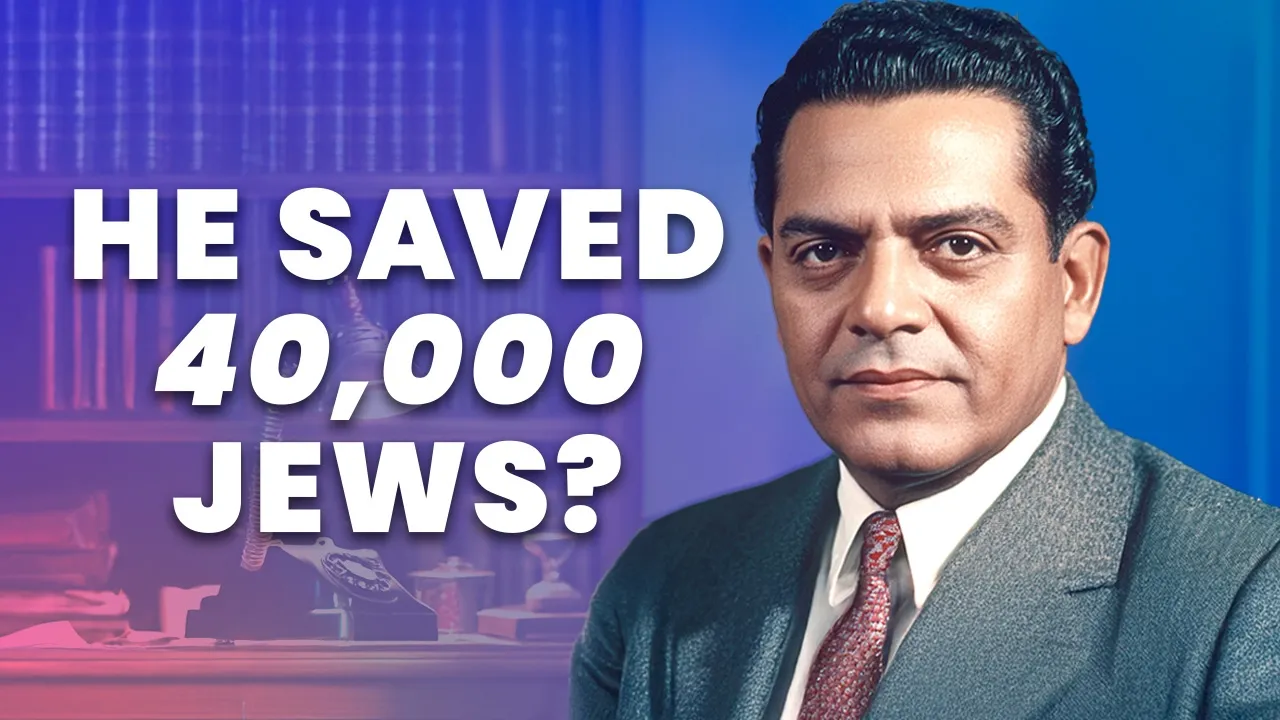
His government tried to muzzle him, but he didn't care. So why would a Salvadoran colonel defy his country to save thousands of Jews. (dramatic music) José Arturo Castellanos Contreras was a military man through and through.
Like his father, he was a career officer in the Salvadoran Army, protecting the country's authoritarian government. But despite his background, Contreras was sensitive. He knew he lived in an unequal society where women and indigenous peoples were treated like second class citizens, and the poor could barely feed their families.
So he began to speak out, calling on his fascist government to do more for its oppressed citizens. El Salvador's dictator didn't like that. Contreras was a threat, a political rival that had to be neutralized.
So Martinez sent him abroad to act as Consul General in Europe. That's how Contreras found himself in Hamburg, Germany, trying to salvage a diplomatic relationship that had grown rocky. Within the year, Germany would invade Poland and El Salvador would sever all diplomatic ties, leaving Contreras out of a job.
But even before the outbreak of World War II, the Nazis were doing their best to ruin people's lives. Contreras was disgusted to learn that German Jews had been stripped of their citizenship, barred from their professions and kicked out of their schools. That disgust turned to horror during the "Night of Broken Glass", when German citizens tore through the streets, torching synagogues, smashing Jewish storefronts and homes, and beating up any Jews they could find.
Meanwhile, the Nazis rounded up tens of thousands of Jewish men shipping them off to labor camps. Contreras had been sent away from El Salvador because of his pesky commitment to social justice. Now, here he was outta the frying pan and into the fire, watching Nazis packed Jewish men into boxcars to be used as slave labor.
So he wrote to the Salvadoran Foreign Minister begging for permission to issue visas to German Jews trying to flee Europe. But the minister refused his request and transferred him to Switzerland, hoping to shut him up. Instead, he sent Contreras on a collision course against the full might of the Nazi war machine.
In 1942, Contreras ran into an old acquaintance in Geneva. When they'd first met, György Mandl had been a successful businessman. Now he was just another Jewish refugee who had fled his home to seek refuge in Switzerland.
He'd made it to safety, but he couldn't rest easy. Back in Bucharest, his friends and family were in mortal danger. Desperate, he begged Contreras for help.
Contreras was a diplomat. Surely he could do something. So Contreras tried.
Yet again, he pleaded with El Salvador's Minister of Foreign Affairs for permission to grant visas to Jewish refugees. Yet again, he was denied. He could've given up, could have told his old friend, György, "Sorry, I can't help you," but that's not what happened.
Instead, he called up a fellow diplomat to help him forge a series of Salvadoran papers for his old friend. Overnight, György Mandl became Jorge Mantello, and then for good measure, the former businessman got a promotion becoming First Secretary to the Salvadoran Consul in Geneva. It was a bogus position, of course, but it was an extra layer of protection for Mandl/Mantello.
And it came just in time because the Gestapo was breathing down Mandl's neck. When they demanded to see his papers, all they saw was a foreign sounding name and a fancy title. So even though Mandl didn't speak a word of Spanish, the Gestapo let him go.
Contreras had just saved an entire family from being shipped off to Auschwitz. This was the moment that Contreras and Mandl realized they could save other Jews. All they needed were forged Salvadoran papers.
The two went into overdrive, secretly producing fake Salvadoran passports and visas for European Jews. Soon, thousands of Jews across central Europe found themselves Salvadoran citizens, even though they never stepped foot in the tiny central American country. But things were getting worse for Europe's Jews.
The Warsaw Ghetto had been liquidated. The so-called "Final Solution" had entered its deadliest phase, and Jews all over Europe were desperate for a way out. Some were paying vast sums for Latin American visas, risking their lives and their entire savings to get a visa on the black market.
But Contreras and Mandl charged next to nothing, even though they needed to pay the typists who were churning out passports around the clock. Most of those funds came straight from Contreras' own pockets. Still, there was simply no way this small operation could issue enough visas for everyone who needed them.
The clock was ticking, lives hung in the balance, so they came up with an alternative. Secretly, the two men began distributing over 13,000 pre-signed blank nationality certificates, each of which could cover an entire family. The papers signed by Mandl and stamped by other consulates in Geneva were carried through a network of couriers to Jews across Europe.
The recipients would then place their own data and photos in the certificates, saving precious time. With these papers in hand, Jews were officially entitled to the protection of the International Red Cross, which safeguarded the rights of citizens of neutral countries. Once they had their certificates in hand, these Jews turned to Contreras who helped them find refuge in international safe houses.
And in the meantime, he used diplomatic authority to convince Swiss and Hungarian officials that these documents were legitimate. The ruse worked. Over the course of two years, Contreras and Mandl managed to save between 30,000 and 50,000 Jews from extermination camps.
In November of 1944, the Salvadoran Minister of Foreign Relations legally validated all of the documents Contreras and Mandl had issued. At last Contreras could take a deep breath. He didn't speak about his actions during the war.
In fact, the world might have even forgot this hero entirely if a Swiss woman hadn't found a mysterious suitcase in her basement full of blank Salvadoran nationality certificates. Slowly the story began to trickle out. It finally reached the ears of American Jewish writer Leon Uris, who managed to track down Contreras for an interview.
By then, he was 82 years old, just an unknown Salvadoran grandpa. But he agreed to talk to Uris. In a rare interview, he told a writer everything, how Mandl approached him, how he begged his country's government for help, how he'd covered most of the costs by himself.
He explained the courier system that brought the papers to Jews across Europe, but he refused to accept the title of hero saying that anyone would've done the same. He never got the public recognition he deserved during his life. It would take another two decades before the Jewish public would learn his name.
But in 1999, the Jerusalem City Council named a street in his honor, El Salvador Street. And in the early 2000s, the Jewish community of El Salvador partnered with Contreras' family to submit evidence of his actions to Yad Vashem, which recognized him as a Righteous Among the Nations. Contreras kept quiet about his heroism, but his descendants are loud and proud.
His grandsons created a live film concerto called "The Rescue", which recounts their grandfather's heroism. Meanwhile, Contreras' daughter continues to share her father's story, insisting it is more important than ever. Too many people, including world leaders, minimize or deny the Holocaust.
And in doing so, they erase the legacy of a man who had the courage to stand up for what was right, even if he stood alone.