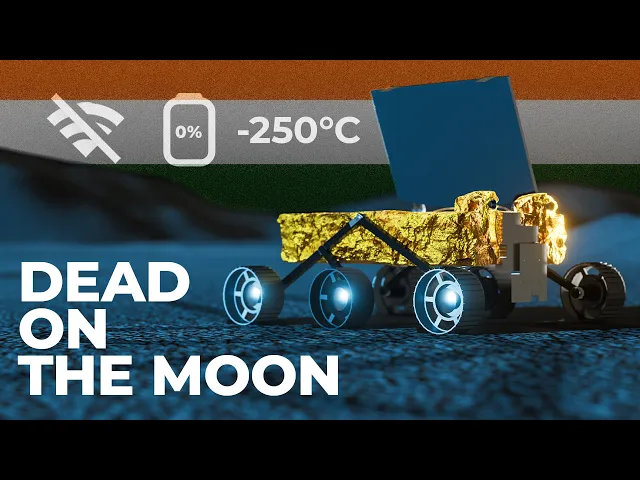
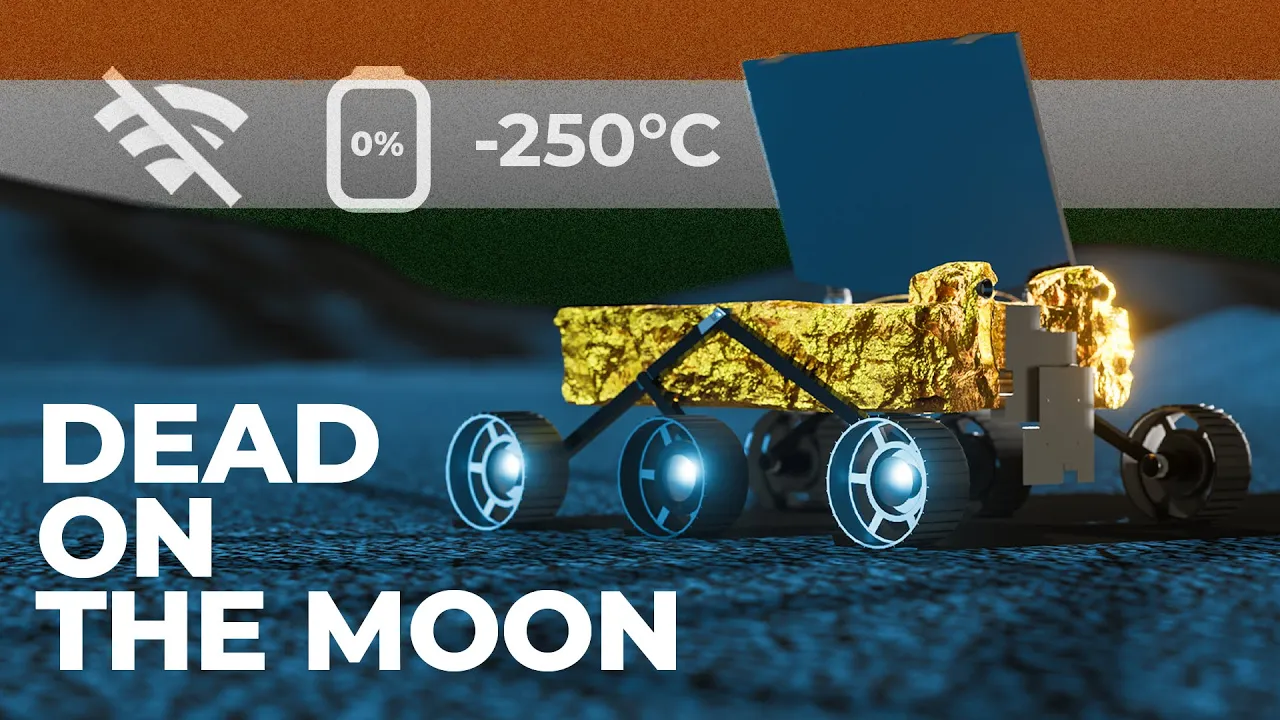
The Chandrayaan spacecraft and its rover have been silent on the Moon now for a couple of weeks. The Moon is an incredibly harsh environment. A single night on the Moon lasts for 14 days meaning the rover and its electronics have to survive mind bogglingly cold temperatures.
Without any power to keep it alive, the rover and its lander are most likely dead. But, when the Sun comes up again, there is a small chance that they could come back to life. The Chandrayaan mission was incredible in many ways.
With just 14 days to live, it performed experiments in an area of the Moon that we know very little about. Not only was it India’s first successful landing on the Moon but they also did it with an extremely low budget. The entire cost for the mission came to just $75,000,000.
Less than half of what China spent on their lunar rover. So what’s going to happen to Pragyan? First we have to look at where Pragyan actually is.
In recent years, space agencies around the world have been racing to get to one particular part of the Moon, the South Pole. It’s predicted that this part of the Moon has ice just below the surface, which could be used for drinking water and rocket fuel. The Moon is already a hostile place, but the poles of the Moon are even worse.
In fact, the coldest temperature ever recorded in our Solar System was in Hermite Crater near the Moon’s north pole. Since parts of this crater never receive any sunlight, the temperature was an incredible -250 degrees. Although Chandrayaan didn’t land directly at the South Pole, it still has to deal with much lower temperatures and of course, lunar night.
But why is the night so long? The Moon orbits the Earth around every 28 days. The side of the Moon that we see from Earth is locked to Earth, meaning this face is always pointing towards us.
And so for 14 days, this face is visible to the Sun. But for the following 14 days, it’s facing away from the Sun. And so with just 14 days of sunlight, the rover had to get busy.
As soon as it landed on the surface, the rover was released and it immediately rotated so that its solar array was facing the Sun. This solar array generates just 50 watts of power, enough to move the rover at around 1 cm per second. The rover has no way of sending its data directly to Earth, so it sends it back to the lander via a small antenna.
From there, the data is sent up to an orbiter and then onwards to Earth. Because of this, the rover has to stay within 500 m. of the lander in order to still communicate.
The rover is largely autonomous. The team in India decides where they want it to go and the rover tries to get there in the safest way possible. It has two cameras on the front of the vehicle which it uses to look out for dangerous obstacles.
This system saved the rover just a few days into the mission when it was heading straight towards a 4 meter wide crater. The rover stopped and turned to head in a different direction. That’s when it came across this old warship.
Just kidding … It didn't find anything like this. But you can find incredible ships like this on War Thunder, the sponsor of today’s video. War Thunder is a free-to-play military action game where you can battle other players online in these epic arenas.
Whether you want to fight on the ground in a Soviet tank, fly above in an American fighter jet or take over a giant naval ship, War Thunder has you covered with a wide range of vehicles from over 10 nations. In fact, there is an entire War Thunder wikipedia site with super in-depth details on every vehicle in the game, like the USS Nevada, which Chandrayaan totally found on the Moon. Each vehicle can be improved and upgraded with extra armor and equipment.
New things are constantly being added to the game, so there are always fresh vehicles to try out. You can play War Thunder on PC, Xbox, Playstation and Mac and best of all, it’s completely free. Download War Thunder today using the link in the description.
All new players and those that haven’t played for half a year will get special bonus vehicles and a premium account for a week. In order for Chandrayaan and its rover to survive lunar night, it has to withstand -200 degree temperatures for a whole two weeks. The rover has a small 10 amp-hour battery but this is nowhere near enough to last for the full 14 days.
Without power, it has no way of running its heaters, a crucial part in keeping all of its electronics alive. Because of India’s tight budget, the electronics weren’t designed to survive the extreme temperatures of the lunar night, and so the rover’s survival is down to fate. China’s rover on the other hand has an RHU, a small device that can heat the rover during the lunar night.
This device contains a radioactive material called plutonium-238. As the material decays, it produces a constant source of heat which can be redirected throughout the rover. The problem is, this material is extremely expensive.
And so, India’s rover had no choice but to simply go to sleep. Nevertheless, India’s 14 days on the Moon were a huge success. A few days in, the rover used a laser detector to find out what elements were present in the Lunar surface.
This works by firing the laser into the surface, turning a small portion of it into plasma. The light from that plasma is then captured and broken down into a spectrum. This basically shows the level of light at different wavelengths.
Every element emits and absorbs light at specific wavelengths, creating a recognizable line on the spectrum. By comparing these lines to the ones found in the plasma, we can determine which elements are present. But what did they find?
Well they found a bunch of elements; things like aluminum, sulfur, iron, silicon and even oxygen. These are all incredibly useful things that humans could mine if they were on the Moon. But perhaps the most impressive experiment from Chandrayaan’s 14 days on the Moon happened below the surface.
Our knowledge of how the Moon formed and its structure beneath the surface is largely theoretical. We believe it has a solid iron core, surrounded by a mantle and a crust. But there is still so much we don’t know about our Moon.
And so, to find out what’s going on below the surface, the Chandrayaan lander drilled a temperature sensor 10 centimeters into the ground. Scientists expected the surface at the South Pole to be cool, around 20 degrees. But Chandrayaan found that the surface was much hotter, at around 60 degrees.
And just 8 centimeters below the surface, the temperature plummeted all the way to -10 degrees, a 70 degree difference. On Earth at this depth, the temperature would only change by a few degrees. Being able to conduct experiments on the actual surface of the Moon is incredibly valuable and something that only India and China have achieved in the 21st century.
On top of finding oxygen and sulfur, Pragyan is also on the lookout for hydrogen, another key sign that ice exists below the surface. But before the rover or lander could do any more work, they had to prepare for night-time. In order to give the rover the best chance of survival, engineers calculated exactly where the Sun would rise in 14 days and they positioned the rover’s solar panel to face that direction.
Then, on the 3rd of September, both the rover and the lander were put to sleep. After a while, their batteries were depleted and all communication with Earth was shut off. As of the time of this video, both vehicles have been enduring the harsh lunar night for 2 weeks and the Sun should be coming up any day now.
If the electronics have survived, the solar panel will start to charge up the battery and the rover will attempt to communicate with the lander, which will automatically try to send its signal over to us. Our receivers here on Earth will be listening and waiting for that signal to come through. If Chandrayaan has somehow survived these 14 days, it will be an incredible achievement and this brave little rover will be able to continue exploring the Moon.
If that signal never comes through, this rover will still go down in history as humanities first venture into the South Pole. And now for the Primal Space giveaway. The winner of the previous giveaway is Matt Thomford, congratulations!
In the next video, we’ll be giving away this LEGO Perseverance rover. All you need to do is sign up at the link below, hit like on the video and leave a comment about what got you into spaceflight. Thank you very much for watching and I’ll see you in the next video!